
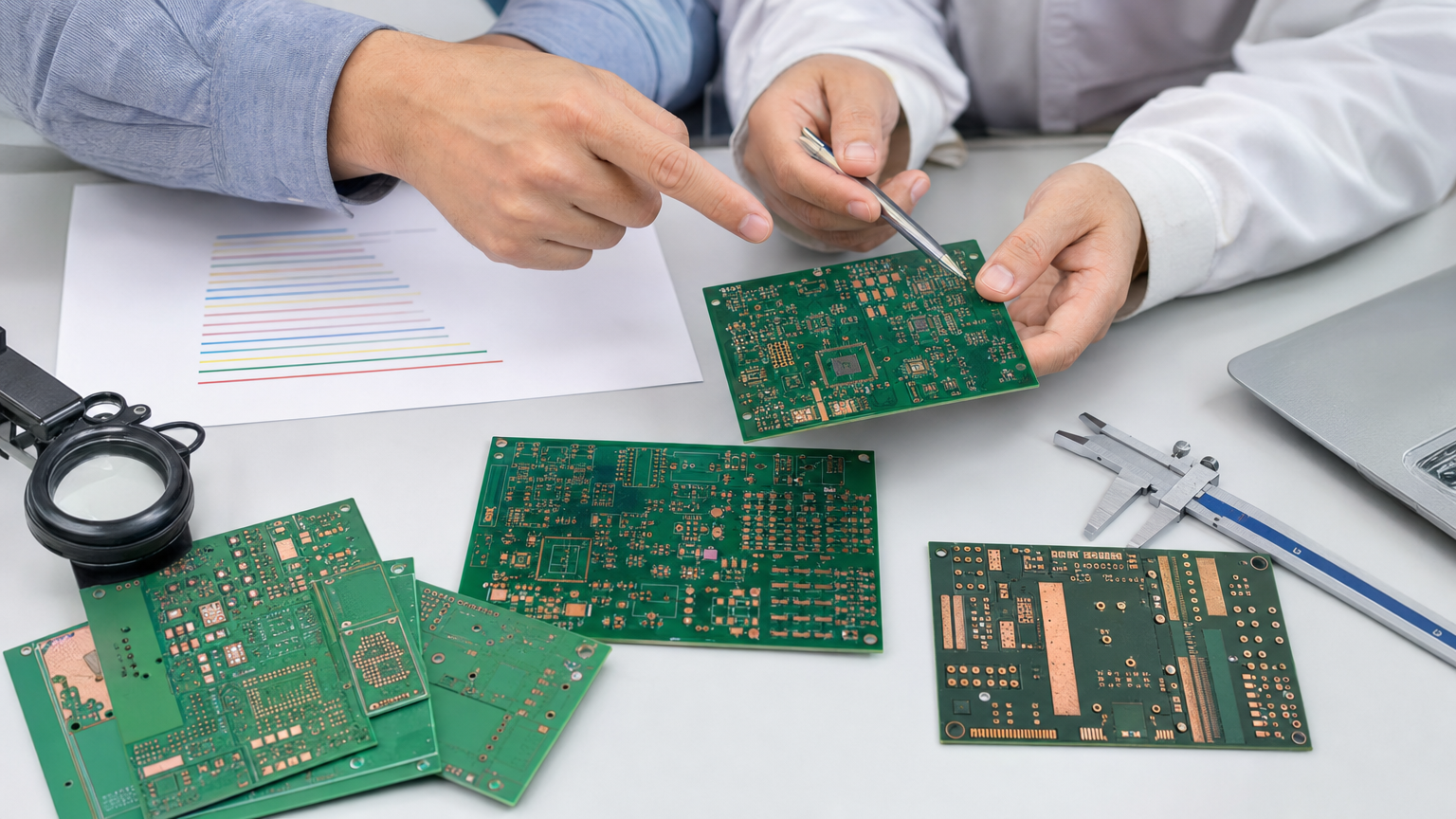
In a 5G radio, the RF front-end sits between the transceiver and the antenna. Power amplifiers, LNAs, switches, filters, duplexers, and matching networks all live on a board whose dielectric and copper are part of the circuit. At these frequencies, laminate choice changes insertion loss, impedance stability, phase behavior, and how repeatable a MIMO channel stays from board to board.
Overseas teams sourcing front-end PCBs from China often overspend by treating every layer like a PA matching network, or underspecify by writing "Rogers or equivalent" with no Dk/Df window, foil type, or hybrid press constraints. Start from the loss budget and the band, then decide where premium material actually earns its cost.
Why 5G makes the laminate decision harder
More bands mean more filters, switches, and routing congestion. More antennas and MIMO paths raise demands on channel-to-channel consistency, isolation, and phase stability. Sub-6 GHz and mmWave are not the same problem: sub-6 often balances RF performance with cost and mixed-signal integration, while mmWave amplifies loss and manufacturing variation until small stackup drifts become performance drifts. Thermal density around PAs adds dimensional stability and heat-spreading needs on top of the electrical list.
Properties that actually move RF results
Dk sets impedance, electrical length, and trace geometry; stable Dk often matters as much as a low absolute number because variation shifts matching and phase. Df drives dielectric loss, which hurts long feeds, receive paths, and mmWave structures. Copper roughness becomes conductor loss as skin effect pushes current to the surface. Thickness consistency protects impedance repeatability across panels. CTE and dimensional stability affect registration, warpage, and long-term reliability through reflow and operating cycles. Thermal conductivity helps PA regions. Moisture absorption can walk dielectric behavior in outdoor and infrastructure environments.
Choosing by Dk brochure alone is incomplete.
Sub-6 versus mmWave priorities
Sub-6 designs frequently accept moderate loss if impedance is stable, the stackup is manufacturable, and hybrid constructions can confine premium laminate to RF layers. mmWave designs push toward lower total loss, smoother copper, tighter thickness control, and stricter process consistency. Cost pressure exists in both, but mmWave performance constraints dominate more often.
Material families in practical language
Enhanced FR-4 can still serve short RF stubs, digital control, and power management on the same product when critical RF paths are short and budgets allow. It becomes risky for long RF runs, tight loss or phase budgets, and mmWave work.
Low-loss hydrocarbon or ceramic-filled hydrocarbon laminates often sit in the middle: better RF behavior than plain FR-4 with more fabrication familiarity than some PTFE systems. PTFE-based and ceramic-filled PTFE materials serve demanding low-loss paths, with tradeoffs in cost and process window. No single family wins every front-end.
Select by function block, not by brand loyalty
Antenna feeds want low loss and stable impedance. PA regions want heat spreading and dimensional reliability under load. LNA paths want low attenuation and clean parasitics. Filter and matching regions want predictable Dk and repeatable electrical length. Mixed RF-plus-digital boards want zoning and hybrid stackups so digital layers do not pay RF laminate prices.
Ask which paths are truly RF-critical instead of asking whether the entire board can be FR-4. That question leads naturally to hybrid constructions: high-frequency material on RF-critical layers, economical materials elsewhere when press and reliability rules allow.
A selection workflow that survives quoting
Define the operating band (sub-6, mmWave, or mixed). Identify loss-sensitive paths. Set targets for impedance, insertion loss, phase, and isolation. Add thermal and environmental needs. Decide full RF laminate versus hybrid. Validate the menu against real fab capability before CAD freeze.
Avoid ignoring copper roughness, treating sub-6 and mmWave identically, blanketing premium laminate everywhere, or picking material without fabrication limits in the room.
Put frequency range, loss-budget assumptions, preferred laminate family and alternates, foil type, impedance tables, and hybrid permission on the drawing. XFPCB high frequency PCB work pairs with impedance control PCB notes; when escape density forces it, bring HDI PCB constraints into the same stackup conversation so RF and fabrication limits are negotiated once.