Buyer guide for USA PCB searches

PCB Manufacturer USAvs China PCB ManufacturerHow to Choose the RightFabrication Partner

Many engineers search for a PCB manufacturer USA option because they need speed, domestic visibility, controlled data handling, or a supplier who can support HDI and high-layer-count designs. XFPCB is a China-based PCB manufacturer, so this guide takes the honest route: it explains when an American PCB manufacturer is the right answer, and when a qualified China PCB manufacturer can be the practical commercial alternative.

pcb fabrication usa pcb manufacturing usa HDI PCB high-layer-count PCB China PCB manufacturer

What Customers Compare When They Search "PCB Manufacturer USA"

Searches such as "pcb fabrication usa", "usa pcb fabrication", "pcb suppliers usa", "pcb manufacturing usa", and "pcb manufacturers in usa" rarely mean only one thing. Some buyers truly need a domestic factory because the project is government funded, defense related, ITAR controlled, or subject to a contract that requires U.S. manufacturing. Other buyers are not bound by domestic sourcing rules, but they are worried about schedule risk, communication, hidden quality problems, or the cost of a failed board spin.

That difference matters. If a program requires domestic production, a China PCB manufacturer should not be treated as a substitute. If the program is a commercial electronics product, an industrial controller, a telecom module, an IoT gateway, a medical non-defense device, a data-center board, or a high-layer-count engineering build that does not carry U.S.-only restrictions, then the sourcing question becomes more practical: which supplier can build the stackup, control the process, communicate clearly, support DFM, and keep the total landed cost under control?

XFPCB is positioned for the second scenario. We are not an American PCB manufacturer and we do not present ourselves as a "made in USA" factory. We are a China-based PCB manufacturer for global buyers who want direct factory support, multilayer PCB fabrication, HDI review, high-layer-count capability, flexible order quantities, and international shipping. The goal is not to argue that China is always better than the United States. The goal is to help you match the sourcing model to the actual risk profile of your board.

USA PCB Manufacturer vs China PCB Manufacturer: Practical Comparison

The most useful comparison is not patriotic and it is not purely about price. A strong sourcing decision compares legal constraints, engineering complexity, prototype urgency, production volume, quality evidence, and communication rhythm. The table below gives procurement teams a sober way to compare a pcb board manufacturer USA option with a China PCB manufacturer such as XFPCB.

Decision Factor USA PCB Manufacturer China PCB Manufacturer such as XFPCB
Domestic or restricted programs Best fit when the contract, export control classification, customer policy, or government procurement rule requires U.S. manufacturing or U.S.-controlled handling. Not a substitute for a U.S.-only requirement. Use only when your compliance team confirms the design can be manufactured outside the United States.
Prototype speed Often attractive for very urgent local iterations, same-region communication, and fast domestic shipping on small prototype quantities. Can be efficient when DFM files are complete and communication is organized, but international shipping and customs should be planned into the schedule.
Cost at scale May be justified for sensitive or urgent work, but unit cost can become difficult for larger commercial production runs. Often attractive for commercial volume, repeated production and multilayer builds where factory-direct pricing and mature supply ecosystems matter.
HDI and high-density interconnect Strong U.S. suppliers emphasize HDI, microvias, advanced materials, Class 3 builds and engineering support for complex designs. XFPCB should be evaluated on stackup review, via structure, minimum trace and space, lamination plan, impedance targets and inspection documentation before release.
High-layer-count PCB Good fit for programs that require domestic capability plus advanced registration, backdrilling, controlled impedance and reliability testing. XFPCB publishes product pages covering multilayer, 16-layer, 20-layer, 32-layer and 40-layer PCB concepts, making it a candidate for commercial high-layer-count review.
Communication and DFM Same-country time zones and direct phone support can reduce friction during early engineering decisions. Works best when the buyer provides complete Gerbers, drill files, stackup expectations, impedance requirements, acceptance standards and a single technical contact.
Best-fit program Defense, aerospace with controlled data, mandated domestic sourcing, extremely urgent engineering iteration, and projects where location is a hard requirement. Commercial electronics, industrial controls, IoT, telecom, data-center, high-layer-count prototypes and production projects where cost, capability and global delivery are the main drivers.

This is why the phrase "top pcb manufacturers in usa" can be useful for a compliance-driven program, while "pcb manufacturing companies in usa" may be only the first step for a buyer who is actually comparing process capability, price and lead time. Location is important, but it should not be the only screening filter.

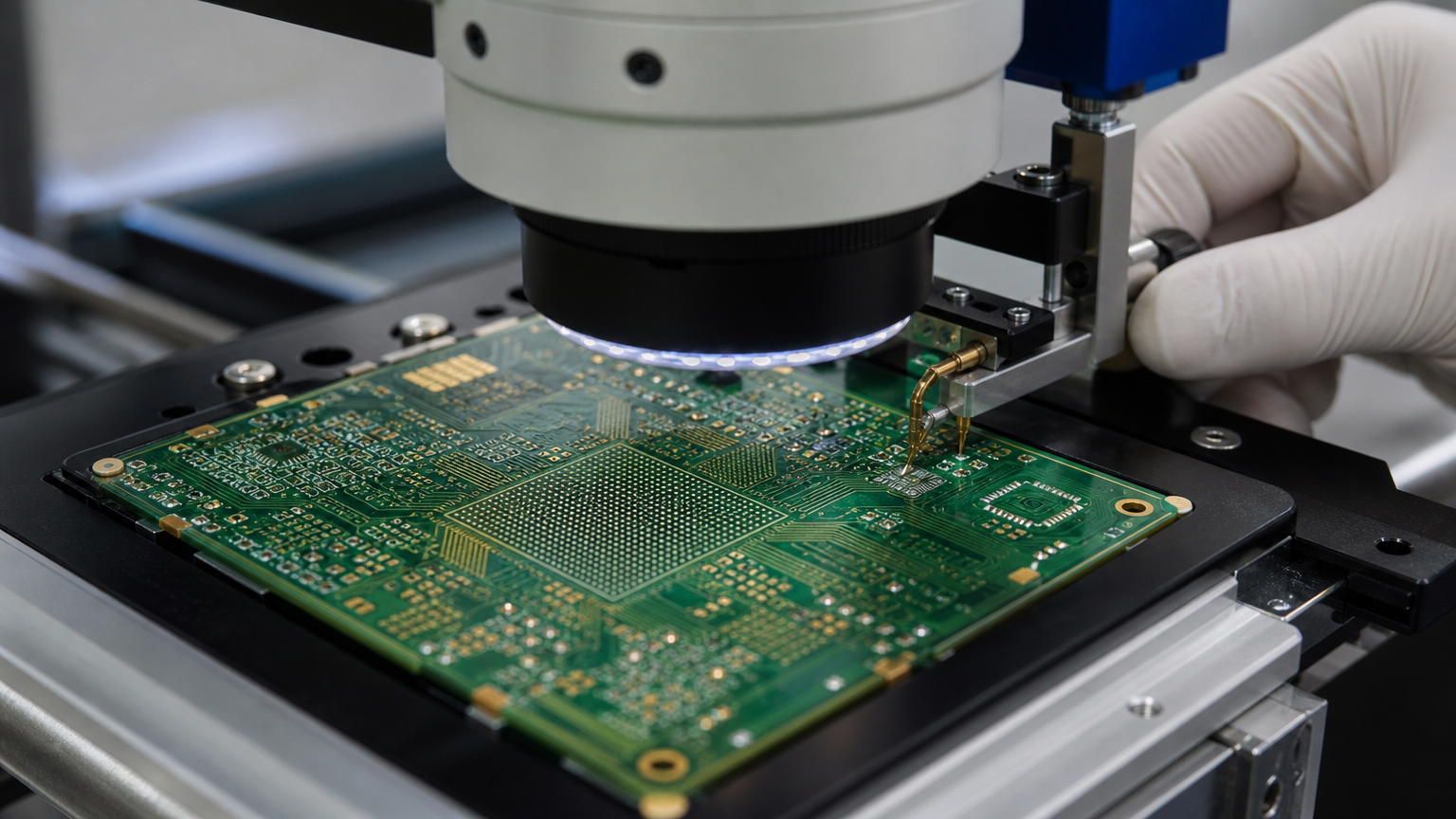
HDI multilayer PCB inspection under digital microscope for high-density interconnect manufacturing review
HDI and high-layer-count boards should be evaluated by stackup, via structure, impedance plan, registration tolerance, inspection evidence and DFM communication, not by country label alone.

When a USA PCB Manufacturer Is the Right Decision

A USA PCB manufacturer is the right choice when domestic production is a requirement, not a preference. If your drawings, Gerbers, stackup, BOM, controlled impedance targets or supporting documents include controlled technical data, your first call should be to your compliance team. U.S. export-control rules can treat design, production and manufacturing information for defense articles as controlled technical data. The official eCFR definition of ITAR technical data includes information required for the design, development, production, manufacture, assembly, operation, repair, testing, maintenance or modification of defense articles. That is not a marketing detail; it affects who can receive the files and where manufacturing can occur.

Domestic sourcing also matters in U.S. government procurement. FAR Subpart 25.1 describes the Buy American framework for supplies, including the idea that manufactured end products may need to be manufactured in the United States and meet domestic content tests, subject to exceptions and specific contract language. A commercial buyer may never encounter those clauses. A defense, aerospace, federal, infrastructure or funded research buyer may face them early in the sourcing process. If your contract says "U.S. origin", "domestic end product", "ITAR", "DFARS", "covered defense information", or "U.S. persons only", do not solve that with a normal offshore quote.

A USA pcb manufacturer can also be the best choice for a very fast prototype loop. If your engineer needs to walk a design through CAM questions today, receive boards quickly, test tomorrow, and immediately spin the layout again, domestic quick-turn capacity may justify the premium. The same applies when your program needs local failure review, on-site customer visits, or U.S.-based chain-of-custody expectations.

The pain point is cost and scalability. Domestic fabrication can be excellent, but the economics may be harder for a commercial product moving from a small prototype to repeated production. Buyers searching "largest pcb manufacturers in usa" or "pcb manufacturing industry leaders usa" often discover capable suppliers, but they still need to ask whether those suppliers are optimized for the buyer's volume, target price, layer count, material requirements and engineering cadence.

Compliance note: this guide is not legal advice. For U.S. procurement and controlled technical data, review the actual contract, end use and export classification with qualified counsel or your compliance team. Public references include FAR Subpart 25.1 and 22 CFR Part 120.

When a China PCB Manufacturer Can Be the Practical Alternative

A China PCB manufacturer becomes attractive when the project is commercial, exportable, repeatable and technically well defined. For many product teams, the hard problem is not finding a supplier in a particular country. It is finding a supplier who will detect manufacturability problems before fabrication, quote consistently, support stackup choices, manage material options, control impedance, document quality checks, and keep production affordable when the board moves beyond the prototype stage.

This is where XFPCB can be part of the conversation. Our current site is built around a direct factory value proposition: multilayer PCB manufacturing, rapid prototyping, PCBA support, global shipping, DFM review and product pages covering standard boards through high-layer-count concepts. The relevant XFPCB pages include 4-layer PCB, 8-layer PCB, 16-layer PCB, 20-layer PCB, 40-layer PCB, multilayer PCB and high-layer-count PCB. Those pages help buyers frame the discussion by layer count, signal integrity, HDI features, reliability expectations and advanced board construction.

The practical advantage of China PCB manufacturing is usually not a single magic number. It is the combination of manufacturing ecosystem, material sourcing, tooling experience, flexible production planning and factory-direct communication. For a commercial product with a stable design, the savings may be obvious. For a complex high-density design, the value may come from a careful DFM conversation that avoids a failed spin. For a high-layer-count board, it may come from having the right stackup discussion early enough to prevent drill, registration, resin fill or impedance issues later.

The weakness is also real. Offshore manufacturing can fail when the buyer sends incomplete files, hides critical acceptance criteria, ignores shipping time, or chooses the lowest number without reviewing capability. It can also fail when a supplier says "yes" too quickly to a board that needs deeper engineering review. A serious China PCB manufacturer should be willing to discuss constraints, not merely promise everything.

Choose a USA PCB Manufacturer When

  • Your customer, contract or compliance team requires U.S. manufacturing.
  • The design contains controlled defense, aerospace or restricted technical data.
  • You need extremely fast local prototype iteration and domestic shipping.
  • The project needs U.S.-based chain of custody, local audits or domestic failure review.
  • Total cost is less important than location, compliance and local engineering access.

Evaluate XFPCB as a China PCB Manufacturer When

  • Your project is commercial and can legally be manufactured outside the United States.
  • You need direct factory pricing for prototypes, pilot runs or repeat production.
  • The board requires multilayer, HDI, impedance-control or high-layer-count review.
  • You can provide complete Gerber, drill, stackup, material and acceptance requirements.
  • You want a supplier who can support the move from engineering sample to scalable production.

How XFPCB Product Pages Help You Compare Suppliers

People who search "pcb manufacturing in usa", "usa pcb manufacturers" or "pcb production usa" often compare capability pages before they request a quote. That is why this guide links directly to XFPCB product categories. The correct question is not "Can any factory make a PCB?" It is "Can this factory understand the board I am actually building?"

4-Layer and 6-Layer PCBs

For IoT devices, industrial controllers, smart hardware and cost-sensitive commercial electronics, 4-layer and 6-layer boards often balance routing density, EMC control and predictable fabrication cost.

View 4-Layer PCB

8-Layer and 12-Layer PCBs

For denser signal routing, blind or buried via review, RF modules, networking boards and advanced digital designs, 8-layer and 12-layer PCBs need a stronger DFM conversation.

View 8-Layer PCB

16-Layer PCB

For BGA fanout, high-speed digital architecture and complex stackups, the 16-layer range is where engineering review, lamination planning and impedance strategy become central.

View 16-Layer PCB

20-Layer PCB

20-layer boards raise the importance of material selection, controlled impedance, backdrilling questions, drill registration and inspection documentation for demanding commercial systems.

View 20-Layer PCB

High-Layer-Count PCB

If you are comparing high-density interconnect pcb manufacturers usa with global suppliers, review the actual layer count, via structure, aspect ratio and reliability expectations first.

View High-Layer-Count PCB

Multilayer PCB Guide

Use the multilayer guide to align on stackup, signal layers, planes, materials, cost drivers and manufacturing choices before you ask any supplier for final pricing.

Read Multilayer Guide
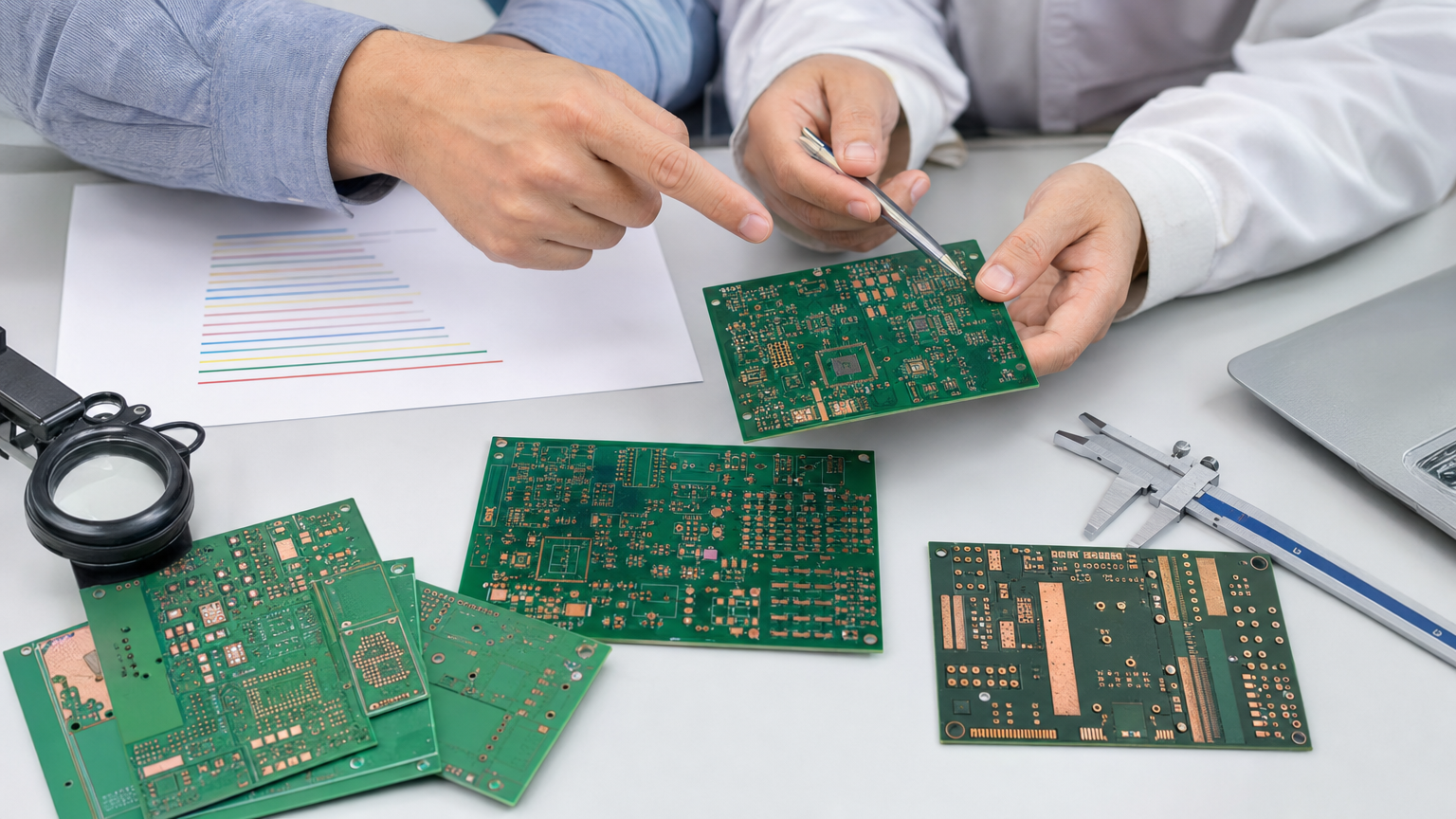
Engineering review table comparing multilayer PCB samples, stackup planning and procurement requirements
A strong PCB supplier comparison should include drawings, stackup requirements, acceptance criteria, quality evidence and logistics, not only a country name or quoted unit price.

Procurement Checklist: Comparing PCB Suppliers USA and Offshore Alternatives

Before you compare quotes from pcb manufacturing companies in usa and China-based PCB suppliers, normalize the requirements. If Supplier A is quoting FR-4 with normal tolerance and Supplier B is quoting high-Tg material with impedance coupons, the price comparison is meaningless. Use the checklist below to force a fair comparison.

  1. Confirm compliance first. Decide whether the project is commercial, export controlled, ITAR related, Buy American restricted, customer restricted, or contractually domestic. Do this before sharing files.
  2. Define the stackup. Provide target board thickness, copper weight, material family, impedance requirements, dielectric constraints, via structures and any layer-pair priorities.
  3. Ask for DFM comments before price becomes final. Good DFM should flag minimum trace and space, annular ring, aspect ratio, drill tolerance, solder mask dam, copper balance and panelization concerns.
  4. Separate prototype and production needs. The best quick-turn prototype source may not be the best supplier for volume production, and the lowest volume source may not be the fastest for engineering spins.
  5. Request quality evidence. Ask about electrical test, AOI, X-ray when relevant, microsection reports, impedance coupons, solderability, material certificates and outgoing inspection.
  6. Calculate landed cost. Include tooling, engineering fees, board cost, assembly if needed, shipping, import duties, customs time, quality risk, rework risk and the value of supplier responsiveness.
  7. Protect your files. Use NDAs, limit unnecessary sensitive information, and never send controlled technical data offshore unless your legal and compliance process allows it.
  8. Judge communication speed and precision. A supplier who asks smart questions early may save more money than a supplier who sends a fast quote with no technical review.

FAQ: PCB Manufacturer USA, USA PCB Fabrication and China Alternatives

Is XFPCB a PCB manufacturer in USA?

No. XFPCB is a China-based PCB manufacturer. We serve global buyers, but we do not claim to be a USA PCB manufacturer or an American PCB manufacturer. If your project legally or contractually requires U.S. manufacturing, use a qualified U.S. supplier.

Can a China PCB manufacturer compete with pcb manufacturers usa?

For commercial projects that are not restricted to domestic manufacturing, yes, a qualified China PCB manufacturer can be competitive on cost, scalable production, multilayer capability and factory-direct support. The decision should still be based on files, stackup, quality evidence and logistics.

When should I choose pcb fabrication usa instead of offshore production?

Choose pcb fabrication usa when domestic production is required by contract, compliance, ITAR-related handling, customer policy, chain-of-custody expectations, or urgent local prototype iteration. These are hard requirements, not normal purchasing preferences.

What are buyers looking for in high-density interconnect pcb manufacturers usa?

They usually care about microvia reliability, laser drilling, blind and buried vias, via-in-pad decisions, fine trace and space, impedance control, stackup engineering, high-quality inspection and a supplier willing to challenge risky design choices before fabrication.

Is the largest PCB manufacturer in USA always the best supplier?

Not always. Size can indicate capacity, but your best supplier depends on your layer count, materials, certifications, engineering support, lead time, volume, price target and compliance needs. A smaller specialist may outperform a large supplier for a narrow technical requirement.

How should I compare a pcb board manufacturer USA quote with an XFPCB quote?

Make both quotes use the same stackup, material, copper weight, solder mask, surface finish, inspection level, impedance requirement, testing requirement, quantity and delivery term. Then compare landed cost, technical comments, documentation and communication quality.

Can XFPCB help with PCB production for U.S. commercial electronics?

Yes, when the project can be manufactured offshore and the buyer provides complete technical requirements. XFPCB can review multilayer, HDI and high-layer-count commercial PCB projects and provide a factory-direct quotation.

Send XFPCB Your PCB Files for a Practical Manufacturing Review

If your project is not restricted to U.S. manufacturing, share the core requirements and we will review whether XFPCB is a fit. For faster feedback, include layer count, board size, thickness, material preference, copper weight, impedance requirements, surface finish, quantity, target lead time and any special inspection needs.

If your project may be ITAR controlled, government restricted, or subject to U.S.-only manufacturing language, do not submit controlled files through this form. Confirm the compliance path first.