
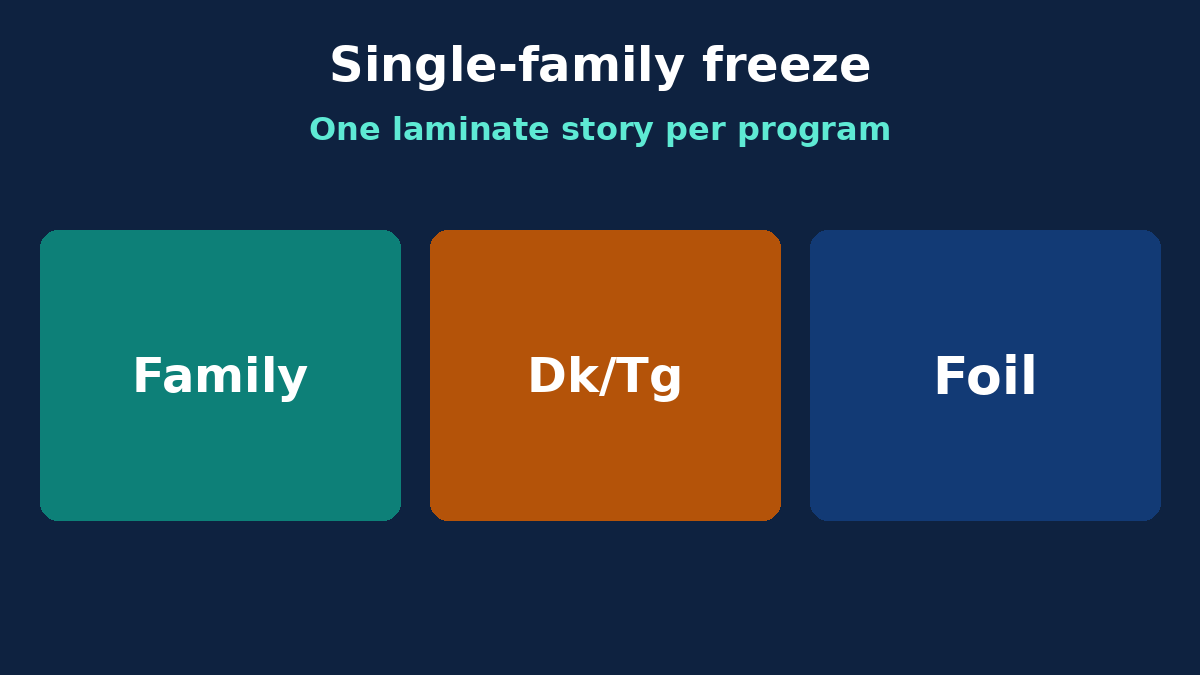
Single-material RFQ discipline means something specific: for one program (or one part-number family), you pick one primary laminate family, freeze the electrical and thermal knobs that matter (Dk intent, Tg class, copper foil type), and stop letting every quote round reinvent FR-4. This article owns that freeze. It deliberately does not cover hybrid multi-material stacks—that is the sister post. Here the goal is program stability: same dielectric story from prototype through MP, so impedance, thermal survival, and purchasing stay aligned.
Buyer decision frame: one family, written window
Decide:
- What is the primary family? (e.g., mid-Tg FR-4, high-Tg FR-4, a named low-loss epoxy family—not a pile of brand logos.)
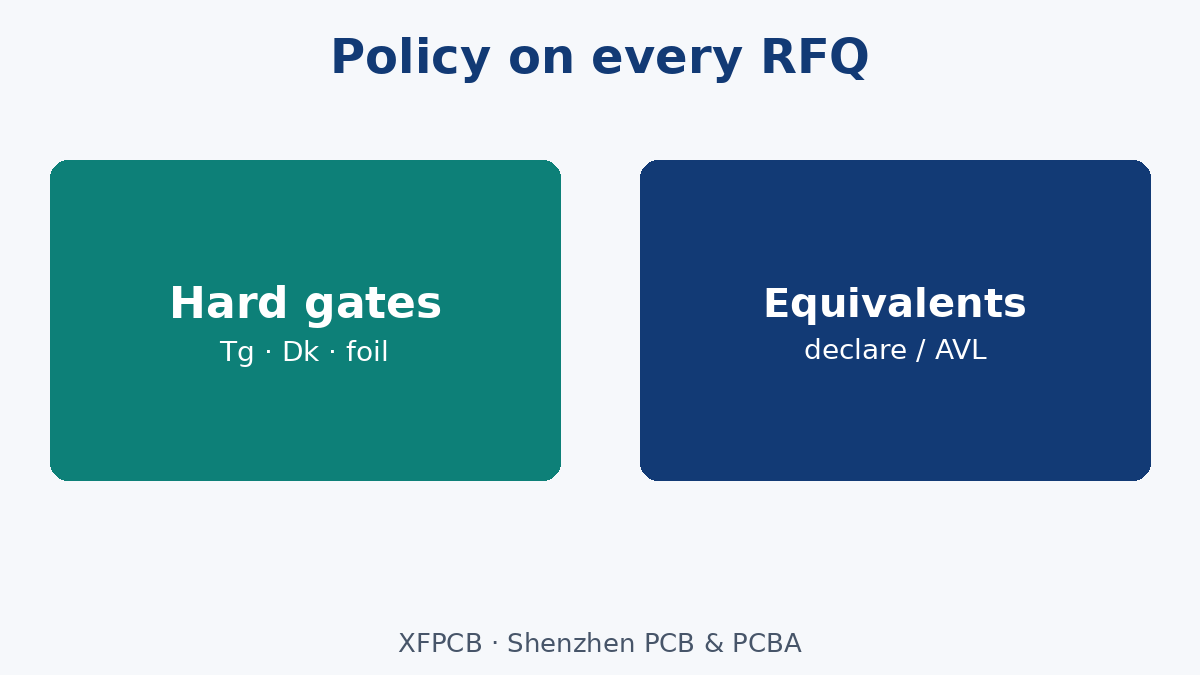
- Which parameters are hard gates? (minimum Tg, halogen-free yes/no, Dk band for impedance layers, foil type on critical layers.)
- Are equivalents allowed inside that family with plant declaration, or is a vendor PN frozen?
Write the answers on a one-page material policy attached to every RFQ for that program. Without it, each buyer and each vendor will optimize locally. See PCB Materials for catalog context; this post is the discipline of freezing one family.
Why programs drift without a freeze
Common drift patterns:
- EVT on mid-Tg; DVT silently on high-Tg “for safety”; MP back to cheapest mid-Tg.
- Impedance modeled on brand A Dk; production on brand B “equivalent.”
- Copper foil changed to whatever the warehouse had.
- Halogen-free required by customer marketing after tooling.
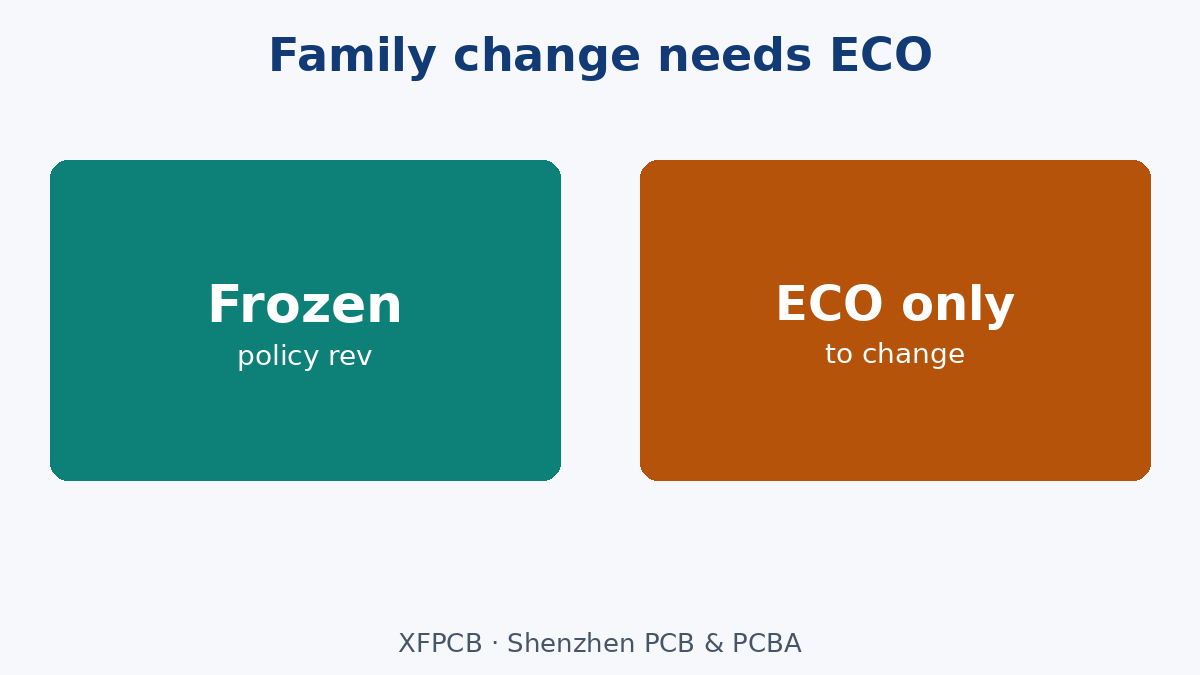
Each drift can be invisible until SI, reflow, or audit fails. A freeze makes drift an ECO, not a chat message.
What “family” means in practice
A family is a performance envelope, not a single SKU. Example policy language (adapt to your reliability owner—do not invent numeric gates in the blog as universal law):
- Primary: high-Tg FR-4 class suitable for lead-free multilayer.
- Impedance layers: dielectric Dk used in design noted; plant declares PN before CAM; alternates only if Dk within agreed band at agreed frequency.
- Foil: RTF/VLP as required on high-speed layers; default ED elsewhere.
- Halogen-free: yes/no per program.
- Documentation: certs retained; no silent swaps.
Slash-sheet language can support the family definition when you use IPC class concepts—still freeze what your program checks.
Dk, Tg, copper type: the three knobs most RFQs under-specify
Dk drives impedance and delay. Freezing family without Dk intent still allows SI drift.
Tg (and related thermal metrics) drives lead-free survival. Freezing “FR-4” without Tg class allows oven surprises.
Copper type drives loss and etch geometry. Freezing resin but not foil leaves a hole.
Put all three on the policy page. Companion identification callouts (slash sheet / vendor PN) live in the laminate identification post; here you decide the program will not hop families every week.
RFQ text that enforces the freeze
- “Program material policy Rev x applies.”
- Primary family named.
- Hard gates listed.
- Equivalents: declare-before-build vs AVL-only.
- Stack PDF must show family-compliant dielectrics.
- ECO required to change family or hard gates.
- Lead-free assembly expectation tied to Tg class.
Attach the policy PDF next to Gerbers. Purchasing should reject quotes that propose out-of-family materials without an ECO number.
What fab can and cannot do
Can: propose in-family equivalents; declare PNs; supply certs; refuse out-of-family stock when policy is clear.
Cannot: keep SI identical across families; honor a freeze you never wrote; magically match legacy boards built on undocumented materials.
Failure modes
- Lot-to-lot impedance shifts after “equivalent” outside Dk band.
- Reflow issues after Tg class drift.
- OEM audit fails on unrecognized laminate.
- Design team simulates one family while production buys another.
Common EQ loop
- No policy; RFQ says FR-4.
- Three vendors, three resins.
- First articles differ in SI margin.
- Emergency freeze after the fact—too late for fixtures already cut.
Break the loop with policy Rev A before EVT RFQ.
Cost traps without invented prices
Changing family to chase a slightly cheaper core can cost a respin. Over-freezing an exotic family for a board that only needs mid-Tg wastes money. Allowing equivalents with no Dk window invites silent change. The freeze should be as tight as risk requires—and no tighter.
Governance: who owns the policy
Name a material owner (usually hardware lead + quality). Purchasing executes; plants declare; nobody freelances. When marketing requests halogen-free late, that is an ECO to the policy—not a quiet PO note. When SI wants low-loss only on two layers, that may push you into the hybrid sister article—do not pretend it is still a single-family freeze.
Coupons and golden boards
When impedance matters, keep coupon history tied to declared PN and policy rev. A golden board from EVT is only golden if MP uses the same family gates. Store declarations with FAI packs. Without traceability, the freeze is theater.
Prototyping under the freeze
Prototypes should use the same family gates even if panel utilization differs. “Any FR-4 for quick turn” teaches the wrong lesson when MP expects high-Tg. If schedule forces a temporary exception, label boards clearly and do not ship them as MP-representative.
Interaction with copper weight and stack symmetry
Family freeze does not replace stack documentation. Copper weights, layer count, and symmetry still need the stack PDF. The freeze only stops dielectric family hopping. Keep Impedance Control PCB callouts consistent with the frozen Dk story, and High Tg PCB when high-Tg is the named family path.
Onboarding new vendors
New fab vendors must receive the policy before first quote. Ask them to map their stocked cores/prepregs into your family gates and list proposed PNs. Vendors who cannot declare PNs against your gates are not ready for impedance-controlled or thermally critical programs.
Linking the freeze to AVL and purchasing systems
Enter the primary family and hard gates into your PLM or AVL notes so buyers cannot create POs that contradict the policy. Train temporary buyers on the policy location. A freeze that lives only in an engineer’s head expires when that engineer is on holiday.
Measuring success of the freeze
Success looks like: quote rounds that declare the same PN class; coupon histories that compare cleanly; fewer EQ emails asking “which FR-4?” Track ECO count for material family changes—if it is high, your freeze is too loose or your requirements are unstable. Stabilize requirements first.
Training checklist for new hardware hires
New engineers should read the program material policy before touching stackups. Pair them with the material owner for the first RFQ. Require a policy citation in design review minutes. Culture beats a PDF that nobody opens.
When marketing or cost-down pressures the freeze
Cost-down workshops love swapping laminates. Require a signed risk assessment covering SI, thermal, and UL/OEM impact before any family change ECO. If savings need a hybrid or a new family, escalate deliberately. Do not “try a reel of something cheaper” on a production lot.
Archive and retention
Keep policy revisions, plant declarations, and certs for the retention period your quality system requires. Field failures years later need that trail. Cloud folders without revision control are not archives—use controlled document numbers.
Relating freeze to impedance coupon history
Every coupon log should reference policy revision and declared dielectric PN. When MP coupons drift from EVT, the first question is whether the family freeze was violated. Without that linkage, teams argue about etch while the resin changed. Put policy rev on the coupon traveler.
Customer OEM material lists
Some OEMs publish approved laminate lists. Map your program freeze onto that list explicitly. If the OEM list is narrower than your freeze, tighten the freeze. If your freeze is narrower, show how it sits inside their list during audits. Do not discover conflict at PPAP-like gates.
Flex programs still need a primary family
Even flex programs should freeze a polyimide system family and copper type for the flex zones rather than hopping vendors every spin. Stiffener materials are additional identities but should not excuse an unfrozen flex core. Keep the single-family idea: one primary flex dielectric story per program unless hybrid rigid-flex requires the multi-material post.
Change control metrics
Review quarterly how many material ECOs occurred and why. Legitimate reasons: OEM mandate, SI failure, thermal failure, supply discontinuity. Illegitimate: buyer preference, unanalyzed cost-down. Publish the metric to purchasing leadership.
Prototype broker vs production fab alignment
Quick-turn brokers may not stock your frozen family. Either pay for the correct material on prototypes or accept that prototype SI/thermal is non-representative—and label it so. Never let a broker special become the undocumented production baseline.
Closing reinforcement for buyers
If purchasing cannot answer “what laminate family is legal on this PO?” in one sentence, the freeze is not operational yet. Fix the policy accessibility before the next quote storm.
Example policy skeleton (adapt—do not copy numbers blindly)
A workable one-pager often contains: program name; policy revision; primary family statement; hard gates (Tg class, halogen-free, foil on HS layers, Dk reference frequency for models); equivalent rules; ECO authority; linked stack template; contact. Fill gates from your reliability and SI owners. The skeleton’s value is completeness—not universal numeric defaults from a blog.
Coordination with solder mask and legend
Mask color and legend do not define laminate family, but some plants warehouse “standard builds” that couple mask and core. State that mask choices must not trigger core swaps. Keep mask notes separate from dielectric freeze language to avoid accidental coupling in quote forms.
High-volume price negotiations under a freeze
Negotiating price inside a frozen family is healthy; negotiating by opening the family is not. Ask vendors for cost levers that preserve gates: panel utilization, copper thieving strategy, finish choice—not resin swaps. Write that boundary into sourcing playbooks.
Multi-site manufacturing
If two XFPCB-class plants or two CMs build the same part, both must operate under the same policy rev. Include policy rev in the PO line text. Divergent site practices recreate the drift the freeze exists to stop.
SI library and material library sync
CAD material libraries drift from purchasing reality. Schedule a periodic sync between the SI library Dk/Df tables and the frozen family declarations. When libraries disagree, stop routing until reconciled. Silent library drift is the digital twin of warehouse drift.
Lead-free and thermal companion rules
Tie the family freeze to lead-free survival expectations from the thermal laminate post. A family that meets Dk but fails Tg class for your reflow count is the wrong freeze. Review thermal and SI gates in one sitting when creating Rev A.
Audit questions to expect
Auditors may ask: what laminate is approved; how equivalents are controlled; how changes are ECOd; how certs are retained. Answer from the policy and records—not from memory. If answers disagree across purchasing and engineering, fix governance before the next audit.
Closing addendum
Operationalize the freeze in PLM, quote templates, and coupon travelers. A PDF alone is not discipline; a PDF that every PO cites is.
Freeze vs AVL breadth
An AVL can list several PNs inside one family. That is still a single-family freeze. Problems start when AVL entries span incompatible Dk/Tg classes under one vague “FR-4” label. Audit the AVL for accidental multi-family sprawl; split lists if needed.
Communication to overseas CMs
Translate the policy into clear English (and Chinese if your CM needs it) with identical revision numbers. Do not allow local PMs to keep a “shadow policy.” One rev, two languages max, same gates.
Purchasing KPI
Add a KPI: percent of PCB POs that cite the material policy revision. Target should be essentially all production POs for the program. Low citation rate means the freeze is documentation theater.
Closing: freeze one story
Single-material RFQ discipline is program hygiene. Pick one laminate family, freeze Dk/Tg/copper intent, allow only written equivalents, and force ECOs for family changes. Leave hybrids to programs that truly need them. XFPCB will build the family you freeze—send the policy with the RFQ so every quote round tells the same material story.