
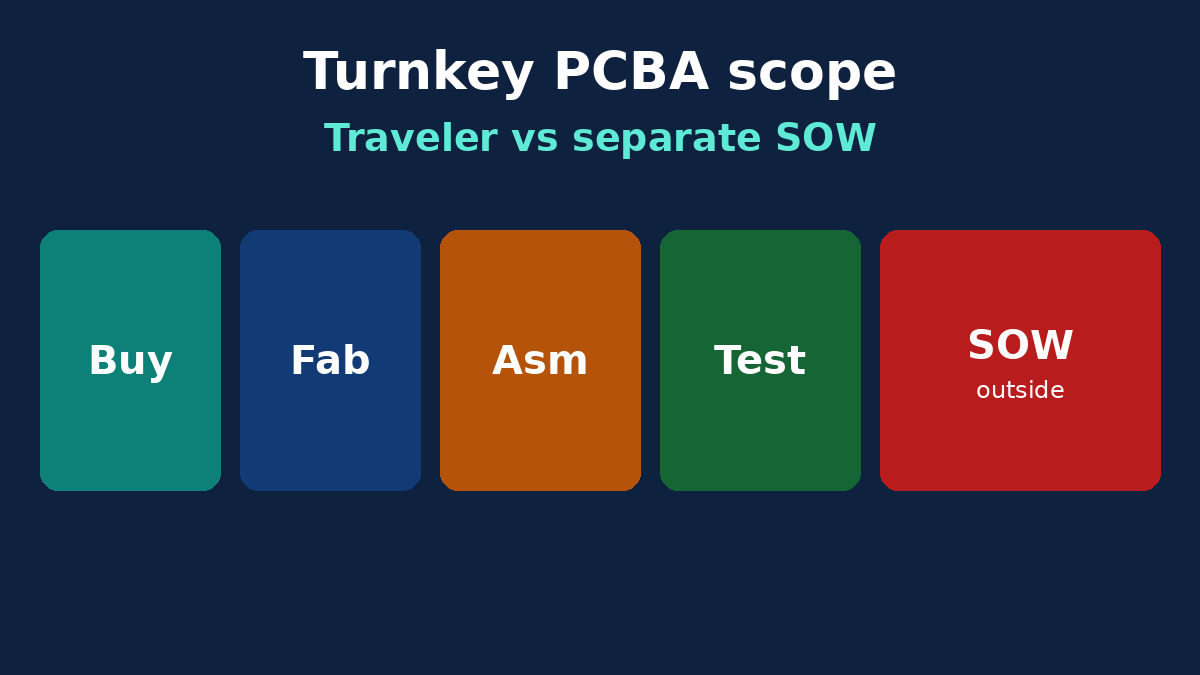
“Turnkey PCB assembly” is easy to oversell. Engineers hear one partner, one schedule, working boards in a box. Factories hear a traveler: buy the AVL, build the bare board, place and solder, run the tests named on the PO, pack and ship. Everything else is a different statement of work—even when the same company can sell it.
This post is that scope map for overseas buyers and engineers. It is not a partner ranking, not a 24–72 hour promise, and not a repeat of consumer freeze-gates or short-timeline exclusions. Those posts ask when speed talk is allowed. This one asks what turnkey is allowed to mean on the traveler.
What turnkey means on a China PCBA traveler
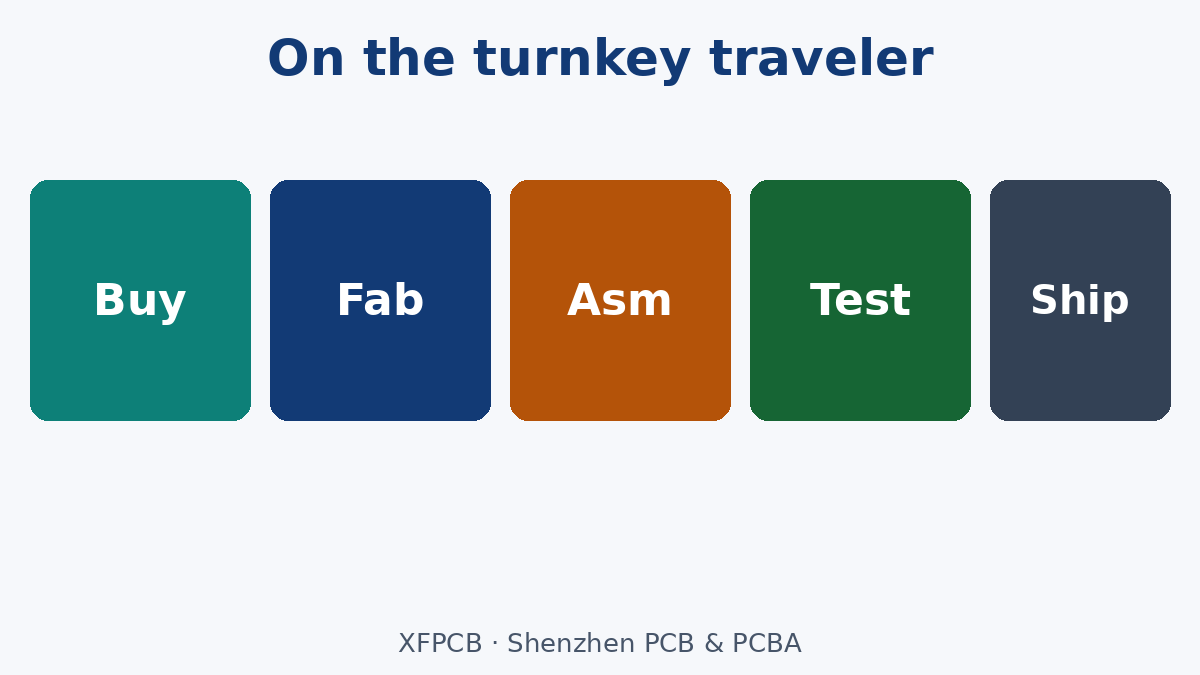
In factory language, full turnkey usually includes:
- Procurement against your AVL (and written alternates), with lifecycle and allocation risk called out in EQ—not silently substituted.
- Fabrication of the bare board to the stack and finish on the drawing (in-house or through a controlled fab partner on the same job package).
- Assembly — SMT and, if quoted, through-hole — with the stencil, profile and class on the traveler.
- Inspection and test you named: AOI, sample X-ray, ICT or flying probe, functional if a fixture exists.
- Pack and ship to the address and Incoterm on the PO.
Our Turnkey PCB Assembly page is that service boundary. You send a buildable package; you get assembled boards that passed the named exit. That is the deal.
What stays outside the traveler unless you buy it separately
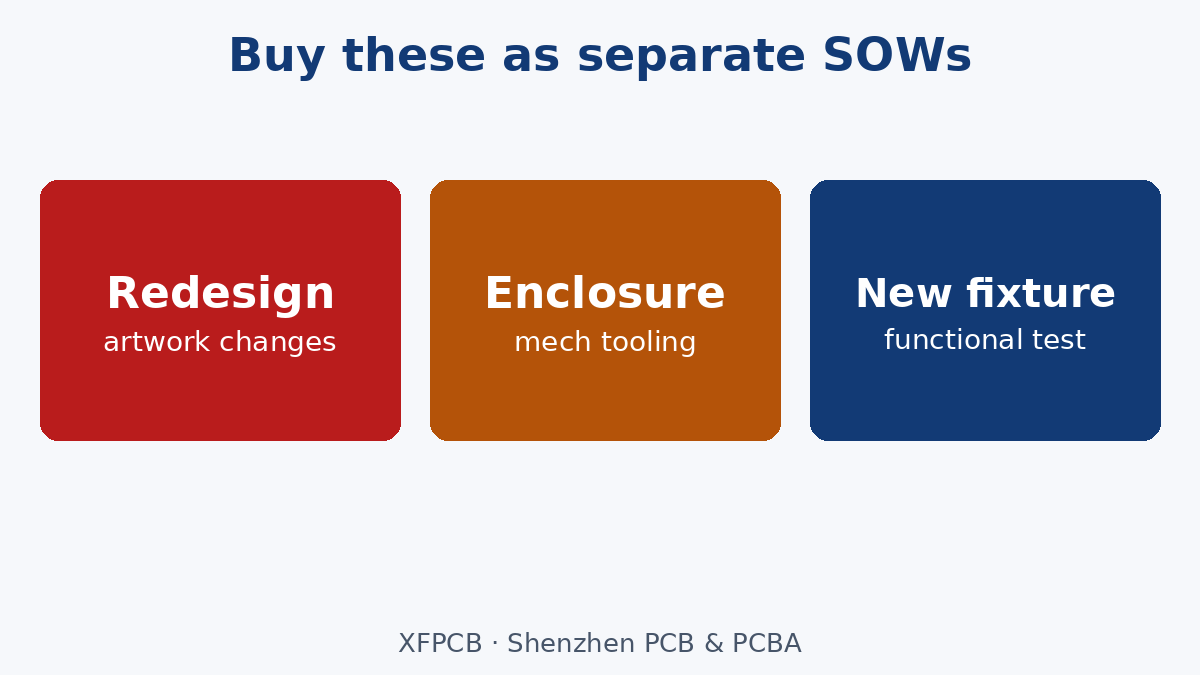
These are common, useful, and not automatic:
- Schematic or layout redesign. DFM notes that change artwork are a revision, not free polishing inside assembly.
- Enclosure, cable and mechanical tooling.
- Firmware bring-up beyond a quoted program load.
- New functional-fixture design when no fixture exists.
- Consignment of buyer-owned parts mixed without a kit rule—that is partial turnkey, and the kit completeness rule must be written.
If you need design collaboration, buy it as an engineering SOW with deliverables. Do not bury it under “turnkey partner” and expect the assembly calendar to absorb an open layout.
What engineers should expect—without brochure language
One accountable schedule for the traveler steps. Hand-offs still exist inside a factory (fab to SMT, SMT to test). Turnkey means those hand-offs are internal to the job package, not that physics disappears.
DFM and BOM validation as EQ, not silent rewrites. Spacing, paste, polarity, moisture-sensitive parts, and obsolete MPNs should surface before paste hits the board. Recommended tweaks that change Gerbers restart the revision clock unless you already froze “build as sent.”
Sourcing with a paper trail. Alternates need your approval path. Transparency is a date-coded AVL and an EQ log, not a claim that shortages never happen.
Volume and process flexibility that is quoted. Low-volume and high-volume travelers differ in stencil strategy, panel, and sampling. SMT versus mixed technology is a line item. Our SMT PCB Assembly page is the placement/reflow path; THT and selective solder are in scope only when the PO says so.
Communication that becomes drawing notes. Proactive updates matter. Chat that never updates the revision on the traveler does not.
Files the turnkey RFQ should carry
Minimum package for a turnkey traveler: Gerbers (or ODB++), stackup and drill, fab notes, centroid/pick-and-place, BOM with manufacturer and MPN, assembly drawing with polarity and class, and the test list. Our Manufacturing Files page is the file grammar. A zip named “final_final” with missing paste layers is not a turnkey start—it is an EQ delay before the traveler opens.
Turnkey versus consignment—one sentence
Consignment means you supply the kit; the factory assembles and tests. Full turnkey means the factory buys the AVL too. Partial turnkey splits the BOM. The procurement-model choice is covered on our kit-versus-turnkey and full-turnkey-versus-consignment posts; here the point is only that “turnkey” without saying which model still leaves purchasing undefined.
Quality that is more than a logo
Name IPC-A-610 class on the PO, name the inspection gates, and name fail disposition. Certificates on the wall do not replace those lines. Traceability (lot codes, date codes, traveler ID) is part of a serious turnkey package when you ask for it in the RFQ—ask explicitly.
What we are not claiming
No invented prototype turn times, no claim that turnkey always beats a multi-vendor chain on cost, no free redesign, and no ITAR or aerospace capability claim. Turnkey PCB assembly is a traveler scope. Put procurement, fab, assembly and named test inside it. Put layout redesign, enclosure tooling and new fixtures in their own SOWs—then the partner conversation is about execution of a defined job, not adjectives.