
The incoming inspection photo looked like a flex cable until the lab bent it again. Glass weave showed through the epoxy where the "flexible" FR-4 strip had been formed for install, then formed again during a field rework. Copper cracked at the weave crossings. The buyer had ordered a bendable interconnect; the fab had shipped thin glass-epoxy that survives a one-time fold and fails when someone treats it like polyimide film.
That mix-up is the substrate decision this article is about. Polyimide (PI) film and FR-4 glass-epoxy are not two grades of the same flex material. One is a non-reinforced polymer film built for ductility. The other is a woven-glass epoxy laminate built for stiffness. China fabs quote both -- including "FR-4 flex" or thin FR-4 that can take a static bend -- so buyers need bend class, Tg and reflow margin, and moisture-bake language on the RFQ before CAM guesses.
Polyimide film versus FR-4 as the default rigid stack
FR-4 remains the default rigid copper-clad laminate for most commercial boards: glass cloth impregnated with epoxy, copper foil on one or both faces, mature drill and plate windows, low moisture uptake (often cited near 0.1-0.2% by weight), and cost that tracks commodity supply. FR-4 does not melt at ordinary lead-free reflow the way some brochure comparisons imply. The resin softens above its glass transition temperature (Tg). Standard grades often sit around 130-150 C Tg; high-Tg FR-4 stretches toward roughly 170-180 C and above. Above Tg, Z-axis expansion accelerates and plated barrels take fatigue. That is a thermal-mechanical limit, not a melting-point claim.
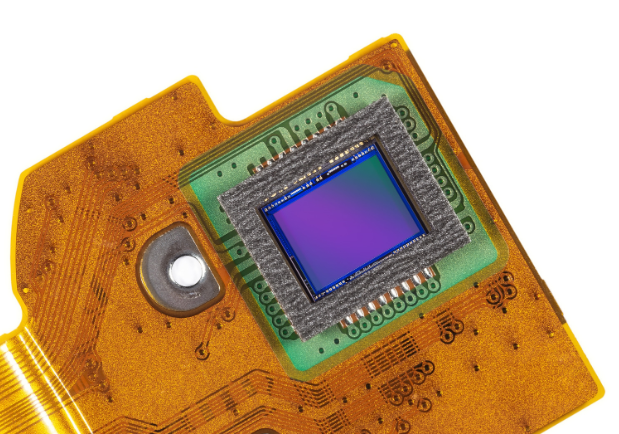
Polyimide used for true flex circuits is typically a film dielectric -- Kapton-class and equivalents -- with copper bonded by adhesive or by adhesiveless casting/sputter routes. The film is non-reinforced. Without glass weave, the cured polymer stays ductile, so the stack can take tight radii that shatter thin glass-epoxy. Continuous operating temperatures for PI film constructions are commonly discussed in the 200-300 C class depending on grade and stack; Tg for standard polyimide film systems is routinely above 250 C, which sits comfortably above lead-free reflow peaks near 240-260 C. Dielectric constant for common PI flex grades often lands near 3.2-3.5 at GHz frequencies, with dissipation factors lower than commodity FR-4 -- useful when controlled impedance rides on thin cores.
Rigid polyimide resin systems also exist (glass-reinforced PI or PI hybrids for extreme-Tg rigid boards). Those are not the same traveler as adhesiveless PI film flex. An RFQ that only says "polyimide" without film versus rigid resin, adhesive versus adhesiveless, and bend duty invites the wrong stack.
Industry writing groups PI materials into families such as pure PI films (strong thermal stability, highly flexible), flame-retardant "third generation" systems tuned for processability, low-flow PI used where resin flow must be controlled, and filled systems that manage shrinkage and brittleness in specific constructions. For flex buyers, the shop questions that matter more than the marketing generation name are film thickness, adhesive presence, copper type, coverlay, and whether any zone is dynamic.
Dynamic versus static bend is the real fork
The fork that decides PI film versus thin FR-4 is mechanical duty, not the word "flex" on a BOM line.
Static flex (flex-to-install) means the circuit is formed a few times at assembly and then sits still -- enclosure routing, a hard-stop hinge fold, a cable that replaces a harness once. Thin FR-4 or "FR-4 flex" (glass-epoxy processed thin enough to bend, often discussed in the 50-100 um class for limited static bends) can be enough when cycle life is essentially one install, frequencies are modest, and cost dominates. Bend radius guidelines for static FR-4 flex are commonly looser multiples of thickness than adhesiveless PI, and dynamic flex life is not the claim. Glass fibers that make FR-4 an excellent rigid dielectric become crack starters under repeated bend; resin delamination and copper fracture at weave intersections follow.
Dynamic flex means repeated motion in use: display hinges, rolling wearables, endoscope sections, robotic joints, HDD-class suspensions. Cycle targets move from single digits into tens or hundreds of thousands. That is PI film territory with rolled-annealed (RA) copper, radius rules from IPC-2223-style guidance, copper near the neutral axis, and no vias or pads parked in the bend. FR-4 flex is the wrong substrate for daily-wear cyclic duty regardless of how thin the core looks on a quote line.
Over-specifying PI on a static install wastes laminate and process cost. Under-specifying FR-4 on a dynamic hinge spends less on day one and fails in qualification. Name the bend class and expected cycles on the drawing before arguing material brand.
Thermal and chemical strengths, moisture and cost drawbacks
Polyimide's advantages show up where FR-4's epoxy matrix runs out of margin.
Thermal stability. PI film constructions hold mechanical integrity through lead-free reflow and into high-ambient use cases that push standard FR-4 past Tg. Aerospace avionics bays, under-hood modules, and medical tools that see sterilization heat lean on that headroom. Repair heat is less likely to cook the dielectric the way repeated iron work can abuse a low-Tg FR-4 board -- still not a license for uncontrolled rework.
Chemical resistance. PI resists many process and field chemicals that attack or swell lesser polymers, which matters in medical, industrial, and some defense contexts where cleaning agents and fluids contact the circuit.
Flexibility and tensile behavior. Non-reinforced PI film supports load through elastic deformation instead of brittle glass fracture. Wearables, conformal medical skins, and odd enclosure shapes use that ductility to follow the product rather than force a rectangular rigid board.
Those strengths sit next to real drawbacks.
Moisture absorption. PI commonly absorbs on the order of 1.5-3% moisture by weight depending on grade and construction -- far above FR-4's ~0.1-0.2%. The absorbed water does not usually destroy mechanical properties in normal use, but it must be baked out before assembly or lamination. Entrapped moisture flashing to steam in reflow is a classic delamination path for coverlay, stiffeners, and multilayer flex. China fab practice treats dry storage and pre-assembly bake (often discussed around 120 C for a few hours, per shop process) as process controls, not optional housekeeping.
Cost. Industry laminate pricing for PI flex materials is often cited in rough multipliers of about 2x to 5x versus standard FR-4 for comparable area, with specialty low-loss or ultra-thin films climbing higher. Those are market ranges, not XFPCB price guarantees. Thin FR-4 flex remains the low-cost static option when the mechanical class allows it.
Dk uniformity and impedance. PI film lacks glass-weave discontinuities, so thin controlled-impedance flex stacks can hold more uniform dielectric behavior than FR-4 microstrip over glass. Lower Dk also allows thinner cores for a given impedance target, which shortens minimum bend radius. That is an advantage for high-speed flex tails -- not a reason to put PI on every consumer IoT board that never leaves a static fold.
RA copper and adhesiveless stacks for flex life
Substrate choice is only half the flex life story. Copper grain structure and adhesive thickness decide whether the film survives the hinge you drew.
Electrodeposited (ED) copper has a columnar grain structure suited to rigid boards and many static flex jobs. Rolled-annealed (RA) copper has elongated grains and higher elongation -- commonly cited in the 20-35% class versus lower ED elongation -- which resists crack initiation under cyclic bend. Dynamic applications need RA copper; grain direction should align with the length of the flex zone. Specifying PI film with ED copper in a dynamic hinge is how "polyimide failed" reports start when the copper was the weak link.
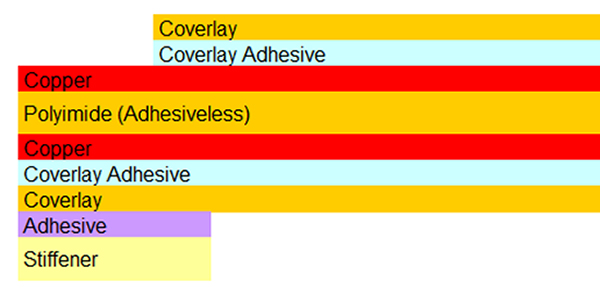
Adhesive-based PI laminates bond copper with acrylic or modified epoxy. They cost less and suit many static or moderate-frequency designs. The adhesive adds thickness, Dk variability, and bend-radius penalty. Adhesiveless (2-layer) constructions cast or sputter copper onto PI so the dielectric stack stays thinner, impedance tighter, and bend endurance higher -- at higher material cost. Fine-line flex and high-cycle hinges lean adhesiveless when the budget allows.
Coverlay, stiffeners, and tear stops still belong on the fab package. PI film does not forgive vias in the dynamic bend or copper that crosses a fold at ninety degrees any more than FR-4 forgives thin PTH barrels.
When a rigid-flex hybrid is the honest middle
Pure PI flex is the right answer when the entire outline must bend or when the product is mainly an interconnect tail. Pure FR-4 rigid is the right answer when nothing moves and planes, heat, or density stay inside rigid process windows. Rigid-flex sits between them: FR-4 or high-Tg rigid sections for component mounting and planes, PI film sections for the moving interconnect.
Hybrid constructions earn their keep when dense SMT and a dynamic or tight static fold share one assembly -- laptop display hinges, camera modules, medical instruments, aerospace electronics that must drop harness weight without losing rigid real estate for BGAs. CTE mismatch at the rigid-to-flex transition, bookbinder or flying-tail geometry, and bend keep-outs become first-class drawing notes. The flex fingers still want PI with RA copper; the rigid fingers keep FR-4 economics where bend never happens.
Rigid-flex is the wrong spend when a discrete cable and two connectors already meet reliability and cost, or when the only motion is a gentle static form that thin FR-4 or a simple PI flex cable could absorb without multilayer rigid fingers.
RFQ callouts XFPCB readers should put on the traveler
Fabs quote what is written. For PI versus FR-4 substrate decisions, the package should lock:
Bend class and cycle expectation -- static install versus dynamic use, approximate cycles, and bend radius as a multiple of finished thickness by zone.
Substrate family by zone -- PI film (adhesive or adhesiveless), thin FR-4 flex for static only, or rigid-flex with FR-4 rigid and PI flex called out separately. Name IPC-4204-class flex dielectric language when you have a slash sheet; avoid bare marketing phrases like "flex-grade" without a type.
Copper type by zone -- RA for dynamic flex, ED only where static duty and the fab agree. State copper weight and grain orientation notes for long flex tails.
Thermal and assembly -- Tg or material grade for rigid sections, lead-free reflow count, and moisture-bake expectation for PI before SMT. Dry-pack and floor-life notes belong with the assembly house when PI multilayer or stiffener stacks absorb humidity in transit.
Impedance and stack -- Dk/Df assumptions, adhesive presence in the model, and whether any shield or coverlay is part of the reference stack. PI's uniform dielectric helps only if the model matches the construction.
Mechanical map -- dynamic bend keep-outs, stiffener outlines, coverlay openings, tear stops, and via keep-outs in hinges. Aerospace, medical, and wearable RFQs should also state IPC class and any cleanliness or biocompatibility constraints the fab must not invent.
XFPCB builds from that zone map so CAM does not upgrade a static FR-4 fold into adhesiveless PI, or ship glass-epoxy into a hinge that needed film.
Buyers who treat polyimide as automatic "better flex" overpay on static installs; buyers who treat thin FR-4 as automatic "cheaper flex" underwrite crack returns on dynamic duty. Match film versus glass-epoxy to bend class, reflow and Tg margin, and bake discipline -- then let the China fab traveler follow the drawing instead of the brochure synonym for flex.