
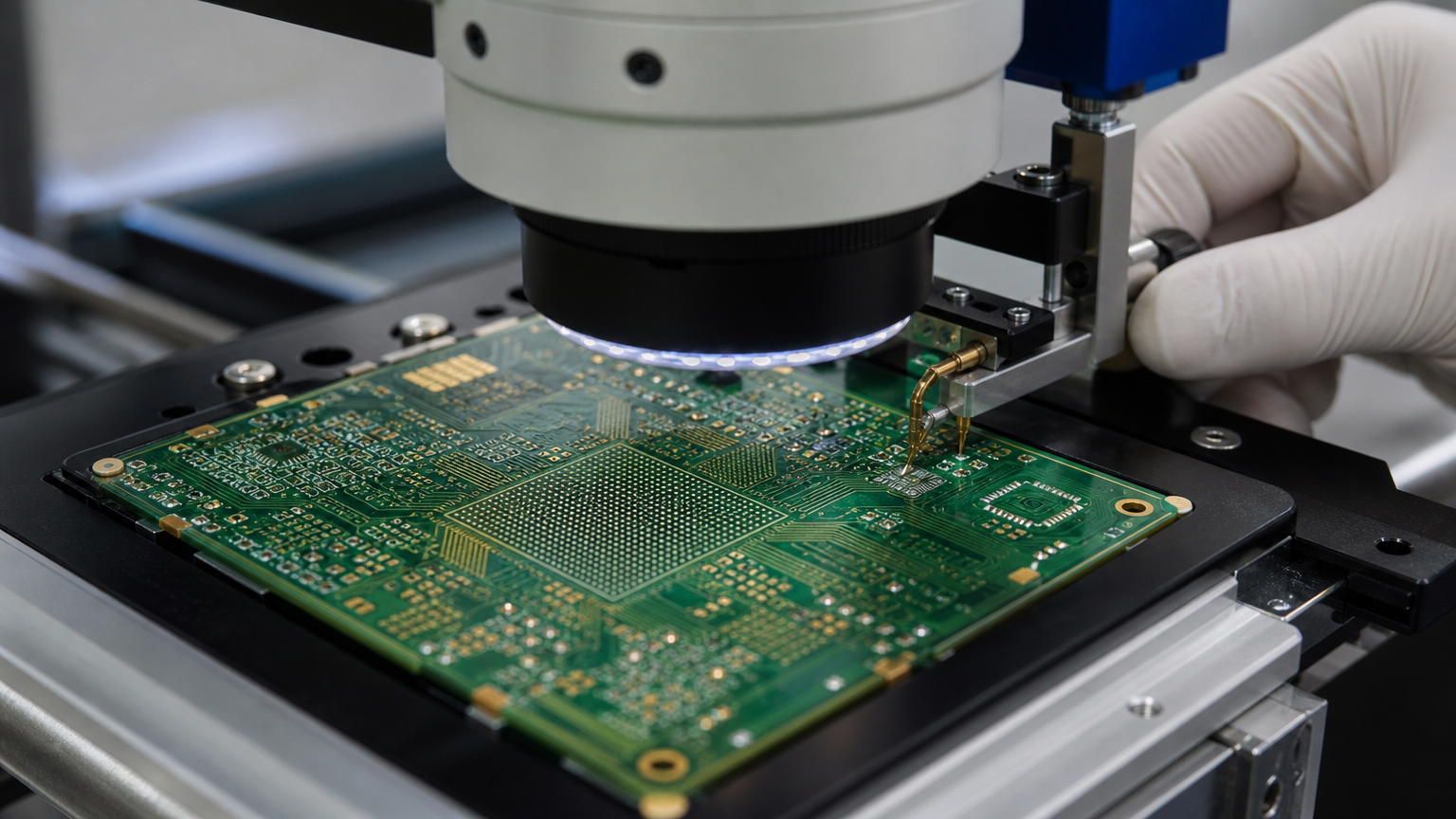
Most overseas RFQs treat BGA soldering as a checkbox: "reflow + X-ray." That language does not protect yield. Paste volume under the balls, whether vias under pads are filled, who owns the thermal profile, and what void fraction fails a lot all decide whether first articles survive thermal cycling or only survive a quick power-on.
BGA joints are hidden. Optical inspection after reflow tells you almost nothing about the ball field. Buyers who skip SPI, treat X-ray as a photo souvenir, or leave void criteria blank discover the cost in field returns and NPI scrap--not in the prototype invoice.
What actually happens in production soldering
Production BGA attach is paste print (or flux-only for some package flows), placement with vision, convection reflow, cool-down, then inspection. Hand hot-air rework is a repair process with different risks; do not confuse it with the process window used to build volume.
Paste chemistry and stencil aperture design set the solder volume available to each ball. Undersize apertures starve joints; oversized or poorly released paste creates bridges. For via-in-pad footprints, unfilled vias act as solder thieves. If your layout uses VIP, the fab note must call for filled, plated, and planarized vias before assembly quotes are compared.
Reflow ownership and board-mass reality
Package peak temperature, time above liquidus, and ramp limits come from the device datasheet and the paste datasheet. Board copper mass, large ground pours, and thick PCBs change how the BGA actually experiences that curve. A profile that worked on a small evaluation board can underheat a production panel with heavy copper.
Ask the assembler which thermocouple locations they use on first-article profiling (package top, nearby copper, board underside). Nitrogen reflow can improve wetting on fine-pitch or OSP finishes; it is a cost and process choice, not magic. State alloy preference (typically SAC305 for RoHS) and any low-temperature constraint early so quotes are comparable.
X-ray, voiding, and acceptance language
2D X-ray finds opens, bridges, major misalignment, and gross voiding. CT helps when stacked voids or complex packages need volume understanding, but it is slower and usually sampled. Decide sample size before production: first-article 100% X-ray on BGA lots is common; ongoing sampling depends on risk.
Void limits belong in writing. Power packages and thermal pads often need stricter area limits than signal balls. Specify whether the limit is per-joint area percentage, largest single void, or both--and whether you measure after reflow only or also after any rework.
Defect modes buyers should name in the quality plan
- Head-in-pillow / non-wet opens from oxidized balls, warped packages, or insufficient paste collapse
- Bridging from excess paste or placement offset
- Mid-chip solder balls and residue that later cause leakage paths
- Cracked joints from excessive rework heat or unsupported board flex after assembly
For package and pitch context before assembly planning, see the BGA and CSP packages guide. Escape and layer decisions that change soldering risk are covered in BGA escape routing on multilayer boards.
RFQ checklist that improves China PCBA quotes
Send package MPNs and ball pitch, paste/alloy preference, VIP fill requirement, surface finish (ENIG is common for fine BGA), warpage notes, X-ray coverage and void limits, and whether functional or ICT fixtures exist. Upload Gerbers, centroid, and BOM through how to place an order so engineering review can catch paste and via risks before stencils are cut.