
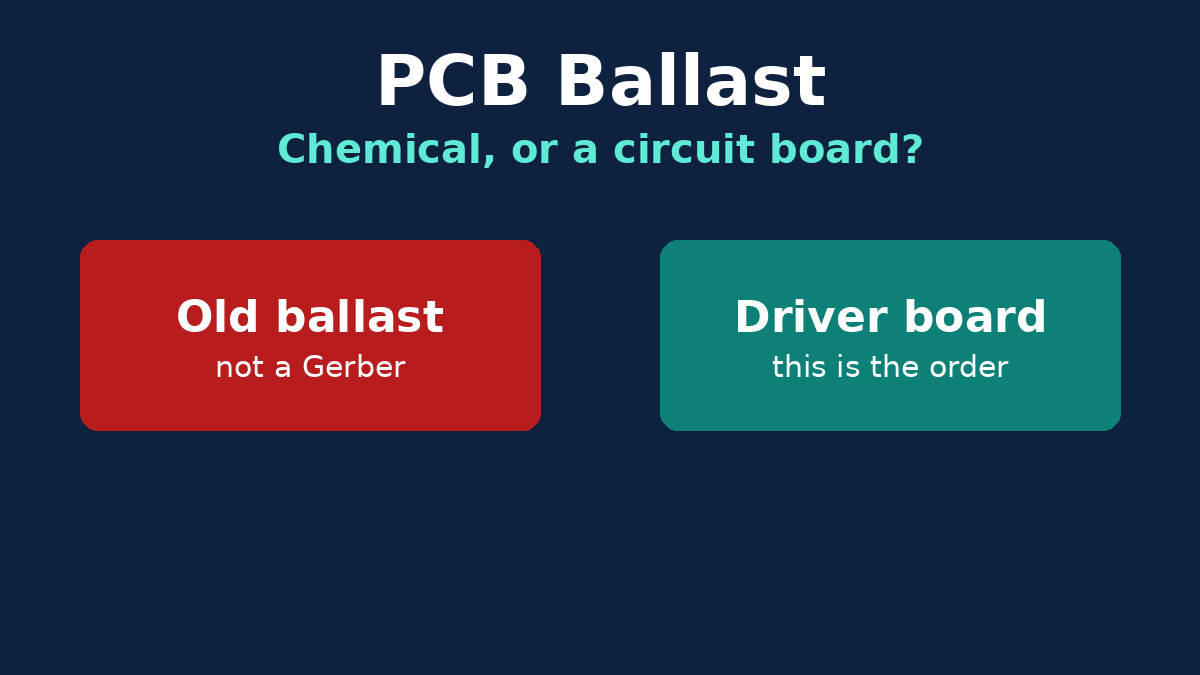
Search the words "PCB ballast" and most of what you find is not about printed circuit boards. In lighting, PCB means polychlorinated biphenyls, a family of chemicals that used to be poured into older fluorescent ballasts. A circuit-board factory is the wrong place to send a leaking one. It is the right place once the job has become a board: an electronic ballast, or the LED driver that replaced it.
Two meanings, and only one of them is an order
A magnetic fluorescent ballast is a lump of iron and copper that limits lamp current at mains frequency. Into some of those units, manufacturers put polychlorinated biphenyls in a small capacitor and in the potting compound, because the material was stable and did not burn easily. That stability is the problem. The chemicals persist, and a ballast that leaks them is a waste issue, not a rework issue.
In the United States, the Toxic Substances Control Act ended PCB manufacture in the late 1970s. EPA guidance is that a fluorescent ballast made before July 1979 may contain them. Ballasts built from July 1978 through July 1998 that do not contain them were required to be marked "No PCBs." A missing label on an old T12 magnetic ballast is why that unit gets treated as suspect, unless its manufacture date is known to be later. T8 and T5 gear is a later generation and is not that magnetic T12 case. After July 1998 the "No PCBs" mark was no longer required, so a new unmarked driver is not the same clue as an old unmarked brick. None of this is a fabrication note. It is a reason not to open the can.
If a unit is leaking an oily or tar-like residue, stop. Do not drill it, crush it, or "just see what's inside." Containment and disposal belong to whoever is licensed for that waste where the building is. A Shenzhen PCB line cannot quote that, and should not be asked to.
What replaced the can
Once the fixture is being redesigned rather than disposed of, two boards show up in RFQs, and they are not the same product.
An electronic ballast still drives a fluorescent lamp. The iron core is gone. A circuit board rectifies the mains and runs a high-frequency inverter into the lamp, well above 50 or 60 Hz, which is why the old hum goes away. The board carries mains voltage, a resonant tank, and usually a through-hole transformer or inductor that runs warm.
An LED driver does the same job for a different load: it turns mains into a controlled current or voltage for LEDs. There is no lamp filament to strike. There is still a switching stage, still magnetics, and still a safety spacing problem. Many products that people still call "ballast PCBs" in an email are drivers.
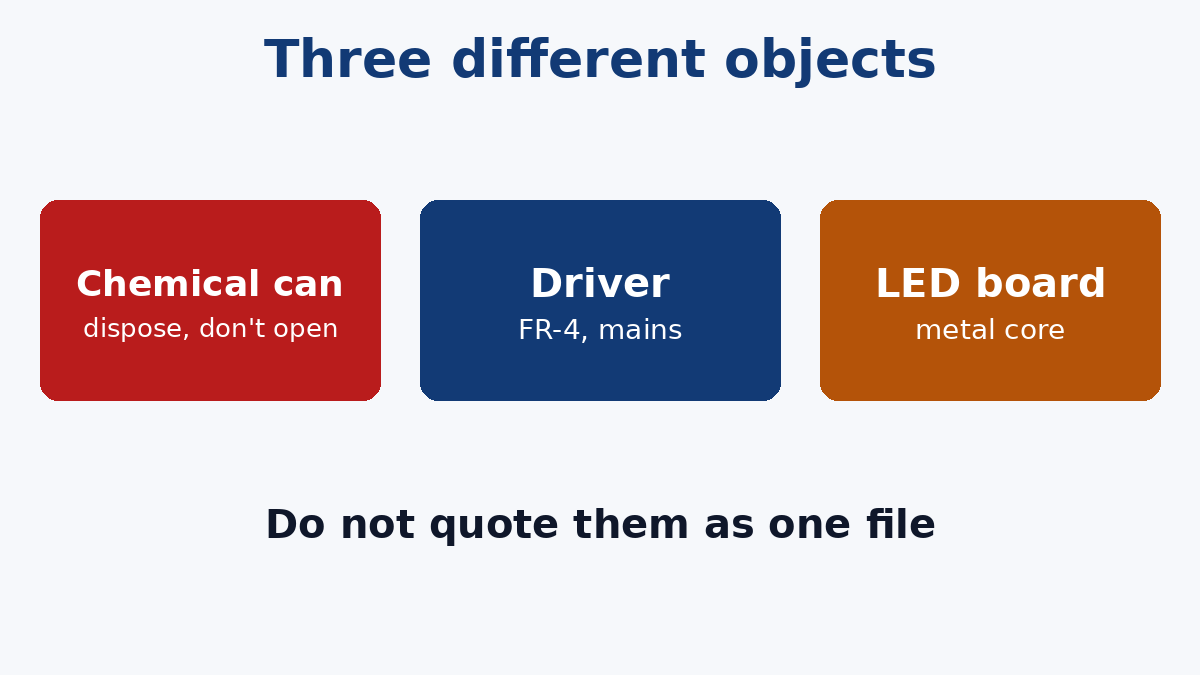
The board the LEDs are soldered to is a third item. It is often a metal-core board chosen to spread heat, and it is not the driver. Our LED Lighting page separates those two: a metal-core board under the LED packages, and an FR-4 board for the power conversion. Our LED PCB Board page is the thermal one. Sending one Gerber and asking for "the ballast PCB" usually means those two got merged in the file name.
What is different about building it
These are mains assemblies. The drawing has to carry the safety story, because the factory will not invent a creepage distance.
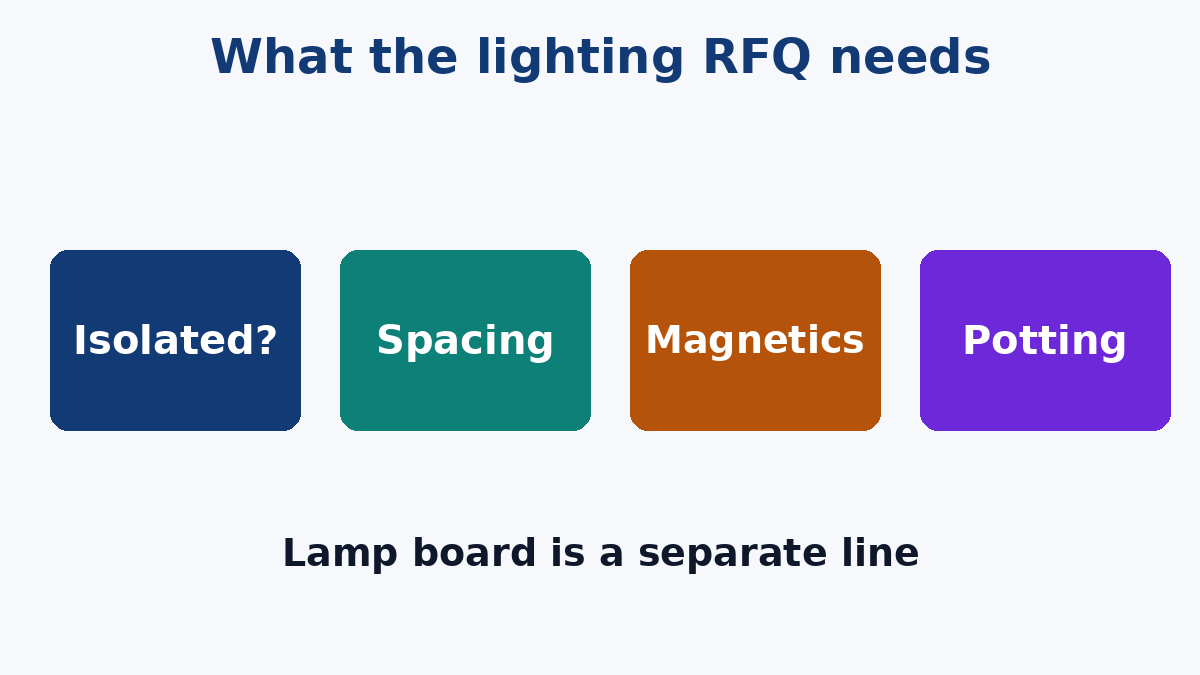
- Isolation. Say whether the output is isolated from the mains, and by which barrier: a transformer with a specified spacing, or a non-isolated topology where the output is not a touch-safe circuit. Lamp controlgear is commonly certified under the IEC 61347 series. Name the standard you are actually certifying to. Do not leave "isolated" as a slogan with no clearance on the drawing.
- Spacing on the board. Creepage and clearance are copper-to-copper and copper-to-edge rules in the layout, including slots if you are using a slot as the barrier. A fab can build the slot. It cannot decide that 3 mm was enough.
- Magnetics. The transformer and the common-mode choke are usually through-hole, tall, and the hottest parts on the board. Our Through-Hole Assembly page is where wave solder is weighed against selective solder for connectors, transformers and other tall parts, after the surface-mount side is already on. Lead length, orientation and a keep-out for the nozzle belong in that note.
- Potting. Modern potting, an epoxy, silicone or urethane you name, is there for heat, moisture or to hold a winding. It is not the chemical potting from a 1970s ballast, and the word "potting" on a lighting drawing should say which. Mark where it is allowed to flow. Test points, connector faces and anything you still need to rework have to stay clear. A potting compound also changes rework from "touch up a joint" to "dig the part out."
- The enclosure it bolts to. Lighting boards often use the housing as the heat sink. A metal-core LED board and an FR-4 driver do not share a stackup, a drill process, or a quote. Ask for them as two lines.
Nothing above is a claim about a particular wattage, a lead time, or a safety certificate. Those come from the product standard and from the files, not from the nickname "ballast."
What to send when the email says ballast
If the attachment is a photo of a black tar-filled brick from a ceiling, that is not a Gerber. The useful reply is that a factory builds the replacement electronics, and a licensed handler takes the old unit.
If the attachment is a design, the quote needs:
- Which product: electronic ballast for a fluorescent lamp, LED driver, or the LED board itself.
- Input and output in electrical terms, and isolated or not.
- The safety standard the layout was drawn to, plus the creepage and clearance you want held.
- Potting, if any: material family, region, and what must stay free of it.
- Two part numbers if the lamp board and the driver board are both in the project.
The chemical and the circuit board only share three letters. The order should make it obvious which one you mean.