
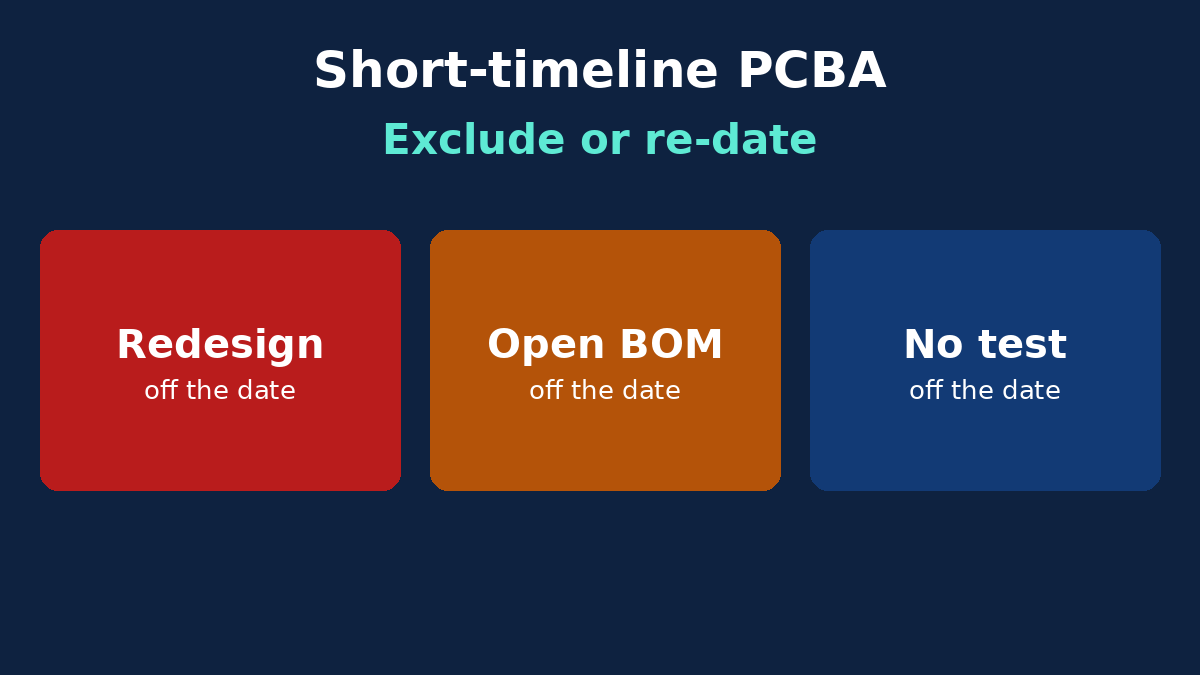
Guides titled “ultimate PCB assemblers for short timelines” usually end in a vendor ranking. That ranking does not move a date. A short-timeline PCBA job moves when the quote is allowed to exclude work that cannot share the same calendar—or when that work is dated on a separate line.
This is a factory view for overseas buyers and engineers. It is not a list of who is fastest, not a 24–72 hour promise, and not a redesign offer hiding inside an assembly PO. Our consumer turnkey freeze-gates post asks what must be locked before speed talk on a consumer product. This post asks a different buyer question: what must be kept out of (or split from) a short-timeline assembly quote so the remaining date can be real.
What a short-timeline PCBA quote is allowed to mean
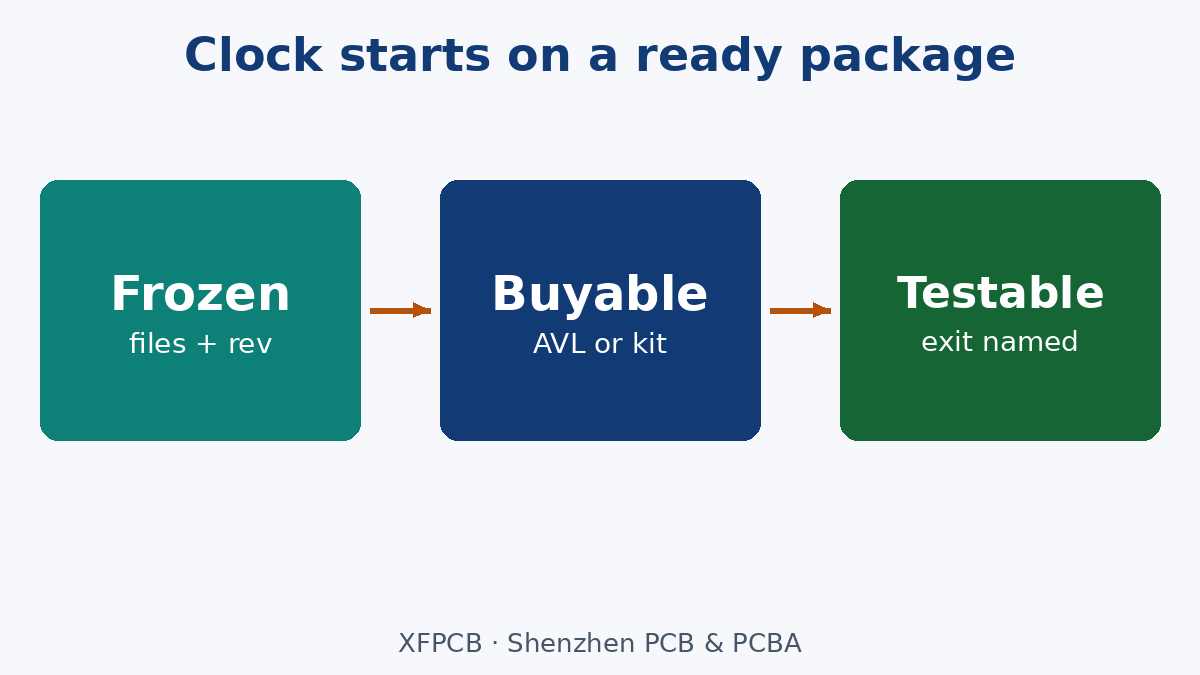
On a China line, a compressed assembly schedule usually means: files and BOM are already buildable, parts are buyable or already kitted, the stencil and traveler match a known process, and outgoing test is named. Our Quick Turn PCB Assembly page is that queue family. The queue does not absorb an open schematic rewrite.
If the RFQ still needs layout changes, AVL discovery, or a test fixture that does not exist, say so. Put those on separate dates. One blended “ship by” that includes all three is fiction.
The assembly path, briefly—and where time actually goes
The board still follows a familiar path: frozen schematic and layout, Gerbers and BOM, bare-board fab, solder-paste print, placement, reflow (and THT if quoted), inspection, the tests you named, pack. Most calendar on a “rush” job is not nozzle time. It is waiting for an answer on an EQ, waiting for a part, waiting for a revision, or waiting for a fixture. Machine capacity only matters after those waits are removed from the critical path.
Panelization, stencil design and feeder setup are real setup work. They belong in the quoted process when the revision is stable. They are not a reason to hide an open BOM inside the same ship date.
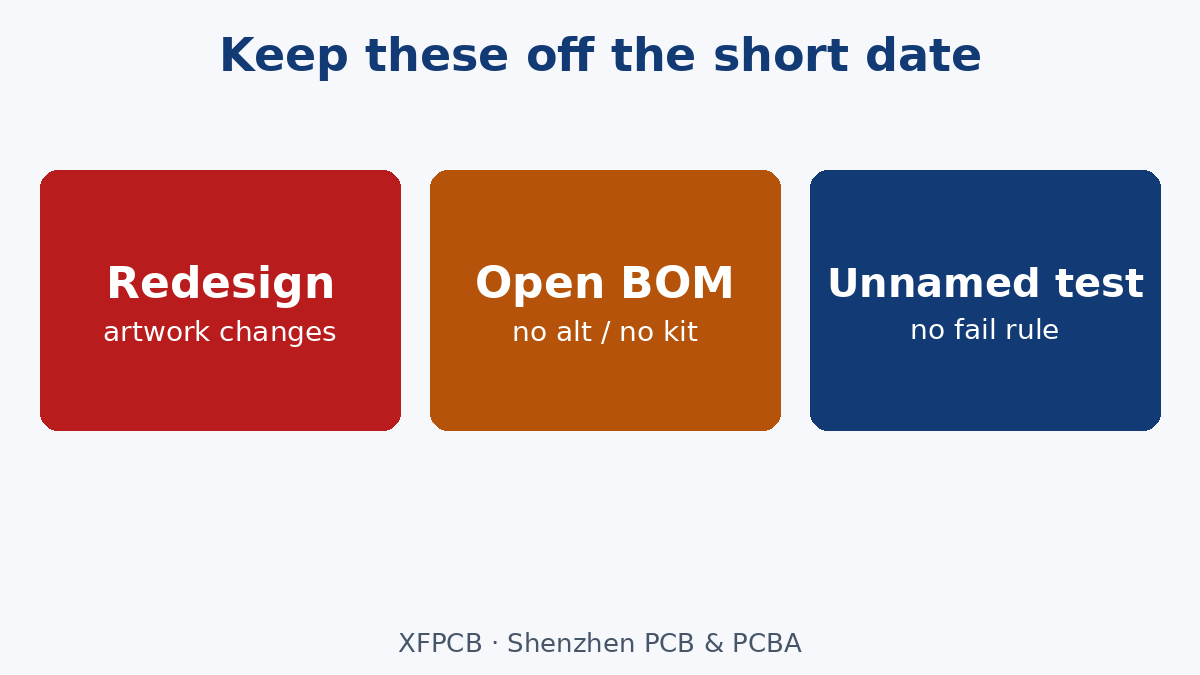
Exclusion 1: Redesign and DFM that changes artwork
A DFM review that returns “move this part” or “widen this pad” is valuable. It is also a new Gerber revision. A short-timeline quote should state whether DFM is advisory-only against frozen files, or whether the clock restarts when artwork changes. Do not sell “we will fix the layout in the build window” as assembly speed.
Design and first-article iteration belong in a prototype loop with an explicit revision rule. Our Prototype PCB Assembly page is that loop—not a silent extra inside a production rush PO.
Exclusion 2: Open AVL and allocation risk
Short timelines die on lines with no stock, no approved alternate, and no consignment. Either:
- the buyer consigns the long-lead and NCNR parts, or
- alternates are already approved on the AVL, or
- purchasing is a separate dated task before the assembly clock starts.
“We have strong suppliers” is not an alternate list. Buffer stock at a factory helps only the MPNs they actually hold for other programs—not your orphaned line.
Exclusion 3: Unnamed test and undefined fail disposition
AOI, X-ray sample, ICT, flying probe and functional fixture are different scopes and different fixtures. A short date that says “tested” without naming which of those run—and what happens to a fail—will stop when the first red board has no owner. Name the exit tests on the quote. Put new fixture design on its own date if the fixture does not exist.
Exclusion 4: Scope creep dressed as flexibility
Mid-build ECO, extra side of SMT, adding wave after reflow was quoted, or changing finish after fab has started, are new jobs. A short-timeline partner can be flexible about queue priority. They cannot be flexible about physics and traveler steps without moving the date. Write the change rule: which changes stop the clock.
How to evaluate a short-timeline assembler without a ranking
Ask for evidence against a defined package, not adjectives:
- EQ response ownership and timezone overlap you can live with.
- Whether fab and assembly share one traveler or two vendors with a kit handoff.
- How alternates are proposed and who signs them.
- Inspection and test list for this revision, not a generic capability brochure.
- What happens when a part goes NCNR after award.
Capacity and equipment matter. They do not replace exclusions. Complexity of the design matters too—but “simplify the design” is an engineering project, not an assembler feature you select from a blog list.
What we are not claiming
No assembler ranking, no invented turn times, no claim that modular design always shortens PCBA by a fixed amount, and no claim that one certificate makes BOM risk disappear. Short-timeline PCBA is a scope contract. Exclude redesign, open AVL risk and unnamed test from the date—or schedule them apart—then the remaining calendar can be negotiated honestly.