
Search results for "standard PCB" often talk past each other. One camp means an off-the-shelf module or development board you can buy today. The other means a board built on a fabricator's everyday process window: common FR-4, ordinary layer counts, stock finishes, and a traveler that does not invent special steps. Both uses are legitimate. Confusing them is how teams either over-engineer an MVP or stay on a kit long after the enclosure and BOM have outgrown it.
This piece is written from a China fab quoting desk for founders, PMs, and engineers who are stuck between buying modules and designing a product board. It clarifies both meanings of "standard," sketches a practical path from MVP hardware to standard-spec fab and then to custom or HDI only when the product earns it, and closes on how RFQs should differ when you stay inside the shop's common capability versus when you need a special process. Treat industry cost talk as qualitative total-cost-of-ownership language, not as XFPCB price quotes.
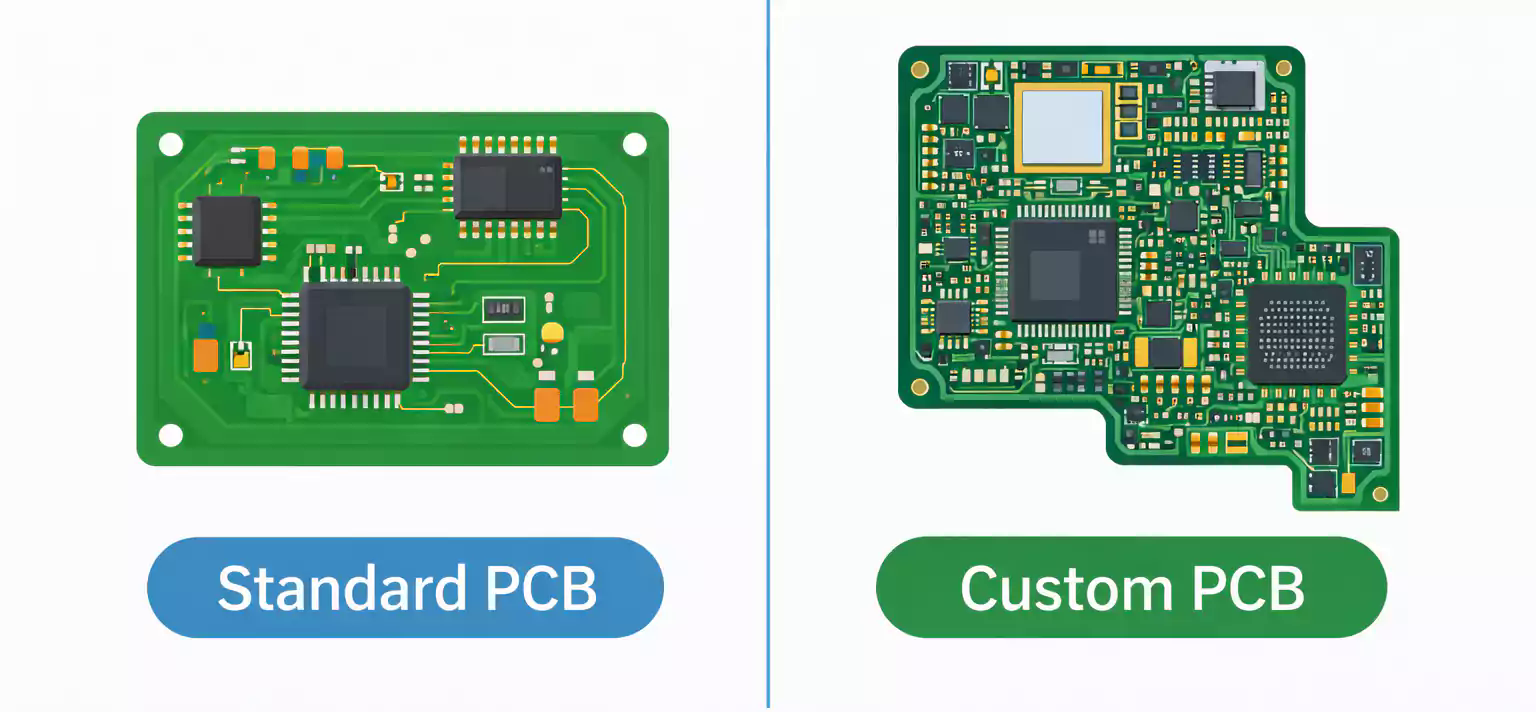
Two meanings of "standard" that search engines mash together
Meaning A -- off-the-shelf board or module. Sensor breakouts, MCU/MPU modules, Wi-Fi or cellular modules, compute modules, Arduino-class kits, Raspberry Pi-class SBCs. You buy a finished functional block. Layout, BOM, and often a slice of certification work already exist on someone else's drawing. Speed is the product.
Meaning B -- fabricator standard-spec process. Your own Gerbers, but built inside the shop's common capability: FR-4 (often mid or high Tg for lead-free), roughly 1-8 layers without drama, conventional thickness, everyday drill and trace/space, HASL/OSP/ENIG from the stock menu, mechanical vias rather than stacked microvia HDI. Lead time is short because the line does not stop to qualify a new press recipe.
A "custom PCB" in everyday buyer language usually means Meaning A failed you and you need a board designed for the product. In fab language, custom often means anything that pulls the job outside Meaning B: Rogers or other specialty dielectrics, blind/buried or HDI microvias, odd shapes and thicknesses, heavy copper, controlled-impedance coupons that force a named stack, Class 3 or harsh-environment callouts, rigid-flex, and similar special process. Both vocabularies matter when you write an RFQ.
Early product reality: modules and kits buy learning speed
For a first bring-up, a module-based architecture is often the honest move. Wireless is the classic case: a pre-certified radio module can cost more per unit than a bare chipset, yet it can spare weeks of RF layout, antenna tuning, and compliance thrash while you are still proving whether anyone wants the product. Compute modules, camera modules, and power modules follow the same logic when the team lacks bandwidth in that subsystem.
What modules actually buy early:
- Shorter schematic and layout cycles on the risky blocks
- Lower early certification and integration risk on RF and complex power
- Firmware and mechanical learning against a known reference design
- A path to a few dozen or a few hundred units without owning every net
What they quietly spend:
- Board area and connector real estate that inflate the enclosure
- Vendor lifecycle risk if the module revises or goes NRND
- Unit economics that look fine at pilot volume and ugly at scale
- Layout and thermal compromises that are hard to unwind later in firmware and housing tooling
Kits fail as commercial products for predictable reasons: fixed form factor, retail BOM pricing, grounding and EMI that were never designed for your plastic shell, and a certification path that treats the kit as a lab tool rather than a sellable device. That does not make kits wrong at week two. It makes them a temporary vehicle.
Middle lane: your design on fabricator standard-spec
Once the architecture is stable enough that you know which blocks stay and which go, the productive middle step is usually a product-owned PCB that still lives inside Meaning B. You drop the oversized kit outline, place connectors where the housing needs them, keep FR-4 and common layer counts, and use the fab's quick-turn window.
That middle lane is where most IoT nodes, simple industrial controllers, and early consumer boards should sit. You own the Gerbers and the BOM. You are not yet paying for specialty laminate, HDI, or exotic shapes. Quotes move faster because CAM recognizes the rules. Yields are predictable because the process is the one the shop runs every day.
Standard-spec is not "cheap junk." It is the shop's high-repeatability lane. If your signals, power, and mechanics fit FR-4 with ordinary vias and finishes, staying there is a schedule and quality choice, not a compromise of pride.
When custom stack, HDI, shape, or RF actually pays
Leave the standard-spec lane when a real constraint appears, not when a brochure says "premium."
Form and mechanics. Wearables, slim handhelds, medical sensors, and oddly shaped housings often cannot absorb a rectangular FR-4 blank with connector stubs. Contoured outlines, controlled thickness, and rigid-flex earn their keep when the plastic is already locked or the user experience depends on millimeters.
Electrical performance. Controlled impedance for multi-gigabit or RF, low-loss dielectrics on the nets that care, via fencing and continuous grounds for PA or sensitive front ends, and isolation between noisy switchers and quiet analog -- these are custom process or custom layout commitments. A board that "worked on the eval kit" can fail EMI or link margin once it is crammed into a metalized shell.
Density and interconnect. Fine-pitch BGA fanout, microvia HDI, and buried structures show up when routing escapes and layer count collide with board size. Jumping to HDI before the package map forces it mainly adds process steps and inspection load.
Thermal and power. Heavy copper, metal-core, dense thermal via farms, and aluminum or copper bases belong when watts have nowhere else to go. That is a different traveler from a four-layer FR-4 IoT board.
Reliability and environment. Harsh vibration, humidity, automotive-style cycling, or Class 3 expectations change materials, plating, and test depth. Call them out because they change the process, not because they sound serious in a pitch deck.
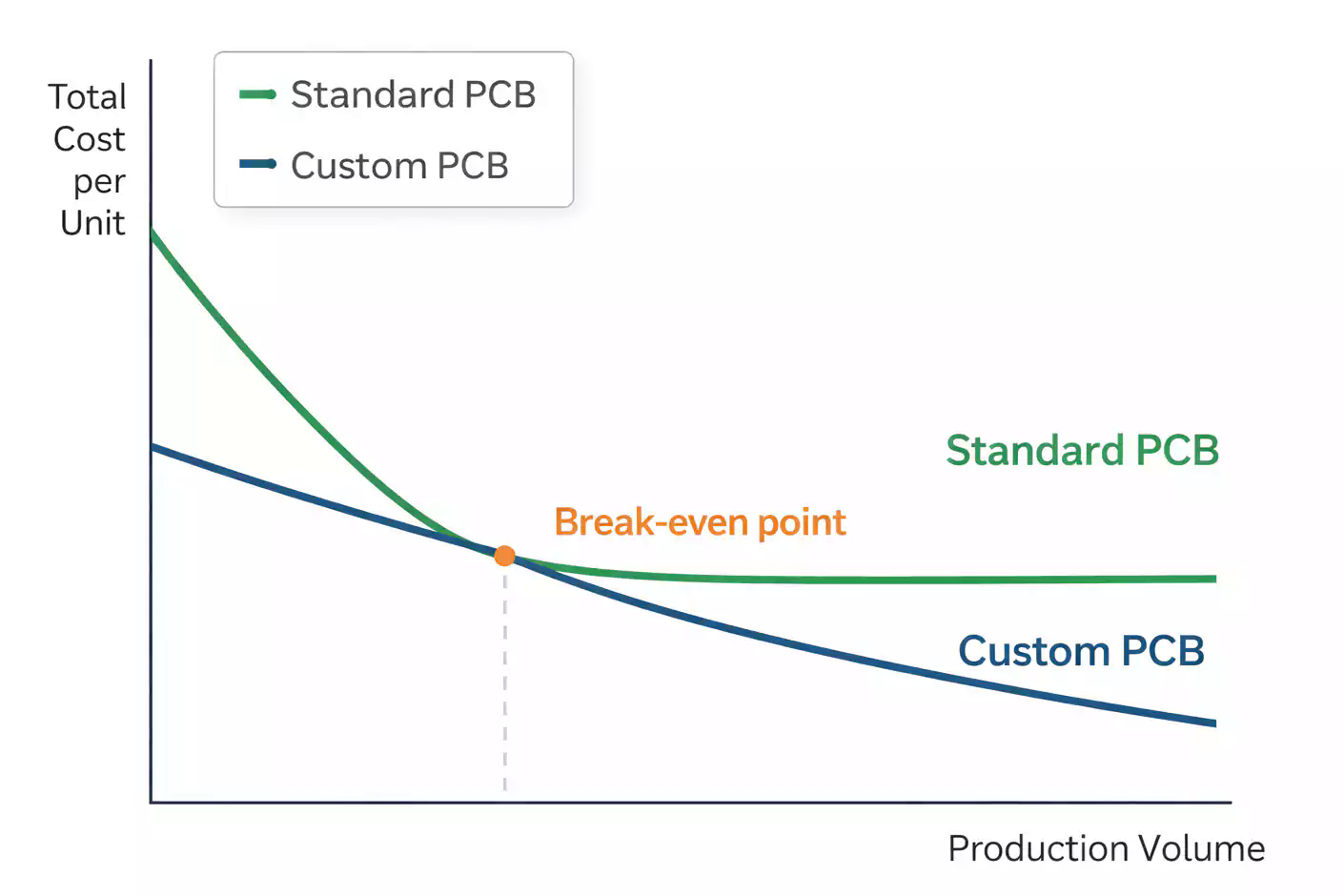
Custom pays when it shrinks BOM and assembly, unlocks a housing that modules cannot fit, or closes a performance or compliance gap that standard-spec cannot. It does not pay when the product is still changing monthly and you would re-spend layout NRE on every pivot.
Volume and enclosure as the real decision triggers
Two triggers convert "maybe later" into "design the product board now."
Enclosure lock. When industrial design freezes outline, antenna keep-outs, connector faces, and thermal vents, a module stack that once lived on a bench becomes a mechanical tax. Brackets, risers, and cable spaghetti show up as assembly cost and field failure risk. That is the moment to own the PCB geometry even if the fab process stays standard-spec.
Volume and TCO. At low pilot counts, module premiums and kit board prices are often cheaper than owning layout, bring-up, and first-article thrash. As monthly volume rises, the premium for integrated modules, extra connectors, and oversized boards compounds. Qualitative TCO usually flips toward a product PCB -- still standard-spec if possible -- before it flips toward HDI or specialty laminate. Exact dollar bands vary by region, complexity, and labor; treat published industry NRE ranges as illustrations of effort scale, not as a quote from any one factory.
A practical sequence many teams survive: prove the function on modules or kits, move to a product-owned board on fabricator standard-spec while the enclosure settles, then open specialty process only for the nets, layers, or shapes that still fail size, SI, RF, thermal, or reliability gates. Skipping the middle lane is how groups burn two custom revisions before the product story is stable.
How RFQs differ for standard-spec versus special process
Write the RFQ in the vocabulary the quoting engineer uses.
For a standard-spec job, say so in plain language: FR-4 class or Tg target, layer count, overall thickness, copper weights, finish from the common menu, solder mask and legend, and that mechanical vias and ordinary trace/space are acceptable. Attach Gerbers, a simple stack note, drill chart, and fab drawing. If impedance is mild and can use the shop's default stack, say that; if you need controlled impedance, still give targets and reference layers even on FR-4 so CAM does not guess. Mention quantity and whether this is prototype or production so panelization and lead-time assumptions stay honest.
For a special-process job, lead with what pulls the traveler off the common line. Name the dielectric family or hybrid intent, HDI or blind/buried structure, unusual thickness or copper, impedance coupons and Dk frequency assumptions, RF or high-current keep-outs, thermal via or metal-core requirements, and any Class or environmental notes. Attach a stack sketch that marks which layers are specialty versus FR-4, plus Gerbers and assembly notes if PCBA is in scope. Ambiguous "custom quality" wording without process flags is how quotes either pad contingency or come back as a clarifying email instead of a number.
Keep Meaning A and Meaning B separate in the cover note. If you are still buying a radio module but fabricating a carrier on standard-spec FR-4, say that. If the RF front end must leave FR-4, say that too. Clear process intent shortens the quote loop and keeps the factory from solving the wrong problem.