
PCB conformal coating is a thin, electrically insulating film applied to an assembled board so the coating follows component and trace contours. Overseas buyers usually specify it to cut moisture-driven leakage, chemical attack, and dendritic growth--but coating the wrong chemistry, skipping mask keep-outs, or shipping dirty boards creates scrap, rework fights, and field returns that a brochure never mentions.
This guide starts from a real failure pattern and when coating is over-specified, then walks chemistry as a tradeoff (not a five-row catalog), masking and thickness windows on the PCBA line, and the inspection language buyers should put on quotes. No FAQ pad at the end--only process facts you can check with a factory.
A field return that coating did not prevent
A mid-volume outdoor controller passed ICT and functional test, then failed after monsoon season. Connectors had been coated; mating force scraped the film into conductive debris near the pins. Flux residue under a tall electrolytic trapped moisture; the acrylic film bridged the residue instead of sealing a clean surface. UV inspection had been "sample only," so incomplete coverage on a dense BGA corner never appeared in the traveler.
The lesson for procurement is not "always buy parylene." It is: conformal coating only protects what you leave clean, unmasked correctly, and thick enough--and it fails loudly when keep-outs and cleanliness are missing from the PO.
When coating is over-specified
Skip or defer coating when:
- The product lives indoors, dry, with short warranty and no condensation path
- Connectors, test points, and heatsinks already consume most of the board as keep-outs
- You still expect frequent field rework with no rework process for the chosen chemistry
- Potting, a sealed enclosure, or conformal on a daughtercard already covers the real exposure
Coating is not a substitute for enclosure IP rating, poor stackup, or uncontrolled ionic contamination. Ask whether the environment actually needs a film before you add cycle time and mask labor to every panel.
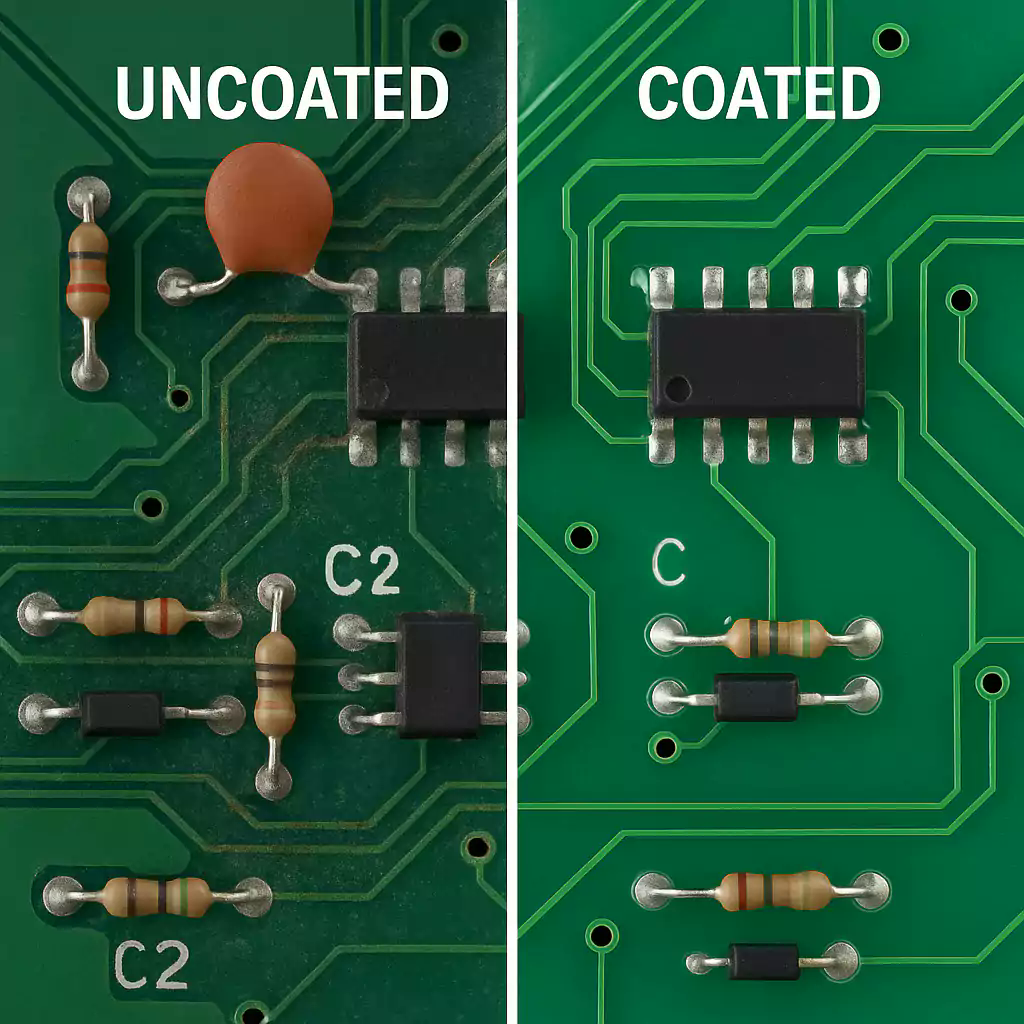
Chemistry as a tradeoff, not a brochure list
Material choice is a negotiation between environment, rework, process equipment, and cost. Treat AR / SR / UR / ER / XY as tradeoff packs:
Acrylic (AR) -- Fast dry, easy solvent strip for rework, solid moisture barrier for general industrial and consumer outdoor boards. Weakest chemical and solvent resistance of the common liquid systems. Default when you expect engineering change and connector rework.
Silicone (SR) -- Flexible through thermal shock and high temperature; good for vibration and wide temperature swing. Harder to remove cleanly; adhesion and soft surface can complicate handling and labeling. Prefer when CTE stress or heat is the driver, not solvent splash.
Urethane / polyurethane (UR) -- Tough against moisture, abrasion, and many chemicals. Rework is slow and often mechanical. Choose when washdown, fuel vapors, or industrial chemicals matter more than easy touch-up.
Epoxy (ER) -- Hard, high adhesion, strong barrier; brittle under flex and essentially non-reworkable without damaging parts. Rare for boards that still need debug; more common when the assembly is sealed for life.
Parylene (XY) -- Vapor-deposited, ultra-thin, pinhole-resistant, excellent dielectric and moisture barrier. Needs vacuum tooling, careful masking, and higher cost. Specify when thin uniform coverage and harsh corrosion environments justify the process--not as a default upsell.
Practical selection narrative
| If your driver is... | Lean toward | Accept the cost of... |
|---|---|---|
| Frequent rework / ECO | Acrylic | Lower chemical resistance |
| Thermal cycling / vibration | Silicone | Harder strip and soft film |
| Chemicals / washdown | Urethane (or epoxy if no rework) | Difficult rework |
| Ultra-thin, harsh corrosion, high dielectric | Parylene | Vacuum process and price |
| Lowest process complexity | Acrylic spray or selective | May need upgrade later |
Match chemistry to the failure you fear. Humidity and condensation push urethane or parylene; high temperature pushes silicone; solvent exposure pushes urethane/epoxy; lab prototypes still changing BOM push acrylic.
Masking and process windows on the line
Application method matters as much as resin type. Selective robotic coat, spray, brush, dip, and parylene deposition each change mask labor, thickness control, and defect modes.
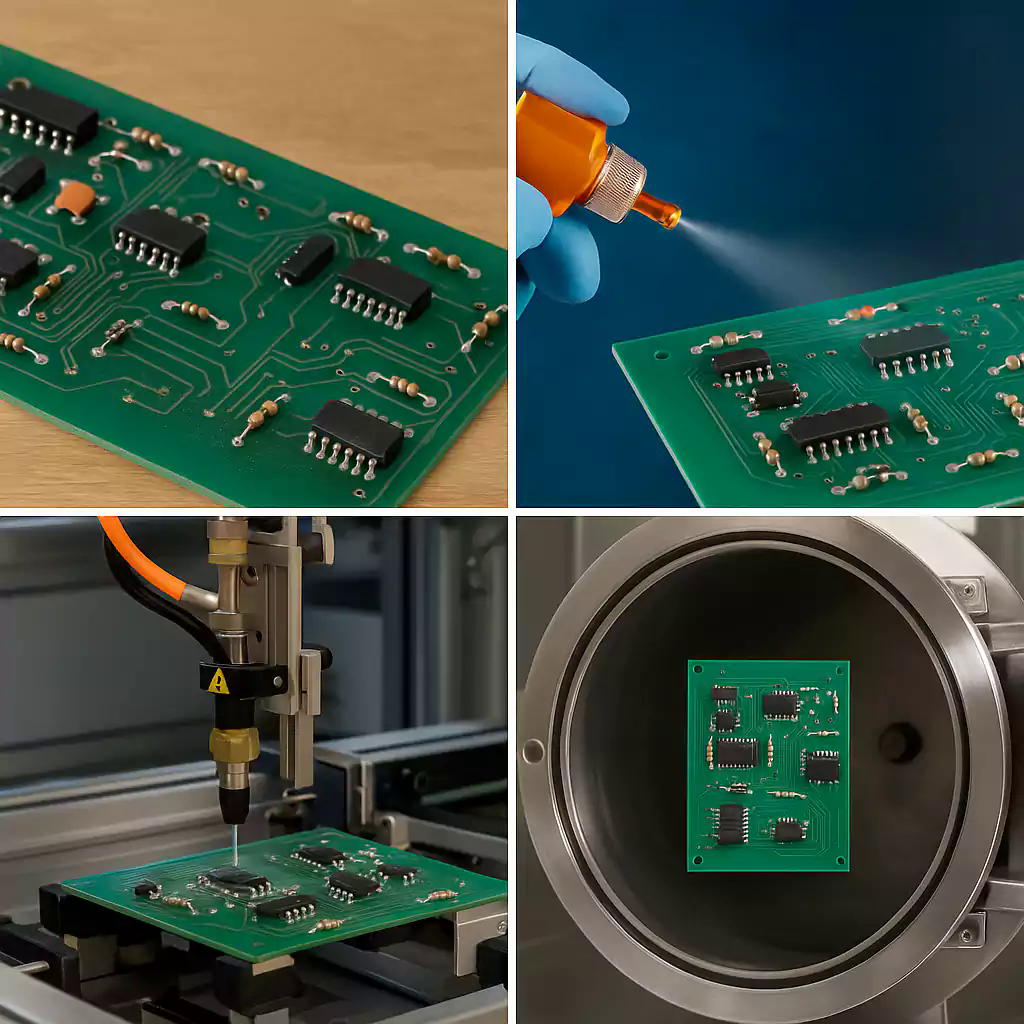
Keep-outs buyers must draw, not assume
Factories cannot guess what must stay bare. Put keep-outs on the fabrication/assembly drawing or a dedicated coating map:
- Connector pins, gold fingers, press-fit zones, and mating surfaces
- Test points, programming headers, and bed-of-nails lands you still need after coat
- Heatsink interfaces, RF shield contact lands, and ground clips that need metal-to-metal contact
- Moving parts, adjustment pots, and optical windows
- Areas reserved for later soldering or wire bond
Masking uses tape, boots, dots, or fixtures. Incomplete mask lists become coated connectors and scrap. Overspray into a keep-out is a process fail even if the chemistry is perfect.
Cleanliness before coat
Coating over ionic residue locks contamination under a dielectric film. Buyers who care about coating reliability should ask:
- What post-SMT cleaning method is used (or whether no-clean is proven clean enough for this product)
- Ionic cleanliness or visual/UV criteria before coat when the program requires them
- Handling rules after clean so fingerprints and flux do not return
A dry, residue-controlled board is part of the coating process--not optional prep.
Thickness and cure windows
Most liquid coatings target a thin film (commonly on the order of 25-75 um / ~1-3 mil depending on material and OEM spec--lock the number your design authority uses). Too thin leaves coverage gaps on tall shoulders; too thick invites bubbles, cracking, and incomplete cure in shadows. Ask the CM for:
- Target dry-film thickness and how it is measured (micrometer, wet coupon, or optical)
- Cure schedule (time/temperature or UV) for the named material
- Edge coverage expectations on fine-pitch leads
Selective coating reduces waste and mask area on dense boards; dip is efficient but floods tall parts and can trap pools; brush is prototype-only; parylene needs vacuum and different mask strategy. Name the method on the quote so cycle time and tooling are comparable.
Defects the line should catch before ship
| Defect | Typical cause | Buyer-facing fix |
|---|---|---|
| Delamination / peel | Dirty surface, wrong primer, contamination | Enforce pre-coat clean + adhesion check |
| Bubbles / voids | Trapped solvent, wrong spray distance, wet undercoat | Control viscosity, flash-off, and application distance |
| Cracking | Excess thickness, brittle chemistry under thermal cycle | Hold thickness window; revisit epoxy vs silicone |
| Incomplete coverage | Shadowing, skipped selective path, bad spray angle | UV 100% or defined AQL + coat-map verification |
| Coated keep-outs | Missing mask map | Drawing keep-outs + first-article photo review |
Inspection acceptance language for buyers
Do not accept "coated per industry practice." Put measurable acceptance on the RFQ and traveler.
What to require in plain language
- Named coating type (AR/SR/UR/ER/XY or commercial product name) and color/UV tracer if used
- Application method (selective / spray / dip / brush / parylene)
- Keep-out drawing revision that matches the build
- Target thickness range and measurement method
- Pre-coat cleanliness expectation (process description)
- Inspection: UV light coverage check coverage (100% or AQL), plus visual for bubbles, peel, and keep-out intrusion
- Rework rules: how coated defects are stripped/recoated and how many heat or solvent cycles are allowed
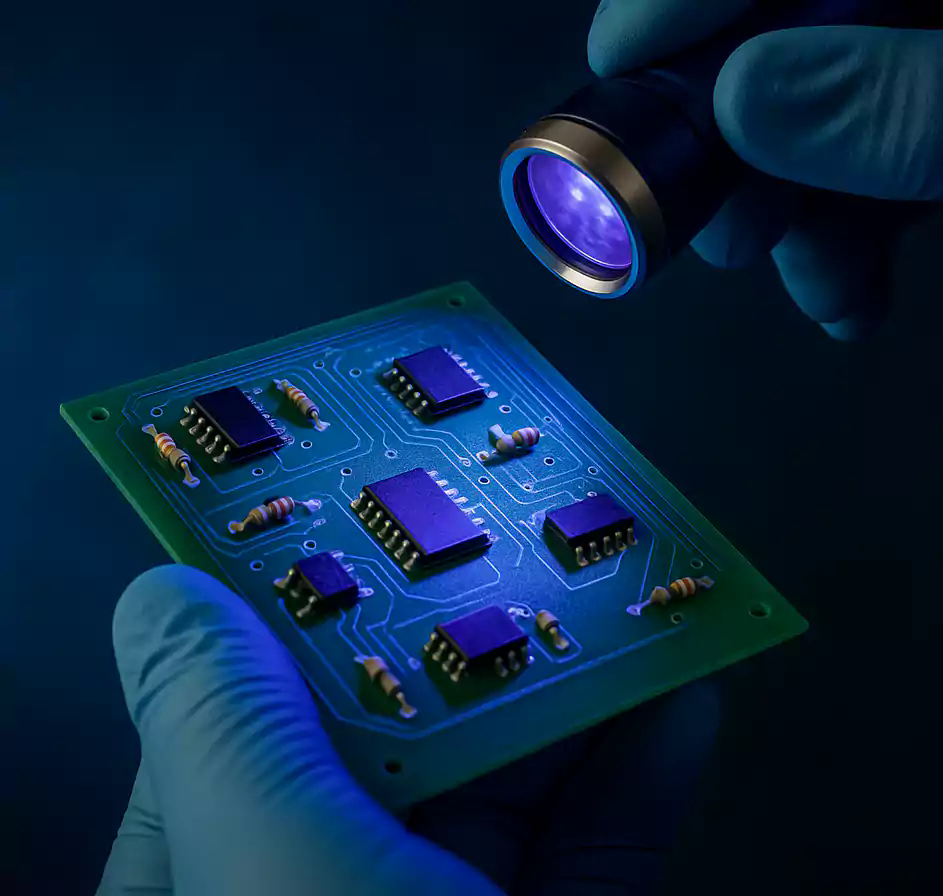
UV inspection is the practical shop-floor check for most acrylic, urethane, and many silicone systems that include a fluorescent tracer. Ask for sample UV photos on first article, especially around BGAs, connectors, and tall capacitors. Parylene and some clear systems need different metrology--agree that up front.
Quote fields that prevent surprises
Ask China PCBA partners to price coating as a discrete line with:
- Chemistry and brand/type
- Method and whether selective programming is included
- Mask/boot labor assumptions (or buyer-supplied fixtures)
- Thickness target and inspection level
- Lead time adder for cure and inspection
- Rework policy if coating fails UV or keep-out checks
Two quotes that both say "conformal coating included" are not comparable until those fields match.
Closing
Conformal coating earns its cost when moisture, chemicals, or insulation risk are real--and when the factory runs clean boards, honest keep-outs, controlled thickness, and UV (or agreed) coverage checks. Over-specified coating wastes money; under-specified process creates silent field fails. Lock chemistry to the environment and rework plan, put mask maps on the drawing, and make inspection language part of the PO before the first panel hits the coat line.
XFPCB supports PCB fabrication and PCBA builds where coating is specified with clear materials, keep-outs, and acceptance criteria. Send Gerbers, BOM, coating map, and target environment notes so the quote reflects real mask labor and inspection--not a vague "coating available" checkbox.