
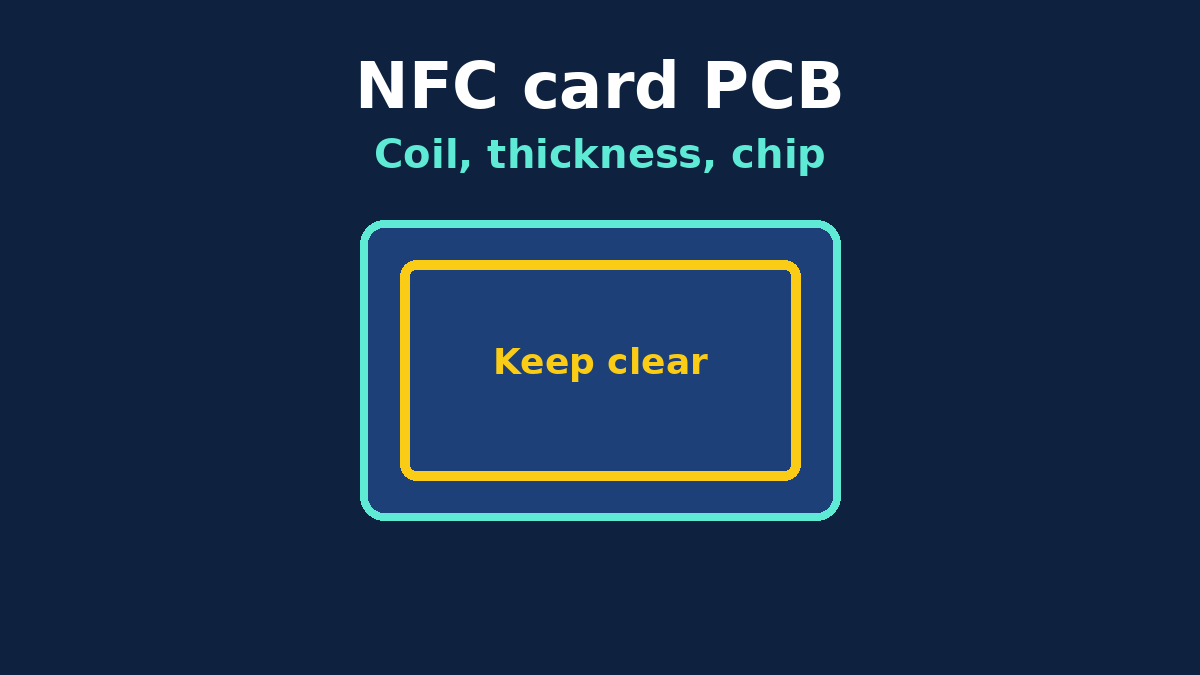
A PCB business card is a small two-layer board that people expect to behave like a plastic card and like a phone tag. Those are three different requirements, and the factory only builds the board you describe. The tap, the wallet fit and the printed name each fail for a different reason.
The coil is the product
Phones read these cards at 13.56 MHz, the carrier used by NFC Forum tags and by ISO/IEC 14443. The "antenna" is a loop of copper on the card. It is an inductor. Together with the tag chip's own capacitance, and sometimes a small extra capacitor, it is supposed to resonate near that carrier so the phone's field can power the chip and read it.
The chip vendor's antenna note is what sets the target inductance for that die. A loop copied from a different chip, or from a picture, is a loop for that other capacitance. Start from the note for the part you will actually place. Change turns, width or the gap between turns when a measurement says the peak is off. Do not add turns because the card "looks" like it needs more range.
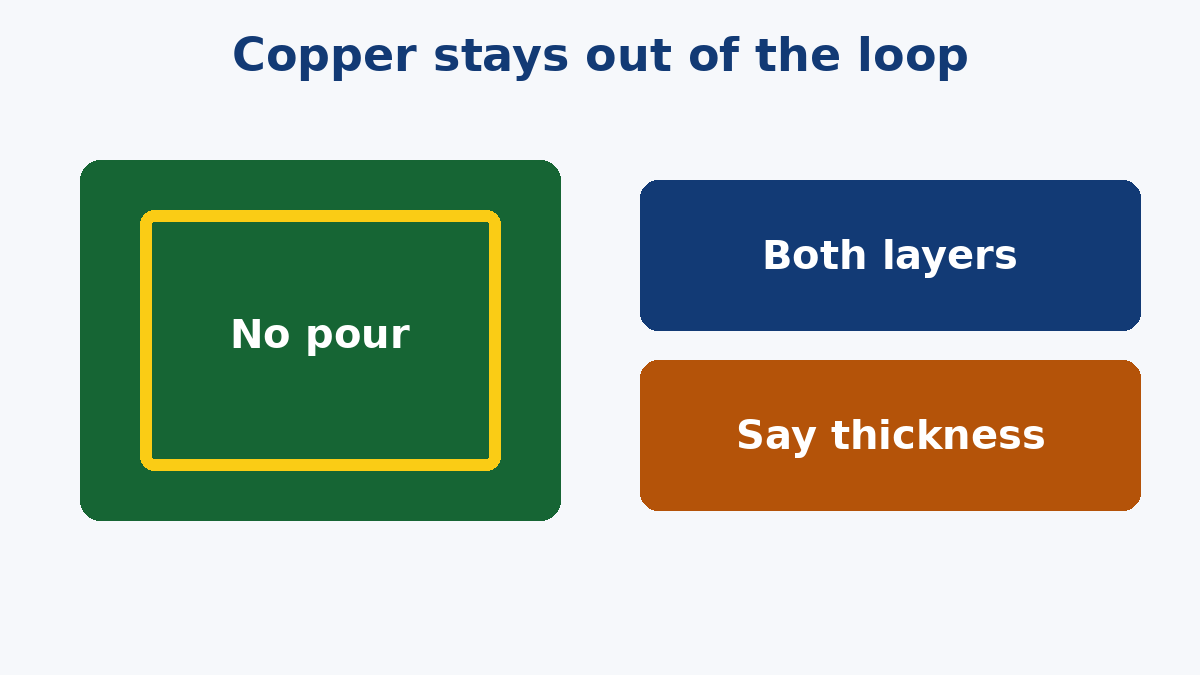
Copper near the loop steals the resonance. That includes a ground pour on the back of the coil, a hatched logo in copper under it, and a name rendered as a copper pour that crosses the loop. Keep a clear window, on both layers, where the coil sits. Silkscreen ink is not copper and does not do this. A gold-looking logo made of copper does.
The loop has to close. On one layer that means a jumper or a zero-ohm across the turns. On two layers a via takes the return under the coil. The via version is the one a board shop builds without a hand-soldered strap. Put the via, and do not tent it shut if you still need to probe the coil while tuning.
A microwave laminate is not what this frequency is asking for. 13.56 MHz on a loop is not a gigahertz trace. Ordinary FR-4 is the usual material. Spending the stackup on a low-loss RF grade does not fix a coil that is sitting on a pour.
Thickness is a wallet question, not a default
A plastic ID-1 card, the familiar bank-card outline, is about 85.6 mm by 54 mm and about 0.76 mm thick. A fabricated board can match the outline. It does not automatically match the thickness. A 1.6 mm PCB is a normal rigid board and a bulky card. Thinner FR-4, often 0.8 mm or 0.6 mm, sits closer to a wallet slot and is more flexible, which also means it bows in a panel and is less kind to a tiny package during assembly.
Say the thickness on purpose. If the card must pass a slot or a lanyard punch, say that too, and keep the coil and the chip off the hole. A routed outline gives a cleaner edge than a V-score, and a score must not cut through a turn of the coil. Mouse-bites leave nubs on a card people will handle. For a stack of cards, a routed profile with a small tab is usually the edge you want, called out rather than left as the panel default.
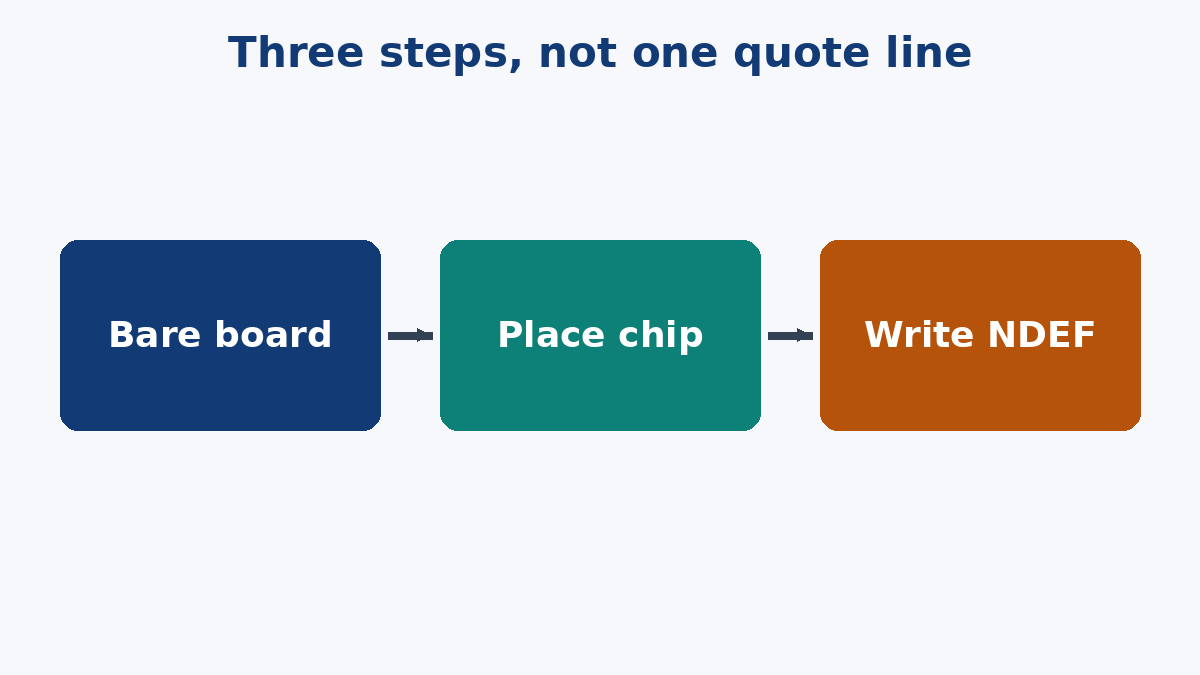
The chip is an assembly, and the data is a third step
The tag IC is a small surface-mount part, sometimes a chip-scale package. The bare board being "done" does not mean the card taps. The lands have to match that package, the finish has to be flat enough for it — a lumpy finish on a land the size of a grain is how the part stands up — and the stencil has to put a small, even deposit there. Our SMT PCB Assembly page is that work: stencil, placement and reflow, including fine-pitch parts, reviewed before the line runs. A business-card lot is still that process. It is not a silk-screen job with a chip stuck on afterwards.
Writing the link into the chip is not fabrication and it is not placement. NDEF, the record a phone opens, is programmed after the part is soldered, with a tool that speaks to that chip. If the quote does not say programming, you receive blank tags. Send the URL, the record type and who verifies a sample phone can open it. A QR code printed on the card is the fallback when a given phone will not tap, and it should be copper and mask, not legend alone. Legend wears and photographs poorly. A QR in the mask, high contrast, large enough to scan at arm's length, still works when the silk is gone.
Test the card the way it will be used: several phones, with and without a case, and not lying on a metal desk. The desk is a ground plane you did not draw. A card that reads on a wooden bench and dies in a pocket full of keys is telling you about metal near the coil, which is the same rule as the pour.
What the order should say
- Outline and finished thickness, and whether a wallet slot matters.
- Two layers, coil window with no copper on either side, via return rather than a hand strap.
- The tag IC by manufacturer part number, a flat finish, and assembly included or not.
- Programming included or not, and the record to write. Blank is the default if you say nothing.
- QR and the name in copper and mask if they have to last. Legend is extra, not the only copy.
- A routed edge that does not cut the coil.
The tap is a tuned loop and a programmed chip. The factory can build both, once the window, the thickness and the data step are actually on the order.