
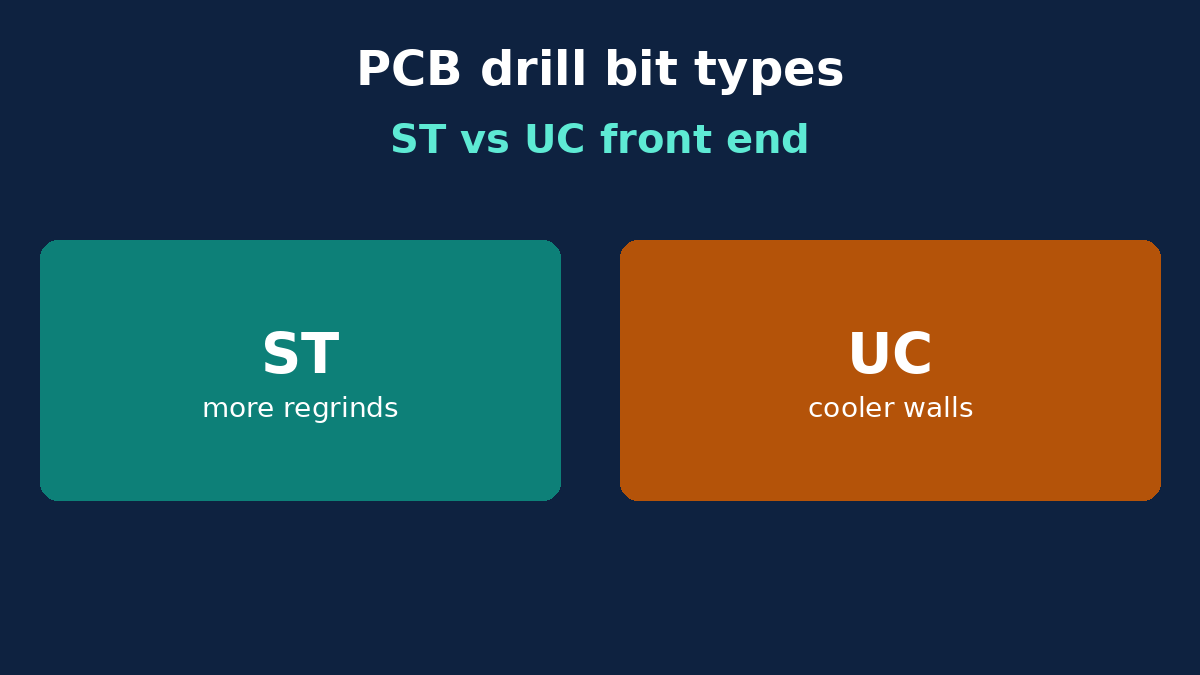
Mechanical drilling quality is not only “what diameter.” The bit’s front-end family and flute layout change heat into the hole wall, chip exit, and how many times the tool can be reground. Buyers rarely pick the SKU—but they do set the hole-wall and aspect-ratio ask that forces ST versus UC and similar choices.
This post is that buyer-facing type map for overseas engineers. Geometry parameters (web, helix, point) are the next article. Laser microvias are a different process entirely.
Shank and body classes (brief)
Shank diameter must match the spindle/collet class the fab runs (common industry shanks include 3.175 mm and 2.0 mm families—confirm with the plant). Standard-type bits keep drill diameter ≤ shank; ID-type bits can run a cutting diameter larger than the shank. Those are machine-fit facts, not quality slogans.
Flute and edge families
Conventional PCB bits use two edges and two flutes. Newer one-flute or one-edge layouts exist to chase position and wall finish under tougher specs. Treat them as process options the fab qualifies—not as a catalog you must name on every RFQ.
ST versus UC: the decision that shows up in walls
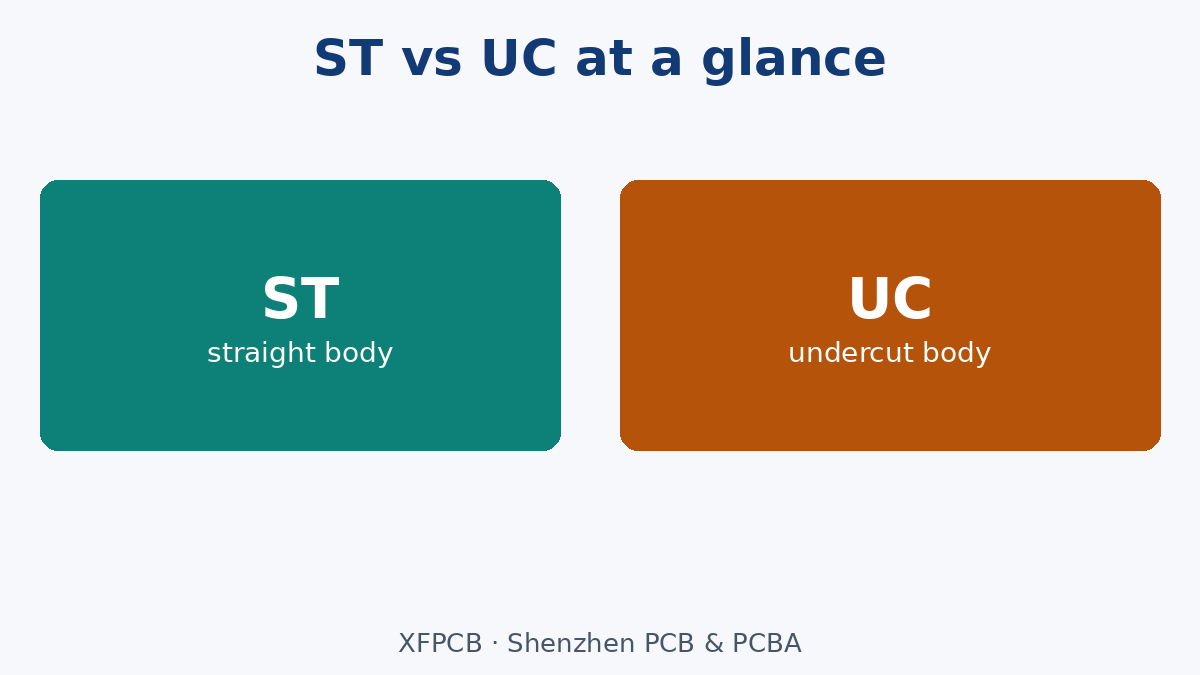
ST (straight) body: generatrix is straight. More contact with the hole wall, more cutting heat, usually more regrind life and simpler tool economics. Adequate for many standard PTH jobs when heat and smear stay in control.
UC (undercut) body: rear of the cutting section is reduced so less of the body rubs the wall. Less heat into the barrel, often cleaner walls—at the cost of fewer safe regrinds because the undercut head length must remain.
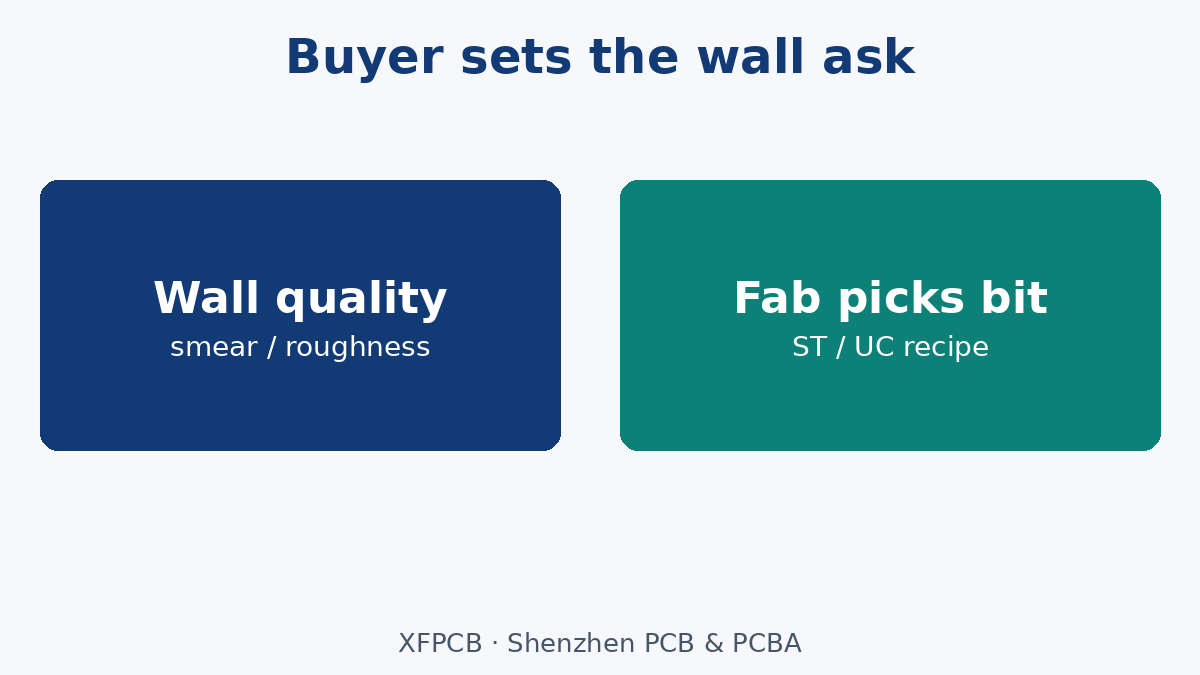
If Class or plating yield is limited by smear and roughness, ask whether the drilling recipe uses UC (or equivalent low-rub geometry) on the critical diameters. If the program is cost-driven commodity PTH, ST plus disciplined hit counts may be the rational default.
Regrind is a quality control, not free life
Bits are reground. Poor regrind leaves worn margin and hurts position and walls—or breaks the next hit. UC bits are limited by remaining undercut head length, not by a vanity “times reground” count. Buyers do not run the grinder; they can require that critical holes are drilled with tools inside the fab’s qualified life window.
What to put on the fab note
- Finished hole sizes and which are PTH vs NPTH.
- Aspect ratio / board thickness context.
- Any hole-wall or smear sensitivity (impedance barrels, filled vias, Class 3).
- Leave bit brand and ST/UC SKU to the fab unless you have a locked process.
Our PCB Fabrication Process page is the drilling seat in the traveler. HDI laser microvias are not this bit discussion.
What we are not claiming
No invented shank or UC-head millimetres as XFPCB law, no regrind SOP, no claim that UC always wins cost, and no flute-count mandate. Set the hole-wall and AR ask. Let ST vs UC fall out of the qualified drilling recipe.