
Flowcharts of PCBA—paste, place, reflow, insert, wave, AOI—are useful literacy. Overseas buyers lose money when the traveler is not gated: stations run without entry criteria, exit without evidence, and holds exist only as tribal knowledge. Skipping SPI “to save time,” programming before AOI clears structural escapes, or coating before FCT blocks pads are not process poetry problems—they are RFQ and audit problems.
This article treats PCBA as a gated traveler: each station has entry rules, exit evidence, and named hold/EQ points; which gates are optional by stage; which RFQ callouts put stations in scope; failure modes from skipped gates; and a buyer checklist to audit a CM traveler. What you are buying commercially lives in PCBA as a procurement object. When one throat beats a split lives in one-stop PCBA RFQ: when vs split. Firmware as a station lives in PCBA programming traveler RFQ. Which test methods belong at proto vs volume lives in the test-stack RFQ matrix. Paste print control detail lives in SMT stencil print: framed, step, SPI. Here the focus is gates, holds, and audit—not another SMT+DIP variant diagram.
A traveler is a sequence of gates, not a poster
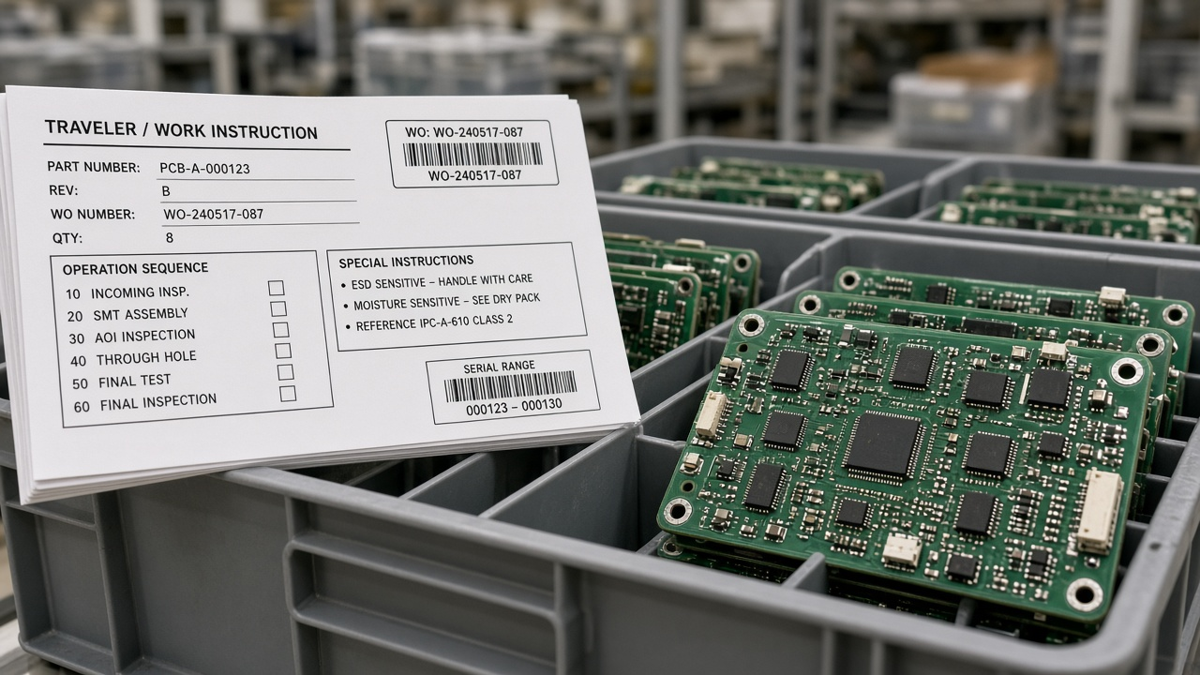
A real traveler answers, for every station you pay for:
- Entry — what must already be true (rev, bake, prior pass, fixture ID)?
- Work — what transforms the board?
- Exit evidence — what proves the station finished (SPI map, AOI result, checksum, FCT log)?
- Hold — when does WIP stop, who releases it, what is rework vs scrap?
If a CM shows a PowerPoint flow without those four columns, you have a brochure—not a controllable process.
Core gated skeleton (customize, do not invent magic)
Typical volume-capable skeleton (stations appear only if in RFQ scope):
| Gate | Entry (examples) | Exit evidence (examples) | Common hold triggers |
|---|---|---|---|
| Kit / kitting release | BOM rev + AVL freeze; MSL status | Kit checklist, shortage list | Wrong MPN, expired MSL |
| Bake / dry | MSL floor life exceeded or policy | Bake log | Oven recipe mismatch |
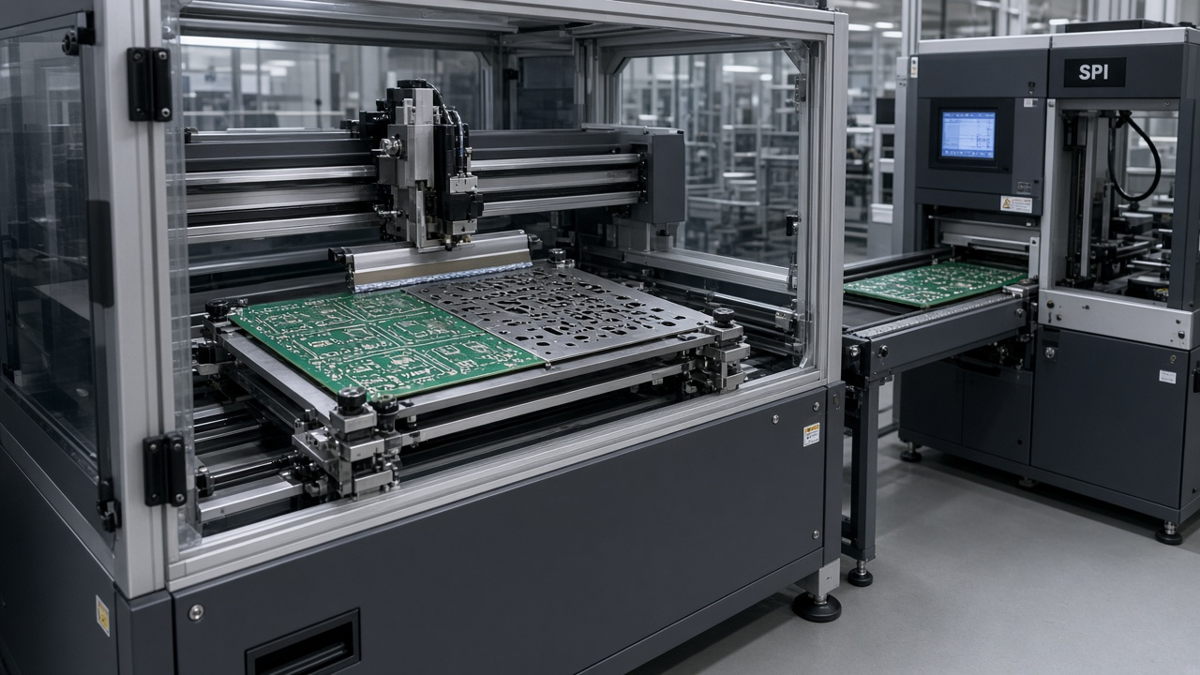
| Stencil print | Stencil ID matches copper rev | SPI volume/area as scoped | SPI out of control |
| Pick & place | Feeder setup vs BOM; program rev | Placement log / first-article check | Wrong polarity cluster |
| Reflow | Profile tied to paste + stack | Profile coupon / MES profile ID | Profile drift, tombstone spike |
| AOI | After cool-down rules | AOI pass/fail + repair loop | Systematic bridge/tombstone |
| X-ray (if scoped) | BTC/BGA risk named | Sample or 100% record | Void % / bridge under package |
| THT / selective / wave | SMT side complete as required | Solder visual / selective program | Fixture/wave defect spike |
| Clean / coat (if scoped) | Residues/access rules | Cleanliness or coat thickness note | Ionic fail, coat on pads |
| Program (if scoped) | Structural gates named; image hash | Verify/checksum log | Verify fail, lock mistakes |
| FCT / ICT / FP (if scoped) | Power-safe after structural | Step results + fail codes | False-fail vs real defect |
| FAI / FQC / pack | Lot release rules | FAI pack + labels | Label/rev mismatch |
Proto travelers may collapse several gates into bench steps—collapse is allowed when written. Silent collapse is how escapes ship.
EQ and hold points that belong on the map
Holds are not failures of culture; they are designed brakes.
Pre-production EQ hold. Gerber/BOM/centroid conflicts unresolved → no kit release. Buying paste time before EQ close is how you fund scrap.
First-article hold. After setup (stencil, feeders, profile, program algorithm), FAI must pass before the remaining lot. Skipping FAI to “make schedule” converts the whole lot into an experiment.
SPI hold. Out-of-control print → stop place. Running place on bad paste creates AOI theater and rework tax.
AOI/X-ray hold. Systematic defect → stop and fix process before programming or FCT burns technician hours on boards that never should leave SMT.
Programming hold. Image hash mismatch or fixture contact fail rate high → stop lock-bit steps; do not brick a lot.
Coat-before-access hold. If FCT/program pads must stay open, coat cannot run first—or pads need keep-outs. Traveler order is a design constraint.
Write who can release each hold (named role, not “engineering”). Overseas buyers should see hold language in the quality plan attached to the RFQ.
Optional by stage: proto vs ramp vs volume
Gates scale with stage policy—not with pride.
| Gate | Proto / EVT | Ramp | Volume / MP |
|---|---|---|---|
| SPI | Often sample or critical nets | Trend + control | In-control expectation |
| Dedicated ICT | Usually avoid | Soft decision | If pad map frozen + volume pays |
| X-ray | Sample on BTC risk | Prove process | Sample or 100% per risk model |
| Program | Bench / on-board, hash gated | Nest emerging | Nest or offline per freeze |
| FCT | Thin smoke | Script hardening | Named limits + logs |
| Coat | Often after bring-up | Access vs protect trade | Frozen order |
| FAI | Every spin | Every process change | Per setup rules |
RFQ must name the stage. A volume traveler priced onto an EVT board is wasted NRE; an EVT traveler frozen into MP is wasted risk.
RFQ callouts that put stations in scope
Do not rely on “standard PCBA flow.” Freeze:
- Station list — which gates exist for this PO.
- Sample vs 100% per inspection/test gate.
- SPI requirement — none / sample / control limits.
- X-ray — package list and AQL or 100%.
- Programming — slot, hash, verify, max reflash.
- FCT/ICT/FP — procedure rev or “not in scope.”
- Coat/clean — chemistry class and order relative to program/FCT.
- Hold/FAI rules — first-piece quantity and lot-hold.
- Fail-code taxonomy — at least AOI / program / FCT separated.
- Evidence retention — what ships with the lot.
If a bidder cannot echo this list, their flowchart is decorative.

Failure modes from skipping gates
SPI skipped. Paste volume wrong → tombstones/bridges discovered late at AOI or field. Cost moves from seconds of SPI to hours of rework.
AOI skipped or rubber-stamped. Polarity and missing parts escape into programming/FCT as “mystery fails.”
Programming before structural clear. Technicians reflash boards with tombstoned crystals; yield charts blame firmware.
FCT before program (when image required). False functional fails or testing the bootloader only.
Coat before FCT/program without keep-outs. Pads insulated; fixture cannot contact; emergency scrape damages boards.
Wave/selective before SMT complete on mixed tech. Wrong thermal history or missing SMDs that should anchor first.
No FAI hold. Feeder setup error replicates across the lot.
No EQ hold on rev skew. Copper Rev B with stencil Rev A.
Each skip should appear on your audit as a named risk, not a surprise.
Buyer checklist: audit a CM traveler
On an NPI visit or document review, ask to see a real traveler PDF/MES screen for a similar class board—not a marketing flow.
Check:
- [ ] Station order matches your RFQ scope (not a generic poster).
- [ ] Entry criteria mention rev IDs (copper, BOM, stencil, FW hash).
- [ ] Exit evidence fields exist (SPI, AOI, program checksum, FCT).
- [ ] Hold points and release roles are written.
- [ ] Fail codes distinguish process vs program vs functional.
- [ ] Proto vs MP variants are separate documents—or clearly parameterized.
- [ ] Coat/program/FCT order matches pad access design.
- [ ] FAI pack contents listed and match what you will receive overseas.
- [ ] Subcontracted stations (if any) still show on the traveler with ownership.
- [ ] Evidence retention period stated.
If the CM cannot show exit evidence columns, assume you are buying hope.
Mixed-technology order without flowchart religion
SMT-then-THT is common; double-sided SMT needs side-order and adhesive/fixture decisions; selective solder replaces wave for dense boards. The gated question is not which poster you prefer—it is whether entry/exit/hold are defined for the path you actually run. Red-glue-plus-wave paths that need extra heat cycles deserve an explicit RFQ note because yield and cost change. Manual solder for sparse THT can be a valid gate with visual exit criteria—write it.
Dual-sided and selective paths: gate the thermal budget
Double-sided SMT is not “run the flowchart twice.” It is a thermal and adhesive policy with gates:
- Bottom-side adhesive or low-melt strategy named when parts must survive a second reflow.
- Tall/heavy parts restricted to the second pass when gravity and wetting risk say so.
- AOI (and X-ray if scoped) after each critical thermal exposure—not only at the end.
- Selective solder after SMT with fixture entry criteria (keep-outs, tape, pallet ID).
If the traveler only says “double-sided SMT” without pass order and inspection-after-pass, you cannot audit whether the second reflow was a planned gate or an improvisation.
MES vs paper: what overseas auditors can actually use
Paper travelers can work for low volume if stamps and fail codes are real. MES travelers help when you need searchable checksum and AOI histories. Either way, demand exportable evidence for the gates you bought. A MES that cannot produce a lot report with station results is not more mature than a stamped paper form—it is only harder to review from another country. Specify the report fields in the RFQ so IT arguments do not appear after award.
Rework loops as gated mini-travelers
Rework is where ungated shops invent process. Require:
- Defect code → allowed rework method (and max cycles on BGAs/MSDs).
- Re-inspection gate after rework (AOI/X-ray/FCT as applicable)—not “back to pack.”
- Serial retention so a board that failed program twice is visible in evidence.
Ungated rework turns your MP traveler into a prototype bench without telling procurement.
Linking gates to commercial ownership
Gates only work if someone owns them. Under one-stop or full turnkey, one throat should own the hold releases across fab-linked and SMT-linked steps. Under split fab+CM, write the interface holds: who stops when fab coupons fail after SMT start; who owns stencil when copper ECOs. Procurement-object language and one-stop vs split freezes decide the owner; this article decides whether the owner’s traveler is auditable.
Evidence package that proves the flow ran
For overseas receiving, demand:
- Traveler ID / MES lot ID.
- Station pass summary with timestamps for scoped gates.
- Program verify extract if in scope.
- FCT/ICT summary if in scope.
- FAI reference for the setup used.
- Deviation list for skipped gates (buyer-approved).
A packing list that says “assembled and tested” without station evidence is not proof the gated flow ran.
Cost of gates vs cost of escapes
SPI, AOI, X-ray sample, and FAI look like taxes on a flowchart. Escapes look like air freight, field returns, and weeks of “which rev was programmed.” Price gates as risk controls tied to stage, not as optional decoration. If you remove a gate to hit a unit-price target, write the accepted escape risk on the PO so AP and quality share the same story.
Freeze checklist before you approve a CM flow
- Station list matches RFQ scope.
- Entry/exit/hold columns exist for each paid station.
- Stage (proto/ramp/MP) named.
- SPI / X-ray / program / FCT in or out with sample rules.
- Order constraints (coat vs program/FCT) written.
- Fail codes separated.
- FAI hold defined.
- Evidence fields and retention defined.
- Subcontract visibility if any station is external.
- Audit artifact (sample traveler) reviewed before award when risk is high.
When in doubt, pay for one documented hold release on the first production lot rather than discovering an undocumented skip after air freight. Gates are cheaper than mystery yield.
What to decide on the next assembly RFQ
Do not start from “show me your process flow picture.” Start from gates:
- Freeze the station list and stage, then demand entry/exit/hold language.
- Put SPI, program, FCT, coat order in the RFQ so skips cannot be silent.
- Audit a real traveler before volume release—especially when programming or coat is in scope.
Flowcharts explain vocabulary. A gated traveler freeze—entry criteria, exit evidence, holds, stage options, skip failure modes, and buyer audit checks—decides whether the CM’s line can prove it built what you think you bought. When layout access, firmware, or volume stage changes, reopen the gate map; do not inherit last product’s “standard flow” onto a coated, serialized board that needed program-before-coat and SPI control.