
“One-stop PCBA” marketing lists fewer suppliers, lower inventory, and happier schedules. Overseas buyers already know those slogans. What actually decides money and risk is when one-stop is the rational RFQ versus a deliberate split (fab house + separate CM, or fab + brokered kit + assembler), what must be frozen in the one-stop package before anyone prices labor, and how to spot fake one-stop—a single invoice hiding dual EQ loops, unowned yield, or a broker in the middle.
This article is a buyer gate for one-stop vs split, not a service brochure. Kit ownership language (full turnkey vs consignment vs partial) lives in full turnkey vs consignment PCB assembly. What may sit inside a turnkey traveler lives in turnkey PCBA scope in and out. BOM lines that survive China quotes live in manufacturable BOM for China PCBA quotes. Programming as a named traveler step lives in PCBA programming traveler RFQ. First-piece setup release lives in PCBA first article inspection (FAI). Here the focus is decision, freeze package, fake-one-stop failure modes, proto→volume under one PO structure, and evidence.
One-stop is an ownership structure, not a slogan
In factory language, a real one-stop (or full turnkey under one commercial throat) means one named party owns:
- Bare-board fabrication to a frozen fab note package (or a named fab under that party’s PO).
- Material procurement and/or controlled consignment receiving against an AVL.
- Stencil, SMT/THT, and the inspection/test steps written on the traveler.
- The single EQ/ECO ledger that ties copper rev, BOM rev, stencil rev, and firmware image identity together.
- Outbound pack and the evidence package you accept at receiving.
If any of those five sit with a different legal entity without a written interface, you do not have one-stop—you have a chain with a marketing label.
Split can still be correct. The question is whether the interfaces are cheaper than the coordination tax.
When one-stop is the rational RFQ
Choose one-stop (or insist on one commercial throat even if they subcontract fab) when two or more of these are true:
| Signal | Why one-stop wins |
|---|---|
| NPI / ECO rate is high | One inbox for Gerber+BOM+stencil+FW; fewer “which kit matches which copper” escapes |
| BOM has allocation risk or many alternates | One buyer owns AVL discipline and shortage recovery under your rules |
| You lack a local materials planner | Inventory, MSL, and date-code policy move to the plant under contract language |
| Test/programming must match fab rev | Same traveler owns DFT access, flash hash, and FAI—less finger-pointing |
| Logistics of kits across borders is painful | One ship-to and one customs story beat three partial shipments |
| You need comparable China quotes fast | One RFQ package; split RFQs invite mismatched assumptions |
Do not choose one-stop only because a slide said “simplify procurement.” If your MCU is ITAR-sensitive, your AVL is locked to a corporate contract house, or you already run a world-class kit line, split or consignment may be cheaper and safer—write the interfaces explicitly instead of pretending one-stop.
When split fab + CM (or kit + CM) is rational
Split deliberately when:
- Fab process class is the bottleneck (HDI, RF laminate, heavy copper) and you want a specialist fab under your direct PO, while a separate CM runs SMT.
- You must own the kit for counterfeit control, bonded inventory, or customer-furnished material rules.
- Volume is stable and ECO rate is near zero—coordination tax is low and dual-sourcing fab vs CM can be a price lever.
- Regulatory or contract barriers prevent one vendor from buying certain lines.
Split failure mode: treating “we email both” as a process. Freeze who owns ECO distribution, who freezes stencil after a pad change, and who holds yield when a fab defect shows up after SMT.
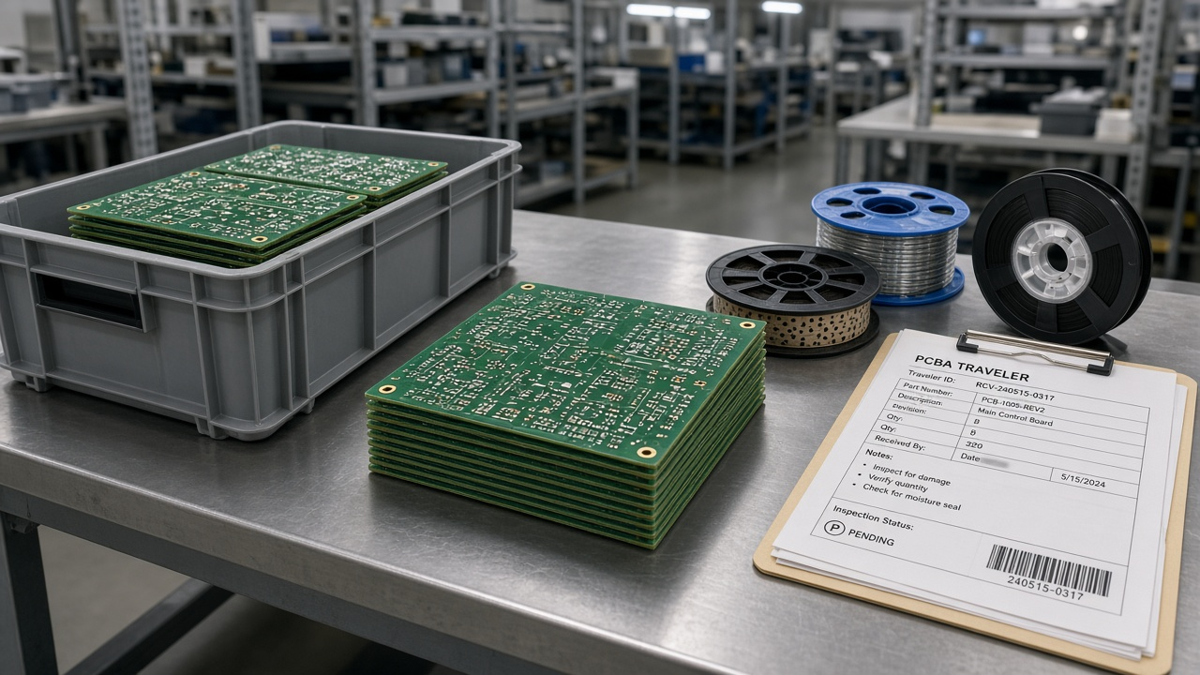
What must be frozen in a one-stop RFQ package
A one-stop quote without a freeze package is a guess. Attach and revision-lock:
- Gerber / ODB++ + fab notes — stack, finish, impedance, via architecture, acceptance (IPC class), panelization intent.
- BOM + AVL — manufacturer + MPN, approved alternates, DNP lines, lifecycle notes; mark “factory may suggest / may not substitute” per line class.
- Centroid / pick-and-place + assembly drawing — polarity, pin 1, keep-outs, press-fit, selective solder callouts.
- Stencil intent — thickness class, step map if any, or “plant designs stencil under these rules.”
- Test stack — AOI/X-ray/flying-probe/ICT/FCT named by stage; sample vs 100%.
- Programming — traveler slot, image hash, verify, UID/OTP if any (see programming freeze).
- Coat / mark / pack — if in scope; otherwise explicit exclusion.
- FAI / evidence — what ships with first piece and with production lots.
- ECO rule — how mid-PO changes are priced and which WIP is scrap vs rework.
If any of items 1–6 are “TBD in chat,” you are not ready for a comparable one-stop RFQ—you are ready for an engineering discussion that should not be scored as a firm unit price.
Fake one-stop: failure modes overseas buyers actually hit
Hidden broker. The “factory” invoices turnkey but buys assembly from a third shop and fab from a fourth, with no process ownership. Symptoms: EQ answers contradict traveler capability; finish or via class changes without CAM questions; yield stories blame “the other site” you never contracted.
Dual EQ loops. You still get separate fab EQ and SMT EQ with different rev letters. Symptoms: stencil lags copper by one spin; BOM alternates accepted on SMT side never reach fab note; FAI packs disagree.
Unowned yield. Defects after SMT are “fab,” defects after test are “design,” and nobody owns the traveler metric. Symptoms: no per-step fail codes; reflash loops without fixture PM; NCRs close with “operator training” forever.
Silent substitution. One-stop buy authority used to swap MPNs without AVL change control. Symptoms: date codes or markings differ from AVL; firmware fails on “same” MCU family; field returns cluster on one lot.
Scope bait. Quote includes “test and programming” with no hash, no fixture class, no sample plan. Symptoms: receiving boards that power but run wrong image; no station logs.
Mitigations on the PO:
- Name fab site and assembly site (even if same company group).
- Require one revision ledger ID on EQ responses.
- Require substitution only via written AVL ECO.
- Require fail-code taxonomy for program/FCT/AOI as applicable.
- Reserve audit rights or a pilot lot FAI before volume release.
Stage gates under one PO structure (proto → volume)
One-stop does not mean one traveler forever. Freeze how the same commercial throat changes policy by stage:
| Stage | One-stop posture | What to reopen |
|---|---|---|
| Proto / EVT | Fast EQ; flying-probe or thin electrical; bench program/FCT; expect ECO | Pad map, BOM churn, firmware hash |
| Ramp / DVT–PVT | Prove MP stack on real process; soft fixtures; measure false-fail | Fixture NRE go/no-go; AVL harden; coat access |
| Volume / MP | Frozen rev; dedicated fixtures where payback is real; evidence retention | Only ECO-driven changes; dual-source rules if any |
Write stage language into the PO (“EVT lot under one-stop scope A; MP under scope B”) so purchasing does not force a volume fixture price onto a board that will respin twice.

EQ as a single throat — what good looks like
Under real one-stop, engineering questions should return as one consolidated EQ package:
- Fab CAM questions and SMT DFM questions in one document or one ticket thread with one rev.
- Alternates proposed with both purchasability and layout impact.
- Stencil and panel notes updated when copper changes—same release.
- Firmware/programming impacts called out when boot straps or debug access move.
If you are still maintaining two spreadsheets—one for the fab FAE and one for the SMT FAE—with no owner merging them, you are living a split even if AP sees one vendor code.
Evidence and FAI under one-stop
Overseas receiving cannot “walk the line.” Demand evidence that matches the freeze:
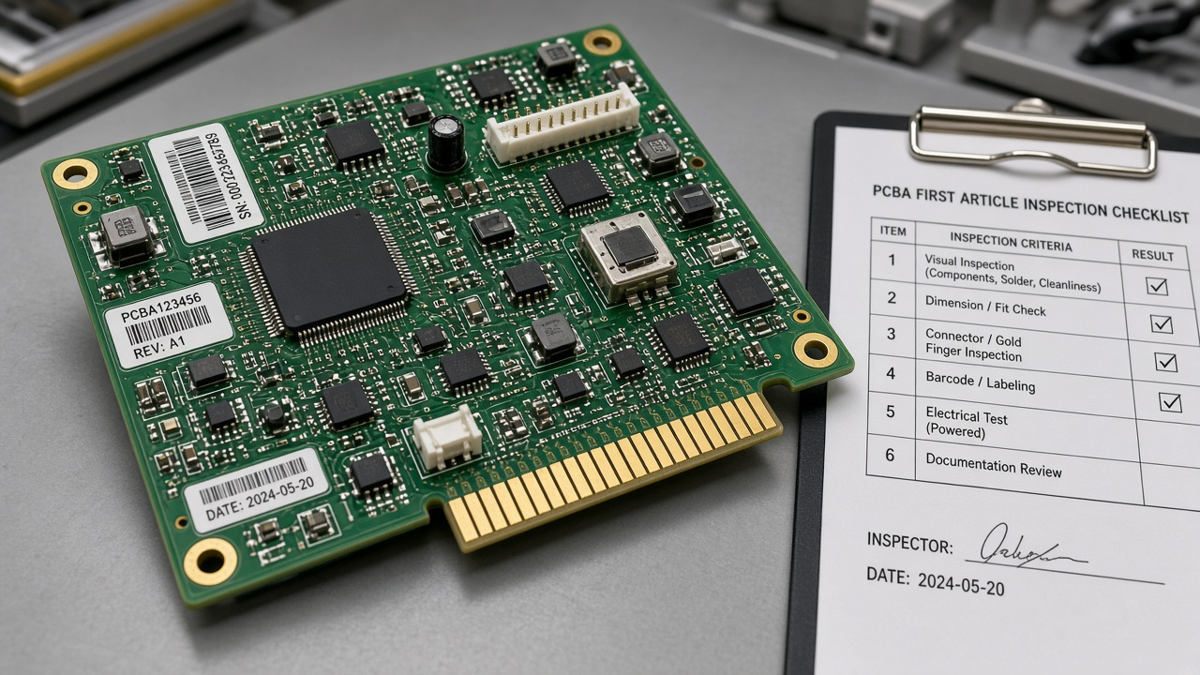
- FAI pack — first-piece proves fab coupon/stack as applicable, stencil setup, placement programs, reflow profile reference, programming setup (image hash), and named test steps.
- Lot evidence — traveler ID, PCB fab lot or date code linkage, key AVL lot traces for critical lines, AOI/FCT/program summaries as scoped.
- Deviation log — every AVL substitute and every test skip with buyer sign-off reference.
- Fail disposition — quarantine rules, rework vs scrap, max reflash if programming is in scope.
One-stop without FAI is a promise. One-stop with FAI and lot evidence is a controllable process. Attach the FAI expectation to the RFQ so bidders price the same paperwork depth.
Cost comparison that is honest
Paper unit price favors whoever omitted scope. Compare at least:
- Material liability (who eats allocation and MOQ).
- ECO administrative hours (your team vs plant).
- Fixture NRE timing (proto vs MP).
- Freight and kit prep (split often hides three shipments).
- Scrap ownership when fab defect is found after SMT.
- Evidence retention (audit cost later).
A slightly higher one-stop number that includes AVL buying, consolidated EQ, programming verify, and FAI can beat a cheap split that assumes your planner works weekends.
Logistics and customs: the hidden split tax
Overseas programs often undercount how many shipments and documents a split creates. Bare boards from fab A, kits from a 3PL, and finished PCBA from CM B means three packing lists, three chance-of-delay events, and three places a revision label can be wrong. One-stop collapses to one commercial shipper and one inbound ASN story—valuable when your receiving team is small.
Still write Incoterms, HS assumptions, and who files what on the RFQ. One-stop does not magically erase export compliance; it only reduces the number of parties who can drop a document. If your product needs country-of-origin statements tied to fab site, name the fab site even under one-stop so origin claims stay honest.
How to score competing “one-stop” quotes
Use a scorecard, not a single unit price:
| Score line | What “good” looks like | Red flag |
|---|---|---|
| Scope echo | Quote restates fab + SMT + test + program + FAI as you wrote them | “Turnkey PCBA” one liner |
| Sites | Fab and assembly sites named | “Our factory” only |
| AVL policy | Substitution classes match your freeze | “We will optimize BOM” |
| Test/program | Methods, sample, hashes named | “100% test included” |
| ECO | NRE/WIP rules stated | Silent on mid-PO change |
| Evidence | FAI + lot log fields listed | COC only |
| Lead-time basis | Tied to kit readiness + ECO freeze | Calendar promise with open AVL |
Reject the cheapest line that omitted programming verify or FAI paperwork. Ask the mid bidder to add missing evidence rather than accepting the low bidder’s silent exclusions.
Receiving gates for overseas buyers
When boards arrive, check against the freeze—not against hope:
- Copper and assembly revs on labels match the PO package.
- Critical MPN markings sample-check against AVL (especially after “one-stop buy”).
- If programming was in scope, spot-check image identity or request station log extract for the lot.
- Cosmetic/FQC criteria match what you paid for; do not invent new cosmetic rules at the dock without an NCR path.
- Open NCRs against fail codes and ownership, not against “vendor quality” as a mood.
A clean one-stop relationship still needs a receiving script. Without it, fake one-stop problems surface months later in the field.
Freeze checklist before you issue the one-stop RFQ
- Decision named: one-stop vs split (and why).
- Sites named: fab + assembly (even if affiliated).
- Kit model named: full / partial / consignment lines.
- File package complete: Gerber, BOM/AVL, centroid, assembly drawing.
- Test + programming scopes written with hashes/sample plans.
- Exclusions listed (system test, enclosure, burn-in, etc.).
- ECO and substitution rules written.
- FAI + lot evidence written.
- Stage (proto vs MP) and fixture class expectations written.
- Single EQ throat required in the quote response format.
What to decide on the next China PCBA buy
Do not start from “we want one-stop because it is modern.” Start from ownership:
- If ECO rate, AVL risk, and cross-border kit pain dominate, freeze one-stop under one revision ledger and price the freeze package—not a vague turnkey line.
- If fab specialty or corporate kit control dominates, freeze a split with written interfaces (ECO distribution, stencil ownership, yield ownership)—not an accidental dual EQ.
- If a bidder cannot name sites, fail codes, and FAI contents, treat “one-stop” as marketing until the package matches this freeze.
Service brochures list advantages. A one-stop vs split RFQ freeze—decision gates, file package, fake-one-stop checks, stage policy, and evidence—decides whether the single PO you signed actually owns the board you think you bought. When ECO rate, AVL policy, or fab process class changes, reopen the freeze; do not inherit last product’s one-stop habit onto a regulated kit you must consign.