
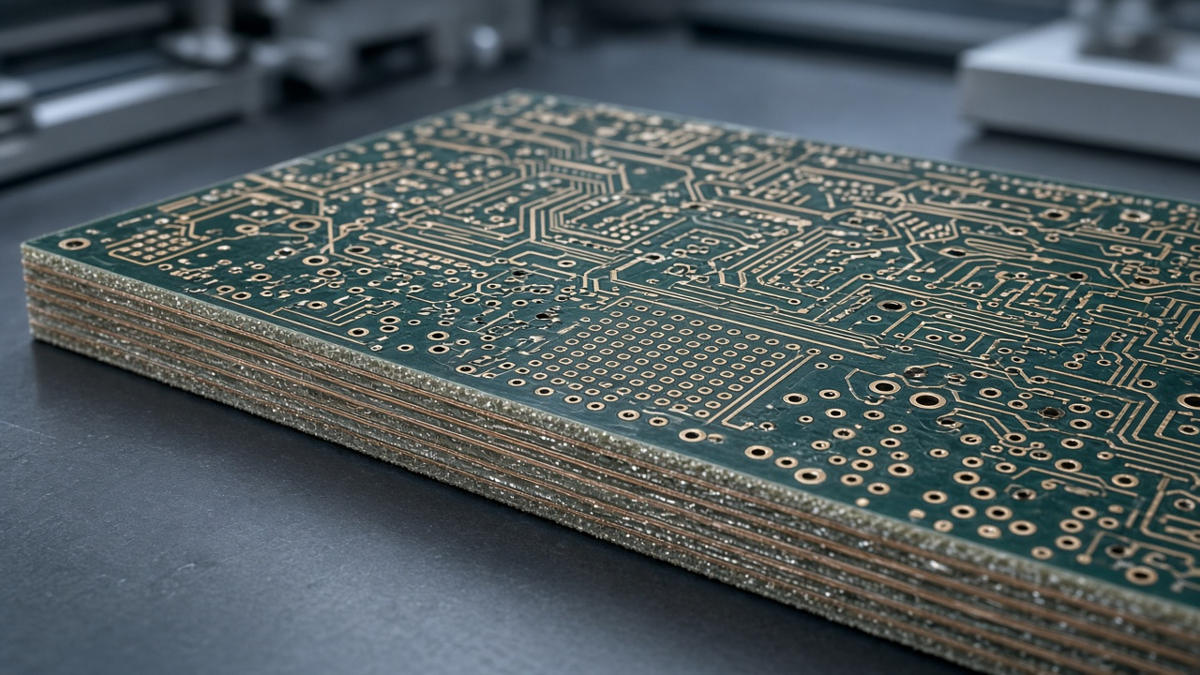
Buyers rarely lose money because they forgot that Df rises with frequency. They lose money when a mid-loss epoxy board was always going to miss the humidity or loss budget—or when a PTFE upgrade was ordered as if it were still an FR-4 traveler, and the fab process, bondply, and sheet economics quietly blew the schedule. Datasheet Dk/Df rows are inputs. The decision that belongs on the RFQ is whether you stay on a mid-loss epoxy family, upgrade a class, or hybridize—and what fabrication changes that choice forces.
This article is that upgrade gate. Family buckets (FR-4 vs flex vs metal-core vs ceramic) live in the existing PCB substrate selection guide. Same-method datasheet comparison lives in comparing laminate datasheets by test method. Program freeze after you pick a family lives in single-laminate-family RFQ freeze. Hybrid stacks when only some layers need the upgrade live in hybrid multi-material stack decisions. Here the question is narrower: what risk triggers force you off mid-loss epoxy, and what process and quote traps arrive with PTFE-class or cyanate-class moves?
Stop optimizing Dk. Start naming the risk that fails first
Three risk axes decide almost every “should we upgrade laminate?” argument we see on overseas RFQs. They are not the same axis, and mixing them produces the wrong material.
| Risk axis | What actually breaks | Mid-loss epoxy often OK when… | Upgrade pressure when… |
|---|---|---|---|
| Electrical length × frequency | Attenuation / eye / link budget on long or hot paths | Short RF/digital runs; margin left after connectors and antennas | Long channels, dense backplanes, mmWave paths, tight loss budgets |
| Resonant / wavelength structures | Frequency shift lot-to-lot from Dk drift | Tunable matching; module antennas off-board; tolerant structures | Printed filters, patches, couplers that must hold tune across lots |
| Humidity / moisture + process heat | Dk/Df shift, CAF risk, delam, warp after bake/reflow | Dry use, short storage, mild reflow count | Biased fine pitch in humidity, long damp storage, many lead-free cycles |
A board can sit at a “high” frequency and still live on mid-loss epoxy if the path is short and the antenna is a module. The same board at a “moderate” frequency can need an upgrade if a long stripline or a printed filter owns the link. Frequency alone is a poor gate. Path length, structure type, and environment are better ones.
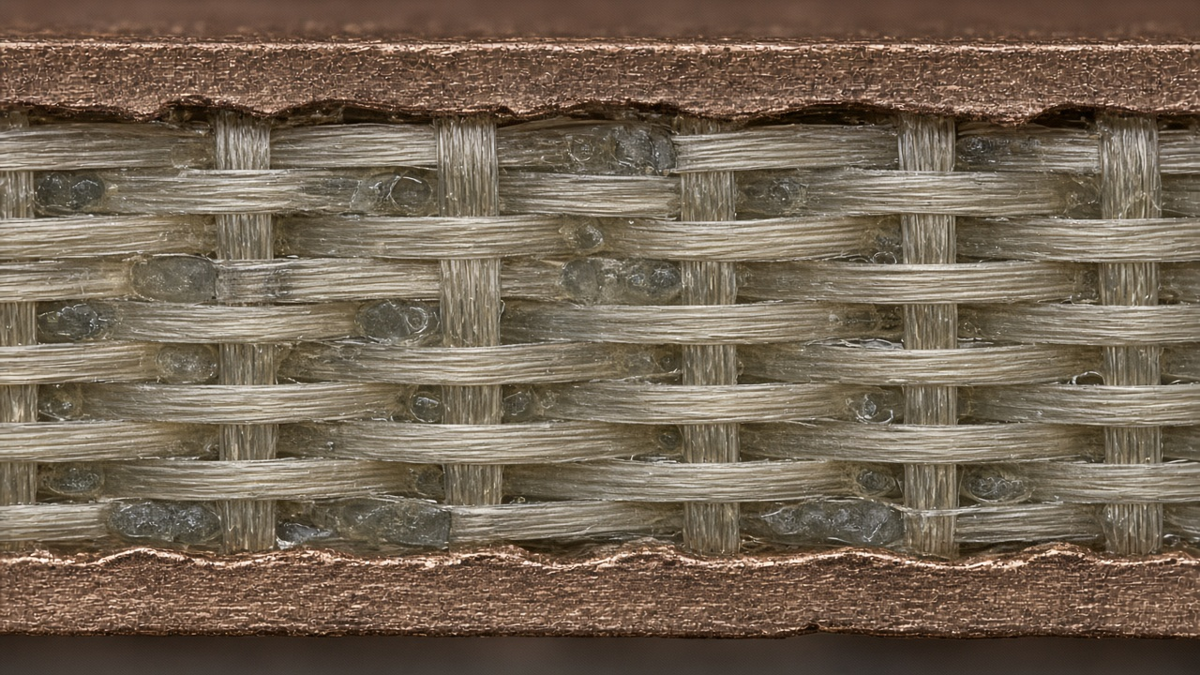
For SI loss-budget thinking (when Df is the gate, not marketing), see the dielectric SI material gate on the site. This post stays on upgrade triggers and fab deltas, not another attenuation tutorial.
What “mid-loss epoxy” means on a traveler (and what it does not)
In buyer language, mid-loss epoxy usually means a glass-reinforced epoxy or epoxy-blend family that is still processed much like conventional FR-4: familiar drill, desmear, and lamination habits, wide core/prepreg thickness menus, and stock availability that keeps quick-turn realistic. Electrically it is better than commodity high-Df FR-4 and worse than dedicated hydrocarbon-ceramic or PTFE microwave systems. Thermally it may be high-Tg lead-free capable—or not—depending on the grade you actually freeze.
What mid-loss epoxy is not:
- A promise of PTFE-class moisture immunity.
- A promise of PTFE-class Dk tolerance for resonant structures.
- A free pass to write “FR-4” on the PO and expect the same resin every lot.
If you stay in this class, still freeze identity (slash sheet / named grade / approved alternates), Tg class, foil type on critical layers, and the Dk you used in the model—at a stated frequency and test-method awareness. Leaving those blank is how Plant A and Plant B “both quote mid-loss” and ship different boards.
Trigger 1 — Humidity and moisture: when epoxy’s Dk/Df drift is the real problem
Resin systems absorb moisture at different rates. Absorbed moisture raises both Dk and Df. In the field that shows up as impedance drift, extra loss, and—when bias and fine spacing meet damp storage—CAF risk that no amount of “lower Df on the datasheet” fixes by itself.
Upgrade pressure rises when several of these are true together:
- The product sees damp warehouses, outdoor-adjacent enclosures, or long idle time before power-up bake is impractical.
- Fine conductors and spacing sit under sustained bias in that environment.
- The stack was modeled dry, and there is no moisture-conditioning plan for FA coupons.
- You are already near the edge of the impedance or loss budget with no margin for Dk/Df rise.
Cyanate-ester-class and many PTFE-class systems are chosen in part because moisture uptake and dielectric shift are more controlled than commodity epoxy—not because their headline Df looks prettier in a slide. That does not mean every humid product must leave epoxy. It means humidity is a named risk on the RFQ: storage class, bake-before-assembly expectation, CAF notes when spacing is tight, and whether the laminate family is required to be low-moisture by policy.
Do not invent a universal moisture-absorption percentage in the blog and treat it as a capability claim. Ask the material owner and the fab what conditioning and cert language they will run for your spacing and bias.
Practical buyer moves before jumping to PTFE:
- Confirm whether the failure you fear is dielectric drift, CAF, or mechanical (warp/delam)—they point to different fixes.
- Tighten epoxy identity and Tg/CAF notes if you stay in family.
- Only then escalate resin class for moisture, and freeze the new family the same way you would freeze mid-loss.
Trigger 2 — Electrical length and loss budget: when mid-loss still closes the eye
Loss is path length times loss per length, plus connectors, vias, and roughness. Mid-loss epoxy often closes the budget when:
- SerDes or RF runs are short relative to the loss allowance.
- Copper roughness and via count dominate over dielectric loss.
- You can shorten routes, improve stack reference, or cut via stubs cheaper than changing resin.
Upgrade pressure when:
- Channels are long (backplane, chassis, antenna feed networks).
- Frequency and length together eat the margin even after geometry cleanup.
- Multiple reflows and moisture make Df worse than the dry datasheet row you simulated.
Here the mistake is upgrading the whole board to PTFE because one long net is hungry. Often the honest answers are: shorten the net, change stack, or move only the hungry layers to a low-loss core (hybrid multi-material). All-PTFE is for when the board is the RF structure, not when one interface is.
Trigger 3 — Resonant structures and Dk tolerance: when “average Dk” is not enough
Impedance of a short 50 Ω line can absorb small Dk error with trace-width tweak or matching parts. Printed antennas, filters, and couplers cannot. They care about Dk stability and lot tolerance, not only the headline number.
Upgrade pressure when:
- Frequency-defining geometry lives in the laminate, not in a chip or module.
- Lot-to-lot tune shifts already showed up on epoxy FA builds.
- The design used a datasheet Dk from a test method/frequency that does not match how you model—or how the fab will coupon.
Before you escalate resin, fix the comparison hygiene: same test method family and frequency awareness when you compare two grades (datasheet method comparison). Then ask whether a tighter epoxy/hydrocarbon grade with declared design Dk is enough, or whether PTFE-class tolerance is required. Many wireless boards never need PTFE; some need one controlled RF layer. That product-level fork is covered in wireless FR-4 vs low-loss decision content on the site—use it when the product is sub-6 wireless; use this post when the question is the upgrade trigger and process cost of leaving mid-loss.
Trigger 4 — Process heat and construction: when the fab cannot treat it like FR-4 anymore
The quietest upgrade trigger is process, not SI. You can pick a resin that meets Df and still fail because:
- Available core thicknesses do not match the stack you drew for epoxy menus.
- Hole wall preparation for PTFE-class materials needs plasma or special desmear the mid-loss line does not run the same way.
- Bondply / prepreg compatibility in a hybrid is undefined on the drawing.
- Registration and Z-expansion differ enough that the HDI or fine-pitch drill map from an epoxy design no longer holds.
If the fab’s high-frequency PCB process book lists different drill, lamination, and hole-prep flows for the family you want, you have left “epoxy traveler with a better Df.” Budget EQ time for process, not only material unit price.
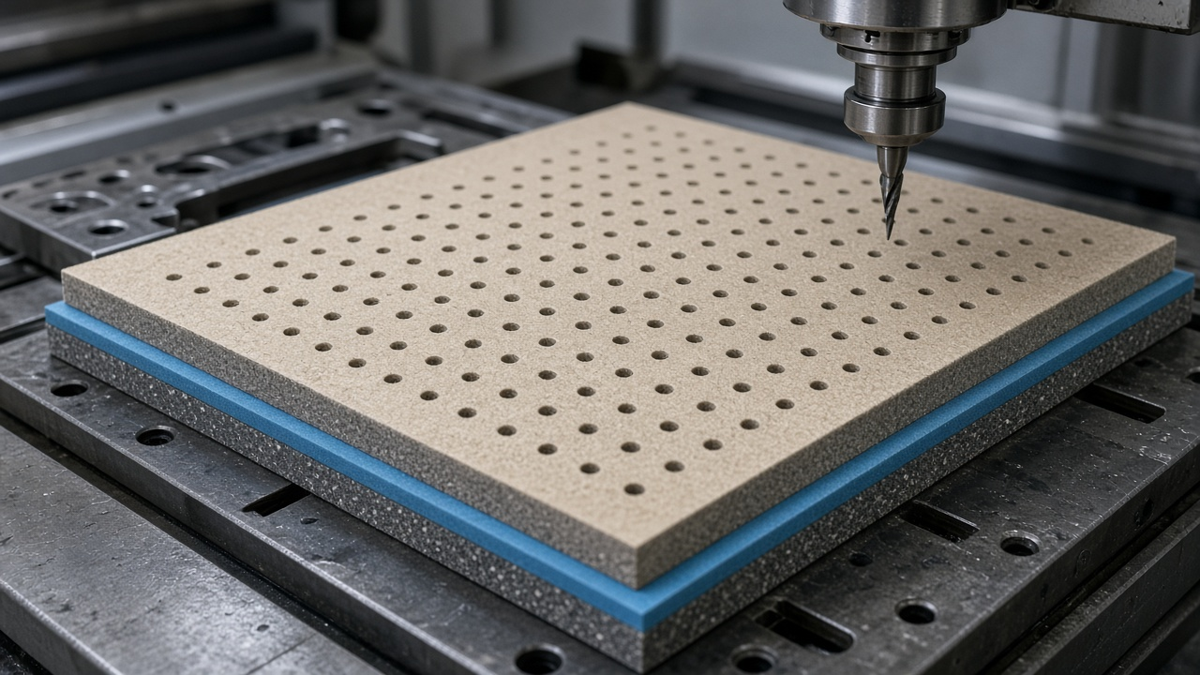
Fab process deltas you must expect when you leave mid-loss epoxy
Treat the table as a planning checklist, not a universal recipe. Confirm each row with the plant that will build your stack.
| Process area | Mid-loss epoxy (typical) | Hydrocarbon / ceramic-filled RF (typical shift) | PTFE-class (typical shift) |
|---|---|---|---|
| Thickness menu | Wide core/PP combinations | Fewer discrete core thicknesses; design around stocked cores | Limited thicknesses; stack follows material, not habit |
| Lamination / bond | Standard FR-4-like PP | Compatible RF prepregs / bond films; watch Dk of bondply on RF layers | Special bond systems; hybrid bondply is an RF part of the stack |
| Drill | Standard parameters | Adjusted feeds/speeds; watch smear | Different drill wear and parameters; entry/exit material matters |
| Hole prep | Conventional desmear | Often still chemical with care | Plasma / specialized smear removal common |
| Registration / CTE | Familiar glass-epoxy behavior | Different X/Y/Z; hybrid warpage risk | Larger process window work; hybrid needs explicit review |
| Coupons | Impedance coupons on epoxy Dk | Coupons must use declared design Dk | Same, plus moisture/bake discipline before measure |
| Panel economics | Commodity sheet use | Higher sheet cost; utilization matters | Sheet minimums and utilization often dominate unit cost on small boards |
Buyer implication: a quote that only changes the laminate line item but keeps the same drill/lamination assumptions as mid-loss epoxy is incomplete. Ask the plant to state whether hole prep, bondply, and available core thicknesses change. If they cannot answer, they are not yet quoting the upgrade—they are quoting a hope.
Quote traps that look like “substrate selection” but are really process blindness
Design Dk vs datasheet Dk
Many RF laminates publish a process/design Dk for modeling that is not identical to the marketing test-method number. If SI used one and purchasing compared the other, you will “meet datasheet” and miss impedance. Freeze the modeling Dk and frequency on the stack PDF, and require the quote to declare the PN that matches it.
Resin content and glass style drift inside one family
Dk and Df move with resin content and glass style even when the family name stays put. A mid-loss “equivalent” with different glass can shift impedance. Equivalents need a Dk band at a stated frequency—not a handshake.
Thickness availability disguised as SI advice
Shops sometimes push a material because they stock a thickness, not because your loss budget needs it—or they resist PTFE because they do not stock your core. Separate electrical need from warehouse convenience in the EQ. If convenience wins, document it as a schedule decision, not an SI decision.
Hybrid quoted as all-RF (or all-RF quoted as hybrid)
All-PTFE on a large digital board burns sheet. Hybrid with one RF core can be the right upgrade—and a different process risk. Force the quote to state construction: all mid-loss, hybrid, or all low-loss. Ambiguous “HF material” line items are not constructions.
Silent process omissions
No plasma callout on PTFE-class, no bondply identity on hybrid, no bake-before-coupon note: these become FA failures blamed on “material.” Put process notes next to the laminate identity on the traveler.
Cost-down that reopens the family after tooling
Changing resin after impedance coupons and fixtures exist is an ECO to the program freeze, not a purchasing tweak. If you upgraded for a reason, cost-down must attack panel utilization, copper, or finish—not the resin class—unless SI and reliability resign the risk.
Stack Dk tolerance: what to freeze so CAM cannot “make thickness” the wrong way
Even inside mid-loss epoxy, CAM can hit finished thickness with different core/prepreg splits. That can preserve mm and still move the dielectric the impedance model assumed.
Freeze on impedance-critical builds:
- Which layers are impedance-controlled and which dielectric identity (or family gate) they use.
- Target dielectric thickness after press for those layers—or allowable core/PP constructions.
- Design Dk and frequency used in the calculator.
- Foil type on those layers (roughness is part of loss, not a footnote).
- Whether resin-content / glass-style alternates are allowed inside a numeric Dk window.
Upgrade does not remove this discipline. PTFE-class cores make thickness menus narrower, which can help or hurt: you may get more dielectric repeatability and less freedom to “fix” a bad stack drawing. Draw the RF layer on a core that exists before you fall in love with a trace width.
A practical upgrade ladder (use as a gate, not a religion)
- Stay mid-loss epoxy if paths are short, structures are tolerant or tunable, humidity/CAF risk is managed with identity + process notes, and fab flow can remain FR-4-like.
- Tighten mid-loss (better grade, foil, stack control, moisture/CAF notes) before leaving the class—many “PTFE requests” are really uncontrolled epoxy.
- Hybrid low-loss on hungry layers when only RF/long channels need the resin; accept hybrid EQ (bondply, drill, warp).
- Cyanate / low-moisture specialty epoxy-class when moisture/thermal stability is the driver and full PTFE process is not justified—confirm fab experience with that family.
- PTFE-class or full RF board when loss, Dk tolerance, or frequency structures demand it and you accept drill/hole-prep/bond/sheet economics.
At each step, rewrite the RFQ construction line. Do not carry step-1 traveler assumptions into step-5 material.
RFQ block for an upgrade decision (paste and fill)
Use this when the question is mid-loss vs upgrade—not when you are still choosing flex vs MCPCB vs ceramic (that is the substrate selection guide).
| Field | What to write |
|---|---|
| Construction intent | Mid-loss only / hybrid (name RF layers) / all low-loss or PTFE-class |
| Why upgrade (risk axis) | Length×loss / resonant Dk / humidity-CAF / process heat — pick primary |
| Mid-loss identity if staying | Grade or slash / Tg / foil on critical layers / design Dk @ freq |
| Upgrade family if leaving | Named family class + approved alternates rule |
| Design Dk & frequency | Modeling values; require PN declaration to match |
| Core thickness lock on RF layers | Real stocked cores, not imaginary epoxy menu thickness |
| Bondply / PP identity on hybrid | Named or class; note if bondply is in the RF path |
| Hole prep expectation | Standard vs plasma/special — confirm with plant |
| Moisture / bake notes | Storage, bake-before-assembly, coupon conditioning if required |
| Equivalents | In-family only inside Dk/Tg window; ECO to change class |
| Quote must show | Construction type + process deltas, not only a laminate SKU |
What to decide before you change the resin line on the next PO
Walk these in order. Stop when the answer is clear; do not skip to PTFE because a competitor blog praised low Df.
- Which risk axis fails first on this part—length×loss, resonant Dk, or humidity/process—not “frequency” as a slogan?
- Can mid-loss still win if you freeze identity, foil, stack dielectric thickness, and moisture/CAF notes?
- If not, is hybrid enough so only hungry layers leave epoxy?
- What fab deltas (core menu, bondply, drill, hole prep, coupons) does the plant confirm in writing for the upgrade?
- What quote traps are banned—design Dk mismatch, silent equivalents, construction ambiguity, process omissions?
- What program freeze locks the choice so the next cost-down cannot silently walk it back?
Fill that list on the traveler. The substrate selection guide tells you which bucket you are in; this upgrade gate tells you whether mid-loss epoxy still deserves the build—or whether you are honestly buying a different process.