
Hybrid and multi-material boards earn their keep when one dielectric family cannot meet every zone’s needs—high-speed corridors on low-loss resin, RF on PTFE-class systems, power on FR-4, or flex tails on polyimide with rigid FR-4 islands. They also earn EQ pain: multiple PNs, press recipes, drill parameters, and impedance notes. This article owns when hybrids are worth it versus the single-family freeze in the sister post. Do not start hybrid by default; start when physics or packaging demands it.
Buyer decision frame: earn the complexity
Approve a hybrid only if at least one is true:
- SI/RF loss or Dk stability cannot be met with the program’s primary FR-4 family on those layers.
- Mechanical flex zones require polyimide while component islands need rigid.
- Thermal/power zones need metal-core or thick copper constructions that conflict with signal laminate choices—and splitting into two boards is worse.
If the driver is “vendor brochure looked cool,” stay single-family. See PCB Materials and High Frequency PCB for family context; this post is the hybrid decision and EQ map.
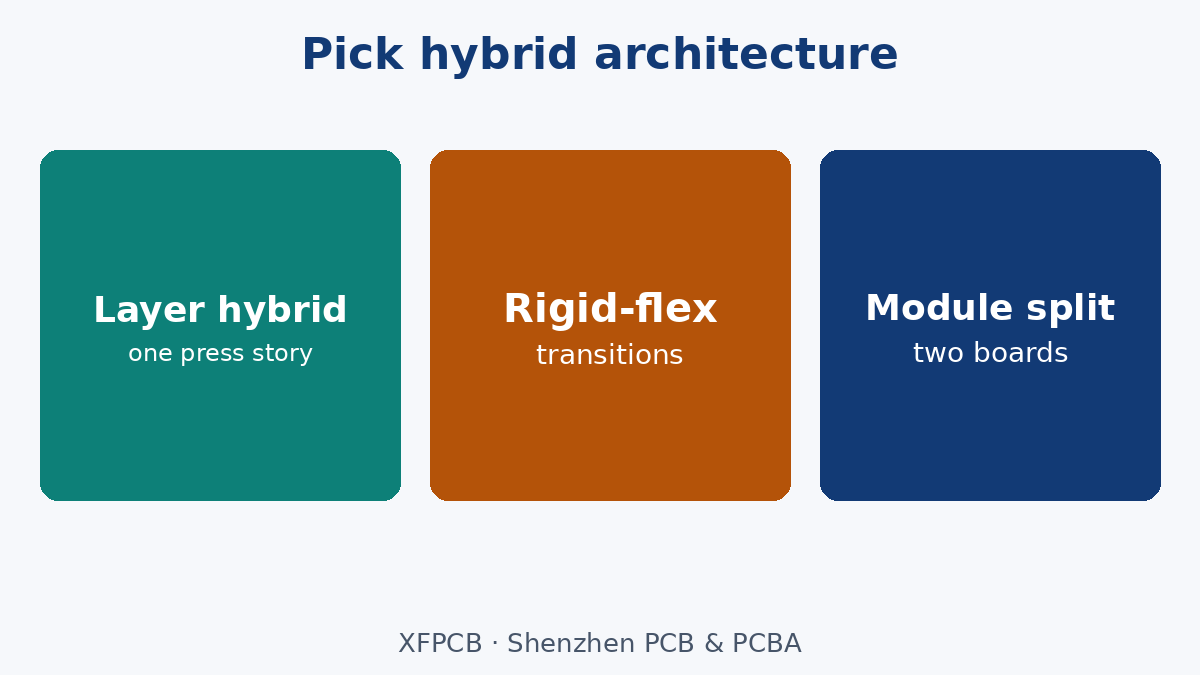
Types of hybrids buyers actually RFQ
- Rigid multilayer hybrid: FR-4 subcomposite + low-loss or RF layers in one press sequence (or sequential).
- Rigid-flex: polyimide flex layers continuous with rigid FR-4 zones.
- Module split: FR-4 digital board + MCPCB LED or RF daughter—commercial hybrid without one exotic press.
- Cavity / embedded: special constructions that behave like multi-material process risk.
Name which type you mean. “Hybrid” alone is not purchasable.
EQ pain you must budget
- Multiple datasheets and Dk tables in one stack PDF.
- Different drill/desmear recipes by dielectric.
- Registration risk across sequential laminations.
- Impedance coupons per dielectric system.
- Longer CAM review and possible material MOQ issues.
- Harder second-sourcing.
If schedule cannot absorb EQ, prefer module split over one-piece exotic hybrid.
When hybrids fail programs
- Only the FR-4 portion was identified; RF layer was “whatever low-loss.”
- Flex transitions lacked keep-outs; copper cracked.
- Cost-down removed low-loss layers without re-sim.
- Assembly profile suited FR-4 but stressed RF bondplies.
- Purchasing substituted one layer’s PN out of family.
RFQ callouts for hybrids
- Explicit “hybrid / multi-material” flag on cover.
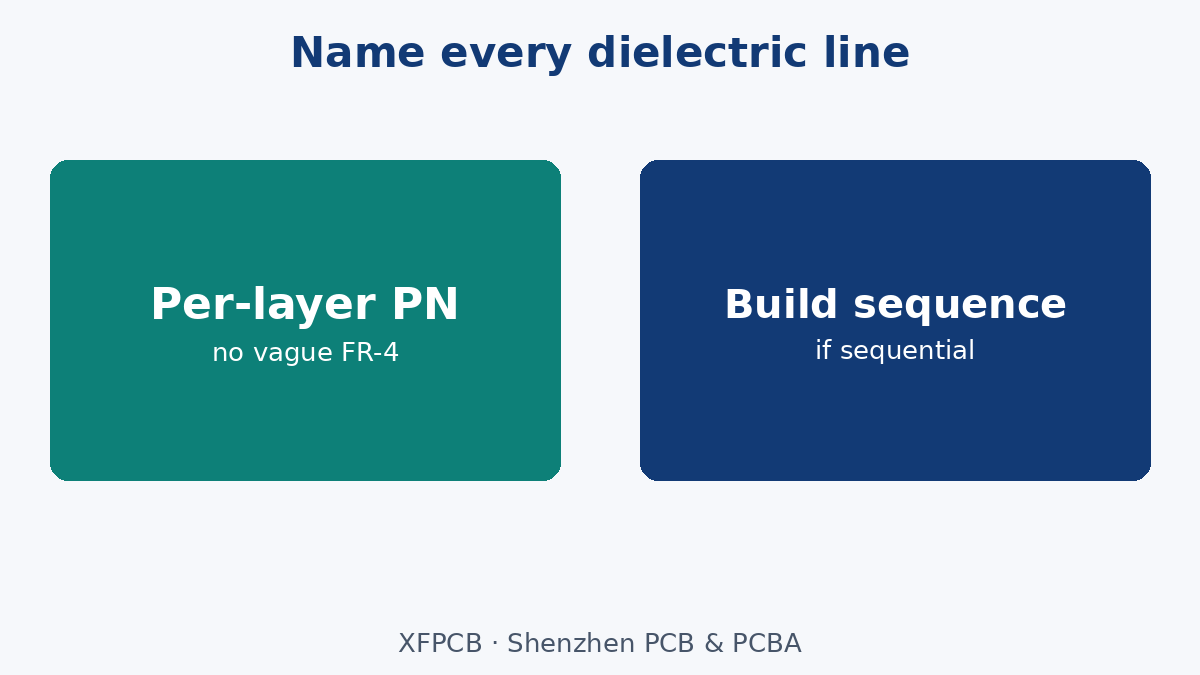
- Per-layer dielectric identity (family/PN).
- Build sequence if sequential.
- Impedance table keyed to dielectric system.
- Drill notes per region.
- Thermal profile compatibility across materials.
- No substitution per dielectric line.
- FAI microsection expectations on critical interfaces.
What fab can and cannot fix
Can: build declared hybrids within capability; declare all PNs; flag incompatible press recipes early.
Cannot: make a single-family price out of a hybrid stack; repair a flex transition you via’d through; guarantee second sources for every exotic bondply.
Module split as a first alternative
Before one-piece hybrid, ask whether two boards + connector/FPC jumper meet packaging and SI. Module splits localize materials and simplify each RFQ. They add connector risk—trade explicitly. Rigid-flex remains right when connectors are unacceptable in the hinge.
Common EQ loop
- Designer mixes laminates in CAD without policy.
- Fab asks for all PNs; half unspecified.
- Quote delays; temporary FR-4-only spin “to move.”
- SI fails; true hybrid returns with lost months.
Break the loop: hybrid design review with material owner before routing completes.
Cost traps without invented prices
Hybrids priced like FR-4 are fiction. Single-family boards forced into RF performance are fiction of another kind. Changing one hybrid layer late cascades coupons and sometimes mechanical. Budget NRE attention, not only unit premium.
Rigid-flex specifics
Rigid-flex is a hybrid class with transition geometry, coverlay, and stiffeners. Link construction selection to the rigid-vs-FPC decision post; here emphasize multi-material identity on the stack—polyimide and FR-4 both named. See Rigid-Flex PCB for capability framing.
High-speed islands on FR-4 boards
A common hybrid: low-loss only on outer or specific stripline layers. That still needs per-layer identity and may need sequential lamination. Do not call it “standard FR-4” on the PO. Update the single-family policy with an exception ECO that becomes a hybrid policy for that part number.
Qualification and golden samples
Qualify hybrids as hybrids. Golden samples must include the same dielectric lines. Cross-section FAI should show interfaces you care about. Store declarations for every dielectric, not only the FR-4 core.
Assembly and moisture
Different materials absorb and release moisture differently. Bake rules may need to cover the most sensitive dielectric. Assembly must know hybrid content—profiles and handling notes belong on the traveler.
Linking the freeze to AVL and purchasing systems
Enter the primary family and hard gates into your PLM or AVL notes so buyers cannot create POs that contradict the policy. Train temporary buyers on the policy location. A freeze that lives only in an engineer’s head expires when that engineer is on holiday.
Measuring success of the freeze
Success looks like: quote rounds that declare the same PN class; coupon histories that compare cleanly; fewer EQ emails asking “which FR-4?” Track ECO count for material family changes—if it is high, your freeze is too loose or your requirements are unstable. Stabilize requirements first.
Training checklist for new hardware hires
New engineers should read the program material policy before touching stackups. Pair them with the material owner for the first RFQ. Require a policy citation in design review minutes. Culture beats a PDF that nobody opens.
When marketing or cost-down pressures the freeze
Cost-down workshops love swapping laminates. Require a signed risk assessment covering SI, thermal, and UL/OEM impact before any family change ECO. If savings need a hybrid or a new family, escalate deliberately. Do not “try a reel of something cheaper” on a production lot.
Archive and retention
Keep policy revisions, plant declarations, and certs for the retention period your quality system requires. Field failures years later need that trail. Cloud folders without revision control are not archives—use controlled document numbers.
Press recipe and desmear differences
Hybrid dielectrics often need different desmear aggressiveness and press temperatures. Plants must know which layers are which before CAM commits. A single generic desmear on a hybrid can attack one resin while under-preparing another—via reliability suffers. Declare materials early enough for process engineering, not the night before drill.
Impedance and loss budgeting across materials
When only some layers are low-loss, document which nets may live where. Designers who route critical SERDES on FR-4 layers “by accident” defeat the hybrid. CAD constraints and stack notes should block illegal layer assignments. Coupons must exist for each controlled dielectric system you claim.
Supply risk of exotic bondplies
Exotic hybrid layers can be single-sourced or long-lead. Before freezing a hybrid, ask purchasing about MOQ and alternate PNs inside the same electrical window. A brilliant SI stack that cannot be bought in volume is not a production stack. Dual-qualify alternates during DVT when risk is high.
Repair and rework limits
Some hybrid materials dislike repeated rework heat. Set rework budgets per zone. RF PTFE-class zones and flex transitions are poor candidates for casual hot-air abuse. Assembly instructions should mark no-rework zones when needed.
Documentation language that prevents “FR-4 quote” mistakes
Cover sheet must say HYBRID in large letters and list dielectric count. Quote forms that only have a checkbox for FR-4 will be filled wrong. Train buyers to reject any quote that does not restate each dielectric line.
Second-source strategy for hybrids
True second sources must match the hybrid layer identities or you re-qualify SI/thermal. Sometimes the honest second source is a module-split architecture rather than another exotic press. Decide in ADVANCE, not when the primary fab is down.
Field failure analysis complexity
FA on hybrids needs to know which dielectric failed. Keep layer maps with FA labs. Microsections should be guided to the suspect interface. Budget FA time higher than single-family boards.
Thermal expansion mismatch across hybrid interfaces
Different resins and copper planes expand differently. Hybrid interfaces and via walls at material boundaries see stress concentrations. Design via transitions carefully; avoid unnecessary vias that cross sensitive interfaces when a layer redirect would do. Reliability owners should review hybrid via charts like they review BGA escape charts.
Electrical isolation and creepage in hybrid LED/power splits
When MCPCB LED sections mate near FR-4 driver sections, creepage and thermal isolation both matter. Metal bases can become unwanted conductors if screws bridge domains. Hybrid at the product level (two boards) can be safer than hybrid in one outline when mains voltages exist. Choose architecture with safety owners present.
CAM checklist unique to hybrids
- All dielectric PNs present
- Sequential build steps drawn
- Laser vs mechanical drill map aligns with materials
- Coupons per system
- Coverlay/bondply notes for flex hybrids
- Explicit “do not substitute” per exotic line
Hand CAM this checklist; do not assume standard FR-4 CAM scripts suffice.
Prototype partial hybrids
Building a non-hybrid prototype to “save time” teaches the wrong lessons if MP is hybrid. If you must, label it non-representative and do not freeze mechanical tooling from it when dielectric thickness will change. Prefer a slower true-hybrid prototype when SI depends on it.
Cost model honesty
Hybrid quotes should break out exotic material and extra process steps. If a quote is lump-sum and surprisingly low, ask which dielectric lines were assumed. Normalize line-by-line before selecting a vendor.
Training for layout teams
Publish a layer-assignment matrix: which nets may use which dielectric layers. Enforce with design rules when tools allow. Hybrids fail when the stack is hybrid but the routing is anarchic.
Inventory and leftover exotic cores
Exotic cores left over from NPI can tempt purchasing to force them into unrelated jobs. Forbid cross-program use without engineering approval. Leftovers are not a free second family.
Closing addendum
Hybrids succeed when identity, process, and routing rules are as disciplined as the SI motivation. If any of those three is soft, return to single-family or module split.
Hybrid stack review gates in NPI
Add mandatory reviews: material owner sign-off at stack proposal; CAM feasibility before routing complete; coupon plan review; assembly profile compatibility review. Skipping any gate recreates the EQ loop. Put gates in the NPI checklist with names and dates.
When to abandon a hybrid
If EQ cycles exceed schedule tolerance, or exotic supply fails, escalate to architecture change (module split or relaxed SI with different signaling). Abandoning early beats failing MP. Document the decision so teams do not revive a dead hybrid casually.
Moisture absorption differences
Log bake procedures per dielectric sensitivity. Flex polyimide and some RF materials need different floor-life discipline than FR-4. Hybrid travelers should carry the strictest applicable handling rule unless zoned handling is defined.
Hybrid FAI photo and microsection set
Define a standard FAI pack for hybrids: stack declaration page, each dielectric cert, microsection at critical interfaces, impedance coupons per system, and flex transition photos if rigid-flex. Incomplete FAI is how hybrids ship with unknown materials.
Vendor capability matrix
Before selecting a hybrid fab, score capability: sequential lamination experience, RF materials handling, flex book-build, and coupon metrology. Do not award hybrid jobs to plants that only run commodity FR-4 simply because their through-via price was low.
Hybrid and UL / OEM stackups
If UL or OEM recognition lists specific constructions, hybrid stacks must appear on those lists or be submitted for recognition. Do not assume FR-4 recognition covers exotic bondplies. Start recognition early—it can dominate schedule more than CAM EQ.
If your team cannot list every dielectric PN from memory of the stack PDF, the hybrid is not ready for quote.
Closing: hybrids by exception
Multi-material stacks are tools for real SI, RF, flex, or thermal conflicts—not badges. Choose hybrids when single-family physics fails, budget the EQ, identify every dielectric line, and prefer module splits when they meet packaging. XFPCB builds hybrids within capability when notes name every material—bring that honesty to the RFQ, and keep single-family freezes for programs that do not need the pain.