
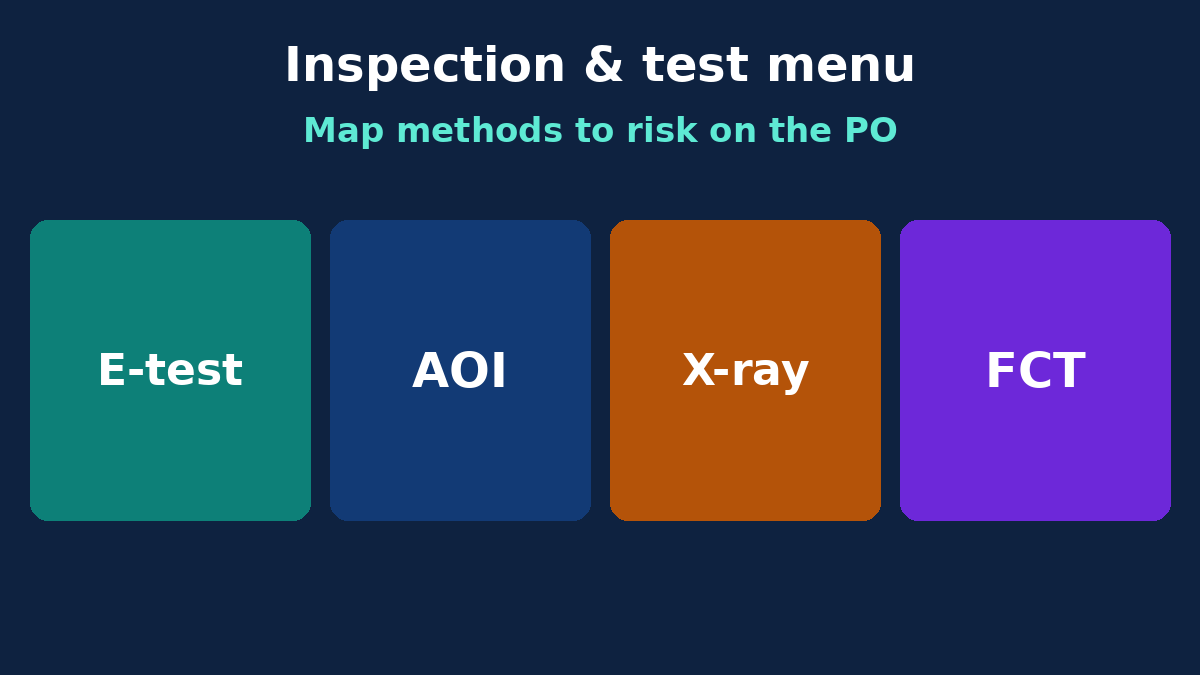
Equipment tour posts that list AOI scanners, flying probes, and X-ray cabinets do not tell a buyer what to put on the purchase order. Inspection and test are a menu. Each method catches a different defect class, costs different fixture and cycle time, and fails differently when scope is vague. This article is a buyer test-plan / scope map: bare-board electrical versus optical, X-ray, flying probe, and functional—what to name by risk, what belongs on FAI versus production travelers, and what EQ usually clarifies. It is not a deep dive into one method, not a machine brochure, and not a promise of zero defects.
Buyer decision frame: risk first, methods second
Before you tick every test box on a quote form, classify the program:
- Bare board only (fab ship to your assembly) vs PCBA (components on board).
- Prototype / NPI vs sustaining production.
- Defect cost: a missed open on a cheap IoT board is not the same as a missed BGA void on a medical or industrial controller.
- Access: can probes reach nets after assembly, or must electrical prove-out happen at bare board?
- Hidden joints: BGAs, QFNs, connectors under shields—optical alone will not see them.
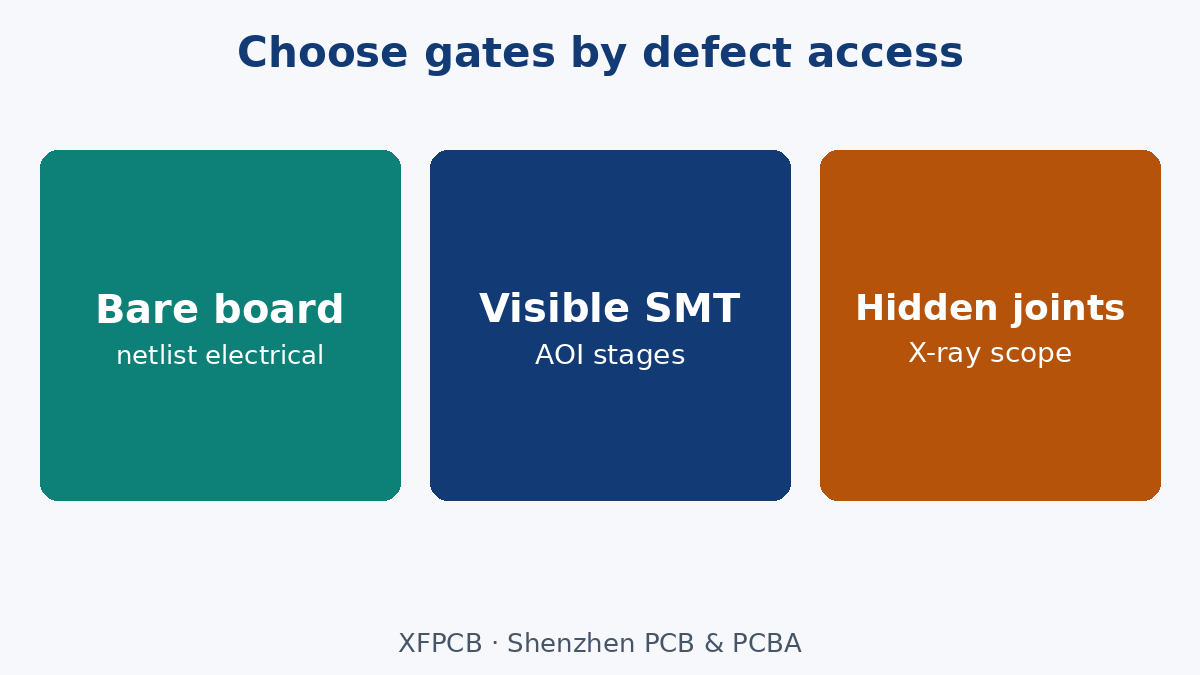
Your PO should name acceptance scope, not “do full inspection.” Plants interpret “full” differently. Map risk to methods, then freeze that map in English on the RFQ. For a hub view of available services, see Testing & Inspection; this post is about how buyers choose among them.
Bare-board electrical: the foundation most RFQs under-specify
Bare-board electrical test (often flying probe on low volume, fixture bed-of-nails on high volume) proves connectivity against the netlist: opens, shorts, and sometimes basic resistance checks. It does not prove solderability, laminate quality under thermal stress, or that your impedance coupon represents every net. It answers: did fab plate and etch the connections the CAD netlist expects?
Call out on the PO:
- Netlist-driven electrical test required (yes/no).
- Flying probe vs fixture expectation when volume changes.
- Whether test coupons / thieving pads may be added on panel rails.
- Isolation and continuity limits only if your quality owner has real numbers—do not invent them in marketing copy; freeze them on the drawing or spec.
Skipping bare-board electrical on dense multilayer to “save cost” shifts opens/shorts discovery into SMT, where diagnosis is slower. For many overseas programs, bare-board electrical is the minimum risk gate before assembly. Details of probe strategy belong with Flying Probe Testing when that is the named method.
AOI: surface truth, not internal truth
Automated optical inspection compares the board or assembled PCB to a golden image or CAD-derived model. On bare boards, AOI catches etch defects, solder-mask issues, and marking problems visible from the outside. On PCBA, AOI catches missing parts, polarity, tombstones, insufficient solder on visible joints, and many shift defects.
AOI does not see under BGA balls, inside plated barrels, or most voids. Buyers who write “AOI 100%” and assume BGA joints are covered create false confidence. Name AOI coverage by stage (bare / post-SMT / post-wave) and by side. If both sides are populated, say so. If a shield can blocks the camera, say whether AOI happens before can install.
X-ray: when joints are hidden
X-ray earns its place for BGAs, bottom-termination packages, and some connector or press-fit joints where optical access is gone. It can reveal voids, bridging under packages, and head-in-pillow signatures that AOI misses. It is slower and more expensive per sample than AOI; it is rarely “every board, every joint” unless risk justifies it.
PO language that works:
- X-ray sample plan (first article, lot sample, or 100% on named packages).
- Which packages are in scope (BGA list, QFN list)—not “all SMT.”
- Whether images are archived with the FAI pack.
Do not order X-ray as a substitute for a bad stencil or wrong reflow profile. Process control first; X-ray confirms. For method context see X-Ray Inspection.
Flying probe vs fixture: volume and access
Flying probe needs little NRE and flexes with ECOs—ideal for prototypes and low volume. Fixture testers cost NRE and shine when thousands of boards share a stable netlist. Changing the board after fixture build is painful. Buyers should state expected volume band and ECO likelihood so the plant does not quote the wrong electrical strategy. After assembly, flying probe access shrinks; bare-board electrical plus ICT/functional at PCBA is the usual split. Name where electrical proof happens in the traveler.
Functional test: prove the product, not only the joints
Functional test (FCT) exercises the assembled board as a product—power rails, communications, sensor paths, firmware loads. It catches wrong-value parts, misprogrammed devices, and subtle parametric issues that electrical continuity never sees. It requires a fixture or bed, software, and a definition of pass/fail owned by the design authority—not by the fab guessing from a schematic screenshot.
PO / RFQ callouts:
- Who provides FCT fixture and procedure (customer vs assembler).
- Pass/fail criteria document revision.
- Whether firmware is loaded at FCT and which binary revision.
- Sample vs 100% at which production phase.
Functional test is not a replacement for bare-board electrical or AOI. It is the top of the stack when field failure cost is high. Skipping lower gates and relying only on FCT makes debug expensive: you know the board fails, not which process step caused it.
Mapping methods to risk classes (practical menu)
Use this as a starting map—adjust with your quality owner:
| Risk situation | Usually name on PO |
|---|---|
| Standard rigid prototype, no BGA | Bare-board electrical + visual/AOI as quoted |
| Dense multilayer / fine pitch | Bare-board electrical mandatory; AOI on etch/mask |
| BGA / QFN heavy PCBA | AOI + X-ray sample or 100% on named pkgs + FCT if product-critical |
| High volume stable design | Fixture electrical at bare or ICT; AOI; FCT sampling plan |
| Fast ECO / NPI | Flying probe; avoid early fixture lock |
| Impedance-controlled | Coupon measurement per stack note (separate from netlist electrical) |
| Cosmetic / branding class | Visual criteria + marking inspection called out |
Impedance and microsection (when required) are materials/process gates, not substitutes for netlist electrical. Keep them as named line items when the stack demands them.
What belongs on FAI vs production travelers
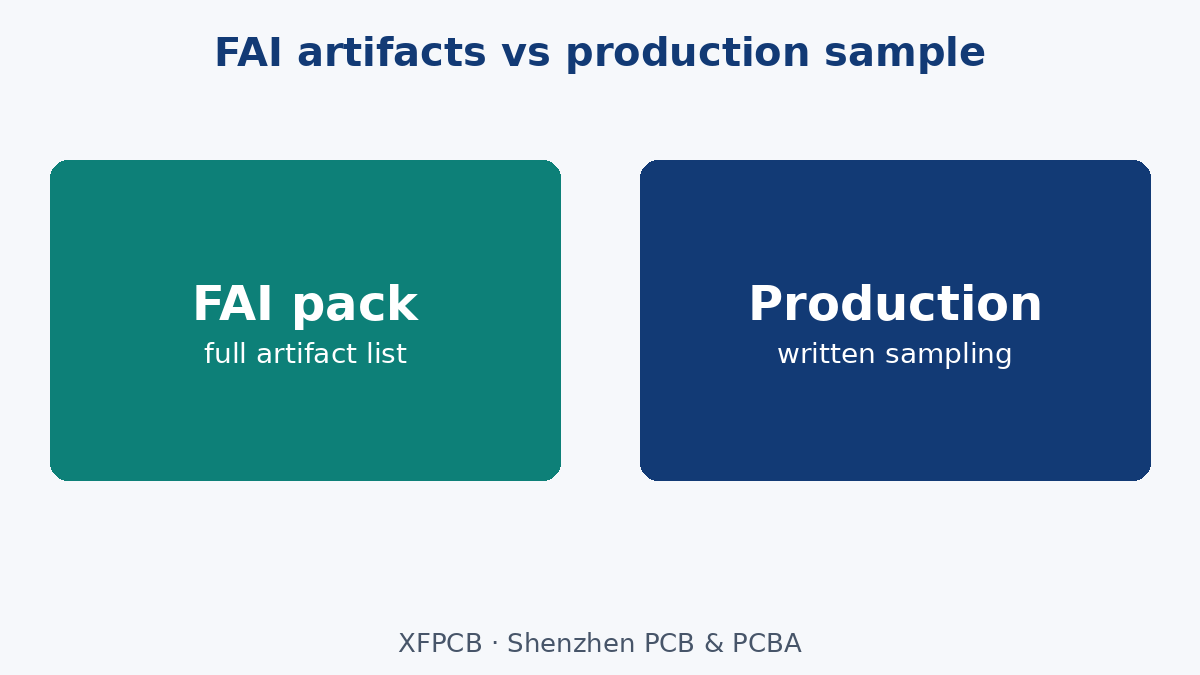
First article inspection (FAI) packs often mix dimensional reports, electrical logs, AOI summaries, X-ray images, and coupon data. Buyers should list required FAI artifacts explicitly. Production travelers may drop to sampling. A common failure mode: FAI was thorough; production silently reduced X-ray to zero without a written sampling plan. Freeze the production sampling rule in the same quality agreement as FAI—not in a chat message after the first lot.
Also separate customer source inspection (you or your agent on site) from plant standard inspection. If you need a hold point before ship, write the hold point. “Inspect carefully” is not a hold point.
Failure modes when the test menu is wrong
- Opens found only after SMT — bare-board electrical skipped or netlist mismatch ignored.
- BGA field failures with clean AOI history — X-ray never in scope.
- Boards pass flying probe, fail in system — no FCT; wrong firmware; parametric issue.
- Fixture obsolete after ECO — volume strategy locked fixture too early.
- Endless EQ about “full test” — PO never named methods and sample rates.
- False fails flooding the line — limits tighter than the design can meet; quality owner must own limits.
Fab and assembly can execute named methods. They cannot invent your risk appetite. If two contract manufacturers quote different test scopes, the cheaper quote may simply omit X-ray and FCT—not “win on efficiency.”
What the plant can and cannot fix
Can do when scoped: run netlist electrical; AOI programs from CAD/BOM; X-ray on listed packages; flying probe or fixture per agreement; archive images and logs into FAI; hold shipments for named gates.
Cannot do from vague language: guarantee “automotive-level” testing without a spec; X-ray every joint on every package at prototype pricing when you only wrote “full inspection”; functional-test a product without procedure and fixture ownership; recover a bad laminate lot with more AOI.
When EQ asks “is X-ray included?” answer with package list and sample rate—not “yes, we do X-ray” as a capability slogan.
RFQ callouts that lock the test plan
Put these on the RFQ / quality notes:
- Bare-board electrical: yes/no; flying probe vs fixture expectation.
- AOI stages: bare / SMT top / SMT bottom / post-rework rules.
- X-ray: package list + sample plan + archive yes/no.
- ICT / FCT: owner of fixture and procedure; revision control.
- Impedance / special coupons: as required by stack—not confused with netlist test.
- FAI artifact list vs production sampling plan.
- Hold points and ship authorization.
- Cosmetic / marking criteria if branding matters.
Keep the test plan revisioned like the BOM. When the BOM gains a new BGA, update the X-ray list in the same ECO.
Common EQ loop on inspection scope
- Quote says “AOI + E-test.”
- Buyer assumes BGA X-ray and FCT are included.
- First articles look fine optically; system test fails or field returns show voids.
- Argument about what “standard inspection” meant.
- Second PO finally lists methods and sample rates.
Break the loop in RFQ round one. China plants will run what you name and price what you name. Capability pages show machines; the PO shows scope. Use both: capability to know options, PO to freeze the menu for this part number.
Assembly vs fab ownership: who runs which gate
Many overseas programs split fab and assembly across two vendors—or one turnkey house with two travelers. Clarify ownership or gaps appear:
- Fab-owned: bare-board electrical, bare AOI, impedance coupons, microsection when specified, dimensional sample on outline and thickness.
- Assembly-owned: SMT AOI, X-ray on packages, ICT/FCT, firmware load, final visual, packing inspection.
- Shared risk: netlist revision control. If assembly programs against BOM rev C while fab tested rev B panels, electrical history lies.
Put vendor ownership in the quality plan. When one China plant does both under turnkey, still name the gates in order on one traveler so nothing is assumed “included because turnkey.” Turnkey means one commercial face; it does not magically expand test scope.
IPC concepts without fake scores
IPC documents (for example acceptance concepts around workmanship and electrical test philosophy) help teams share language. They do not replace your PO. Saying “IPC Class 2” without naming which inspections apply still leaves AOI/X-ray/FCT open. Use class language as a workmanship baseline if your quality owner requires it, then still attach the method menu and sample rates. Do not invent Cpk tables or ppm claims in the RFQ narrative—freeze measurable limits only where your quality system already owns them.
Rework and retest rules
Undefined rework rules create silent risk. If AOI fails a joint and an operator touches up under a microscope, does the board need re-AOI? If X-ray fails void criteria and the BGA is reflowed again, is X-ray repeated? Write retest-after-rework expectations for the packages that matter. Otherwise production optimizes for ship date and your FAI images no longer represent the lot.
Cost traps without inventing numbers
Ordering every method on every prototype board burns schedule and cash when risk is low. Omitting bare-board electrical on dense boards burns more later. Locking a bed-of-nails fixture before the netlist stabilizes burns NRE twice. Paying for 100% X-ray on packages that AOI can see is misallocated budget. The cheap trap is matching a competitor’s buzzword list; the expensive trap is discovering scope gaps after SMT. Align sample rates with defect cost and access—not with fear.
Closing: name the menu by risk
Inspection and testing are not one switch labeled “quality.” They are a menu of electrical, optical, X-ray, and functional gates. Map program risk to methods, write that map on the PO, separate FAI from production sampling, and update the plan when packages change. XFPCB will execute the named scope—bare-board electrical, AOI, X-ray, flying probe, and functional when you own the procedure—without pretending that one scanner replaces the rest. Bring the risk map to the RFQ, and EQ stops being an argument about what “full inspection” meant.
If you only remember one habit: never let a capability photo substitute for a scoped line on the traveler. Machines prove a plant can test; the PO proves which tests this part number receives. That distinction is the whole buyer test-plan discipline.