
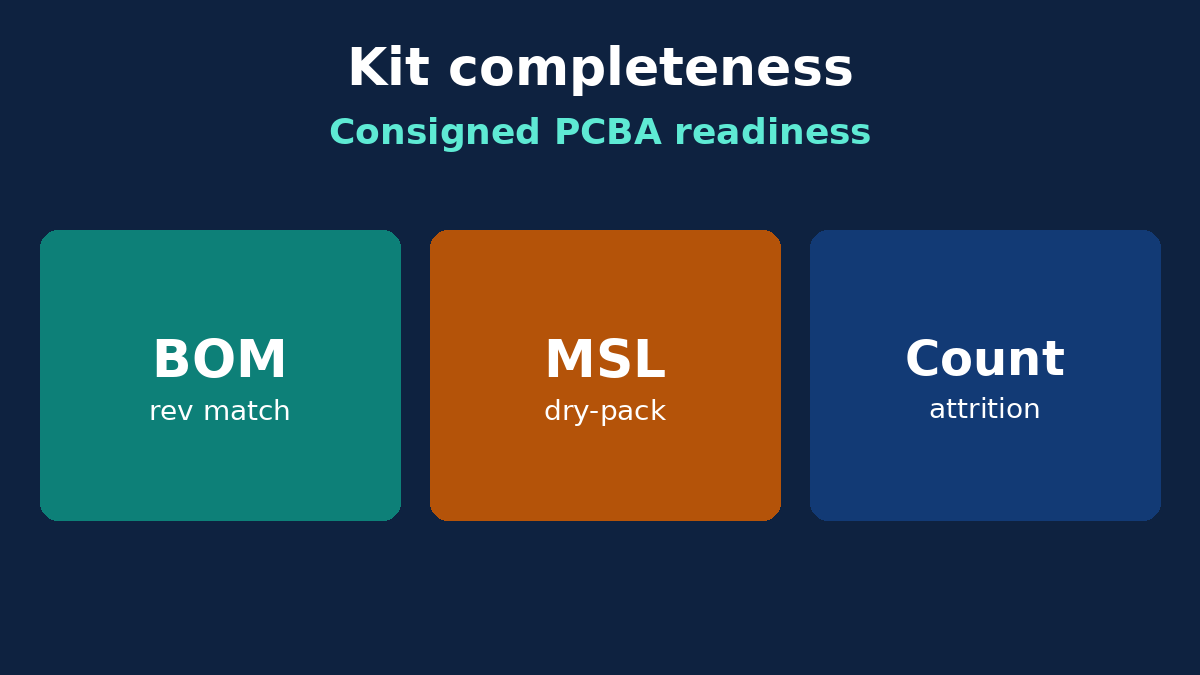
“Kit” is one of the most overloaded words in electronics sourcing. Hobby etching kits, maker soldering kits, and consigned PCBA kits for a China assembly line are not the same product. This article is for overseas buyers who send (or receive) a parts kit for board assembly: what the kit must contain, how kitted assembly differs from turnkey and from bare-board-only buys, and which missing-kit failures trigger EQ before a single stencil hits paste. It is a completeness and EQ checklist—not a DIY etch tutorial and not a generic turnkey sales page.
Buyer decision frame: three commercial models
Freeze which model you are buying before you argue about lead time:
- Bare board only — fab ships empty PCBs; you or another assembler own all parts.
- Kitted / consigned assembly — you (or your purchasing agent) supply parts (and often boards); the assembler builds to your BOM and kit list.
- Turnkey — the assembler (or turnkey fab+assembly house) procures parts to the BOM, builds, and ships assemblies—sometimes with customer-furnished exceptions.
Kitted assembly fails when the commercial model is turnkey in the email and consigned in the box—or the reverse. Write the model on the RFQ cover. If you want Turnkey PCB Assembly, say turnkey and own the AVL rules. If you are consigning, say kit and own the completeness checklist below. How to Place an Order still applies; the kit list is an extra gate for consigned jobs.
What “kit” must mean on a consigned PCBA job
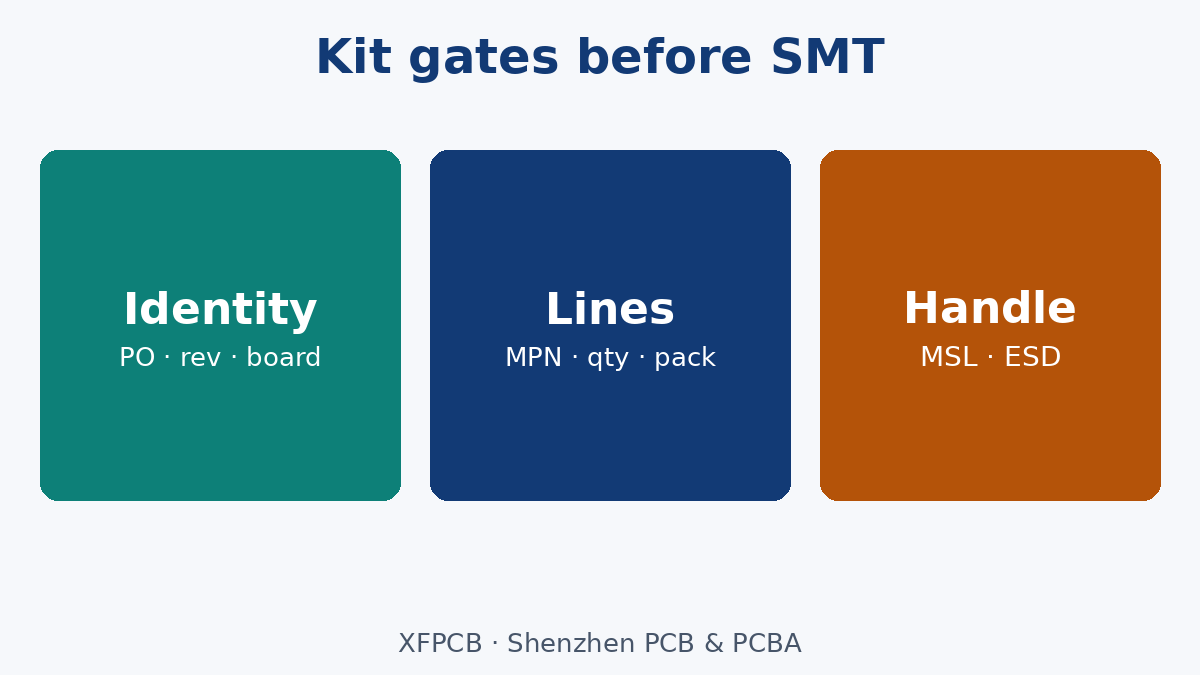
A production-ready kit is not a bag of reels and a hope. At minimum the assembler needs:
- Boards at the correct revision (or clear panelization notes if boards ship separately from parts).
- BOM revision matching the kit contents and the Gerbers/centroid.
- Parts for every line: correct MPN (or approved ALT), quantity with attrition where agreed, and packaging the line can feed (reel, tray, tube, cut tape with leader rules).
- MSL and dry-pack status for moisture-sensitive devices—or explicit bake plan ownership.
- Polarity / orientation aids for non-obvious packages (LEDs, connectors, electrolytics).
- Firmware / programmed parts policy: blank vs pre-programmed; who programs; which checksum.
- Solder paste / stencil ownership if not standard house paste.
- Paperwork: packing list keyed to BOM line, COC if required, date codes if you care, RoHS/REACH statements if your quality system requires them.
- Specials: press-fit tools, thermal pads, shields, screws, labels, conformal-coat mask if in scope.
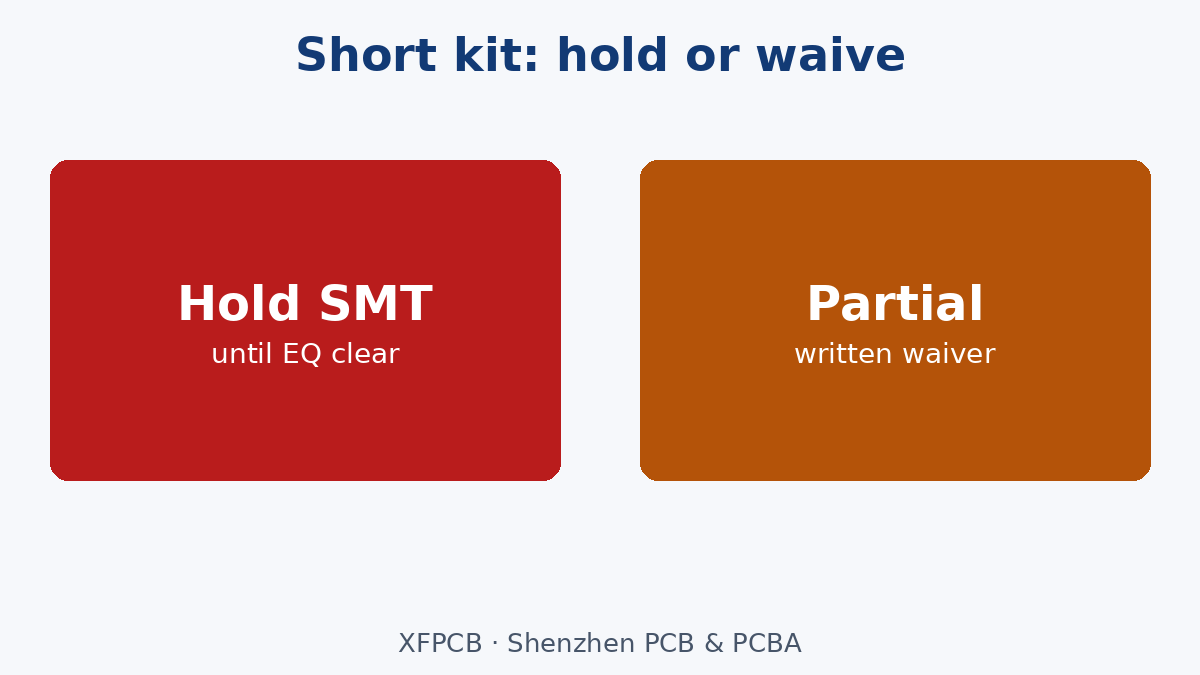
If any of those are “coming next week,” it is not a kit—it is a partial that will idle the SMT line or force incomplete builds.
Kitted vs turnkey vs bare: where EQ pain differs
Bare board: EQ is fab notes, stack, finish, test. Parts risk is elsewhere.
Turnkey: EQ is AVL, alternates, lead-time of long-pole parts, counterfeit controls, and who may substitute. Kit completeness is the assembler/buyer’s joint receiving problem against POs they placed.
Kitted: EQ is your box vs your BOM. The assembler did not choose the MPN; they can only refuse to load a mismatch. Missing one 0402 pull-up stops a whole lot as surely as a missing BGA. Receiving inspection against the BOM is the critical path—not the stencil design.
Buyers sometimes consign “everything except the expensive FPGA” and call it turnkey. Name hybrids explicitly: turnkey with customer-furnished parts (CFP) list. Unnamed hybrids are where kits go incomplete.
Missing-kit failures that stop the line
These show up repeatedly on China SMT lines receiving overseas kits:
- Quantity short — attrition not included; 0201/0402 loss unplanned; connector spares zero.
- Wrong MPN / wrong date-code policy — kit picked to an old BOM; assembly loaded new centroid.
- MSL breach — bags opened in transit; no humidity indicator; bake ownership unclear.
- Polarity unmarked — diodes, LEDs, connectors arrive without clear orientation marks matching silkscreen.
- Parts on the wrong package type — bulk loose parts for a reel-fed line; cut tape too short for feeder.
- Programmed IC mismatch — firmware rev not labeled; blanks mixed with programmed.
- Substitutions without ECO — purchasing swapped an ALT that changes footprint or height.
- Missing mechanicals — shields, clips, thermal interface, screws called on BOM but not in the carton.
- Board rev mismatch — fab shipped rev B; kit packed for rev A BOM.
- Partial kits with “use from bond store” — bond store empty or different MPN.
Each of these becomes EQ before paste. The assembler is right to hold. Schedule promises that assumed a complete kit were fiction.
Completeness checklist (attach to the RFQ / ship pack)
Use this as a living checklist—adapt to your quality system:
Identity
- [ ] Job / PO / part number / revision on every carton label
- [ ] BOM revision and date matching assembly files
- [ ] Board revision and quantity match kit matrix
Line-by-line
- [ ] Every BOM line present or explicitly back-ordered with assembler approval
- [ ] Approved alternates documented; unapproved parts quarantined
- [ ] Quantities include agreed attrition
- [ ] Feeder-compatible packaging
Environment & handling
- [ ] MSL parts sealed with HIC and desiccant; breach log if any
- [ ] ESD packaging for ESD-sensitive devices
- [ ] Batteries / hazardous parts declared for shipping
Process inputs
- [ ] Centroid / pick-and-place file rev matches BOM
- [ ] Gerber / ODB++ / paste layers match board rev
- [ ] Stencil ownership clear
- [ ] Firmware procedure if programming in-circuit or offline
Receiving gates
- [ ] Packing list sortable by BOM line
- [ ] Photo or count method for high-value parts
- [ ] Hold-for-EQ contacts on both sides
Send the checklist with the kit; do not assume the courier bag is self-explanatory.
What assemblers can and cannot fix
Can do: count and quarantine; request missing lines; bake per JEDEC-like procedures when ownership is clear; load approved ALTs already on the AVL; build partials only with written authorization.
Cannot do: invent missing MPNs; accept footprint-changing substitutions without ECO; recover MSL-unknown parts without a quality decision; program firmware without files and checksum ownership; pretend a short kit is complete to hit a date.
If you need SMT PCB Assembly on a consigned kit, the completeness gate is part of the service—not an annoyance. Budget receiving days in the schedule.
RFQ language that prevents kit EQ loops
On consigned RFQs, add:
- Model: consigned kit / turnkey / hybrid CFP list.
- Kit due date relative to SMT start (kit must clear receiving before schedule starts).
- Attrition policy by package size class (your numbers—not marketing invention).
- ALT rules and who may approve.
- MSL bake ownership and max floor life handling.
- Partial-build authorization rules (never silent).
- Labeling: every unique MPN bag labeled with BOM line reference.
- Board supply path: same PO or separate fab PO with rev lock.
Also state whether leftover kit returns to you or stays on bond. Unclear bond stores become mystery inventory next ECO.
Common EQ loop on kits
- Buyer ships “most of the parts” to hit a date.
- Assembler opens cartons; finds shorts, wrong reels, open MSL bags.
- Email storm; SMT slot missed.
- Replacement parts air-freighted; still missing shields.
- Second kit finally complete—schedule already slipped twice.
Break the loop with a kit readiness review before shipping cartons: BOM vs packing list dry-run, MSL audit, polarity check on samples, rev alignment with boards. China assembly houses will run that review if you ask; they cannot run it on a kit still on the airplane.
Receiving inspection: how to run the gate without drama
Treat kit receiving like incoming inspection on a critical part. Best practice for overseas kits landing in a China plant:
- Book a receiving window; do not drop cartons on the SMT supervisor’s desk mid-shift.
- Sort by BOM line, not by bag color. Photograph high-value trays before opening ESD bags when your quality plan requires it.
- Quarantine mismatches immediately with a red-tag log: wrong MPN, short qty, open MSL, damaged leads.
- Issue one consolidated EQ list within an agreed number of business hours—not twenty scattered emails.
- Do not start paste until quarantine is cleared or a written partial-build waiver exists.
Buyers who skip receiving to “save a day” often lose a week to mid-line stops. The checklist above is useless if nobody is paid to execute it.
Attrition, leftovers, and bond store hygiene
Small chip components disappear into feeders and floor loss. Agree attrition bands by package class in the contract—your quality/purchasing owners set the numbers. After the build, decide:
- Leftovers return with the finished goods,
- Leftovers stay on bond for the next lot,
- Or leftovers are scrapped with a record.
Unlabeled bond shelves are how the next kit becomes a mystery mix of date codes and ALTs. Every bond location should reference the customer part number, MPN, and PO. When ECOs obsolete a part, scrub bond—do not let dead MPNs ride into the next kit by habit.
Counterfeit and open-market risk on consigned parts
When you consign, you own sourcing channel risk. Assemblers can do visual and some basic checks; they are not a full authenticating lab unless contracted. Prefer franchised channels for high-risk packages (processors, power ICs, memory). If open-market buys are unavoidable, say so, raise incoming inspection depth, and accept that EQ may include quarantine for remarking or date-code anomalies. Turning a blind eye to bargain parts in a consigned kit transfers the field failure back to your brand—not to the SMT operator.
Cost traps without invented prices
Air-freighting missing 0402s costs more than including attrition the first time. Turnkey “because kit is hard” can be right when purchasing bandwidth is low—but then own AVL discipline. Consigning counterfeit-risky open-market parts without incoming inspection shifts liability into your carton. Partial builds create WIP and mixed firmware states that quality hates. The deepest trap is calling a job turnkey while sending a half kit—commercial terms and physical reality disagree, and EQ multiplies.
Firmware, labels, and after-SMT kit pieces
Kits are not only SMT feeders. Post-SMT pieces—housings, labels, MAC ID stickers, conformal coat, and programmed serial schemes—belong on the kit matrix if they are consigned. Missing labels stop pack-out as hard as missing chip resistors stop SMT. If functional test needs a golden unit or interface cable, put that in the kit list too. Test fixtures often sit in a gray zone: customer-owned, assembler-owned, or shared. Name the owner so FCT is not waiting on a kit line nobody packed.
Coordination with bare-board fab
When boards and parts ship from different places, the kit is only complete when both arrive at assembly with matching revisions. Add a rev gate: do not open SMT until board lot traveler rev equals BOM board rev. Panelization and breakaway tabs must match the stencil and fixture the assembler prepared. A perfect parts kit with the wrong board outline still fails. Align fab ship dates and kit ship dates in one schedule owner—split ownership is how “parts arrived, boards next week” becomes the project status for a month.
Closing: completeness is the product
For consigned PCBA, the kit is half the product. Turnkey moves purchasing risk to the assembler; kitted assembly keeps purchasing risk with you and turns receiving into the critical path. Bare board leaves parts out of scope entirely. Choose the model deliberately, attach a completeness checklist, and do not start the SMT clock until BOM, boards, MSL, polarity, and paperwork agree. XFPCB can build turnkey or consigned work when the commercial model and the carton contents tell the same story—send a complete kit, or choose turnkey and freeze the AVL, but do not mix them silently.
One practical test before you courier anything: can a stranger rebuild your packing list into a BOM-sorted receiving sheet without asking Slack? If not, the kit is not ready. Completeness is paperwork and packaging discipline as much as it is part count—and that discipline is what keeps kitted assembly schedules real.