
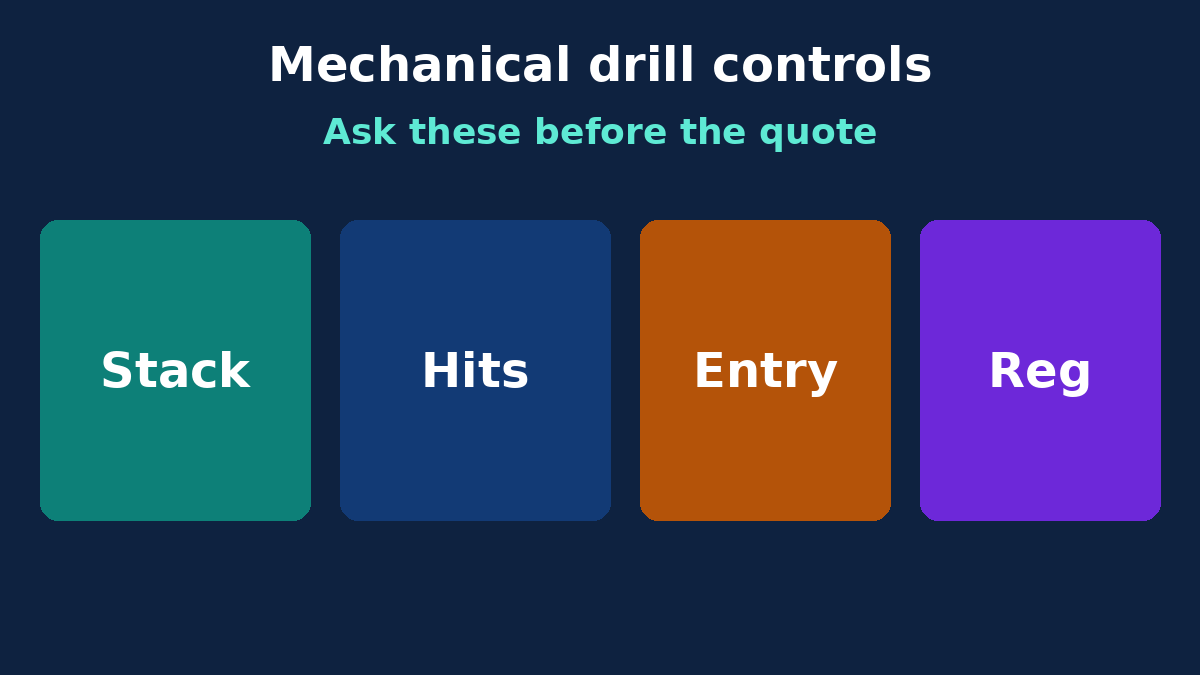
Mechanical drilling still makes most through holes on rigid boards. Method encyclopedias (single-pass, step, pilot, flip) describe plant options; they rarely tell a buyer which process controls to challenge on an EQ. This post is that control list—stack height, hit count, entry/backup, and registration—written from a China fab floor. Hole-class naming and bit ST/UC geometry live in sibling articles.
Why “we drill after lamination” is not enough
On multilayers, drilling follows press-out so the bit must hit pads that already exist inside the stack. On double-sided boards the sequence is simpler, but the same four controls still decide wall smear, position, and breakage risk. Asking only for “CNC drill” on the RFQ leaves those knobs with the plant—fine for commodity, risky when aspect ratio, fine pads, or plating-critical vias are on the drawing.
Stack height: how many panels under one hit
Fabs often drill multiple panels stacked under one program to raise spindle utilization. Taller stacks save machine time and raise wander, heat, and diameter scatter toward the bottom of the stack—especially on small tools and thick boards. Buyers should ask:
- Will this job drill as a single panel or a named stack height?
- Are small-diameter / high-AR tools restricted to thinner stacks?
- Is stack policy frozen on the traveler for production repeats?
You do not need to dictate spindle RPM. You do need to know whether the quote assumes a stack that can miss your position or wall ask.
Hit count: when the bit is retired
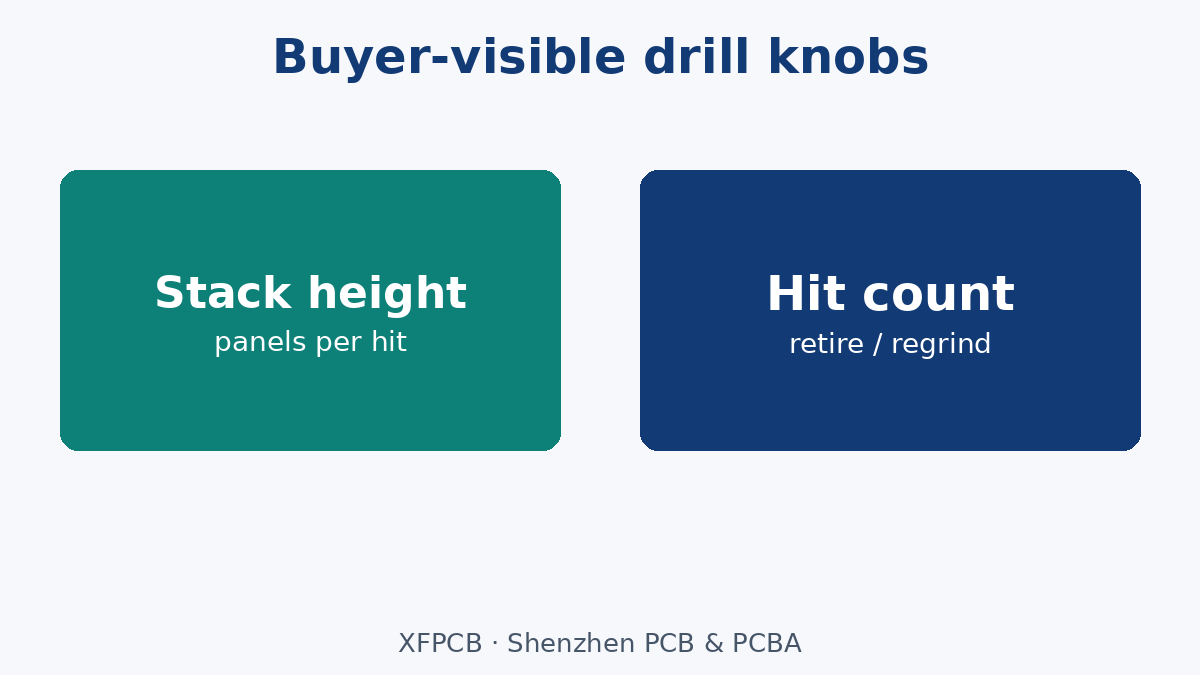
Every bit has a hit budget before the plant swaps or regrinds. Worn tools enlarge holes, raise roughness and smear, and break more often. Commodity quotes bury hit count inside “standard process.” For plating-critical or tight-tolerance holes, ask:
- What hit-count band applies to the smallest tools on this job?
- Are regrind bits allowed on this part, or first-life only?
- Is broken-bit / re-drill disposition written (scrap vs rework vs EQ)?
ST versus UC body choice and flute geometry affect how long a bit stays in the window; those trades are separate. Here the buyer lever is forcing the plant to name a retirement rule when the drawing is unforgiving.
Entry sheet and backup board
Entry (often aluminum or coated sheet) stabilizes the bit at break-in, spreads heat, and reduces top-side burr and wander. Backup under the stack supports exit, limits burr, and protects the table. Cheap or reused entry/backup shows up as nail-heading, exit burr, and position scatter—not as a line item you see. Useful EQ questions:
- Entry and backup materials for this laminate and copper weight?
- Fresh vs reused policy on fine-pitch / small-tool jobs?
- Any customer-locked entry brand only if you already qualified one?
Do not invent a universal “must use X mm aluminum” rule on the fab note unless your OEM process requires it. Do require the fab to confirm entry/backup is part of the controlled recipe, not scrap filler.
Registration and compensation before the spindle runs
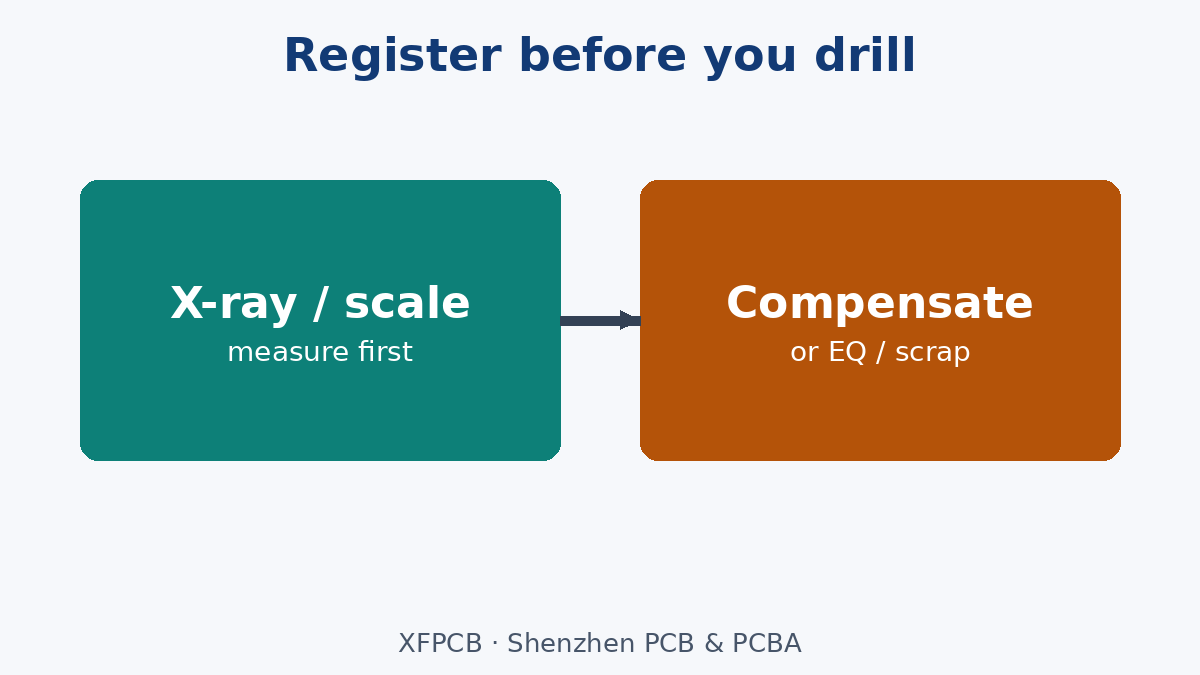
Multilayer drill accuracy starts with inner-layer registration. Plants use X-ray or optical targets, measure scale/offset, then compensate the drill program. Front-and-back or flip drilling for thick or oversized panels adds a second alignment risk. Ask:
- Is pre-drill X-ray / scale compensation standard on this layer count?
- Who owns the decision if measured misregistration exceeds your pad/annular-ring budget—auto-compensate, EQ, or scrap?
- For controlled-depth features, is depth tied to a layer (must-not-cut) rather than a single absolute Z for every panel?
Deep-hole strategies (step pecking, pilot then open, front-and-back) are plant methods for chip load and AR. Buyers care that the method is chosen for wall quality, not that every peck increment appears on the drawing.
What belongs on the PO versus the traveler
On the drawing / fab note: finished hole classes, AR-sensitive features, position tolerances that matter, controlled-depth / back-drill layer rules, and any locked process from a prior qualification.
On the traveler (ask in EQ, freeze for repeats): stack height band, hit-count / regrind policy, entry/backup family, registration measurement gate, and broken-bit disposition.
Our PCB Fabrication Process page places drilling in the full flow. For position and wall evidence after drill, see Testing & Inspection. High layer counts raise registration stakes—start from the High Layer Count PCB overview when the stack itself is the risk.
What we are not claiming
No invented RPM/feed tables, no universal stack-height limits, no claim that one peck recipe fits all FR-4, and no bit-brand list. Hole-type naming was the previous post; bit ST/UC and geometry are separate. Ask for the four controls so the mechanical drill recipe that ships matches the board you thought you bought.