
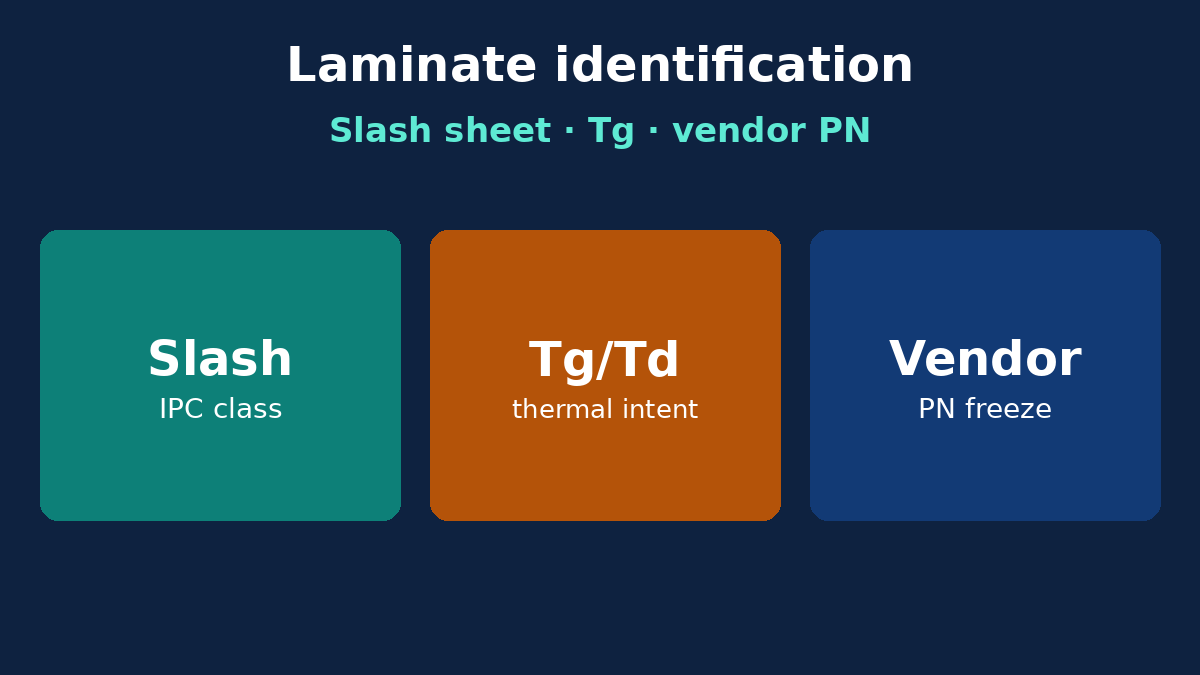
Calling a stack “FR-4” is not laminate identification. Procurement and CAM need a traceable callout: IPC slash-sheet class (when you use that language), glass transition and decomposition intent, copper foil type, and—when the program requires it—a vendor laminate part number that the plant can buy and certify. Silkscreen logos and marketing names on a sample board do not replace that discipline. This article owns identification and RFQ callout—not a full copper-clad encyclopedia and not a datasheet beauty contest. The goal is a note a China fab can purchase and build against without guessing which mid-Tg epoxy you meant.
Buyer decision frame: what “identify” must mean
Before RFQ, decide which identification level the program needs:
- Generic performance class — e.g., standard FR-4 mid-Tg for non-critical consumer boards where plant-equivalent materials are acceptable within a written window.
- IPC slash-sheet aligned class — performance sheet language (IPC-4101 family concepts) so equivalents must meet named thermal/electrical envelopes.
- Frozen vendor PN — one manufacturer’s core/prepreg system locked for impedance, CAF risk posture, or OEM AVL.
Level 1 is cheapest to quote and loosest in EQ. Level 3 is strictest and often correct for high-speed, automotive-tier, or regulated programs. Mixing levels—“any FR-4 but also exact Rogers-like behavior”—creates impossible RFQs. Pick one primary identification mode per part number. Link materials hub context via PCB Materials when you need the broader catalog view; this post is about how you write the callout.
IPC slash-sheet language: useful, not magical
IPC-4101-style slash sheets exist so “FR-4” stops meaning twenty different resin systems. A slash sheet points at a performance envelope: resin/glass family, thermal metrics, and related requirements. Using slash-sheet language on an RFQ helps plants propose equivalents that are in family—if you also freeze the metrics that matter to you (Tg minimum, Td expectation, CAF-related notes, halogen-free if required).
What slash sheets do not do:
- Guarantee identical Dk/Df to the laminate you simulated last year under a different brand.
- Replace copper foil type callouts (ED vs RTF vs VLP families) when etch and loss matter.
- Survive if your drawing says slash sheet A and your impedance model assumed brand B’s Dk table.
Practical approach: name the slash-sheet class or the vendor PN, state Tg/Td intent, and attach the stack table. Do not paste an entire IPC table of thickness grades into marketing prose—put tolerance needs on the drawing where metrology belongs.
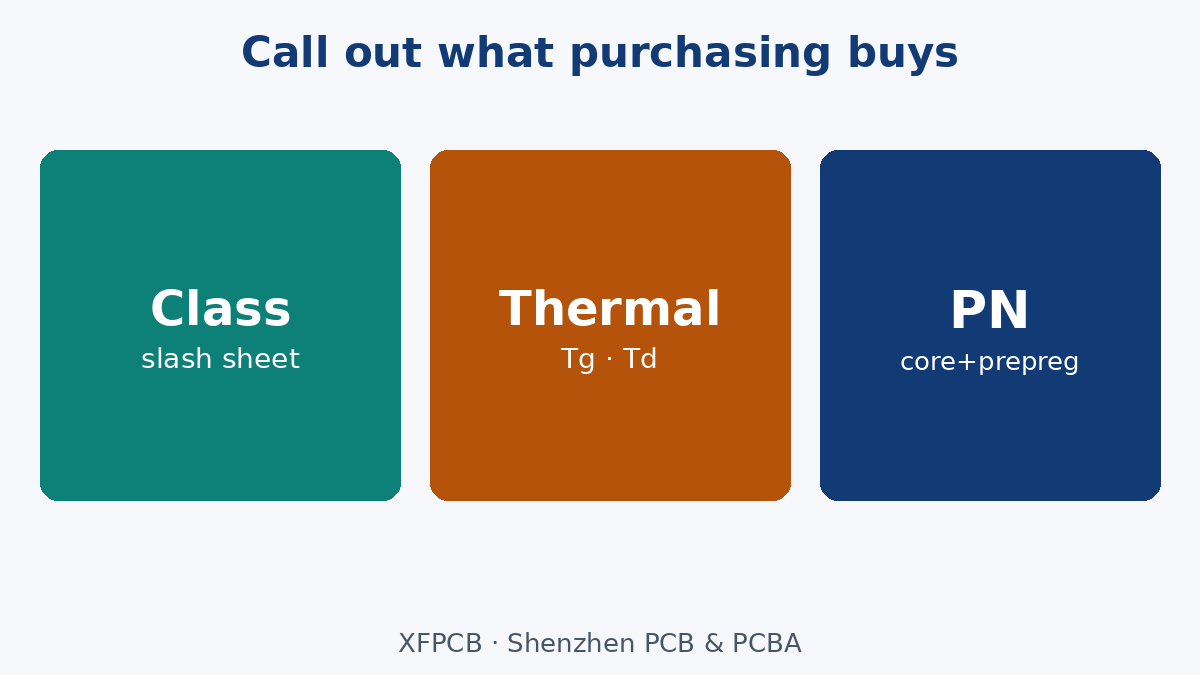
Tg, Td, and CTE: call out what assembly will stress
Tg (glass transition) indicates when the resin softens mechanically. Lead-free assembly profiles push many boards near or through Tg multiple times; mid-Tg vs high-Tg is a real selection gate for multilayer and heavy copper. Td (decomposition) speaks to chemical breakdown at higher temperatures—relevant to multiple reflows and rework. CTE mismatch with copper and components drives via stress and warpage risk.
On the RFQ:
- State minimum Tg if the program requires it (your number from the reliability owner—not a blog invention).
- Note lead-free assembly expectation so the plant does not assume legacy tin-lead thermal stress.
- For thick boards or large BGAs, ask whether high-Tg or filled systems are recommended—then freeze the answer in the stack note.
Identification without thermal intent is how a “FR-4” quote arrives in a resin that survives fabrication but browns or delaminates in your reflow oven. Companion thermal-stress detail belongs in lead-free laminate survival notes; here, freeze the identifiers that point CAM to the right family.
Vendor part numbers vs “equivalent”
When SI, RF, or OEM AVL demands it, freeze vendor core and prepreg PNs (or a short approved list). Equivalents are fine when you define the equivalence window: Tg, Dk tolerance band for impedance layers, halogen-free, and UL recognition needs. Equivalents are not fine when every brand’s “mid-Tg FR-4” is assumed identical at 10 GHz.
RFQ patterns that work:
- “Primary: [Vendor] [PN] cores/prepregs per stack table. Alternates only from AVL list Rev x.”
- “IPC-4101/xx class acceptable; plant to declare brand/PN before build; Dk for impedance layers per datasheet used in coupon design.”
- “Do not substitute high-speed / low-Dk on signal layers without written ECO.”
Ask for material certificates or lot traceability when your quality system requires them—name that requirement. Silent hope is not identification.
Copper foil identity is part of laminate callout
Laminate identification is incomplete without foil. ED, RTF, VLP/HVLP families change insertion loss and etch geometry. Heavy copper clad vs foil-up constructions change what “1 oz” means after plate. On impedance and fine-line boards, call foil type on the stack note next to the dielectric PNs. Plants that only see “1 oz FR-4” will choose a default foil that may not match your loss budget.
Also name finished copper vs foil start when the distinction matters to your drawing. Confusion between start foil and finished thickness is a classic EQ topic; identification discipline includes copper language, not only resin names. See Impedance Control PCB when the dielectric+foil pair is locked for coupons.
Silkscreen myths and sample-board traps
Teams sometimes “identify” laminate by:
- A UL mark style on an old sample,
- A logo in the copper pour,
- A salesperson’s nickname (“the blue FR-4”),
- Or a photo of a core stamp that is no longer on the AVL.
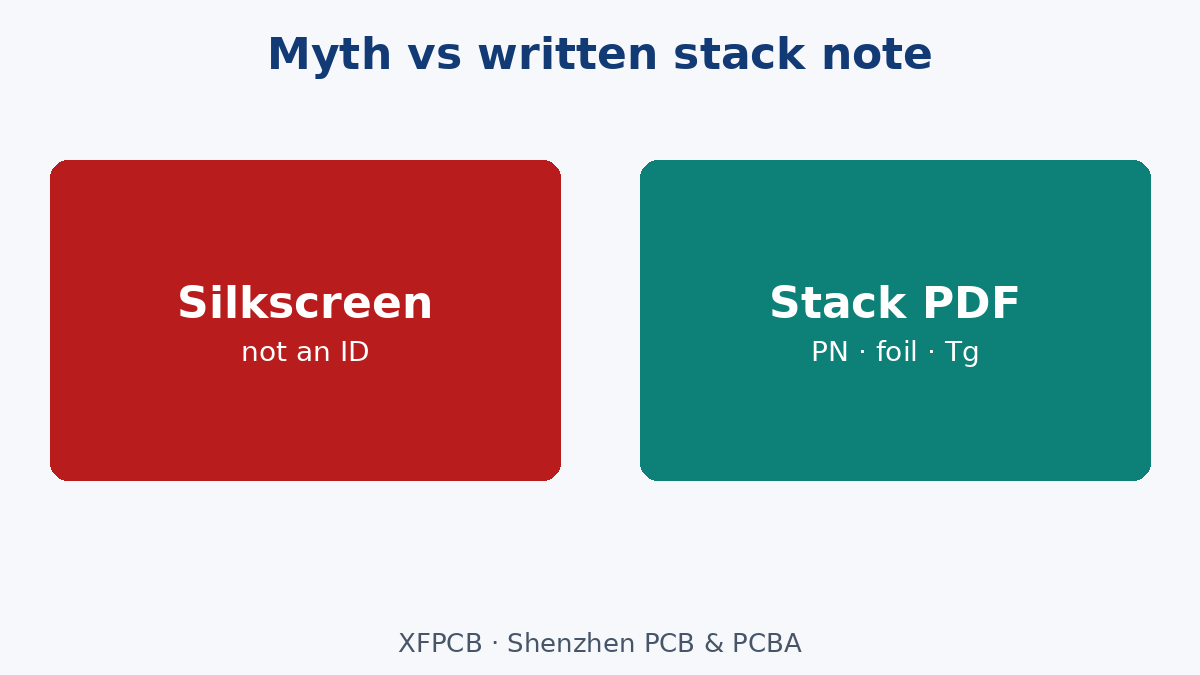
Those clues can start a conversation; they are not RFQ callouts. Stamps get removed in process. Logos are not slash sheets. Color is not Tg. If you must match a legacy board, obtain the original stackup document or run material analysis—then freeze PNs going forward. Do not ask a plant to “match this scrap board’s feel.”
Incoming and fab verification (concepts, not fake metrology tables)
Identification continues after purchase:
- Confirm incoming cores/prepregs against PO (PN, thickness class, foil).
- Retain lot traceability for failure analysis.
- Use microsection on FAI when dielectric thickness on impedance layers is critical.
- Reject silent substitutions even if the board “looks fine.”
IPC documents describe thickness classes, foil types, and visual quality concepts—use them inside your quality procedures with the actual tables from the standard you own. Do not rely on blog-transcribed millimetre charts as contractual limits. Put contractual metrology on drawings and QAM documents.
Failure modes from weak identification
- Impedance drift lot-to-lot — dielectric brand changed; Dk table changed; coupon still “passed” under a different assumption.
- Reflow delamination / pad cratering stress — Tg/Td too low for lead-free profile and rework count.
- CAF or insulation resistance surprises — material class changed without CAF-aware selection (discuss risk language; no fake %).
- UL or OEM audit fail — built material not on recognized stack.
- EQ ping-pong — buyer said FR-4; plant used one mid-Tg; designer expected high-Tg high-speed hybrid.
Fab can declare what they plan to buy when you ask. Fab cannot retroactively make two different resin systems the same.
What fab can and cannot fix
Can: propose equivalents inside a written window; declare brand/PN before CAM commit; provide material certs when contracted; build to frozen PNs; flag when a requested slash sheet and a requested Dk model disagree.
Cannot: guarantee every “FR-4” behaves like your last lot; recover a board already pressed on the wrong system; extract a vendor PN from a silkscreen myth; meet aerospace-style material controls without that scope on the PO (and XFPCB does not claim ITAR programs).
RFQ / drawing callouts checklist
- Identification mode: class / slash-sheet / frozen vendor PN.
- Tg minimum (and Td notes if required) for assembly stress.
- Halogen-free / high-Tg / high-speed family flags as applicable.
- Copper foil type on impedance and fine-line layers.
- Stack table with core and prepreg constructions.
- Alternates AVL or “declare before build.”
- Cert / UL / lot traceability requirements.
- Lead-free assembly expectation tied to material choice.
- Explicit ban on silent dielectric swaps on controlled layers.
Attach datasheets for frozen PNs. For multilayer context see Multilayer PCB Guide. Keep manufacturing file set consistent via your usual Gerber/ODB++ + stack PDF pack.
Common EQ loop on laminate ID
- RFQ says “FR-4.”
- Plant quotes mid-Tg standard.
- Designer’s model used a different Dk and higher Tg.
- Coupons fail or SI margin disappears; argument about what FR-4 meant.
- Second spin freezes vendor PNs—should have been RFQ round one.
Break the loop by choosing identification level deliberately and writing it once in the stack note everyone shares.
Prepreg vs core identity on the stack table
Buyers sometimes identify “the laminate” as a single brand while leaving prepreg unnamed. In multilayer work, cores and prepregs are a system. A core PN with a random prepreg of similar Tg can still shift resin content, thickness after press, and Df on inner dielectrics. On the stack table, identify both core and prepreg lines. If the plant proposes a book-build change (different core thickness with compensating prepreg), require a written EQ that restates finished dielectric heights on impedance layers. Identification is not finished until the pressed stack is still the stack you modeled.
Color, weave, and other false IDs
Glass weave style (e.g., spread glass vs traditional styles) and resin color are not substitutes for PNs. Weave can matter for skew on high-speed differential pairs—when it does, call the weave or glass style requirement explicitly with your SI owner’s language. Do not assume “green soldermask boards use the same core.” Mask color is independent. Likewise, “high-Tg” stamped on a warehouse rack is not lot identity—check the cert against the PO.
Documentation pack that travels with the job
A clean identification pack includes: stackup PDF with PNs or slash-sheet class, datasheets for frozen dielectrics, copper foil notes, assembly thermal expectation (lead-free yes/no), and AVL for alternates. Keep that pack revision-locked with the Gerbers. When purchasing updates a PN, bump the stack revision—even if artwork copper did not change. Many “mystery SI changes” are material ECOs that never touched the gerber zip name.
Cost traps without invented numbers
Over-freezing exotic PNs on a board that only needs mid-Tg FR-4 inflates cost and lead risk. Under-identifying high-speed layers to “any FR-4” inflates respins. Allowing equivalents without a Dk window invites silent SI change. Demanding slash-sheet language without thermal or foil callouts still leaves the important knobs free. Identify at the level the risk deserves—then stop tinkering in chat.
High-frequency and low-loss naming discipline
When the board uses low-loss or RF laminates, brand-and-PN discipline tightens. Generic “high frequency material” language is not purchasable. Name the system, the thickness, and the copper foil that your model used. Hybrid FR-4 + RF stacks need both identities. If a cost-down proposes swapping only the RF section, treat it as a new SI project—not a purchasing tweak. Identification here protects insertion loss and phase; it is not pedantry.
Hybrid and multi-material boards
When one board mixes FR-4 with high-speed or RF laminates, identification must be per zone / per layer, not one slogan on the cover sheet. Name each dielectric family in the stack table. Hybrid builds earn extra EQ; they also fail fast when only the rigid FR-4 section was identified. (Program-level multi-material strategy is a sister topic; here the rule is: every dielectric line gets an identity.)
Closing: write the name CAM can buy
Laminate identification is complete when a stranger in purchasing can place an order for cores and prepregs that match the designer’s intent. Slash-sheet class, Tg/Td intent, foil type, and vendor PNs when required are the tools. Silkscreen myths are not. Put the callout on the RFQ and stack note, declare equivalents only inside a written window, and keep lot identity for the day something fails. XFPCB will build to the material identity you freeze—help CAM by naming it clearly the first time.
If your team only remembers one sentence for the RFQ cover: name the dielectric the way purchasing must buy it. Everything else—Tg, foil, certificates, AVL—hangs off that sentence. Vague FR-4 language is how identification becomes archaeology after the first failed lot.