
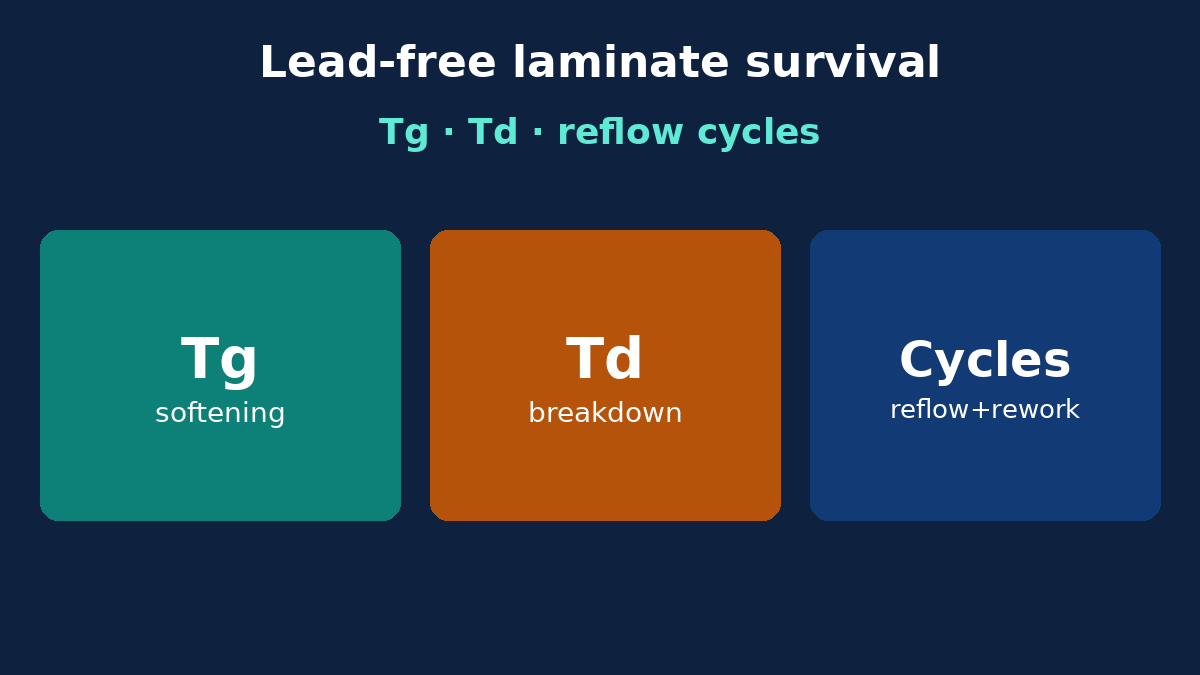
Lead-free assembly raised the thermal bar for copper-clad laminates. Peak reflow temperatures sit higher than legacy tin-lead profiles, and real products often see multiple reflows plus possible rework. Boards that survived fabrication can still delaminate, measle, or grow via stress failures after SMT. This article owns laminate survival under lead-free profiles for fab-plus-assembly RFQs: Tg and Td intent, what multiple heat cycles do, CAF risk language without fake percentages, and drawing callouts that keep material choice honest. It is not a RoHS legal brief and not a high-speed Dk/Df tutorial—those sit nearby. Here the question is: will the dielectric you named still be a dielectric after the oven?
Buyer decision frame: thermal stress is a program input
Before you quote “FR-4,” answer:
- Is assembly lead-free (almost always for modern overseas programs)?
- How many heat cycles are realistic (SMT top, SMT bottom, selective solder, rework allowance)?
- Are there large BGAs, heavy copper, or thick boards that amplify Z-axis stress?
- Is the laminate identified only as FR-4, or with Tg/Td / slash-sheet / vendor PN discipline?
If thermal cycle count and material class are unset, plants will pick a convenient mid-Tg system that etches well and may brown or separate in your profile. Freeze thermal expectation next to material identity. For material naming discipline see the laminate identification sister note; for assembly process ownership see Lead-Free Assembly.
Tg vs Td: what each tells the RFQ
Tg (glass transition) marks where the resin softens mechanically. Operating and process excursions through Tg change modulus and CTE behavior; multilayer vias feel that change as barrel stress. Mid-Tg vs high-Tg FR-4 is a real gate for lead-free multilayer work—not a marketing badge.
Td (decomposition) speaks to chemical breakdown at higher temperature. A material can have adequate Tg for mechanical stiffness yet still be a poor choice if decomposition margins against your peak profile and rework are thin. Datasheets list both for a reason: survival is not one number.
On the RFQ, state:
- Lead-free assembly yes/no.
- Minimum Tg if your reliability owner requires it (their number on the drawing—not a blog invention).
- Preference for higher Td / lead-free-capable systems when multiple reflows are expected.
- Any ban on legacy low-Tg materials for this part number.
Do not paste universal peak-temperature tables into the PO as if every oven and every alloy were identical—own your profile with the assembly house, then pick laminate against that profile.
Multiple reflows: the failure mode buyers forget
First-pass SMT is not the whole story. Double-sided SMT, through-hole wave or selective solder, module attach, and rework add cycles. Each cycle accumulates thermal fatigue in resin and in plated through-holes. Failure modes include:
- Delamination / blistering (“popcorning” when moisture is also present).
- Measling and weave exposure after heat.
- Increased risk of interconnect stress (barrel cracks) on thick boards.
- Solder-mask discoloration that may be cosmetic—or a hint of deeper heat damage.
Moisture is a co-conspirator. Boards and some packages need dry handling; bake ownership should be clear for both laminate and MSL parts. A dry, high-Tg board still has limits; a wet mid-Tg board fails earlier. Put moisture and cycle expectations in the process note, not only in the fab stack.
CAF risk language without invented percentages
Conductive anodic filament (CAF) growth is an electrochemical migration risk along glass-resin interfaces under humidity and bias. Lead-free thermal history can influence material and drilling quality interactions that matter to CAF posture. Speak carefully:
- Prefer CAF-aware material classes when spacing, bias, and humidity environments demand it.
- Keep drill quality and desmear discipline in scope—CAF is not only a resin slogan.
- Do not invent survival percentages, ppm, or “CAF-free” absolute claims in marketing copy.
RFQ language that works: “CAF-resistant material class required per AVL; plant to declare brand/PN; clean drill/desmear per process capability.” That is risk posture—not a fake reliability number.
What fab can and cannot fix
Can: build with declared high-Tg / lead-free-capable systems; control press cycles; dry panels per procedure; microsection FAI when requested; refuse silent swaps to low-Tg stock.
Cannot: make a low-Tg legacy laminate behave like a high-Td system in your oven; erase moisture already driven into a poorly stored panel; guarantee infinite rework cycles; claim ITAR or military thermal quals XFPCB does not offer.
If EQ discovers delamination after SMT, the honest path is material and process review—not “add more AOI.”
Stack and copper choices that interact with heat
Thick boards, heavy copper, and large package sizes increase thermomechanical stress. High-Tg materials help but do not remove the need for sane via aspect ratios and copper balance. Uneven copper can warp through reflow and crack joints even when resin Td is fine. Freeze copper weights and balance notes with the thermal material choice. Hybrid stacks (FR-4 + high-speed) need every dielectric to survive the same oven—do not put a thermally weak layer in a lead-free assembly just because SI liked its Dk.
Assembly RFQ callouts (fab + SMT together)
Put these on the combined or split travelers:
- Lead-free solder process required; max expected reflow/rework cycle count (your number).
- Laminate identity: Tg minimum / slash-sheet / vendor PN as applicable.
- Moisture: bake rules for boards if required; MSL for parts.
- Peak profile ownership: assembler provides profile; designer/reliability approves against material.
- Microsection or thermal stress test on FAI when risk is high (name the test—do not say “full reliability”).
- Rework limits for BGAs on this laminate.
- No silent material substitution clause.
See PCB Materials for family context and High Tg PCB when high-Tg is the named product path—still freeze the PN/class on the stack.
Failure modes mapped to causes
| Symptom after SMT | Often points to |
|---|---|
| Internal delamination / blisters | Moisture + thermal margin; low Td/Tg for cycle count |
| Via opens after thermal cycles | CTE/Z stress; thick board; marginal plate; material soft through Tg |
| Pad cratering (assembly) | Stress + material/pad design—not only “bad solder” |
| Brown/burnt appearance | Profile too hot for mask/laminate; wrong material class |
| Early CAF / IR complaints in humid bias | Material class + drill quality + design spacing |
Use the table for EQ questions—not as a root-cause automaton.
Common EQ loop
- Board quoted as FR-4, built mid-Tg.
- Double-sided lead-free SMT plus rework.
- Delamination or via issues on thick regions.
- Argument about whether fab or assembly “overheated.”
- Respin with high-Tg declared—and cycle count written down.
Break the loop by naming lead-free survival as a material + profile pair in RFQ round one.
Via reliability and Z-axis expansion under lead-free heat
Plated through-holes live in a sandwich whose Z-axis expansion rises as resin softens through Tg. Lead-free profiles drive that excursion harder than tin-lead ever did. Design choices that interact with laminate survival:
- Aspect ratio and plating quality—thin barrels fail first under cyclic strain.
- Large BGA fields that locally stiffen the board and concentrate stress at via necks.
- Heavy copper that changes local stiffness and heat sinking during reflow.
Material upgrades (higher Tg, filled systems) help, but they do not forgive aggressive aspect ratios or poor desmear. On the RFQ, when boards are thick or via-dense, ask the plant to confirm process capability for the stack and name the thermal material class together. Splitting those conversations is how you get a beautiful mid-Tg etch with vias that open after the third heat cycle.
Rework policy is a laminate specification
Every BGA rework is another thermal cycle—often localized and harsher than oven reflow. If your service strategy allows multiple module swaps in the field or at the depot, write a rework cycle budget into the reliability note and choose laminate accordingly. Assemblers should also know maximum localized heat exposure rules. A PO that is silent on rework implicitly assumes first-pass yield forever—an assumption field returns will punish.
Interaction with solder mask and finishes
Mask discoloration after lead-free is sometimes cosmetic and sometimes a warning. High-temperature-capable mask systems exist; call them out when cosmetics or insulation resistance after heat matter. Surface finishes (ENIG, HASL lead-free, etc.) also see the same oven—finish choice is not laminate choice, but the traveler should list both so EQ does not blame the wrong layer when pads look stressed. Keep finish and laminate notes in one pack.
Prototype vs production thermal honesty
Prototype shops sometimes hand-solder or use gentle profiles that hide laminate weakness. Production double-sided lead-free with nitrogen and full peak soaks will not. Do not qualify a cheap mid-Tg on a gentle prototype line and then release it to a harsher mass profile without a thermal gate. Align the qualification profile with the production profile—same material, same stress story.
Cost traps without invented prices
Buying the cheapest mid-Tg for a thick, BGA-heavy, double-reflow board is false economy. Over-specifying exotic polyimide where high-Tg FR-4 would survive wastes money. Skipping bake to save a day can cost a lot. Allowing material equivalents without Tg/Td windows invites silent thermal downgrades. Align material class with real cycle count and package stress.
Moisture, packing, and floor life after fab
Fab may ship dry-packed boards when requested; assemblers may open them early. Define who owns floor life after bag open. If boards sit on a humid dock for a week, your high-Tg choice will not save you. Write packing requirements (dry pack yes/no, desiccant, HIC) on the fab PO when lead-free multilayer risk is real. This is operational survival, not datasheet poetry.
Selecting mid-Tg vs high-Tg without folklore
Not every lead-free board needs the highest Tg on the shelf. Thin, simple, single-reflow consumer boards often run successfully on qualified mid-Tg systems when moisture and profile are controlled. Thick industrial controllers with heavy copper, big BGAs, and depot rework usually do not. Make the choice with cycle count, thickness, and package stress—not with fear. When in doubt, ask the plant for a material declaration against your profile and freeze that declaration. Folklore that “RoHS means only polyimide” wastes money; folklore that “any FR-4 is fine for five reflows” wastes boards.
Documentation for audits and customers
OEM customers may ask which laminate survived which profile. Keep material certs, stack revisions, and assembly profile approvals together. When a field failure appears years later, that pack is how you show the dielectric was chosen on purpose. Identification without thermal records is half a story—pair them in the quality file.
What we are not claiming
No universal peak °C table that fits every alloy and oven, no “every 10 °C doubles degradation” rule presented as law, no CAF percentages, no claim that high-Tg alone fixes poor via design, and no ITAR thermal qualification claims for XFPCB. Own your profile and your material identity together.
Hybrid RF or high-speed dielectrics in the same press cycle must survive the same lead-free profile as the FR-4 zones. Do not assume an RF laminate automatically has thermal margin—or that FR-4 zones can be downgraded because the RF core is exotic. Declare thermal capability per dielectric line on hybrid stacks, and run the assembly profile conversation once for the whole part number.
Closing: survive the oven on purpose
Lead-free assembly is a thermal contract with the laminate. Freeze Tg/Td intent, cycle count, moisture rules, and no-substitution language so the dielectric that etches cleanly also exits reflow intact. XFPCB will build the material class you name and can coordinate with lead-free assembly when that scope is on the PO—bring survival into the RFQ, not into the failure analysis after the first production lot pops.
Practical test for the RFQ cover sheet: can purchasing buy a dielectric that your assembly profile will not punish? If the cover only says FR-4 and RoHS, the answer is accidental. Add Tg/Td intent and cycle honesty—and laminate survival becomes a controlled input instead of a post-mortem topic.