
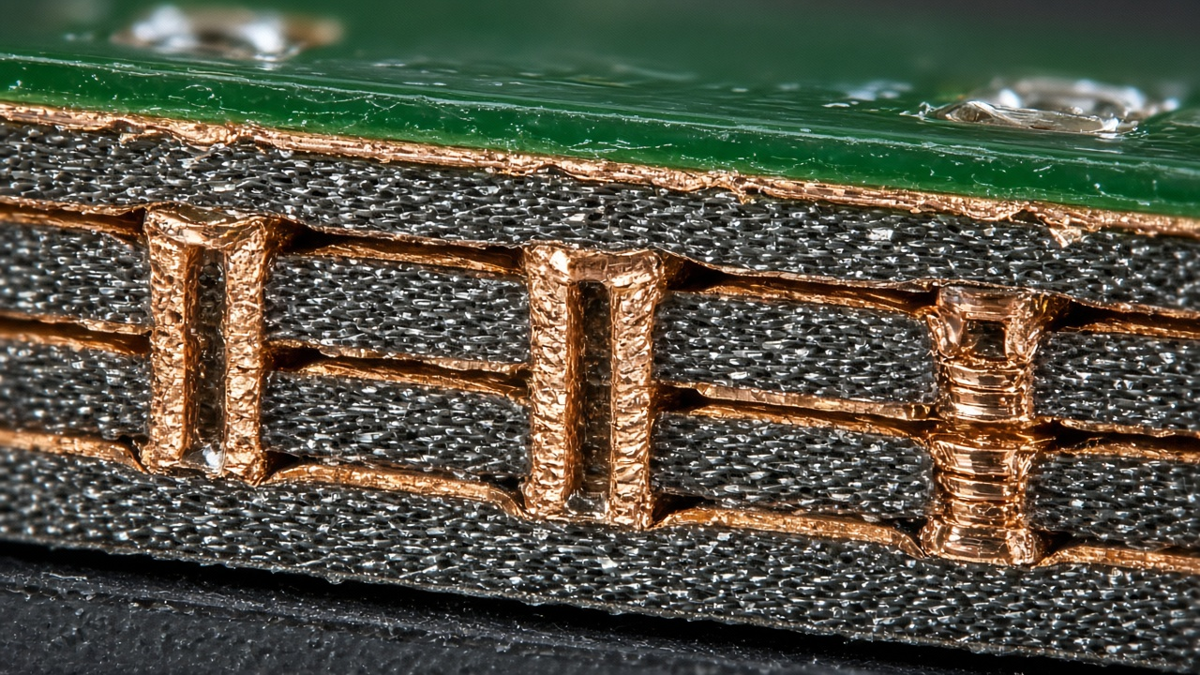
Via taxonomies list through, blind, buried, microvia, thermal, and via-in-pad as if the buyer’s job were memorizing names. Overseas programs lose money when the via architecture on the RFQ does not match the stack, speed, or density the product actually needs: through-vias on a thick board that violate aspect ratio, “add layers” when HDI microvias would have escaped cheaper, thermal and signal vias mixed under one vague fill note, or stubs left on multi-gigabit nets with no back-drill policy. The plant then quotes the wrong process book—or ships barrels that crack, register poorly, or kill the eye diagram.
This article is a via architecture policy freeze for buyers and stack owners. It is not a via-type encyclopedia. Hole-class naming (via vs PTH vs slot) lives in PCB hole types on the RFQ. When fill/cap is forced for via-in-pad lives in via fill RFQ: when forced & acceptance. HDI build-up choice lives in HDI PCB stackup DFM. Stub removal detail lives in back-drill stub and must-not-cut layer. Here the focus is architecture as cost and reliability policy: through vs HDI, aspect gates, stubs, thermal vs signal on one traveler, quote-class callouts, and failure modes.
Via architecture is a stack decision before it is a drill chart
Every via structure implies a fabrication route:
| Architecture intent | What the plant must be ready to run | Quote class shift |
|---|---|---|
| Through-via only | Mechanical drill + plate on finished thickness | Commodity multilayer |
| Blind/buried | Extra lamination / sequential cycles | Higher than through-only |
| Microvia HDI | Laser + fill/plate sequences per stack | HDI process book |
| Back-drilled through | Controlled depth drill after plate | SI specialty adder |
| VIP fill-and-cap | Fill + planarize + cap (see via-fill freeze) | Assembly-driven adder |
Writing “vias as needed” with no architecture intent lets Plant A price through-hole on 16 layers and Plant B price 1+N+1 HDI for the same Gerber story. Freeze the intent, then attach drill charts.
Decision gate: more layers with through-vias—or HDI?
Ask in this order:
- Can the BGA/package escape with through-vias and an acceptable layer count? If yes, through-via multilayer may win on quote simplicity—confirm fanout in the BGA escape playbook before assuming HDI.
- Does escape force microvias or via-in-pad density that through-holes cannot give without absurd layer count? Then HDI (or VIP with fill-and-cap) is a forcing function, not a prestige upgrade.
- Is the board already thick for mechanical/connector reasons? Through-via aspect ratio may fail before routing density does—HDI or larger drills become gates.
Wrong policy: ordering HDI because a slide said “modern,” while a clean 8–10L through-via stack routes. Opposite wrong policy: refusing HDI while packing impossible escapes into a thick through-via board.

Aspect ratio: the reliability gate that overrides CAD hole size
Aspect ratio (board thickness ÷ drill diameter) governs plating difficulty and thermal-cycle stress on the barrel. Buyers do not need to invent universal limits in a blog; they need to freeze the pair (finished thickness class × min drill) and require the plant to confirm capability—or redesign.
Policy moves:
- If mechanical thickness is primary (connector Z), raise min drill or accept sequential/HDI rather than hoping tiny through-holes plate.
- If density forces tiny holes, question finished thickness or move to microvias with low aspect.
- Put aspect confirmation on the RFQ next to thickness and min via tools—not buried in a capability PDF nobody attaches.
Failure mode when ignored: thin barrels, voids, corner cracks after reflow—often blamed on “lamination” when the architecture asked plating to do the impossible.
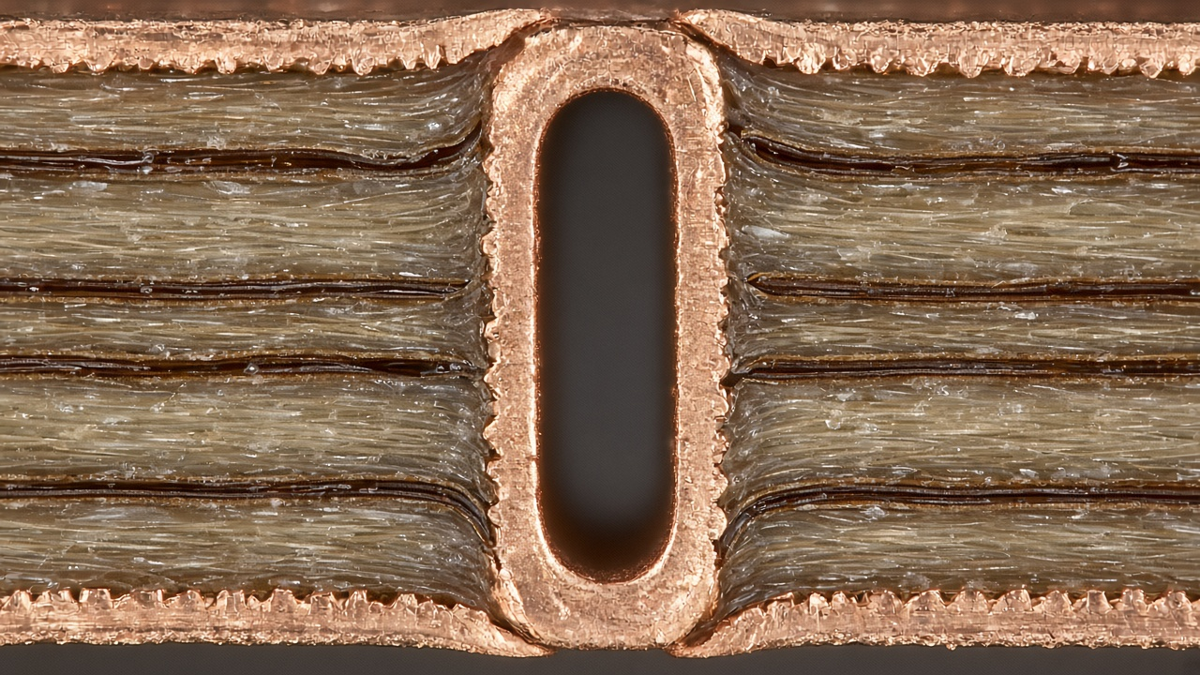
Barrel formation quality still depends on desmear and electroless before electrolytic build; architecture policy does not replace that gate—it decides whether the hole geometry is plateable at all.
Stub control: when through-vias become SI liabilities
A through-via that only needs to connect top to L3 still leaves copper barrel below L3 unless you back-drill or use blind/microvia structures. At high data rates that stub reflects energy.
Architecture choices:
- Back-drill unused stub on critical nets (freeze must-not-cut layers—see back-drill companion).
- Blind/microvia so the stub never exists.
- Accept stub only when speed/length budget allows—and write that acceptance so purchasing does not “save” back-drill later.
RFQ trap: impedance and pair notes present, no stub policy. SI fails; fab says Gerber never asked for back-drill.
Thermal vias vs signal vias on the same RFQ
Mixing intents under one note causes fill and tent mistakes:
| Intent | Typical architecture note | Do not assume |
|---|---|---|
| Signal / escape | Min drill, registration, stub policy | Thermal array rules |
| Thermal under pad | Via count/pitch, open vs filled intent | Same fill as VIP signal |
| Stitching / fencing | Pitch around RF or board edge | Random via sprinkle |
| VIP under BGA | Fill-and-cap class (via-fill freeze) | Tenting “nearby” |
Freeze separate callouts for thermal arrays and VIP signal vias. Open thermal vias that must stay open for a heatsink path are not the same class as resin-filled capped VIP. Point fill details to the via-fill article; here only insist they are not one checkbox.
Cost traps buyers should name on purpose
Via architecture drives panel cost through drill hits, laser cycles, sequential lamination, fill-cap count, and back-drill hits—not through the word “via” alone.
| Trap | What happens | Freeze that helps |
|---|---|---|
| Tiny through-holes on thick boards | Scrap / plate issues / requote | Aspect pair confirmed |
| Blanket HDI label | Wrong process priced | Stack type 1+N+1 / 2+N+2 named |
| All vias filled | Cost blowout | Selective VIP map (via-fill freeze) |
| No back-drill on SI nets | Late ECO | Stub policy per net class |
| Via count explosion | Drill time dominates | Escape review before layer add |
| Mixed thermal/VIP notes | Wrong plug/fill | Separate structure classes |
See PCB cost traps for panel, via, and finish for how via hits bundle into quotes; this freeze keeps architecture from being the silent driver inside those traps.
RFQ via-structure callouts that change quote class
Require bidders to restate:
| Field | Freeze |
|---|---|
| Primary architecture | Through-only / blind-buried / HDI microvia / mixed (describe) |
| Finished thickness class | With min drill → aspect confirmation |
| HDI stack type if any | e.g. 1+N+1 vs deeper—per HDI DFM gate |
| Stub policy | None / back-drill nets / blind only |
| VIP / fill-cap set | Pointer to via-fill structure class + via list |
| Thermal via policy | Open / filled / capped—per array |
| Registration / annular intent | Critical classes called out |
| FA evidence | Continuity; microsection sample if high aspect or HDI; stub depth if back-drilled |
| No silent architecture swap | ECO to move through↔HDI or drop back-drill |
A quote that prices “standard vias” against an HDI Gerber is not comparable to a quote that prices laser cycles.
Failure modes tied to architecture—not to “bad vias”
| Symptom | Likely architecture miss | First corrective ask |
|---|---|---|
| Barrel crack / ICS after reflow | Aspect too high; thin plate | Thickness vs drill; section |
| Open after thermal cycle | Registration/annular; weak plate | Drill QA + plate gate |
| SI eye collapse | Stub left on through-via | Back-drill or blind |
| BGA open at VIP | Fill/cap class wrong | Via-fill acceptance—not more through-holes |
| Quote 2× apart | Architecture ambiguous | Restate primary architecture |
| Cannot escape BGA | Through-only on too few layers | HDI or layer/escape redesign |
| Heatsink pad solder void | Thermal vias open when VIP fill expected—or filled when open needed | Separate thermal policy |
Through-via multilayer: when it remains the right freeze
Keep through-via architecture when:
- Layer count needed for routing/planes is moderate.
- Aspect ratio at min drill is inside the plant’s confirmed window.
- Speeds do not require stub removal—or back-drill is an accepted adder on few nets.
- VIP count is low or avoidable by escape.
Escalate inside through-via (larger drills, more layers, selective back-drill) before jumping to full HDI—unless escape math already failed.
HDI / blind architecture: when it is the right freeze
Move to HDI or blind/buried when:
- Escape density forces microvias or VIP.
- Through-via aspect cannot be met at required thickness.
- Stub-free short transitions are cheaper than deep back-drill forests.
Then freeze stack type and via span (L1–L2, etc.) on the RFQ—adjectives like “HDI-ish” are not architecture. Fill for stacked microvias and VIP stays in the via-fill freeze; do not re-specify material encyclopedias here.
Registration and stack-hit: architecture meets drill control
Blind/buried and stacked microvias multiply registration risk. Through-vias on thick stacks multiply drill wander risk relative to annular ring. Architecture policy should point to mechanical drill and stack-hit controls on critical tools without turning this post into a drill-bit manual—require FA position capability appropriate to the annular you drew.
Panelization and drill-hit economics (architecture, not bit catalogs)
Architecture choices change how many hits a panel takes and whether those hits are mechanical, laser, or depth-controlled back-drills. Buyers should ask for a rough via-hit narrative on dense boards:
- Through-via escape on many layers → high mechanical hit count; watch min tool mix.
- HDI microvia → laser cycles per build-up; stacked vs staggered changes risk more than “hit count” alone.
- Selective back-drill → fewer SI problems, extra CNC depth program and scrap risk if must-not-cut layers are wrong.
You do not need a drill-bit treatise to freeze architecture. You need the plant to acknowledge which hit families exist on your stack before they underbid a through-only shop against an HDI Gerber. Drill diameter/position FAI still matters for annular integrity—architecture policy decides which holes are critical enough to call out on FA.
Mixed-architecture boards: write the spans
Many products are not pure through-via or pure any-layer HDI. They combine L1–L2 microvias for escape with through-vias for power and connectors. That is valid—and it is a mixed architecture that must appear on the RFQ:
- Microvia spans listed (e.g. L1–L2, L16–L15).
- Through-via tools listed separately with aspect confirmation.
- Fill-and-cap only on the VIP subset (via-fill freeze), not on every microvia by slogan.
- Stub policy only on the nets that need it.
If the quote collapses everything to “HDI board,” you will not see which adder you are paying for—and CAM may apply the wrong process to the wrong holes.
Freeze checklist before Gerbers go to quote
- Primary via architecture named (through / HDI / mixed with spans).
- Thickness × min drill confirmed for aspect—or redesign flagged.
- Stub policy for high-speed nets written.
- VIP/fill deferred to via-fill structure class with selective list.
- Thermal arrays called out separately from signal VIP.
- Quote must echo architecture (laser cycles, sequential, back-drill, fill-cap) as separate understandings—not one “via” line.
- ECO rule for architecture change after award.
What to decide on the next multilayer RFQ
Do not start from “which via type sounds advanced.” Start from escape density, board thickness, and speed:
- If through-vias clear aspect and routing, freeze through-via architecture and only add back-drill or selective VIP where forced.
- If escape or aspect fails, freeze an HDI stack type and via spans—then apply the via-fill freeze only where pads demand fill-and-cap.
- If thermal and signal vias share a pad field, split their structure notes before anyone tents or fills the wrong set.
Via catalogs explain vocabulary. An architecture freeze—aspect, stub, through vs HDI, thermal vs VIP, and quote-class callouts—decides whether the board is manufacturable at the price you think you bought. When thickness, package pitch, or data rate changes, reopen the freeze; do not inherit last board’s through-via habit onto a dense BGA that already needed microvias.