
Catalogues of “PCBA burning” usually walk socket programmers, ISP cables, and a verify-after-write checklist. Overseas buyers already know firmware must land in non-volatile memory. What actually breaks schedule and yield is where programming sits on the traveler, which RFQ callouts the EMS must freeze (fixture class, checksum, unique ID, security/OTP, partial vs full image), and what evidence package proves a lot was programmed correctly—without confusing a flash fail for an FCT fail, or burning boards before they can survive reflow.
This article is a programming traveler and RFQ freeze for turnkey and consignment PCBA. It is not a programmer hardware catalog, and it does not rewrite powered FCT scope. Where assembly steps sit relative to SMT lives in PCB assembly before and after the SMT line. How test stacks change by stage lives in the proto→ramp→volume RFQ matrix. Powered behavior gates live in functional circuit testing. Pad access for probes and headers lives in DFT pads and nets probes miss. First-piece setup release lives in PCBA first article inspection (FAI). Here the question is narrower: when do you program, what must the PO name, what yield traps to budget, and what evidence overseas buyers should demand.
Programming is a traveler policy, not a tool brand
Treat firmware load as a named step with inputs and outputs, the same way you treat SPI, AOI, or selective solder. The tool (socket gang programmer, bed-of-nails ISP, clip-on SWD, boundary-scan box) is secondary until the traveler answers:
- Which revision of which image is allowed on this lot?
- At which station does the write happen—and what must already be true about the board?
- What proves success (blank check, write, verify/checksum, optional unique ID, optional security lock)?
- What happens on fail (reflash once, quarantine, swap MCU, scrap)?
If those four are missing, two plants can both say “programming included” and deliver different products: one with a bootloader-only image, another with production firmware locked and serialized.
Traveler slots: pre-SMT, post-reflow, FCT nest, or offline
Pick the slot for engineering reasons, then freeze it on the traveler. Do not inherit last product’s habit.
| Traveler slot | When it fits | What must already be true | Typical risk |
|---|---|---|---|
| Offline / pre-place (chip programmed before SMT) | High volume; MCU or flash available as programmed tape/reel; layout has no need for on-board pads | Known-good image; tape labeling matches firmware rev; MSL still valid after any bake/handle | Wrong-rev reel; mix-up with blank parts; cannot patch after place without rework |
| Post-reflow / before FCT (on-board ISP/JTAG) | Most NPI and mid volume; firmware still moves; one PCB rev, many FW spins | MCU soldered and powered rails safe to energize for program; DFT pads/header present | Power brown-out during write; ESD; probe wear; programming before AOI/X-ray hides process defects as “flash fails” |
| Inside FCT nest (program + verify as FCT steps) | Volume with frozen image; fixture already touches power + debug | FCT procedure owns flash identity; golden board and limits defined | Merging flash and functional fail codes; slow cycle if full image every board |
| Field / depot / late bind | Unique ID, crypto keys, or customer region config after system test | Secure process for keys; clear “blank vs final” state in MES | Untracked boards leaving factory half-programmed; warranty ambiguity |
Rule of thumb for overseas RFQs: default to post-reflow on-board programming with a named image hash unless volume and part logistics clearly justify pre-programmed devices. Pre-programming looks cheap until a late firmware ECO forces a reel quarantine.
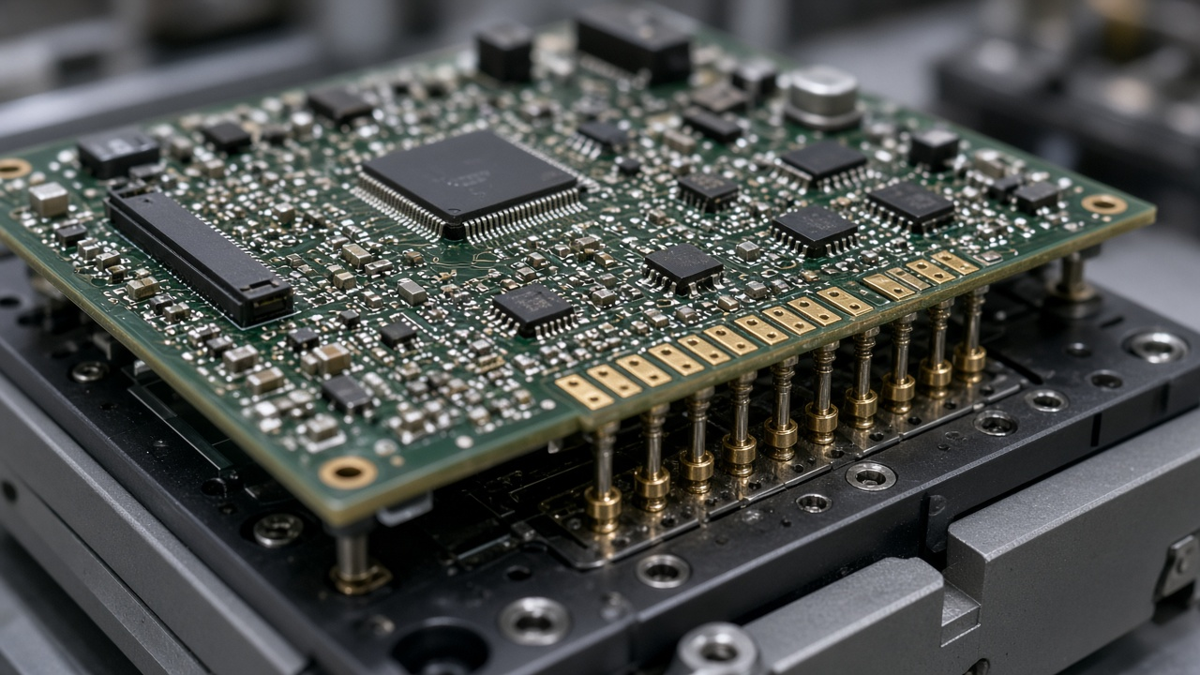
Pre-SMT programming — when it earns the slot
Use offline programming when:
- The MCU/flash is cheap to scrap if wrong, or the supplier can reprogram under NDA.
- The image is frozen for the whole PO (or you can segregate reels by FW rev in MES).
- On-board access is poor (no pads, under shield, or coat before access).
Do not use offline programming as a shortcut when firmware still changes weekly. You will invent a second inventory of “almost the same” parts.
Post-reflow on-board — the NPI default
After SMT (and after the structural gates you named—often AOI, and X-ray where BTCs need it), program through ISP/SWD/JTAG/UART bootloader pads. Strengths: one blank part number, late FW spins, serial/UID at the last responsible moment. Weaknesses: you must design pads, power the board safely, and train operators not to treat every verify fail as a bad MCU.
Place programming after you trust solder joints enough that a flash fail is more likely a process or image problem than a tombstoned crystal. Programming a board that never should have left AOI wastes programmer time and confuses yield charts.
FCT-station programming — merge carefully
Many volume lines program inside the FCT nest: power up → flash → verify → run functional steps. That is efficient if the procedure separates fail codes:
PROG_VERIFY_FAILvsRAIL_OORvsUSB_ENUM_FAIL- Retest rule for one reflash vs functional retest after reseat
If every failure prints as “FCT fail,” you cannot tell whether the flash station, the fixture contact, or the product under test is the problem. Keep programming identity (image hash, blank-check result) in the log even when FCT owns the station.
Method choice as a traveler decision (not a catalog)
Buyers ask “socket or ISP?” The better question is what the traveler must guarantee.
Offline socket / gang programmer. Fits pre-place or tray programming of MCUs/flash. Needs correct adapter, algorithm, and Vcc/Vpp limits for that exact die revision. Yield traps: bent pins on adapters, wrong algorithm family, ESD at the socket, and unlabeled trays after a lunch break.
On-board ISP / SWD / JTAG / vendor bootloader. Fits assembled PCBA. Needs DFT lands or a header, a stable power inject path, and a cable/fixture that does not stress fine-pitch connectors. Yield traps: intermittent pogo contact, ground bounce on long cables, and “pass” when only a bootloader sector wrote.
Boundary scan / JTAG chain programming. Fits boards designed for it; can program multiple devices in a chain. Needs a correct BSDL/chain description and a frozen chain order after ECO. Yield traps: one open TDI/TDO blamed on “bad flash,” and chain breaks after a connector ECO.
Name the access method on the RFQ (offline socket / on-board SWD / on-board UART bootloader / JTAG chain). Do not leave “programming” unqualified while two bidders price different contact schemes.
RFQ callouts that change the quote class
Freeze these lines so China EMS quotes are comparable. Soft phrases like “firmware burn included” are not enough.
| RFQ callout | What to write | Why it changes money or risk |
|---|---|---|
| Image identity | Filename + SHA-256 (or vendor CRC) + release note rev | Prevents Rev A binary on Rev B BOM |
| Partial vs full | Full chip image vs bootloader-only vs app partition | Partial looks cheaper; field updates may assume full |
| Blank check / erase | Required before write? Chip erase allowed? | OTP/fuse parts cannot “erase and retry” |
| Verify method | Read-back compare and/or checksum; which address ranges | Verify-off is a known escape path |
| Unique ID / serial | Who writes UID; format; duplicate rule | Serialization at wrong station creates collisions |
| Security / OTP / readout protect | Lock bits set at factory? Key provisioning owner? | Irreversible; wrong sequence bricks lots |
| Fixture class | Clip / pogo nest / ICT-shared nails / offline socket | NRE and cycle time |
| Power during program | Fixture PSU limits; current clamp; brown-out abort | False fails from weak USB power banks |
| Owner of golden | Who holds known-good programmed board; re-verify interval | Drift and “it worked last month” fights |
| Traveler slot | Pre-SMT / post-reflow / FCT nest / late bind | Labor, WIP, and ECO cost |
| Fail disposition | One reflash; then quarantine / MCU swap / scrap | Yield math and NCR language |
| Data retention | Per-board log fields and how long kept | Overseas audit and RMA |
Attach the approved image file (or a controlled download link with hash) to the PO package. Chat-app binaries are not controlled documents.
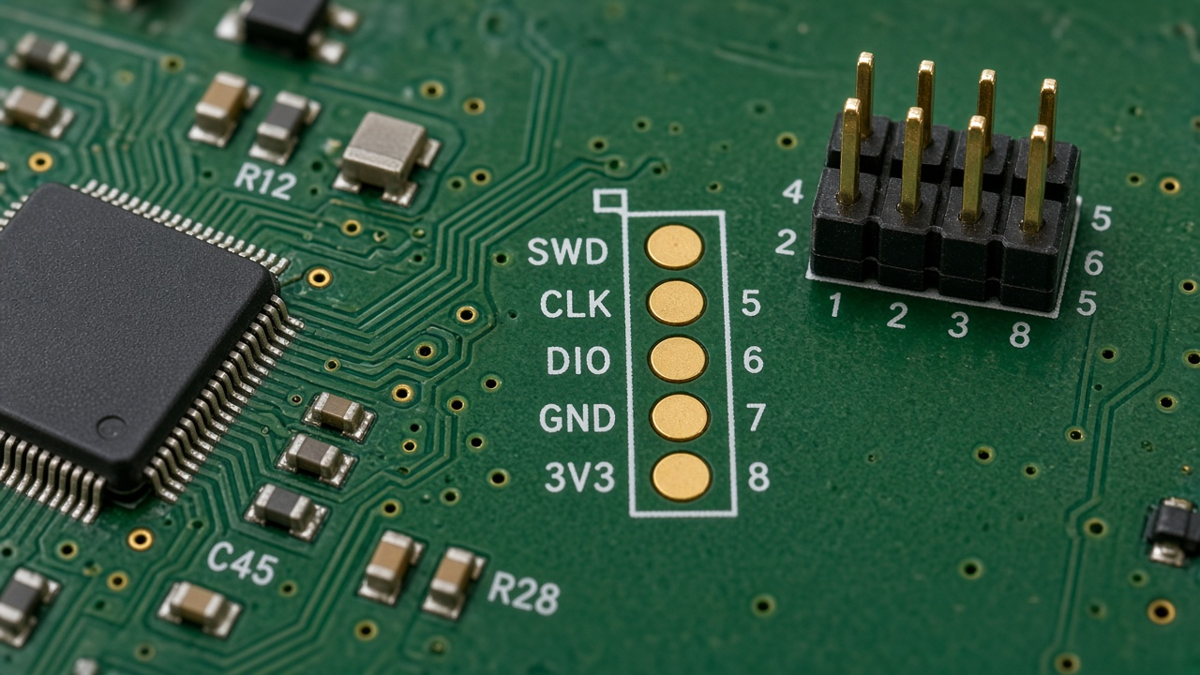
DFT for programming — pads that survive production
Programming DFT is a subset of general probe DFT, with extra constraints because energy and write cycles are involved.
Practical habits:
- Dedicated ISP/SWD/JTAG lands with enough copper and mask opening for production pogos—not only a 1.27 mm debug header you plan to depopulate later without a pad fallback.
- Pinout on the assembly drawing and silk where space allows; ambiguous pin 1 is a classic reverse-cable brick event.
- Power and return for program sized for inrush of the target plus programmer; do not rely on a fragile USB receptacle you will wear out in test.
- Keep-outs for clamps around tall shields, batteries, and displays; note coat: if conformal coat happens before program access, either leave pad keep-outs or move programming earlier.
- Series resistors / protection on debug lines if the product sees field ESD—confirm they do not violate the programmer’s timing/voltage assumptions.
- Do-not-program zones documented (high voltage, RF PA bias) so operators do not improvise clip leads.
If pads cannot be reached after mechanical assembly (enclosures, press-fit, underfill), the traveler must program earlier—or accept offline programmed devices. Do not discover that at FAI.
Yield traps: false-fail vs bad flash
Programming yield charts lie when fail codes are coarse. Separate these families before you buy more sockets.
Contact and fixture false-fails. Oxidized pads, worn pogos, misaligned nests, operator lift during write. Signature: high fail rate that recovers on reseat or second fixture; verify fails in random address ranges; neighboring stations fine. Fix: pogo life counter, cleaning interval, nest PM, dual-fixture A/B check.
Power integrity false-fails. Brown-out mid-write, shared bench supply sag, long thin ground. Signature: fails correlate with other loads on the same PSU; partial programs; checksum fails after “successful” write. Fix: dedicated clamped supply, abort-on-UVLO, cable gauge, Kelvin sense if needed.
ESD and handling. Especially offline sockets and uncoated boards. Signature: intermittent MCU death after socket, latent fails at FCT. Fix: grounded operators, ionizers where policy requires, socket maintenance, humidity control—not “reflash harder.”
Wrong image / wrong algorithm. Signature: whole lot fails verify the same way; or boards “pass” program and fail every functional step with identical symptoms. Fix: hash gate in MES before the station can start; algorithm revision locked to die marking.
True device or solder defects. Open Vcore ball, wrong crystal, missing pull-up on boot strap. Signature: fails persist across fixtures and images; often also fail structural or FCT rail checks. Fix: do not loop reflash—branch to debug/disposition.
Security lock mistakes. Setting readout protection or OTP with the wrong image, or locking before verify. Signature: irreversible; scrap or vendor unlock only if even possible. Fix: two-step traveler—verify unlock state, then lock as a separate signed step.
Budget probe wear and golden-board drift as maintenance, not as mystery yield loss. A fixture that programmed yesterday’s lot can false-fail today’s lot after a weekend of oxidation.
Acceptance evidence overseas buyers should demand
A packing list that says “programmed” is not evidence. Ask for a package that survives distance and time zones:
- Image control record — approved hash, who released it, which PO/lot it applies to.
- Station log extract — board serial or panel+position, timestamp, operator or fixture ID, blank-check result, verify/checksum result, fail code if any.
- Sample depth — 100% program+verify vs sample; if sample, the AQL or count must be written (do not assume).
- Golden correlation — date the golden was last confirmed against the same image hash.
- Security step record — if lock/OTP is required, a separate pass/fail column (not buried inside “program OK”).
- Link to FAI — first-piece should prove the programming setup (fixture, algorithm, image, limits) the same way it proves stencil and reflow; attach program logs to the FAI pack when programming is in scope.
- Retest / rework trail — how many reflashes, who authorized MCU replacement, and whether the board kept the same serial.
For regulated or high-reliability programs, agree retention length up front. For consumer NPI, even a CSV per lot plus the hash line in the COC already prevents most “which firmware did we ship?” disputes.
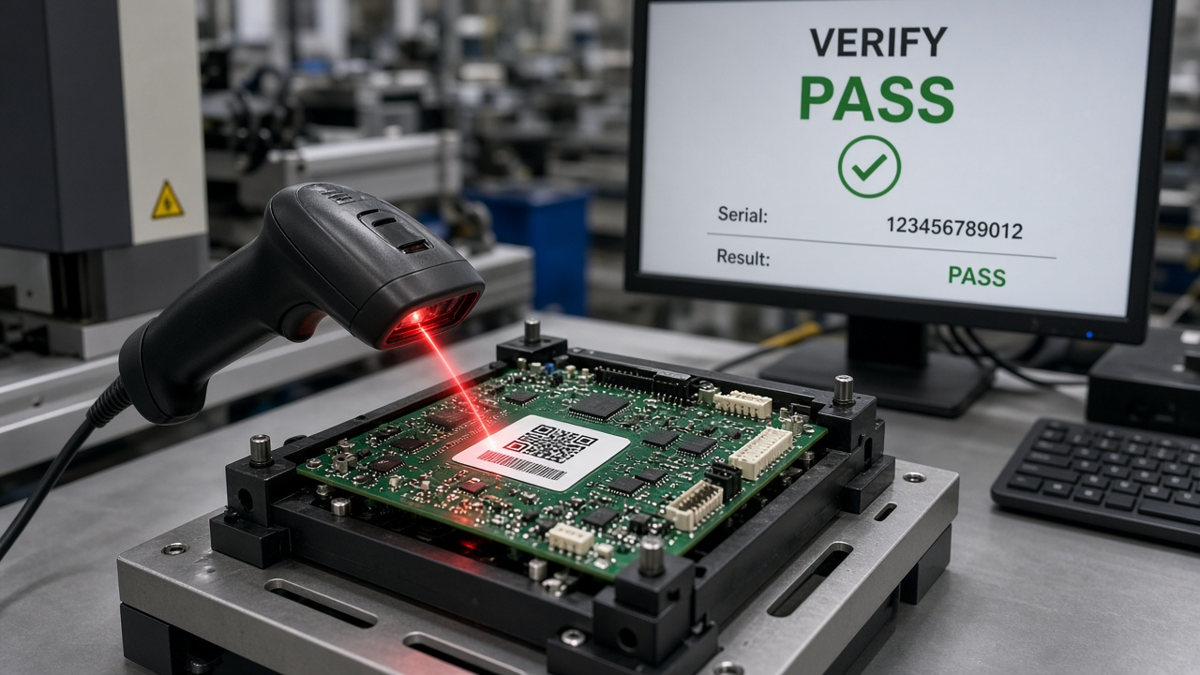
Boundaries: do not merge programming into every other gate
Keep language sharp on the PO:
- Programming proves the intended non-volatile image (and optional UID/lock) landed and verified.
- FCT proves powered behavior under a defined stimulus—often after programming, sometimes including it as steps with separate codes.
- AOI/X-ray/flying-probe/ICT prove structure and many passives; they do not execute your application image.
- FAI releases the production setup for the lot, including programming setup when in scope—not a substitute for ongoing 100% verify.
- Coat / pack / FQC happen after you decide whether pads must still be accessible.
If a bidder quotes “test and burn” as one line with no slot, no hash, and no verify method, ask them to split it before award.
Proto vs volume: when the traveler should change on purpose
Prototype lots: prefer on-board programming, thin verify, and easy image swaps. Avoid buying a gang-socket empire before the MCU choice freezes.
Ramp: lock the image hash process in MES, measure false-fail rate of the fixture, and decide whether programming stays a bench step or moves into the FCT nest.
Volume: freeze traveler slot, fixture class, pogo PM, and evidence fields. Pre-programmed reels become attractive only when ECO rate is low and reel control is real.
When firmware or debug topology changes, reopen the programming freeze the same way you reopen a stencil after a pad ECO—do not silently keep yesterday’s algorithm.
Freeze checklist before the PCBA RFQ goes out
- Traveler slot named (pre-SMT / post-reflow / FCT nest / late bind).
- Access method named (offline socket / SWD / UART bootloader / JTAG chain).
- Image identity (file + hash + rev) attached to the PO package.
- Partial vs full and blank-check/erase rules written.
- Verify method and address coverage named.
- UID / security / OTP owner and sequence named (or explicitly “not used”).
- Fixture class and power limits named.
- Fail disposition and max reflash count named.
- Evidence fields and retention named.
- Boundary vs FCT/AOI/FAI written so “burn included” cannot swallow other gates.
What to decide on the next programmed PCBA lot
Do not start from “which programmer brand.” Start from traveler and evidence:
- If firmware still moves, freeze post-reflow on-board programming with a hash-gated image and clear verify—keep offline reels off the table until ECO rate drops.
- If volume is high and the image is frozen, decide deliberately between pre-programmed devices and FCT-nest programming, and price fixture PM and false-fail rate either way.
- If security or UID matters, freeze those as separate traveler steps with their own evidence—not a checkbox inside “burn OK.”
Programming catalogs explain cables and sockets. A traveler freeze—slot, image identity, verify, security, fixture class, fail disposition, and overseas evidence—decides whether the lot you receive is the firmware you think you bought. When the MCU, boot mode, or enclosure access changes, reopen the freeze; do not inherit last board’s “program somewhere before ship” habit onto a coated, serialized product that needed lock-bit control at a named station.