
PCB substrate is the dielectric foundation of the board — typically cores and prepregs that set electrical behavior (Dk/Df, impedance), thermal and mechanical reliability (Tg, CTE, CAF), and a large share of material cost. Copper foil carries current; solder mask and finishes protect and contact the surface — they are not the substrate. Buyers who write only “FR-4” (or “flex / aluminum / ceramic” as vague checkboxes) get incompatible China quotes: Plant A prices commodity mid-Tg FR-4, Plant B prices a named high-Tg slash sheet, and neither matches the stack the design assumed.
This China-fab guide answers first: what substrate means on the traveler; why FR-4 is a flame-rating / class family, not a single recipe; a selection matrix for standard digital, high-speed/RF, flex, metal-core/LED thermal, and ceramic power; core vs prepreg vs copper foil roles; and the RFQ fields that stop silent laminate swaps. Deeper companions: copper-clad laminate, Dk & Df, custom PCB material selection, aluminum PCB guide, polyimide advantages and disadvantages.
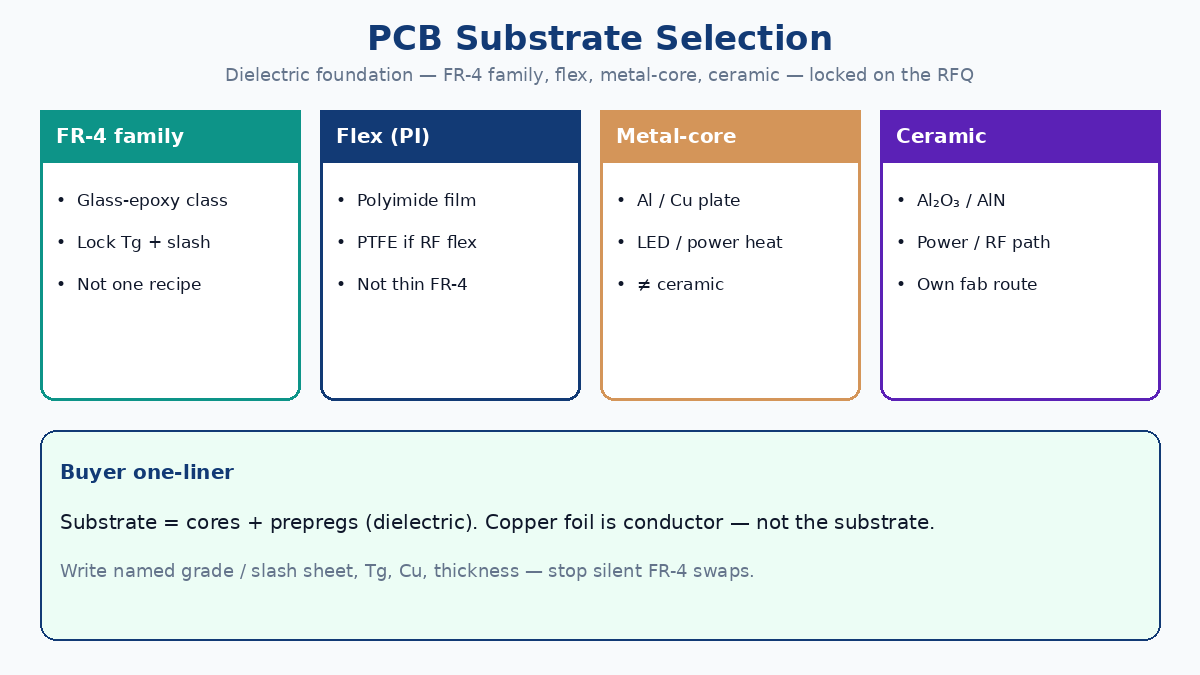
Answer first: substrate = dielectric foundation (core / prepreg)
| Term | Factory meaning | Why buyers care |
|---|---|---|
| Substrate / dielectric | Insulating layers between copper — cores and prepregs in a multilayer build | Sets impedance, loss, heat path, and much of unit cost |
| Core | Cured laminate with copper (often double-sided CCL) | Stable reference for etch, impedance, and mechanical spine |
| Prepreg (PP) | B-stage resin + glass that melts and bonds at press | Fill, bond, and dielectric thickness between cores / outer foil |
| Copper foil | Conductor layer (ED, RTF, VLP, RA on flex, etc.) | Current, etch factor, registration — not the dielectric |
| “FR-4” on an RFQ | Often a family of glass-epoxy grades meeting a flame class | Without Tg / slash sheet / named grade, quotes are not comparable |
One-line definition: substrate is what the copper sits on and what separates layers electrically. If the RFQ never names the dielectric family, Tg window, or approved alternates, CAM will fill the blank with the plant’s cheapest stock that still looks “FR-4-ish.”
Clarify two common mix-ups gently: flex is usually polyimide film (sometimes PTFE for RF flex) — not “FR-4 flex” as a default; and aluminum / metal-core is a thermal metal-backed construction, not a ceramic substrate. Ceramic (Al₂O₃, AlN, etc.) is a different materials and process family. Naming the wrong bucket on the RFQ burns EQ cycles before any panel ships.
💡 Procurement Pro-Tip: Put substrate on the product line of the RFQ the same way you put copper weight and finished thickness. “Standard FR-4” alone is a cost request, not a material lock.
FR-4 is a family — lock Tg, Dk/Df, CAF, and slash sheet
FR-4 (and related flame ratings) describes a class of glass-reinforced epoxy systems, not one resin recipe. Mid-Tg commodity FR-4, high-Tg lead-free grades, CAF-resistant systems, and controlled-Dk variants can all sit under a loose “FR-4” label in brochure language. Buyers who need repeatability lock IPC-4101 slash sheets, named commercial grades, or an approved-alternate list — plus Tg (and Dk/Df when nets care).
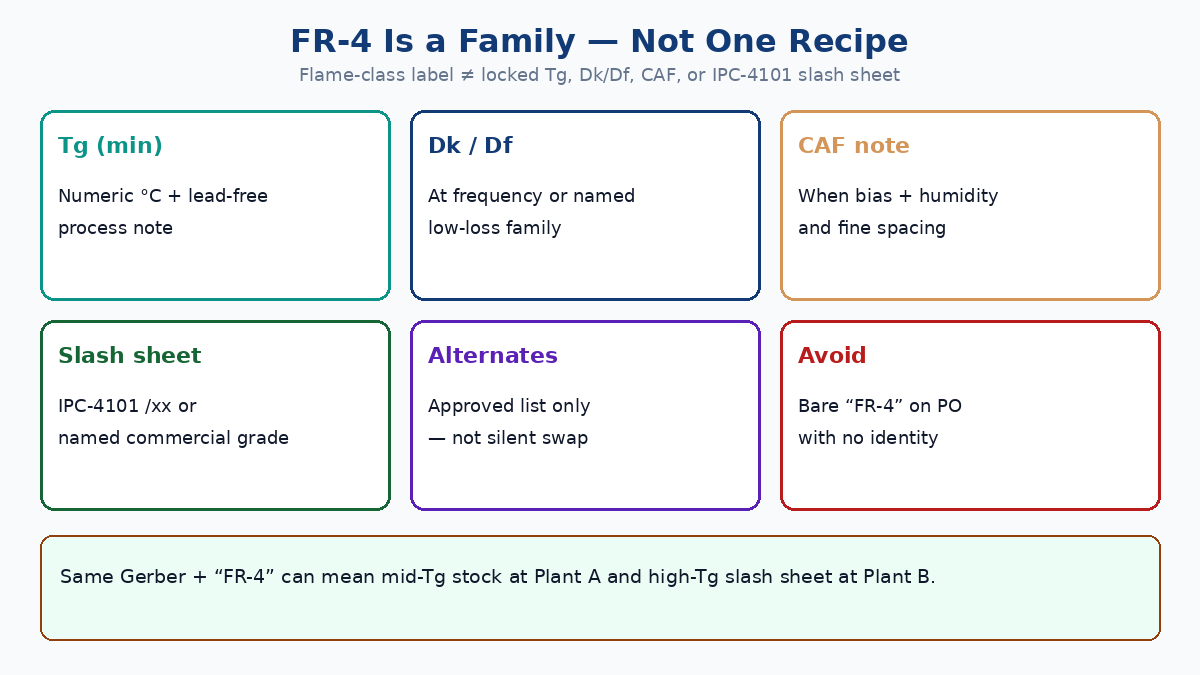
| What people say | What to write instead | Fail mode if left vague |
|---|---|---|
| “FR-4” | Named grade or IPC-4101 slash sheet + Tg min | Mid-Tg stock vs high-Tg lead-free — different risk, same label |
| “High Tg” | Numeric Tg (e.g. ≥150 °C / ≥170 °C) + lead-free process note | Soft Tg through reflow → pad crater / warp disputes |
| “Low loss FR-4” | Dk/Df at frequency or named mid/low-loss family | Commodity Df on a high-speed net → SI retune |
| “CAF resistant” | CAF note + spacing / humidity context when bias applies | Fine-pitch humidity shorts blamed on “mystery laminate” |
| “Equivalent OK” | Approved alternate list with same slash / Tg / Df window | Silent swap to cheaper resin mid-lot |
Electrical depth for Dk/Df: PCB dielectric constant and dissipation factor. Laminate construction vocabulary: copper-clad laminate. Broader decision tree when you leave commodity FR-4: custom PCB material selection guide.
Buyer rule: FR-4 on the PO without Tg and identity is an invitation for silent material substitution. China fabs stock many “FR-4” SKUs. Force the quote to mirror your stack table (core/prepreg identity or slash sheet, Tg, copper weights) so every bidder prices the same dielectric risk.
⚠️ Factory callout: If Plant A’s quote lists a named high-Tg sheet and Plant B’s quote says only “FR-4 1.6 mm,” they are not bidding the same board — even when both Gerbers and layer counts match.
Selection matrix: when each substrate family earns the RFQ
Use the matrix as a routing table, not a price list. Unit cost depends on thickness, copper, panel utilization, and China stock — inventing dollar numbers here would mislead. Lock the family first; then lock the named grade.
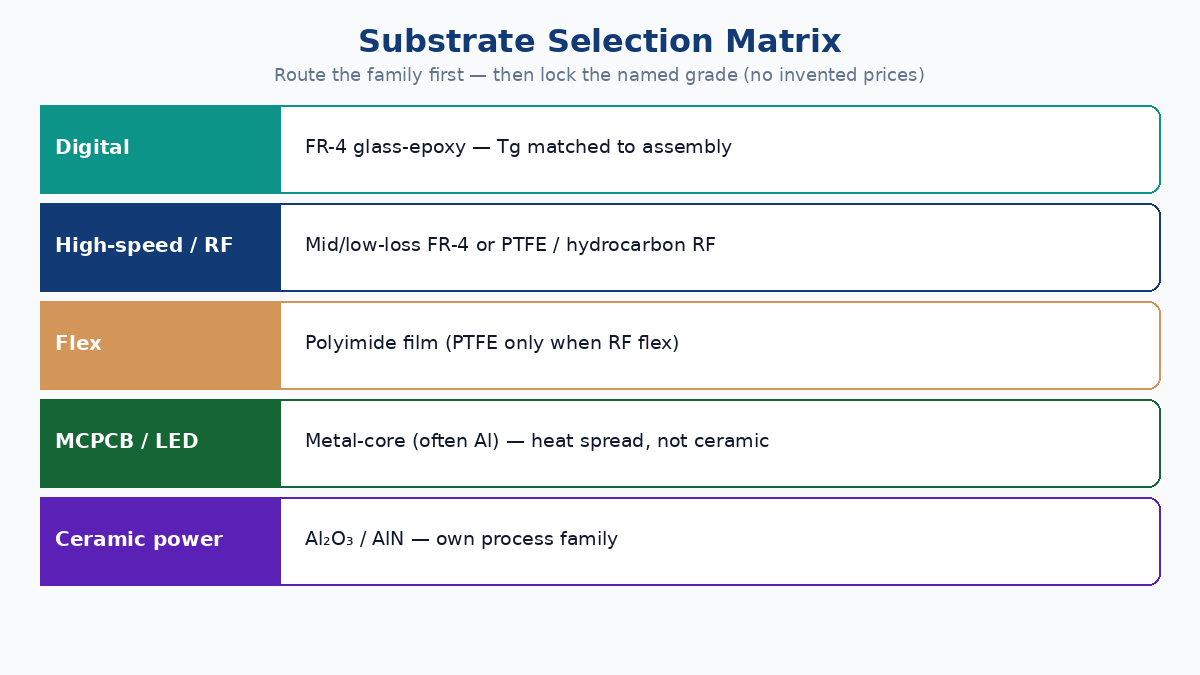
| Use case | Typical substrate family | Why it fits | What buyers must still lock |
|---|---|---|---|
| Standard digital / mixed-signal | FR-4 glass-epoxy (Tg matched to assembly) | Cost, availability, known fab process | Tg, thickness, Cu weight, slash/grade or alternates |
| High-speed / controlled impedance | Mid/low-loss FR-4 or specialty low-loss laminates | Stable Dk, lower Df vs commodity | Dk/Df @ freq, glass style notes, impedance coupon |
| RF / microwave | PTFE / ceramic-filled / hydrocarbon RF laminates | Controlled Dk, low loss at GHz | Named RF laminate, Dk tolerance, foil type |
| Flex / rigid-flex | Polyimide film (PTFE only when RF flex needs it) | Bend, space, weight; PI handles reflow classes | PI thickness, adhesiveless yes/no, Cu type (RA/ED) |
| LED / power thermal (MCPCB) | Metal-core (often aluminum) + dielectric + Cu | Spreads heat under LEDs / power devices | Metal type/thickness, dielectric thermal resistance class |
| High-power / extreme thermal / RF ceramic | Ceramic (Al₂O₃, AlN, …) | High thermal conductivity, high-temp capability | Ceramic type, metallization process, not “aluminum ceramic” |
Gentle corrections that save EQ:
- Flex ≠ “thin FR-4.” Dynamic and most install flex use polyimide film constructions. Thin FR-4 strips can do one-time form; they are not film flex. See polyimide PCB advantages and disadvantages.
- Aluminum MCPCB ≠ ceramic. Metal-core boards put copper and a thin dielectric on a metal plate for heat spreading. Ceramic substrates are sintered ceramics with different fab routes. For MCPCB depth: aluminum PCB guide. For ceramic grades: companion ceramic AlN vs Al₂O₃ content on the site.
- PTFE belongs in RF (or RF-flex) rows, not as a synonym for “flex.” Calling every soft board “PTFE flex” confuses buyers and fabs.
When thermal, electrical, and mechanical needs collide, escalate with custom PCB material selection rather than stacking buzzwords on one line of the RFQ.
Core vs prepreg vs copper foil — who does what
Multilayer travelers are built from three roles that RFQs often blur into one “material” checkbox.
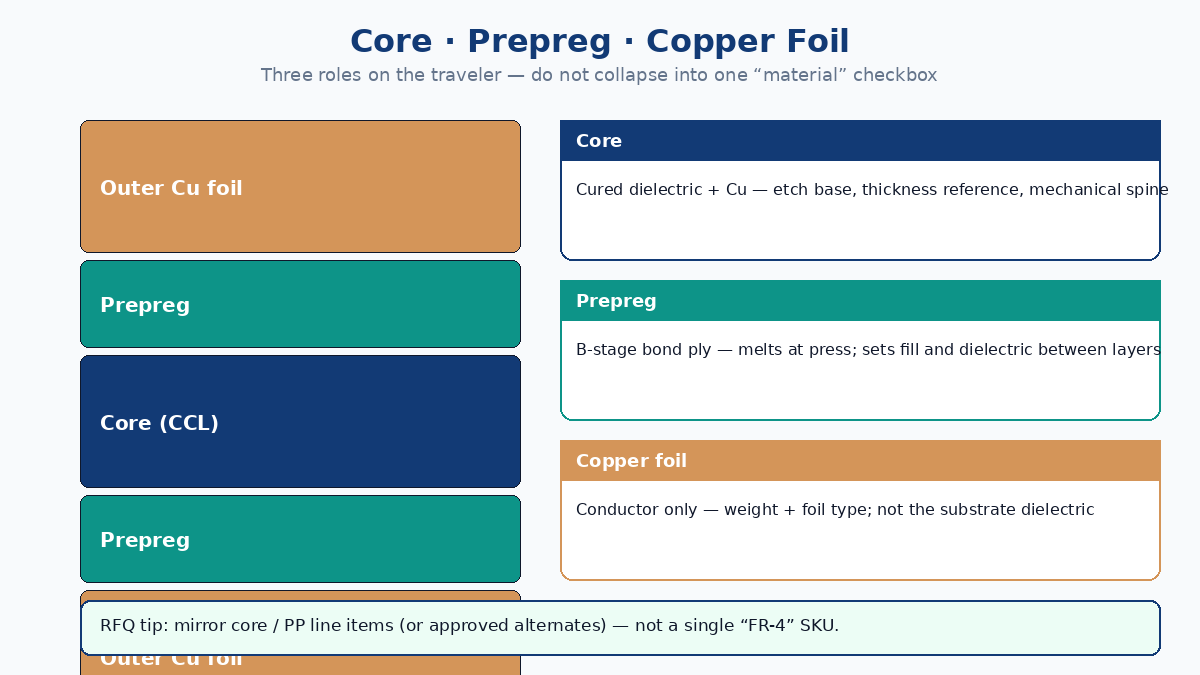
| Role | What it is | What it controls | Buyer lock |
|---|---|---|---|
| Core | Fully cured dielectric + copper (CCL) | Reference thickness, etch base, mechanical stiffness | Core thickness, Cu weight, laminate identity / Tg |
| Prepreg | Partially cured bond ply | Bond between cores / foil; dielectric fill; final dielectric thickness after press | PP type / resin content family matched to cores; count and style |
| Copper foil | Conductor (outer foil or on core) | Resistance, etch factor, roughness (loss / peel) | Weight, foil type (ED/RTF/VLP/RA as needed) |
Practical stack language: “2 × cores + N prepregs + outer foil” is how fabs think. Writing only “4-layer FR-4 1.6 mm” leaves CAM free to choose core/prepreg splits that hit thickness but miss impedance or registration intent. When impedance or HDI registration matters, attach a stack table (core/PP thicknesses and identities) — one table prevents three EQ loops.
Dimensional and registration companions when thin cores stretch: see site content on laminate dimensional stability and multilayer stackup fabrication. Electrical companions for the dielectric numbers: Dk & Df. Construction of the clad sheet itself: copper-clad laminate.
💡 Procurement Pro-Tip: Ask the fab to mirror core and prepreg line items on the quote (or list approved alternates). A single “FR-4” SKU on the quote with no core/PP split is a thickness and price quote — not a stackup lock.
China fab RFQ: stop wrong-material and silent-swap quotes
Paste a short substrate block into every RFQ so Plant A and Plant B price the same risk. Soft XFPCB practice is the same: named laminate or approved list, Tg, copper, thickness, and a written no silent swap rule.
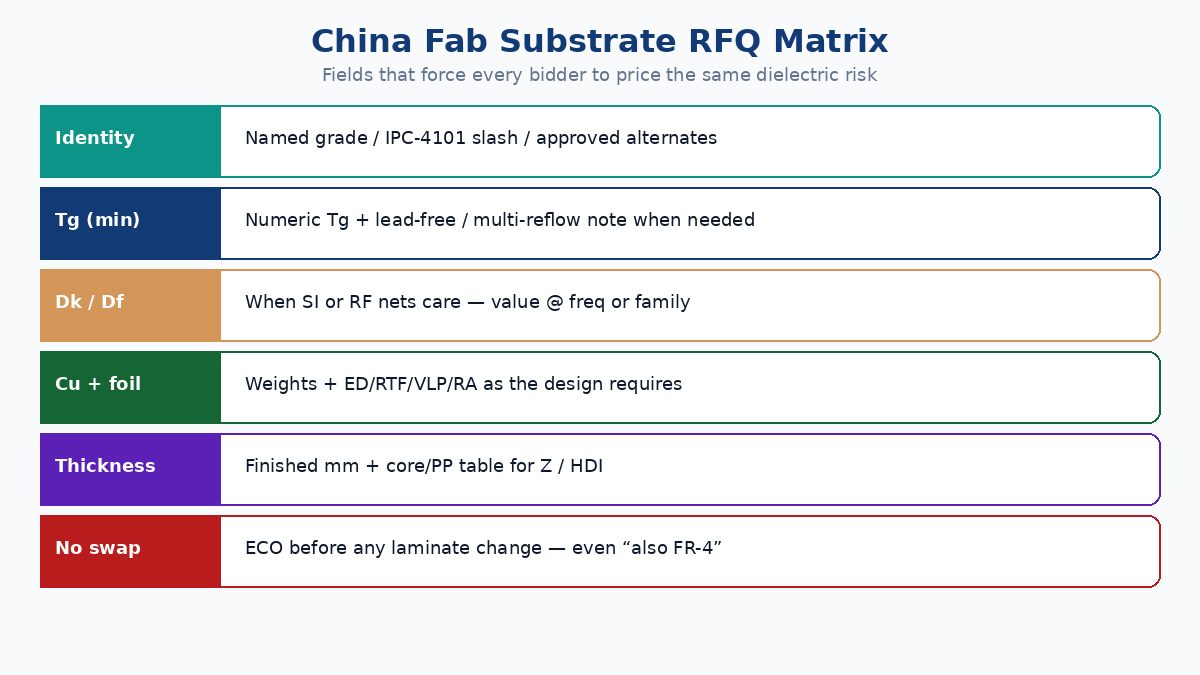
| RFQ field | What to specify | Fail mode if missing |
|---|---|---|
| Laminate identity | Named grade or IPC-4101 slash sheet or approved alternates | Commodity FR-4 vs specialty priced as the same |
| Tg (min) | Numeric Tg + lead-free / multi-reflow note when needed | Soft Tg through assembly → reliability disputes |
| Dk/Df (when needed) | Values @ frequency or named low-loss / RF family | SI / RF nets on wrong dielectric |
| Copper weight & foil type | e.g. 1 oz outer / 0.5 oz inner; RTF/VLP/RA if required | Unexpected etch, loss, or flex fatigue |
| Finished thickness & stack | Overall mm + core/PP table for impedance / HDI | Thickness met with wrong dielectric split |
| Family when not FR-4 | Flex PI / MCPCB metal / ceramic type — explicitly | Flex quoted as thin FR-4; Al quoted as “ceramic” |
| Change control | No silent laminate swap without ECO / buyer approval | Mid-lot resin change that still “meets FR-4” |
No silent swap is the line that protects NPI and volume alike. Many China travelers allow “equivalent FR-4” unless the PO forbids it. Require the fab to list the exact core/prepreg (or slash sheet) they will run, and to ECO any alternate — even if the alternate is also “FR-4.”
When the board leaves commodity FR-4, point bidders at the matching depth pages so EQ starts informed: custom material selection, aluminum / MCPCB, polyimide, Dk/Df, CCL basics.
Soft close — XFPCB substrate quoting
XFPCB quotes from the stack and material block you send, not from a brochure checkbox. Share Gerbers or a stack sketch, named laminate or approved alternates, Tg, copper weights, finished thickness, and whether the build is standard FR-4, flex, metal-core, or ceramic-adjacent. We will mirror those fields on the quote and flag silent-swap risk before award — so Plant A and Plant B (including us) bid the same dielectric, not the same marketing word.
Related reading to attach to the RFQ package: copper-clad laminate, Dk & Df, custom PCB material selection, aluminum PCB guide, polyimide advantages and disadvantages.