
Electrically conductive adhesive (ECA) is a polymer glue loaded with metal particles so a cured joint conducts current — and often heat — without melting solder. China PCBA lines reach for ECA when the thermal budget kills a part, when a package cannot take solder metallurgy, or when anisotropic paste must connect fine pads without bridging. Default still remains solder for most SMT and THT; ECA is a controlled exception that needs its own dispense, pressure (for ACA), cure ownership, and inspection rules on the RFQ. This factory note defines ECA, splits ICA vs ACA, covers formulation and cure systems, then locks when a China SMT/dispense line will accept adhesive instead of solder — plus failure paths buyers fear and the RFQ fields that keep quotes comparable.
Answer first: what ECA is, and when it replaces solder
| Question | Factory answer |
|---|---|
| What is ECA? | Resin + conductive fillers that form electrical paths after cure (particle contact, sometimes tunneling across thin polymer gaps) |
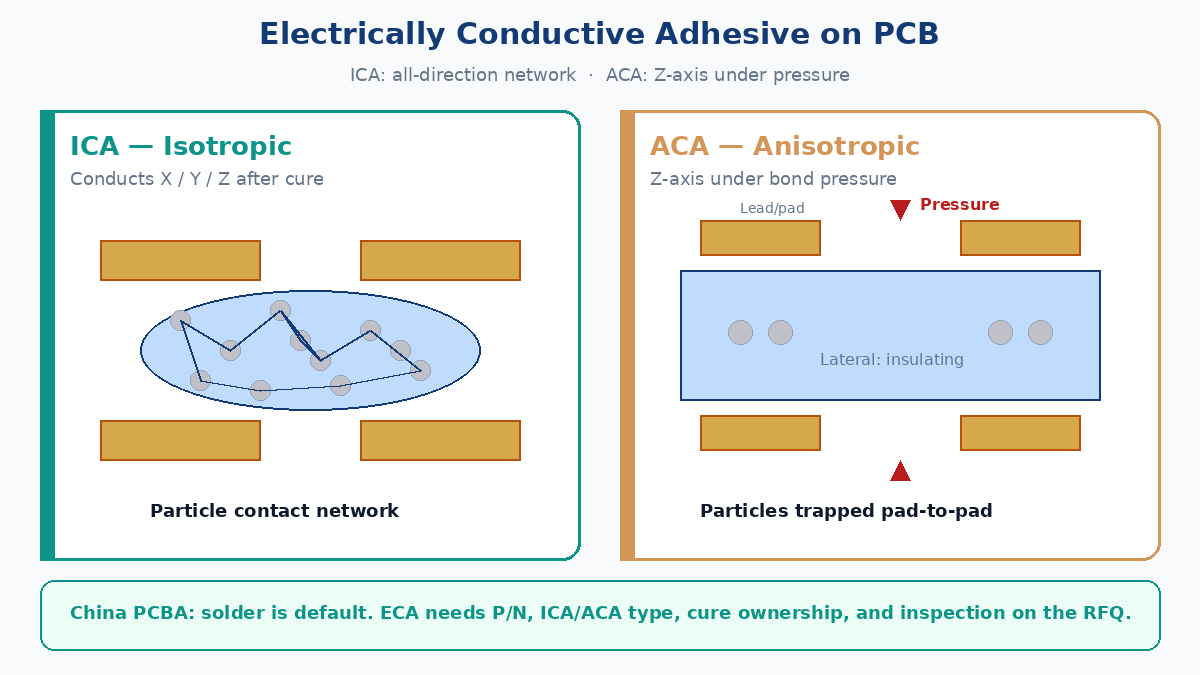
| ICA vs ACA | ICA conducts in all directions after cure; ACA conducts mainly in the Z-axis under pressure and stays insulating laterally |
| Why not always solder? | Heat-sensitive dies/sensors, incompatible finishes, flex/stress joints, or fine pitch where solder bridges |
| Default on China PCBA | Solder (paste + reflow or wave/selective) unless the drawing forces adhesive attach |
| What the plant must own | Adhesive P/N or type, dispense/print window, ACA pressure, cure profile, inspection limits, rework policy |
Buyer rule: if the BOM only says "conductive epoxy" with no type, cure, or inspection callout, expect solder-line defaults, open-joint scrap, or a quiet no-quote.
💡 Procurement tip: Put ECA on the traveler as its own process family — not as a paste substitute. Same stencil printer can print ICA paste; it is still a different material family with different cure and rework rules.
How conduction works without solder metallurgy
Solder melts, wets metal, and freezes into a continuous alloy bridge. ECA never forms that alloy. Conductivity comes from:
- Particle–particle contact — fillers touch each other and the pad/lead metallization once resin shrinks and packs the network.
- Tunneling / thin-film paths — where particles sit close but not fully fused, electrons can still cross thin polymer gaps. That path is more sensitive to incomplete cure, humidity swell, and filler settling than a solder fillet.
That is why ECA joints care about volume, particle loading, and cure completeness more than about "wetting shine." An open ECA joint often looks like a neat glue blob with high resistance — not a classic cold solder appearance.
ICA vs ACA (do not mix process windows)
| ICA (isotropic) | ACA (anisotropic) | |
|---|---|---|
| Conduction | X/Y/Z after cure | Mainly Z under bond pressure |
| Typical use | Die attach, jumper repair, ground/heat straps, some connectors | Fine-pitch display/flex-to-board, chip-on-glass style attach |
| Short risk | Bridging if volume/spread uncontrolled | Lateral short if particle density + pressure + gap wrong |
| Open risk | Low filler contact, underfill of gap, incomplete cure | Insufficient pressure, uneven bond line, contamination |
| Process ownership | Dispense or print + cure profile | Dispense/print plus controlled pressure/fixture + cure |
ICA is the common "silver epoxy" story on RFQs. ACA is a different process: the adhesive is insulating in-plane until particles are trapped between opposing pads under load. Treating ACA like ICA (dispense only, no pressure recipe) is how factories create intermittent opens or mysterious lateral shorts.
Formulation buyers should recognize (no magic resistivity claims)
Commercial ECAs are engineered mixes, not "glue with metal dust":
- Resin matrix — epoxy is common; acrylic, silicone, and hybrid systems appear when flexibility or cure speed matters.
- Fillers — silver dominates for conductivity and oxidation resistance; copper, nickel, and gold-coated particles show up for cost, migration control, or specific metallizations. Loading and particle shape (flake vs sphere) set contact quality more than marketing slogans.
- Solvents / rheology — control dispense stringing, stencil printability, and wet-out. Wrong viscosity = voids or starve.
- Additives — adhesion promoters, anti-settling agents, tougheners, ionic purity packages. Settling in the syringe or jar is a real yield killer if the line skips mix/refresh rules.
Do not invent or demand single resistivity numbers on the RFQ unless the adhesive datasheet and your electrical model already agree. Call the adhesive part number (or qualified equivalent list), filler family if the drawing requires it, and the datasheet cure window the plant must own.
Cure systems: RT, medium, high temp, UV
| Cure class | What it means on the line | Buyer watch-out |
|---|---|---|
| Room temperature | Long open time / overnight cure; limited capital | Incomplete cure if rushed into test; humidity sensitive |
| Medium thermal | Oven or conveyor bake below typical lead-free peak | Profile ownership still required — "bake awhile" is not a profile |
| High thermal | Higher oven setpoints, still usually below solder reflow peaks | Thermal budget gain shrinks; verify part rating |
| UV / UV+thermal | Light cure for speed or shadowed dual-cure | Shadow under opaque packages; dual-cure must finish both legs |
Under-cure → high resistance that may "improve" or drift after more heat. Over-cure / wrong ramp → brittle joints, cracked fillets, or pad lift on delicate finishes. Put time–temperature (and UV dose if used) on the traveler; do not leave cure as operator folklore.
When China PCBA lines accept ECA vs insist on solder
Factories prefer solder whenever thermal budget, pad finish, and package allow it. Solder has mature paste/print/reflow windows, IPC visual criteria most inspectors already know, and cheaper materials than silver-filled epoxies.
ECA is usually accepted when one or more hold:
- Peak temperature of reflow or wave would damage the device or nearby materials.
- Package or die attach was designed for adhesive (many sensors, LEDs, RF dies, flex interconnects).
- Pad finish and component metallization are adhesive-qualified (ENIG is common; OSP and some immersions need datasheet confirmation — do not assume solderability = adhesiveability).
- Mechanical stress on flex or vibration nodes favors a polymer joint over a brittle solder fillet and the design was analyzed for that choice.
- Pitch / gap makes ACA the intended interconnect, not a solder bridge lottery.
Lines push back to solder when:
- The part is a standard SMT package with a solderable finish and no thermal objection.
- The RFQ is silent on adhesive P/N, cure, and inspection — plants will not invent a stable process for free.
- Rework must match field service solder practice and the customer forbids adhesive rework limits.
- Volume cost cannot absorb Ag-epoxy material plus slower cycle / lower first-pass yield.
Pad finish note for RFQ language: name ENIG / OSP / immersion Ag / immersion Sn next to the adhesive callout. OSP windows and shelf life that work for solder paste may not match ECA wet-out and adhesion. Package note: QFN/BGA ground pads and heat slugs sometimes use thermal/electrical epoxy under a soldered perimeter — call that hybrid attach explicitly so the plant does not omit adhesive or omit solder.
Process windows: dispense, print, ACA pressure, cure ownership
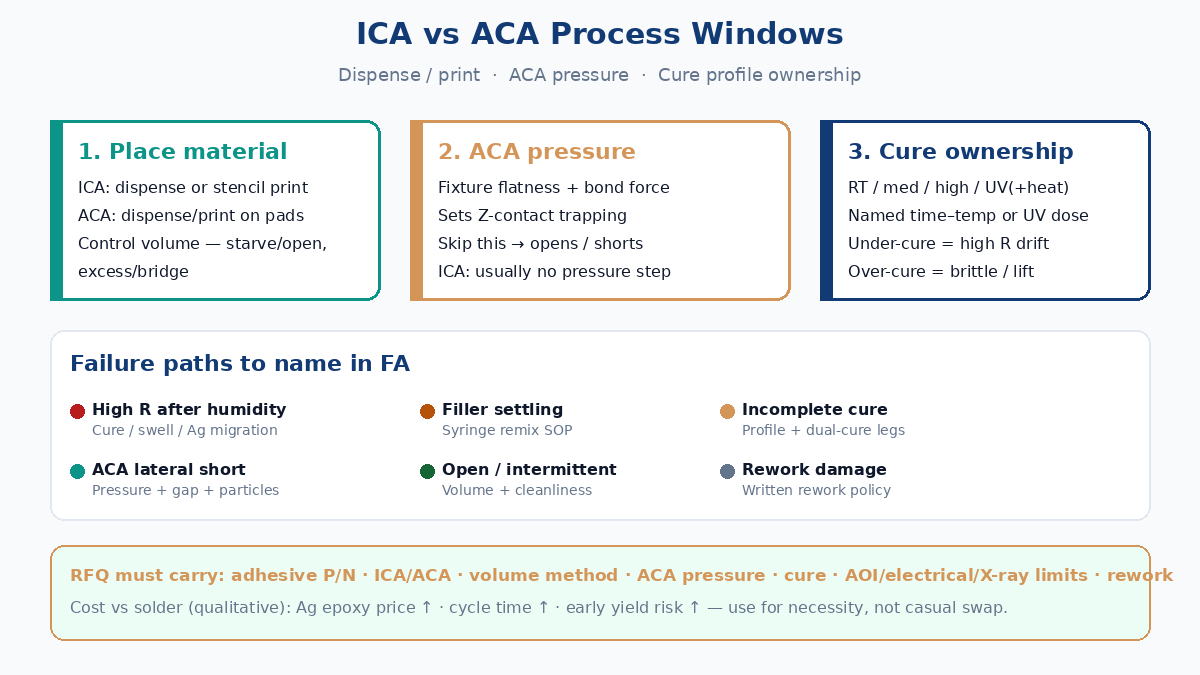
ICA
- Dispense (needle/jet) for dots and fillets; stencil/screen print for larger footprints when rheology allows.
- Control volume and placement — starve = open; excess = bridge to adjacent copper.
- Own mix life, syringe refresh, and anti-settling practice from the datasheet.
ACA
- Same placement care plus bond pressure, bond-line thickness, and fixture flatness.
- Particle trapping between pads is the joint; pressure too low → open; wrong gap/pressure/particle loading → lateral conduction (short).
- Do not quote ACA as "just conductive glue dispense."
Shared
- Cure profile owner named on the PO (customer recipe vs plant proposal locked after FA).
- Cleanliness / flux residue rules if ECA follows or precedes solder steps on mixed boards.
- Handle time between dispense and cure (skin-over and moisture pickup).
⚠️ Watch out: Quotes that say "conductive adhesive OK" with no dispense vs print choice, no ACA pressure note, and no cure table. That language prices optimism, not a process.
Failure modes buyers actually fear
| Failure | Typical path | What to lock on RFQ / FA |
|---|---|---|
| High resistance after humidity | Incomplete cure, polymer swell, Ag migration / corrosion on dirty surfaces | Cure completeness check; cleanliness; bias-humidity if the product needs it |
| Filler settling | Syringe/jar storage, skipped remix, long pot life abuse | Mix/refresh SOP; lot control; reject criteria for separation |
| Incomplete cure | Short oven time, wrong setpoint, UV shadow | Profile with thermocouples; dual-cure both legs |
| Lateral ACA short | Excess particles / wrong pressure / pad gap | ACA process window + electrical short test plan |
| Open / intermittent | Starve volume, contamination, no pressure on ACA | Volume SPC, plasma/clean if specified, bond pressure record |
| Rework damage | Peeling cured epoxy, overheating pads, leftover conductive smear | Written rework policy: allowed / limited / scrap-only |
Silver migration under bias and humidity is a reliability topic for Ag-filled systems on fine gaps — address with cleanliness, conformal coat decisions, and spacing rules where the product requires it. Do not treat "we used conductive epoxy" as automatic immunity from electrochemical failure.
Cost structure vs solder (qualitative)
Expect ECA builds to cost more than the same attach in solder when solder is viable:
- Material — Ag-filled epoxies are typically far more expensive per gram than solder paste.
- Cycle time — dispense + dedicated cure can be slower than a mature reflow lane; RT cures add WIP time.
- Yield / NRE — new ACA fixtures, profile FA, and early open/short scrap raise the first-lot bill.
- Inspection — AOI may not "see" alloy fillets; electrical test and sometimes X-ray limits need explicit scope (X-ray is poor for many polymer joints — do not assume solder X-ray criteria transfer).
Use ECA for technical necessity or design intent, not as a casual substitute to "avoid reflow."
China PCBA RFQ checklist for ECA jobs
Copy these fields onto the RFQ so bidders price the same process:
- Adhesive P/N (or approved equivalents) and ICA vs ACA type
- Where used — reference designators / pad map; hybrid solder+adhesive callouts
- Volume / method — dispense vs print; target bond-line or dot size if critical
- ACA pressure / fixture — if ACA; who owns fixture NRE
- Cure — time–temperature and/or UV dose; who owns the profile
- Pad finish + package — ENIG/OSP/etc.; moisture sensitivity / max temp
- Inspection — AOI expectations, electrical test, X-ray limits (or "X-ray N/A — polymer joint")
- Rework policy — allowed methods, max cycles, or scrap-only
- Cleanliness / coat — wash compatibility, ionic limits, conformal coat over ECA yes/no
- FA / first article — resistance or continuity criteria after cure and after stress if required
Incomplete adhesive notes become silent solder defaults or non-comparable quotes. Complete ones are short and sit beside the BOM line for that attach.
Closing
ECA is a legitimate interconnect on China PCBA lines when heat, package, or anisotropic pitch make solder the wrong tool. It is not a drop-in paste swap. Name ICA vs ACA, lock formulation by P/N, own dispense/print and ACA pressure, write the cure profile, and state inspection plus rework rules before the traveler hits the floor. Do that, and adhesive attach becomes a quoted process — not a scrap surprise after humidity or first power-up.