
Epoxy and silicone potting protect a finished PCBA by filling a cavity or encapsulating a region with a thick polymer mass — not a thin conformal film. Procurement that only writes “potting OK” leaves Shore hardness, Tg, CTE, adhesion, keep-outs, and rework to the house default. This China assembly guide compares electronic-grade epoxy vs silicone (plus polyurethane as an alternative), when conformal coating beats potting, datasheet RFQ fields, design keep-outs, the clean→mask→mix→degas→dispense→cure traveler, and the CTE/stress path that cracks BGA and MLCC joints.
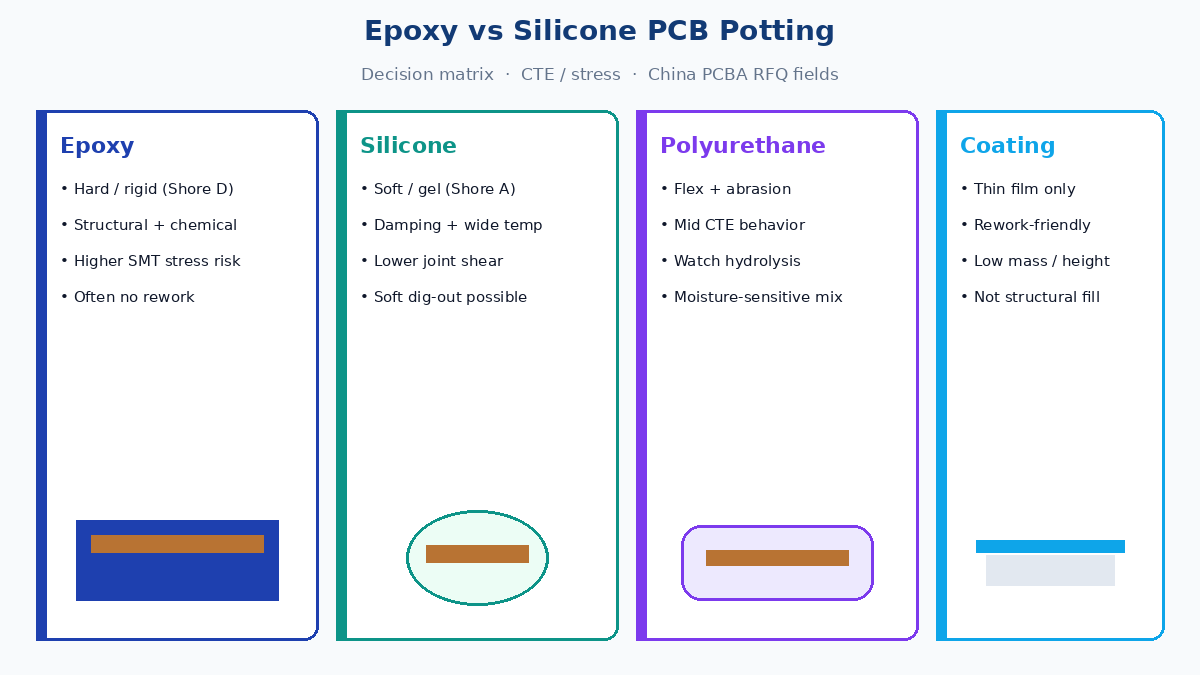
Decision matrix — epoxy vs silicone vs PU vs coating
Use this table for RFQ triage before chemistry brand fights start. Values are qualitative; lock numbers from the TDS you actually buy.
| Factor | Epoxy potting | Silicone potting | Polyurethane (PU) | Conformal coating |
|---|---|---|---|---|
| Typical Shore feel | Hard / rigid (often Shore D class) | Soft / elastomeric (often Shore A class) | Mid — flexible to semi-rigid | Thin film, not a bulk Shore callout |
| CTE / stress on SMT | Higher stress risk on BGA/MLCC if CTE mismatch + thick fill | Lower stress; absorbs expansion | Between epoxy and silicone depending on formulation | Low mass; stress usually not the coating film |
| Shock / vibration | Structural support; can transfer load into joints | Damping; good for wire / tall parts | Good damping with more abrasion toughness than many silicones | Limited structural help |
| Thermal cycling | Watch Tg and CTE vs board/parts | Excellent flex through cold/hot swings | Solid mid-range; hydrolysis risk if poorly chosen | Film follows board; enclosure still owns IP |
| Chemical / moisture | Strong barrier vs many fluids / fuels | Moisture barrier good; some solvents attack | Varies; moisture/hydrolysis is the classic PU watch-out | Condensation / leakage help — not a gasket |
| Adhesion | Strong on many plastics/metals when prep is right | Needs primer on some plastics/metals | Generally good; check plastic family | Chemistry-dependent thin-film adhesion |
| Thermal conductivity | Unfilled: modest; filled: can trend higher than soft silicones | Soft gels often modest; filled grades available | Filled grades available | Film adds little thermal path |
| Electrical insulation | High dielectric strength grades common | High resistivity / soft gel for HV gaps | Good insulator when dry and fully cured | Thin — creepage still needs layout |
| Cure / rework | Often irreversible; mechanical dig-out | Soft grades removable with care | Harder than soft silicone; still tough | Often reworkable (family-dependent) |
| When it wins | Rugged, chemical, structural cavity fill | Wide temp, vibration, reworkable soft fill | Abrasion + flex without full epoxy rigidity | Moisture/ionic without mass, weight, or no-rework |
💡 Procurement tip: Put the protection goal on the RFQ first (shock vs moisture film vs chemical splash vs soft gel for HV). Chemistry follows the goal. “Waterproof potting” without an IP enclosure plan still fails rain tests.
When conformal coating beats potting
Choose coating (not potting) when:
- Field or depot rework must stay realistic
- Weight, height, or thermal mass cannot grow
- The threat is condensation / ionic leakage, not structural shock
- Connectors, heatsinks, and RF cans need wide keep-outs that a pour would bury
- Cycle time and masking cost must stay mid-range
Choose potting when shock, wire security, cavity sealing, or chemical soak dominate — or combine: coat the board, pot only the high-stress sub-region. XFPCB already covers conformal coating process posts; this article owns full epoxy vs silicone potting (+ PU) for China assembly RFQs.
Electronic-grade compounds — what “electronic” actually means
“Electronic-grade” is not a marketing sticker. For PCBA potting it usually means:
- Low ionic contamination (halides, alkali) so residues under the mass do not drive electrochemical migration
- Controlled outgassing where vacuum, optical, or sealed modules care
- Flame / UL or OEM AVL only when the product requires it — do not invent listings on the PO
- Compatible cure with solder mask, plastics, and residual flux chemistry after cleaning
- Documented dielectric and volume resistivity on the TDS
Reject vague “black epoxy for electronics” without a TDS and lot COA path. Color is not a grade.
Rigidity, CTE, and the BGA / MLCC failure path
Hard epoxy that bonds the board to a housing or fills thick over tall BGAs can turn thermal expansion into joint shear. Soft silicone tends to strain-relieve. The failure path factories see:
- Board CTE ≠ potting CTE ≠ ceramic MLCC / package CTE
- Temperature swings expand/contract the mass
- Rigid epoxy transfers strain into solder joints and ceramic bodies
- MLCC flex cracks, BGA corner cracks, or lifted pads show up after cycling — not always at room-temp functional test
Factory controls:
| Control | Why |
|---|---|
| Prefer soft silicone / flexible PU near fine-pitch BGA / large MLCC arrays when shock is not the only driver | Cuts CTE-driven shear |
| Limit potting thickness over sensitive packages; use dams / partial fill | Less absolute ΔL for the same ΔT |
| Match Tg language to operating and storage extremes | Below Tg epoxy is glassy/stiff; above Tg behavior changes |
| Qualify with thermal cycle + mechanical shock on real assemblies | Coupon-only Shore data does not prove joint life |
| Call out “no rigid fill over BGA region” on the keep-out drawing when required | Traveler-enforceable |
Do not invent ppm/°C CTE numbers or W/m·K claims in the RFQ. Require the supplier TDS values and compare them qualitatively (higher / lower / filled vs unfilled) against your board stack and package set.
Mechanical, thermal cycling, chemical / moisture
Mechanical: Epoxy adds structure — good for hanging wires, connectors under pull, and boards that see drop. Silicone damps vibration and protects delicate bonds without locking the board into a brick. PU often sits between: tougher abrasion than many gels, more flex than hard epoxy.
Thermal cycling: Soft elastomers win when the product sees deep cold to hot soak. Hard epoxies need a deliberate CTE/Tg story and often thinner sections or filled grades chosen for the duty — not the cheapest black resin in the stockroom.
Chemical / moisture: Epoxy generally resists fuels, oils, and many solvents better. Silicone resists moisture well but can swell or weaken in some hydrocarbon solvents. PU watch-out is hydrolysis in hot-humid service if the grade is wrong. Encapsulant does not replace a gasketed IP housing when immersion is the real requirement.
Adhesion — coupon on real solder mask and plastic
Adhesion failures look like clean peel at the mask or housing interface after shock or cycle. Paper coupons lie.
Factory adhesion practice:
- Pour / dispense on production solder mask color and finish (not bare FR-4 only)
- Include the actual housing plastic (PC, ABS, nylon, PBT, etc.) and any primer the TDS requires
- Clean with the same process as the traveler (ionic clean, bake-out)
- Cure per TDS (time/temp/humidity legs)
- Pull / peel / cross-hatch or agreed torque-off method; record primer lot if used
⚠️ Watch out: Silicone on oily mask or unprimed polypropylene is a classic “looks filled, pops out in shipping” escape. Primer is a process step, not optional folklore.
Thermal conductivity and electrical (qualitative only)
Thermal: Unfilled potting compounds are modest conductors. Filled (ceramic / other) grades trend higher and can help spread heat when the design has no metal path — but they also raise viscosity, abrasion on mixers, and often stiffness. Compare TDS thermal conductivity rankings for your shortlist; do not paste invented W/m·K into marketing copy or this RFQ.
Electrical: Electronic potting is usually an insulator. Soft silicone gels are common where high-voltage creepage needs a soft dielectric fill. Hard epoxy offers high dielectric strength in thin sections but can crack and create voids that become partial-discharge sites. Specify dielectric strength / volume resistivity from the TDS, plus max operating voltage and pollution degree context from the product standard — not guesswork.
Cure, rework, and polyurethane as the third path
| Chemistry | Cure patterns (typical) | Rework reality |
|---|---|---|
| Epoxy | Two-part room-temp or heat-assisted; some one-part heat cure | Usually destructive dig-out / scrap |
| Silicone | Two-part addition or condensation; soft gels to firm rubber | Soft grades can be cut out; contamination risk remains |
| PU | Two-part; moisture-sensitive parts common | Possible with heat/cut; messier than soft silicone |
Pick epoxy when chemical resistance, structural fill, and permanent encapsulation beat serviceability.
Pick silicone when temperature extremes, vibration damping, and soft-pack stress relief dominate — or when limited rework is a product requirement.
Pick PU when you need more abrasion / tear toughness than soft silicone and more flexibility than hard epoxy, and you can manage hydrolysis and mix moisture control.
Datasheet / RFQ parameter checklist
Put these fields on the China assembly RFQ or AVL line — empty cells become house defaults:
| RFQ field | What to ask |
|---|---|
| Chemistry family | Epoxy / silicone / PU (+ primer if required) |
| Shore hardness | Shore A or D target band from TDS |
| Tg | Glass transition relevant to operating range (esp. epoxy) |
| CTE | TDS values α1/α2 or stated method — compare qualitatively to board/parts |
| Thermal conductivity | TDS value or “filled / unfilled” + rank vs alternatives — no invented W/m·K |
| Viscosity / mix ratio | Mix ratio tolerance, pot life, gel time |
| Cure schedule | Time/temp/humidity; post-cure if required |
| Dielectric / resistivity | Per TDS; voltage class of product |
| Flammability / AVL | Only if product requires listed grade |
| Color / UV tracer | If inspection needs it |
| Keep-outs | Drawing zones: connectors, vents, sensors, LEDs, screw lands, RF cans, test points |
| Rework policy | Allowed / forbidden; scrap disposition |
| Adhesion coupon | Mask + housing plastic + primer note |
| Cleanliness before pour | Method + ionic limit if warranted |
| Acceptance | Void criteria, fill height, hardness spot-check, visual |
Design keep-outs
Potting keep-outs are assembly drawing objects, not Slack notes:
- Mating connectors, screw bosses, grounding points that must stay bare
- Heatsink interfaces and thermal pads that need metal contact
- Pressure / humidity / gas sensors and microphone ports
- LEDs, light pipes, optical windows
- Adjustment pots, switches, fuse holders
- RF shield cans that need electrical contact at the skirt
- Label / QR areas and any depot test lands
- Weep / pressure-equalization paths if the housing design needs them
Use dams, tape, boots, or molded covers so the pour stops where the drawing says. Partial potting (component clusters only) is often smarter than flooding the whole board.
Process steps — China PCBA traveler
Treat potting as clean → mask → mix → degas → dispense → cure, then inspect.
1. Clean
Flux and ionic residue under a thick mass become a moisture battery. Align cleaning with the coating/potting chemistry (aqueous, saponifier, solvent, bake). “No-clean” flux is not automatically “leave it under epoxy.”
2. Mask / dam
Apply keep-outs and dams per drawing. Verify connector boots and tape edges before mix — fixing mask after pour means scrap.
3. Mix
Follow mix ratio by weight or volume as the TDS states. Scrape sides/bottom. Two-part errors show up as soft spots, sticky surfaces, or incomplete cure days later. For moisture-sensitive PU, control open time and humidity.
4. Degas
Vacuum degas mixed resin when the TDS and void budget require it. Skipping degas is a top source of bubbles at component shoulders and under BGAs.
5. Dispense / pour
Bottom-up fill or staged pours reduce trapped air. Control temperature of board and resin (cold resin = higher viscosity = more voids). Respect pot life — mid-cure dispense creates knit lines and weak zones.
6. Cure
Oven or room-temp per TDS. Record profile. Soft-touch “dry” is not full cure for many systems. Demold / ship only after the documented cure (and post-cure if specified).
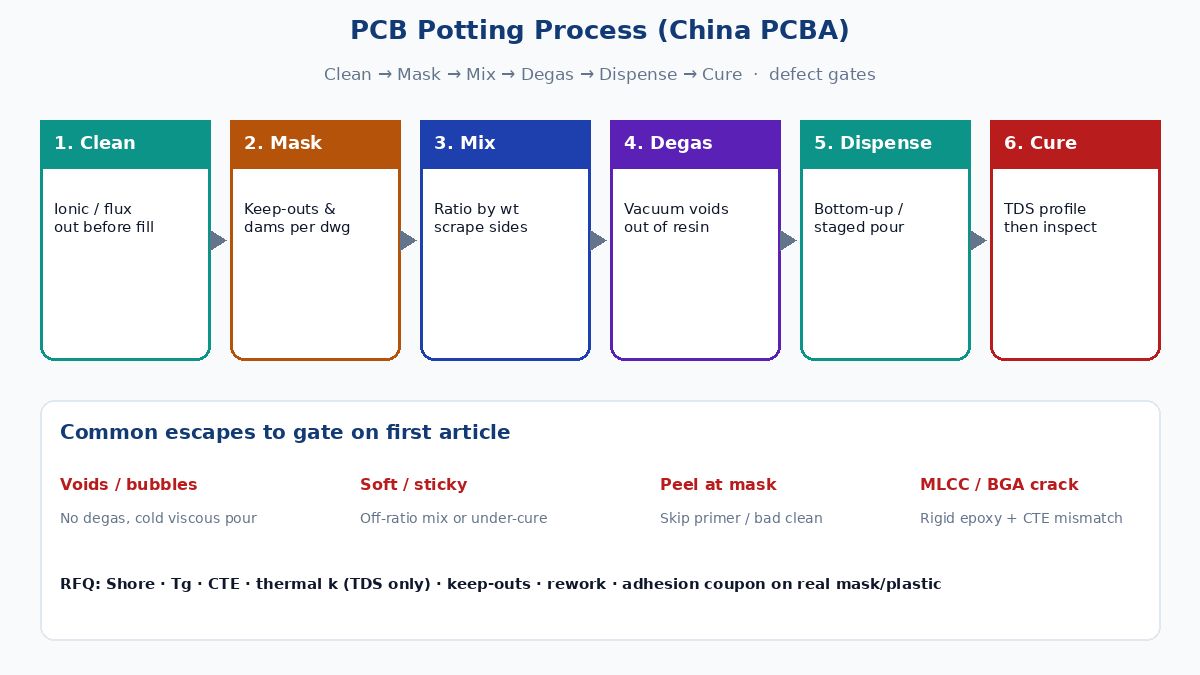
Defects and escapes
| Defect | Likely cause | Buyer / line response |
|---|---|---|
| Bubbles / voids | No degas, fast pour, cold viscous mix, trapped under parts | Require degas + pour method; X-ray/section on FA |
| Soft / sticky regions | Off-ratio mix, incomplete cure, contamination | Quarantine lot; verify mix scales and cure chart |
| Peel at mask / housing | Poor clean, missing primer, wrong plastic | Adhesion coupon on real materials |
| Cracked MLCCs / BGA corners after cycle | Rigid epoxy + CTE mismatch + thick fill | Soften chemistry, thin fill, keep-outs over packages |
| Connector contamination | Mask failure | Keep-out audit before pour; scrap policy |
| Warpage / bowed housing | Shrinkage + hard epoxy locked to shell | Staged cure, softer grade, mechanical float |
| Incomplete fill | Viscosity, dam leak, short pot life | Process capability on first article height map |
China assembly RFQ — copy block
Use language like this (edit numbers only from your chosen TDS):
Potting: electronic-grade [epoxy / silicone / PU] per attached TDS. Shore [A/D band], Tg and CTE per TDS. Thermal conductivity per TDS (filled/unfilled as quoted) — do not substitute unfilled for filled without written approval. Mix ratio and cure schedule per TDS; vacuum degas required unless waived. Keep-outs per drawing [rev]. Adhesion coupon on production solder mask and housing plastic [material]; primer [yes/no per TDS]. Cleanliness: [method]. Rework: [not allowed / limited soft dig-out]. Acceptance: fill height, void criteria, hardness spot-check, visual contamination of keep-outs.
That block gives procurement Shore, Tg, CTE, qualitative thermal intent, keep-outs, and rework in one traveler-readable place.
Bottom line for buyers and factories
Epoxy potting wins on rigidity, chemical toughness, and permanent structural fill. Silicone wins on stress relief, thermal cycling, and soft-pack vibration — at the cost of structural “brick” behavior and sometimes primer-dependent adhesion. PU is the flexible middle when abrasion and tear matter and hydrolysis is managed. Conformal coating still beats any potting chemistry when rework, weight, and thin-film moisture protection are the real needs.
For China PCBA quotes: send the decision goal, the RFQ parameter table, a keep-out drawing, and an adhesion coupon plan. Chemistry brand can follow AVL; process discipline cannot.