
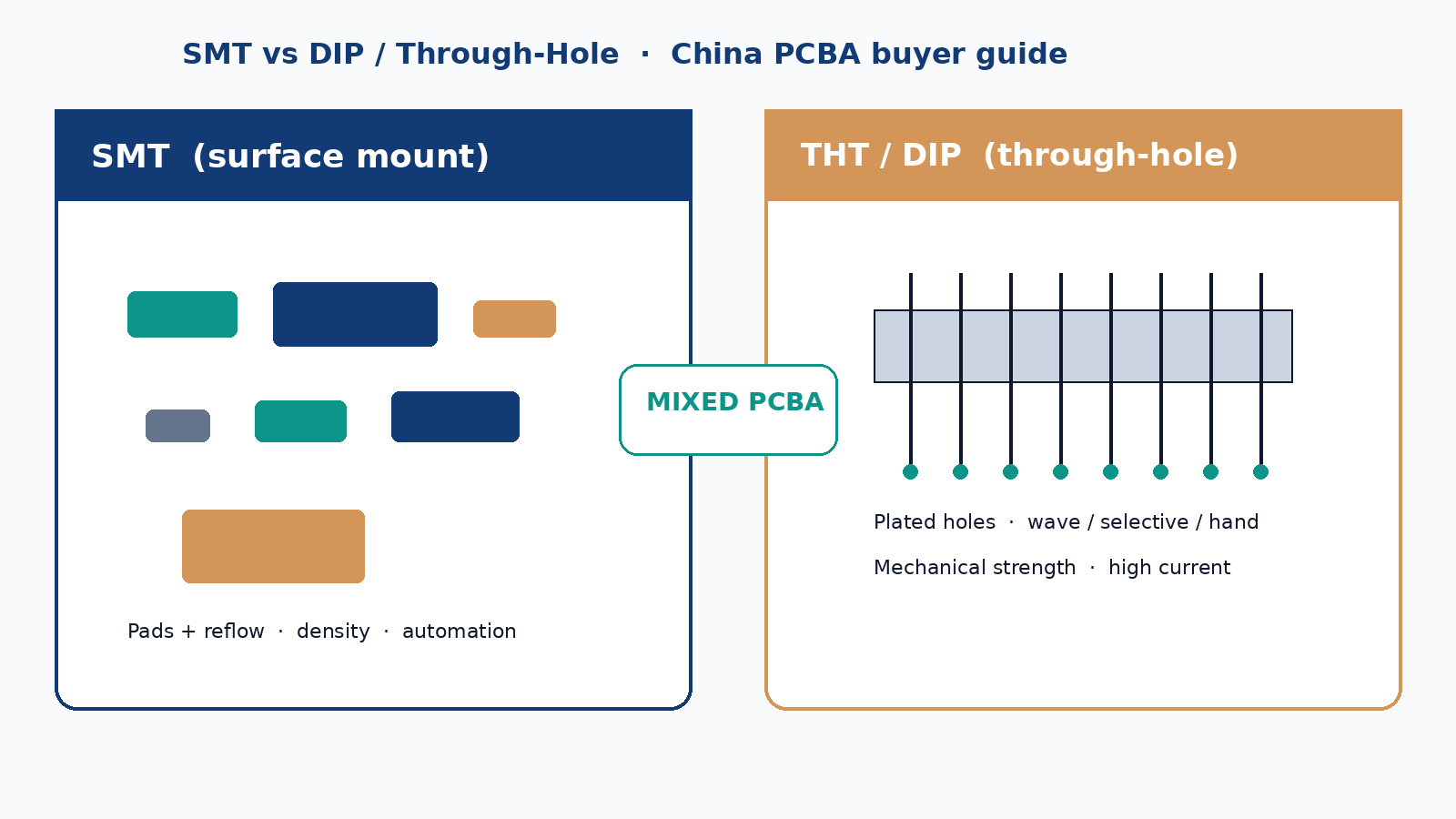
SMT is surface-mount technology: parts sit on copper pads and reflow in an oven. DIP, in buyer RFQs, is usually shorthand for through-hole / PTH insertion — not only the dual-in-line IC package. Through-hole (THT) still wins where connectors take cable yank, power pins carry amps, or field service needs a socket. Most China PCBA quotes today are mixed: SMT for density, THT for mechanical and power parts. The quote fails when the plant assumes a wave sequence you never approved, or when two bidders price different hole-fill and selective rules against the same Gerber set.
This page answers first, then gives a decision table (density and automation versus stress, current, vibration, and serviceability), a mixed-technology process order, a wave-versus-selective-versus-hand cost/quality map, and an RFQ matrix that keeps mixed-technology China PCBA quotes comparable.
Answer first: SMT, DIP package, and THT process
| Term | What it means on a factory traveler | Buyer trap |
|---|---|---|
| SMT / SMD | Paste → place → reflow on surface pads | Treating "we have SMT" as capability for your finest pitch |
| DIP (package) | Dual-in-line IC with two parallel pin rows — a through-hole package | Assuming every THT part is a DIP IC |
| THT / PTH / through-hole | Leads insert through plated holes; soldered by wave, selective, or hand | Using "DIP" and "THT" as if they were identical process steps |
| Mixed technology | SMT plus THT on one board (typical modern PCBA) | Quoting SMT-only rates against a BOM that still has connectors |
In China PCBA RFQs, "DIP assembly" almost always means through-hole insertion and soldering capacity — headers, power terminals, transformers, relays, and yes, DIP ICs. Clarify package vs process in the first email so bidders do not under-scope axial/radial odd-forms or press-fit connectors.
💡 Procurement Pro-Tip: Write "THT/PTH insertion + solder method" on the RFQ. Keep "DIP" only when you mean the dual-in-line package. Ambiguous language is how one quote includes selective nozzles and another assumes hand solder on fifty pins.
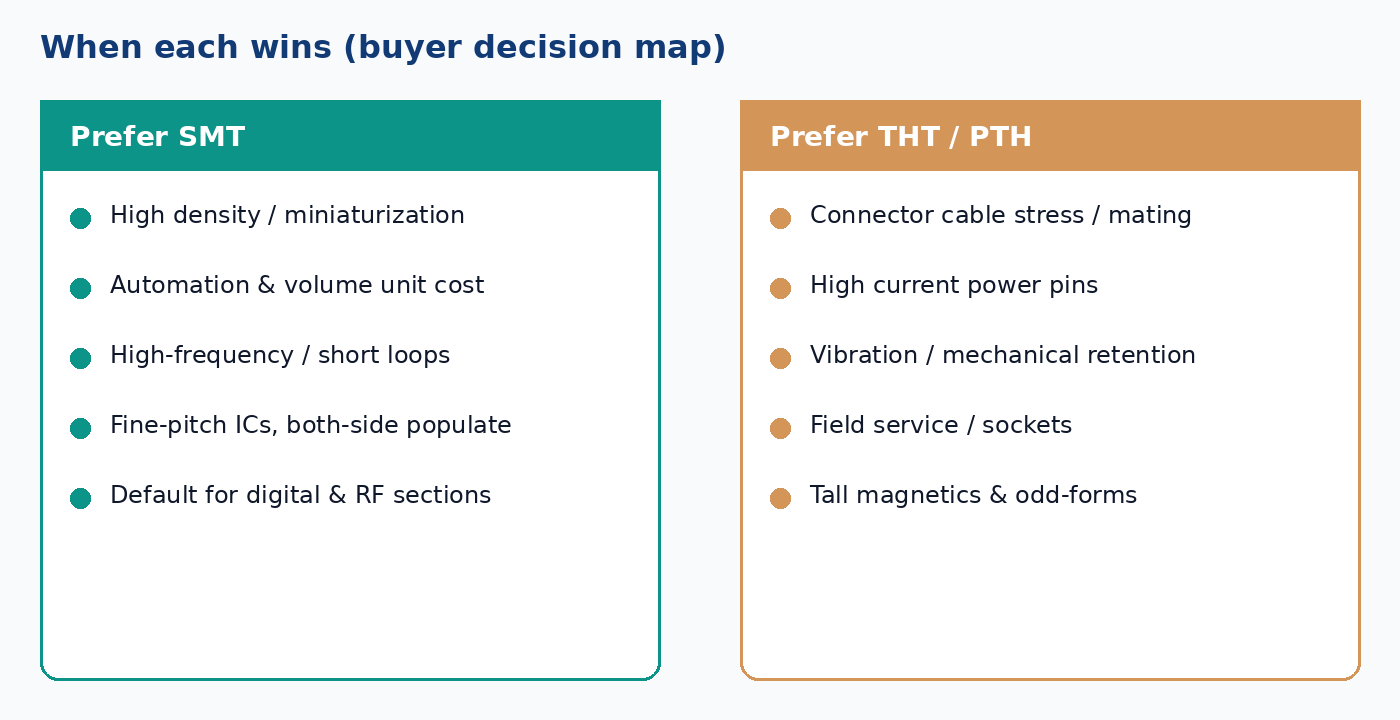
Decision table: when SMT wins vs when through-hole wins
| Design driver | Prefer SMT | Prefer THT / PTH | Mixed note |
|---|---|---|---|
| Board density / miniaturization | Default — 0402/0201, fine-pitch ICs, both sides | Rare; THT eats real estate | Keep THT only where stress or current forces it |
| Automation / unit cost at volume | High — pick-and-place + reflow scales | Lower — insert + wave/selective/hand | Volume SMT with few THT pins is the usual cost winner |
| High-frequency / controlled impedance | Shorter leads, smaller loops | Long leads and stubs hurt RF | Prefer SMT RF front-ends; THT only on low-speed I/O |
| Connector cable stress / mating cycles | Weak — pads tear under yank | Strong — pins anchored in plated holes | Through-hole or press-fit for panel and cable connectors |
| High current / power | Possible with heavy copper + multiple vias | Straightforward pin cross-section | Power terminals and magnetics often stay THT |
| Vibration / shock | OK if underfill/staking specified | Better mechanical retention | Automotive/industrial I/O often hybrid |
| Field service / socketability | Hard — rework needs hot air / BGA tools | Easy — sockets, replaceable modules | Socketed MCUs and relays remain THT for a reason |
| Thermal mass odd-forms | Reflow may be wrong tool | Wave/selective/hand or press-fit | Transformers, large electrolytics, tall relays |
Rule of thumb: default new digital and RF sections to SMT; keep through-hole for connectors that take mechanical load, power pins above what copper geometry comfortably carries, and parts that must be field-replaced without a full SMT rework station.
Related depth on SMT process stages: SMT PCB assembly process. For density-driven layout choices, see SMT high-density PCB design benefits.
Mixed technology: process order that plants actually run
Standard China mixed-tech order is SMT first, then THT. Reflow heats the whole board; wave or selective after SMT means you must protect already-placed surface parts from wave heat and flux.
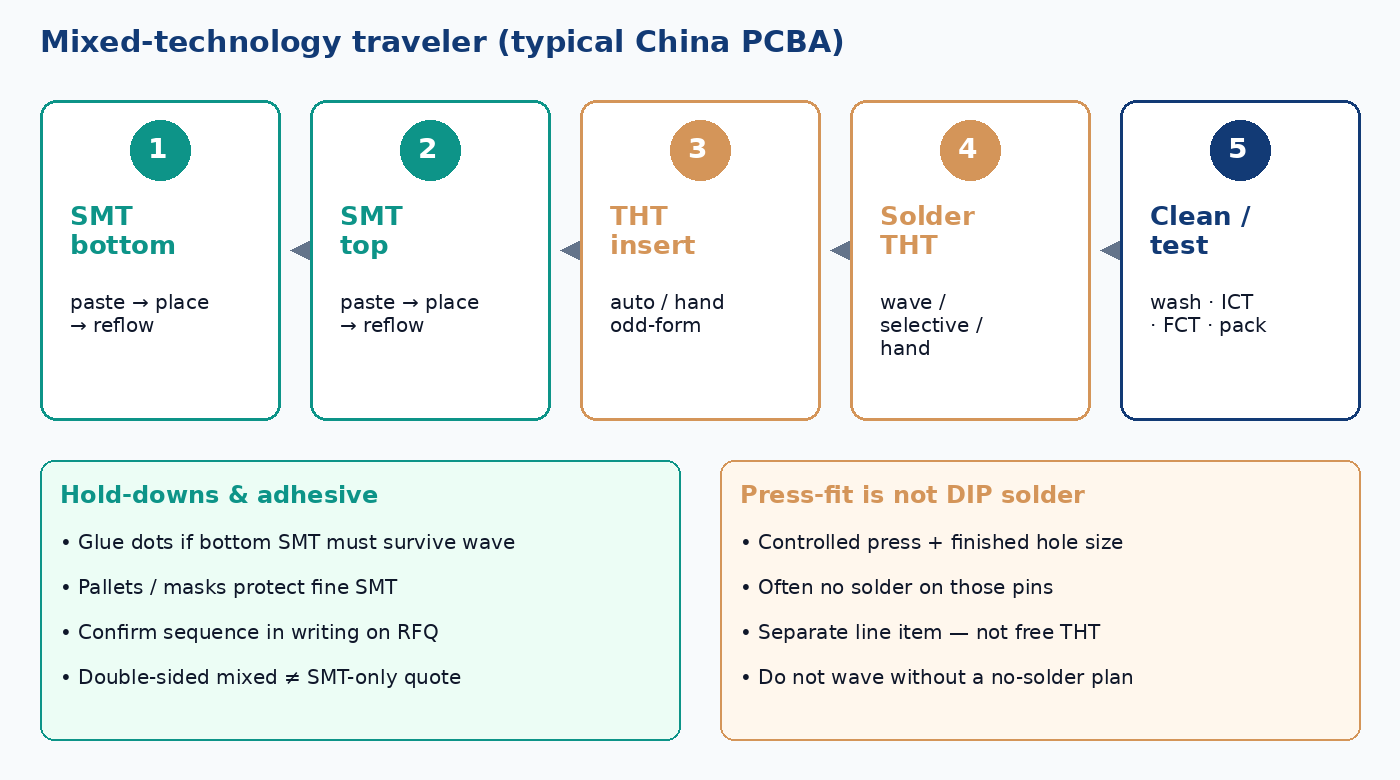
Typical traveler (confirm in writing):
- SMT bottom — paste, place, reflow (if double-sided).
- SMT top — paste, place, reflow.
- THT insertion — auto-insert where pitch allows; odd-form by hand or semi-auto.
- Solder THT — wave, selective, and/or hand per part class.
- Wash / no-clean — per flux chemistry and cleanliness class.
- Coat / test / pack — conformal coat if specified, then ICT/FCT.
Adhesive and hold-down. Bottom-side SMT that must survive a top-side wave often needs adhesive (glue dots) or a process that avoids wave on that side entirely — selective is the usual escape. Tall THT parts may need hold-down during invert. Glue is a process step with cure time; if the quote never mentions adhesive on a double-sided mixed board, ask how bottom SMT survives THT heat.
Press-fit note. Press-fit connectors are not "DIP solder." They need controlled press equipment, correct finished hole size, and often no solder on those pins. Price them as a separate process line — not as free THT insertion. Mixing press-fit with wave without a solder-mask or selective plan creates bridges and damaged housings.
⚠️ Watch Out for: Quotes that say "SMT + DIP OK" with no sequence. Sequence decides whether you need selective nozzles, adhesive, or a pallet with masks. Two plants can both be "capable" and give non-comparable prices if one assumes full wave and the other assumes selective on thirty pins.
Wave vs selective vs hand for THT
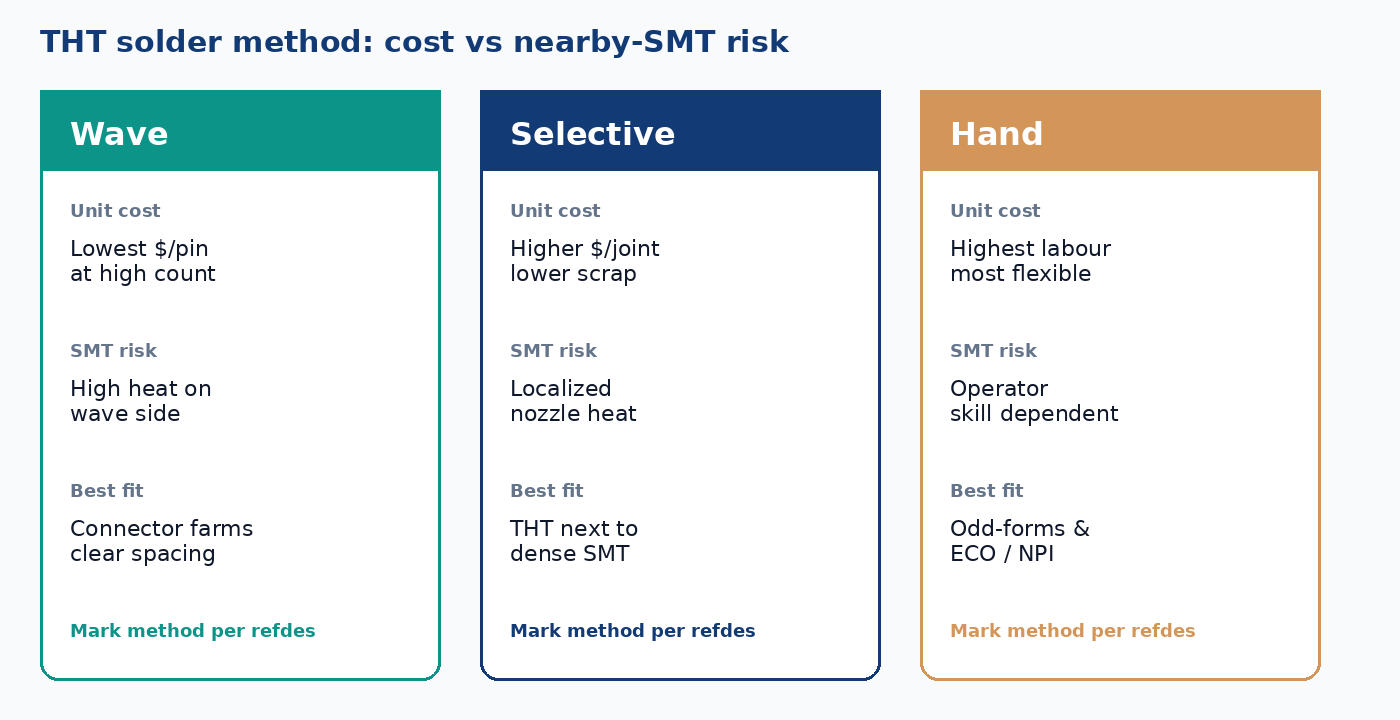
| Method | Unit cost at volume | Heat / nearby SMT risk | Best fit | Weak spot |
|---|---|---|---|---|
| Wave solder | Lowest per pin when many pins face the pot | High — floods the wave side | Connector farms, power pins with spacing, same alloy | Dense SMT on wave side; fine-pitch THT bridges |
| Selective solder | Higher per joint; lower scrap on mixed boards | Localized nozzle / fountain | THT next to tall or fine SMT; mixed alloys; dense layouts | Programming/fixtures; slow vs wave on huge pin counts |
| Hand solder | Highest labour; flexible | Operator-dependent | Odd-forms, ECO, true low pin count, prototypes | Not a production plan for hundreds of dense pins |
Quality signals to demand
- Hole-fill target (e.g. IPC-A-610 Class 2 vs Class 3 vertical fill expectations — put the class on the PO).
- Whether pallets / selective masks protect SMT.
- Flux type and whether wash is in scope.
- Who programs selective solder paths and who owns that NRE.
Wave is efficient when pin count is high and the wave side is clear. Selective is the right default when SMT density on the solder side makes a full wave reckless. Hand solder bridges NPI and odd-forms — treat a quote that plans hand solder for a production connector farm as a capacity or capability gap, not a bargain.
Equipment context for printers, placers, and test gates sits in PCB assembly equipment list.
China PCBA RFQ matrix for mixed SMT + THT
Paste this into the RFQ so bidders answer the same fields. Brochure "DIP capable" lines fail here; comparable quotes survive.
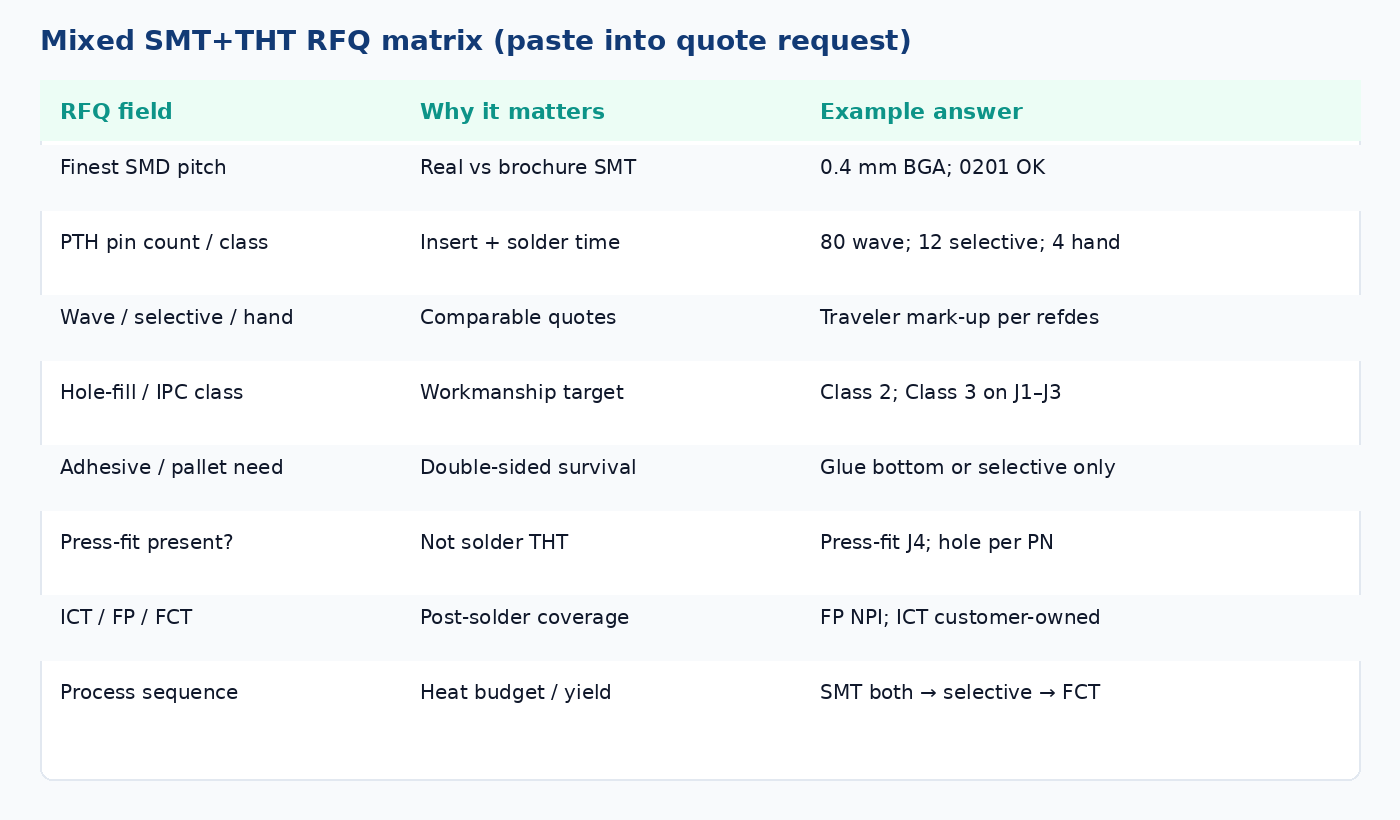
| RFQ field | Why it matters | Example answer format |
|---|---|---|
| Finest SMD pitch / package | Separates real SMT lines from marketing | "0.4 mm BGA; 0201 OK; QFN wettable flank" |
| PTH / THT pin count by class | Drives insert + solder time | "80 wave pins; 12 selective; 4 hand odd-form" |
| Wave vs selective vs hand map | Makes quotes comparable | Traveler mark-up per THT refdes |
| Hole-fill / IPC class | Vertical fill and workmanship | "IPC-A-610 Class 2; Class 3 on J1–J3" |
| Adhesive / pallet / mask need | Double-sided mixed survival | "Glue bottom SMT before wave" or "selective only" |
| Press-fit present? | Not solder THT | "Press-fit J4; hole size per vendor PN" |
| ICT / flying probe / FCT | Coverage after mixed solder | "Flying probe NPI; ICT fixture customer-owned at volume" |
| Process sequence | Yield and heat budget | "SMT both sides → selective THT → no-clean → FCT" |
| Alloy | Stops SnPb-by-habit on export work | "SAC305 unless exemption stated" |
Also state: BOM lines that are THT vs SMT, any moisture-sensitive devices, and whether conformal coat follows solder (coat after wash/dry, never before THT solder). Sourcing model (turnkey vs consignment) changes who owns connector long-leads — see full turnkey vs consignment PCB assembly.
Design habits that keep mixed quotes honest
- Group THT on one side when possible — simplifies wave pallets and selective paths.
- Keep keep-out around THT pins — paste-side SMT too close to wave pins is a scrap generator.
- Call out press-fit and no-solder holes on the fabrication and assembly drawings, not only in a BOM note nobody reads.
- Socket vs solder — if you need field swap, specify the socket PN; do not assume the CM will invent one.
- First-article photos — demand solder-side photos of the densest THT neighborhood plus X-ray/AOI rules for nearby SMT.
A clean mixed-tech drawing with pin-class notes often cuts more quote variance than another round of unit-price negotiation.
Prototype vs volume on mixed-technology boards
NPI and volume often share the same SMT line and the same selective machine, but the gates differ. On a 20–50 piece pilot, hand solder for a handful of odd-forms is normal; selective program NRE may not amortize yet. On a recurring 2k/month release, the same odd-forms should be reclassified: auto-insert or fixture, selective paths locked, and hole-fill audited to the IPC class on the drawing.
| Topic | Prototype / NPI | Volume release |
|---|---|---|
| THT method | Hand + limited selective OK | Wave and/or selective per pin class; hand only for true odd-forms |
| Sequence proof | First-article traveler + photos | Golden traveler; ECO stops documented |
| Hole-fill check | FA cross-section or strong visual on sample | Sample plan tied to class; scrap/rework loops measured |
| Test | Flying probe / limited FCT | ICT when fixture amortizes; FCT as designed |
| Adhesive / pallet | Decide on FA if double-sided | Locked in traveler; glue cure logged |
Do not let a successful hand-soldered pilot silently become the volume process plan. Re-quote the THT method when monthly pin-minutes cross what a bench can sustain without quality drift.
Soft next step
If you already have Gerbers, BOM, and a centroid (XY) file, XFPCB can mark each THT refdes as wave, selective, hand, or press-fit and return which RFQ fields above belong in your China PCBA quote — including whether adhesive or a selective program is required on a double-sided build — without forcing a wave process that would cook bottom-side SMT.
⚠️ Watch Out for: Side-by-side quotes that never state hole-fill class, solder method per pin class, or SMT→THT sequence. Those numbers are not comparable, regardless of how close the unit prices look.