
Full turnkey PCB assembly is usually the lower-TCO and lower-overhead choice when the assembler owns BOM buying, AVL discipline, and shortage recovery under one traveler; consignment PCB assembly wins only when you must retain part control or already absorb kitting cost; partial turnkey PCB assembly splits the BOM so you consign controlled lines and the factory buys the rest. Pick the model by who should own cash, counterfeit exposure, and line-stop risk -- not by which quote looks cheapest before landed cost.
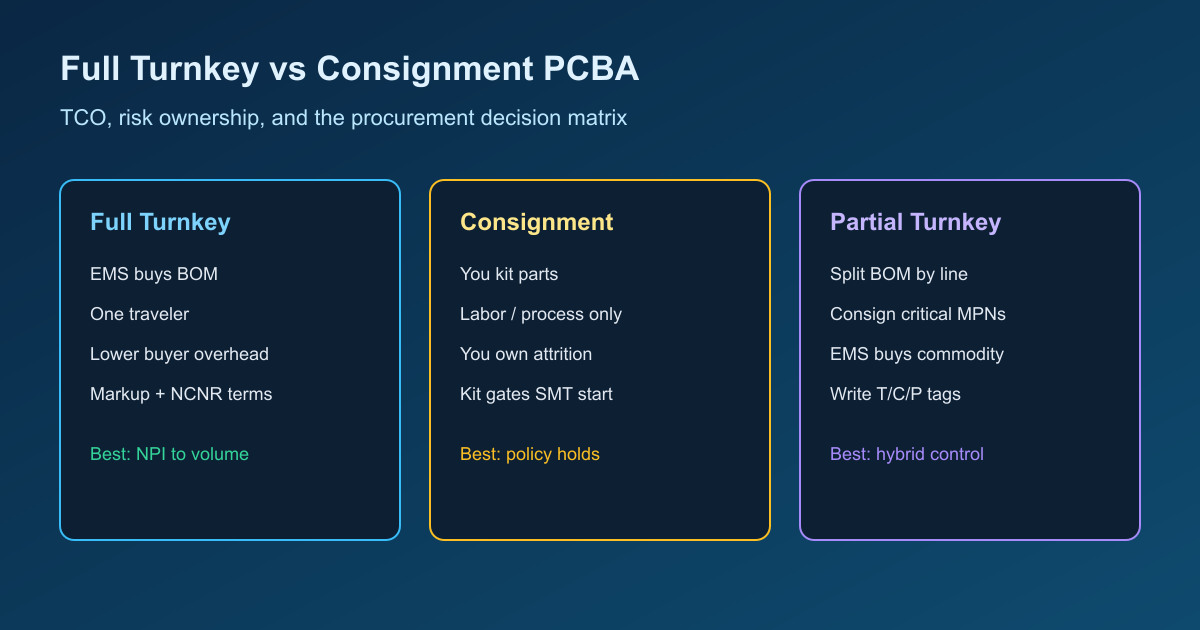
Full turnkey PCB assembly is a manufacturing model where the EMS buys the full BOM (within your AVL), fabricates or receives bare boards, builds SMT/THT, inspects, and delivers assembled PCBA under one commercial responsibility.
Consignment PCB assembly is a manufacturing model where you kit and ship all (or nearly all) components, and the EMS provides labor, solder materials, process control, and test -- while you retain ownership of parts, attrition, and most shortage risk.
Partial turnkey PCB assembly is a manufacturing model where you consign selected lines (allocated MCUs, custom magnetics, programmed devices, or policy-controlled parts) and the EMS purchases the remaining commodity BOM under agreed alternates.
Key Takeaway: Normalize every PCBA bid to the same sourcing model before you compare unit price. Add your buyer labor, freight, tariffs, warehousing, attrition, MOQ excess, and downtime risk to consignment; subtract hidden component markup opacity only after the AVL and NCNR terms are written. The cheapest labor line is rarely the cheapest program.
Turnkey vs consignment vs partial turnkey: comparison table
| Dimension | Full Turnkey | Consignment | Partial Turnkey |
|---|---|---|---|
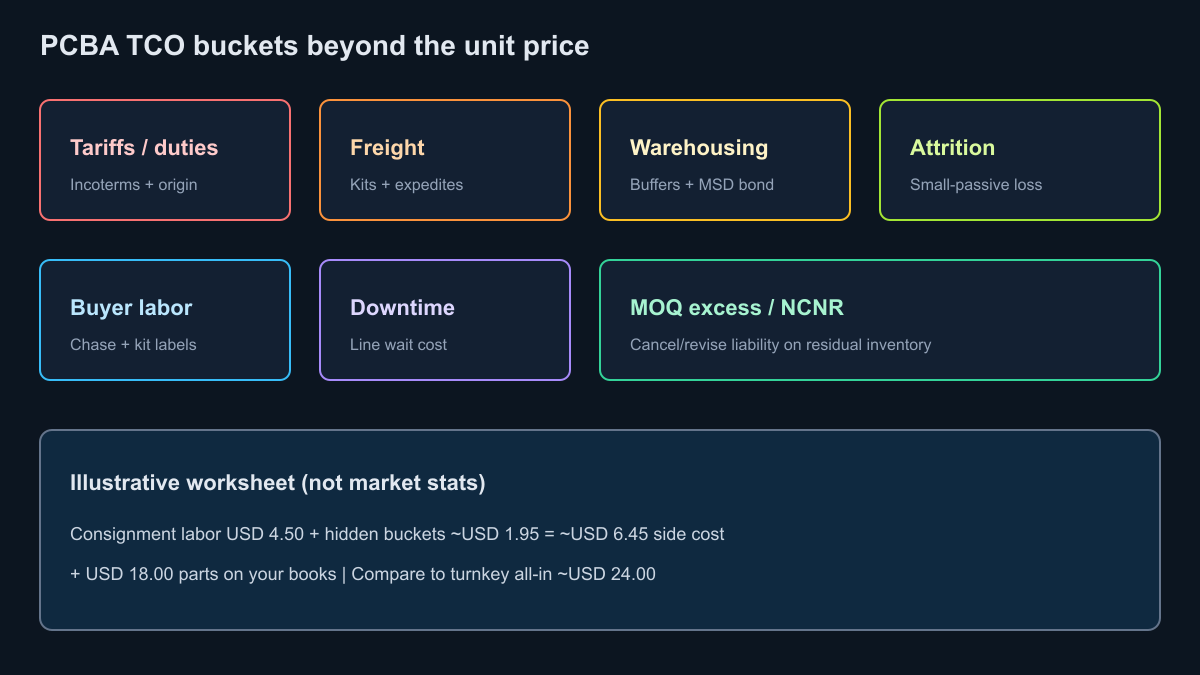
| Lead Time | Factory owns buy-and-build path; shortage chase stays on one desk | Kit arrival gates SMT start; late bags stop the line | Commodity lines move in parallel; consigned critical parts remain the schedule hinge |
| Cash Flow | Higher PO value earlier (parts + labor); less buyer inventory on your books | You buy and hold inventory; EMS invoice is mostly labor/NRE | Mixed: you fund controlled lines; EMS funds passives and common ICs |
| Risk Ownership | EMS owns procurement execution; you still own AVL policy and approved alternates | You own kit completeness, MSL/bake status, counterfeit intake, attrition | Split by line: write which MPNs are consigned vs turnkey in the PO |
| Engineering Overhead | Lower day-to-day buying; higher need for clean BOM/AVL up front | High: kitting, labels, date codes, shortage expedites, RMA of bad kits | Medium: maintain two flows and clear handoff rules |
| Component Markup / Visibility | Markup embedded; demand distributor invoices or cost-plus rules for visibility | True authorized-distributor unit cost visible to you; no EMS part markup on kit | Markup only on EMS-bought lines; consigned lines stay at your cost |
| Counterfeit Exposure | Lower when EMS buys authorized channels with AS5553-style controls; gray-market shortcuts are a red flag | You control channel -- or inherit broker risk if your buyers cut corners | Controlled lines stay on your channel; commodity lines follow EMS AVL |
| Best Fit | NPI-to-volume with clean AVL, high passive commonality, one-throat accountability | ITAR/policy holds, consigned programmed parts, or when your purchasing desk already runs the BOM | Allocated MCUs + commodity passives; hybrid programs with mixed control needs |
TCO: unit price is not landed program cost
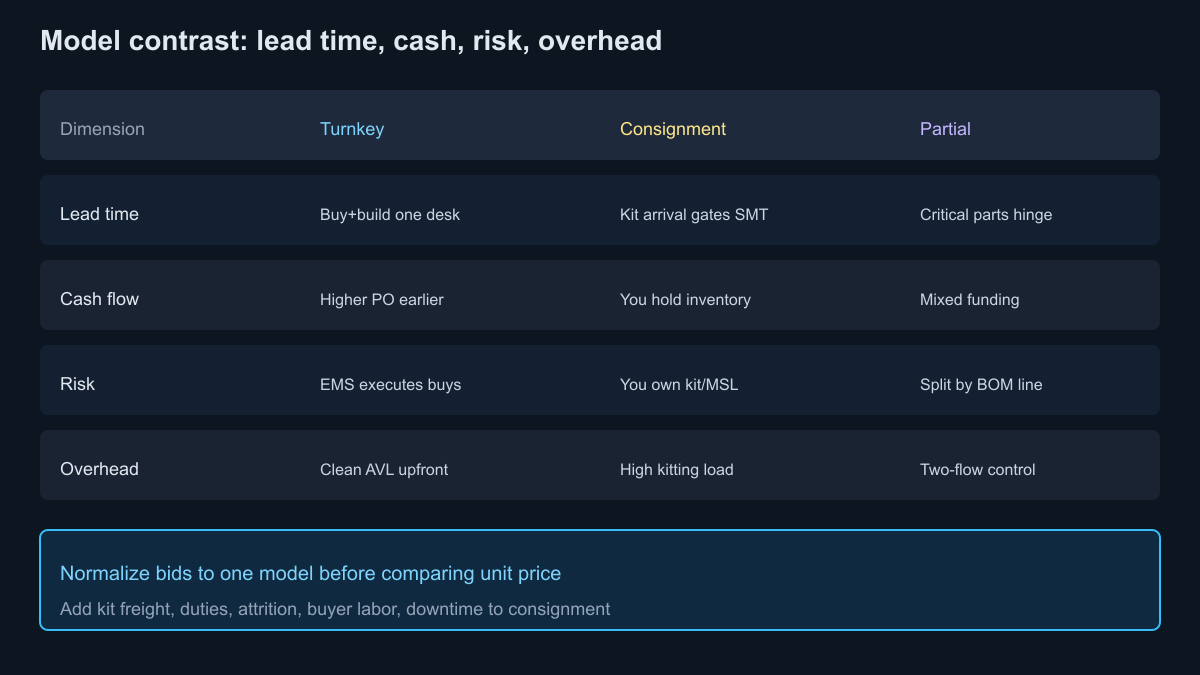
Total cost of ownership (TCO) for PCBA sourcing is labor + components + freight + duties + warehousing + attrition + buyer labor + downtime + MOQ excess -- not the assembly line item alone. Consignment quotes that omit those extras understate the program; turnkey quotes that hide NCNR and gray-market risk understate failure cost.
Hidden cost buckets buyers miss
- Tariffs / duties: Incoterms and country of origin move landed cost even when the SMT minute rate looks identical.
- Freight: Multi-leg kit shipments, expedites, and split deliveries often exceed the "saved" EMS markup on passives.
- Warehousing: Consigned buffer stock, bond rooms for MSDs, and excess after ECO revisions sit on your balance sheet.
- Attrition: Small passives routinely need a handling allowance; under-kitting stops SMT and creates premium reorders.
- Buyer labor: Hours spent chasing shortages, labeling kits, and resolving wrong date codes are real OpEx.
- Downtime: A stopped line waiting on one bag of 0402s costs more than the parts.
- MOQ excess / NCNR: Turnkey buys against MOQ create residual inventory risk unless cancel/revise liability is capped in writing.
Illustrative arithmetic (not market statistics)
Label the following as illustrative only -- a worksheet pattern, not XFPCB proprietary market data.
Assume a 1,000-board run. BOM materials at authorized distributor cost: USD 18.00/board. EMS assembly + test: USD 4.50/board.
- Consignment-looking bid: USD 4.50 assembly. Add kit freight USD 0.40/board, duties USD 0.25, warehousing USD 0.15, attrition/reorder USD 0.35, buyer labor USD 0.50, expected downtime reserve USD 0.30. Illustrative landed: ~USD 6.45 labor-side + USD 18.00 parts you already buy = ~USD 24.45/board program view (parts on your books).
- Full turnkey bid: USD 24.00 all-in (parts + labor) with authorized-channel AVL, SPI/AOI scoped, and NCNR terms stated. Markup versus distributor list may be ~10-15% on materials in this illustration (USD 18.00 -> ~USD 20.00 materials equivalent embedded), but you remove most buyer labor, kit freight, and shortage chase.
If your team already staffs purchasing and holds inventory efficiently, consignment can win. If shortage chase and kit errors dominate your last three builds, turnkey often wins on TCO even when the turnkey number is higher than "assembly-only."
Responsibility guide: who owns the hard calls
Write ownership into the RFQ and PO. Ambiguity is how field failures and stoppages become email disputes.
| Topic | Full Turnkey | Consignment | Partial Turnkey |
|---|---|---|---|
| EOL / alternates approval | EMS proposes; you approve against AVL before buy | You own EOL watch and alternate picks in the kit | EMS proposes on turnkey lines; you own consigned lines |
| Counterfeit / traceability | EMS channel policy + lot/date-code trace on traveler | Your incoming inspection and CoC pack; EMS records kit IDs | Split by line; both sides keep lot records |
| Warranty / rework | Process defects under EMS workmanship; part defects per agreed warranty boundary | Labor defects under EMS; part defects usually your claim path | Same split as ownership of the failing line |
| Shortage stoppage | EMS escalates buys / alternates per AVL SLA | You expedite or authorize substitutes; clock stays on kit | EMS covers commodity shortages; you cover consigned critical path |
⚠️ Watch Out for: Quotes that mix turnkey and consignment line items without a line-level ownership table. You will pay twice for the same shortage -- once in schedule, once in change orders.
💡 Procurement Pro-Tip: Require the quote to restate sourcing model per BOM line (T / C / P), authorized-distributor-first policy, gray-market escalation rules, NCNR liability on cancel/revise, and Incoterms before you open the price column.
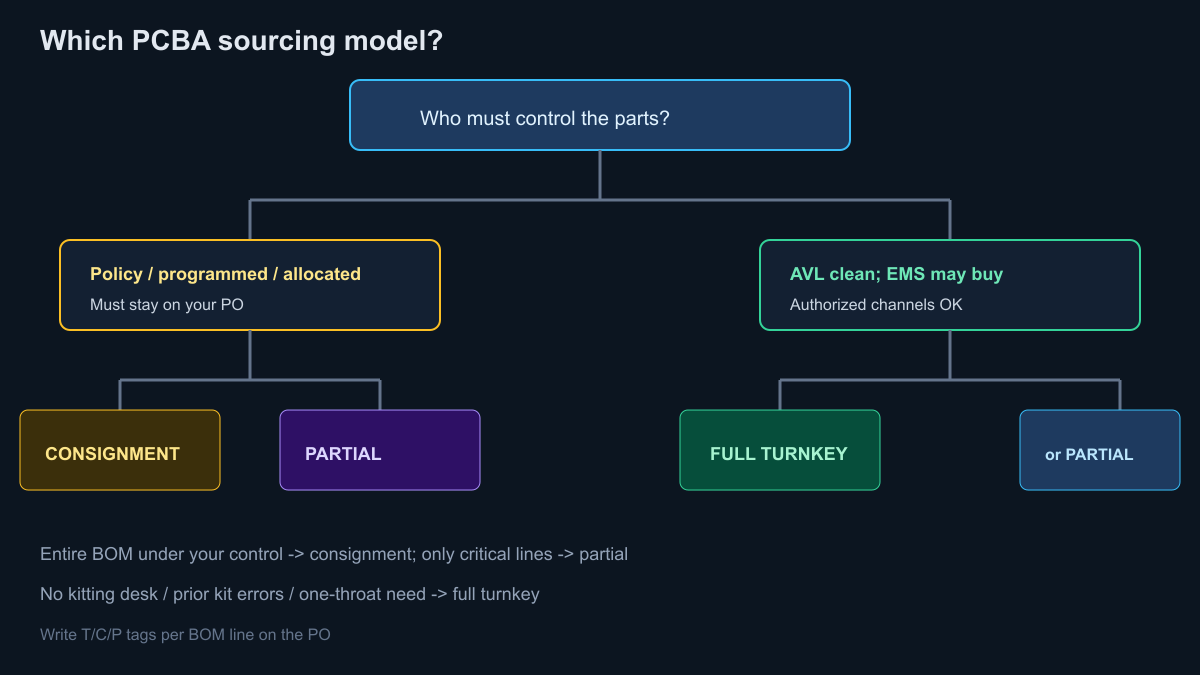
ASCII decision tree: which model?
```
Start: Who must control the parts?
+-- Policy / programmed / allocated parts must stay on your PO
| +-- Entire BOM under your control? ---> CONSIGNMENT
| +-- Only critical lines? ---> PARTIAL TURNKEY
| (consign critical; EMS buys commodity)
+-- AVL is clean; factory may buy authorized channels
+-- Do you already staff kitting + shortage chase efficiently?
| +-- Yes, and kit quality is proven ---> CONSIGNMENT or PARTIAL
| +-- No / kit errors caused prior stops ---> FULL TURNKEY
+-- Need one throat for buy+build+test accountability ---> FULL TURNKEY
```
Procurement decision matrix: Prototype | NPI | Mass Production
| Stage | Recommended model | Why |
|---|---|---|
| Prototype | Consignment or light partial | Engineering still spins the BOM; you may hand-carry samples; MOQ excess on turnkey burns cash for parts that will change |
| NPI | Partial turnkey or full turnkey | Freeze AVL on commodity lines; consign only allocated MCUs/programmed parts; one traveler reduces EQ thrash before pilot |
| Mass Production | Full turnkey (or stable partial) | Volume needs shortage recovery, reorder cadence, and clear NCNR/excess rules; consignment at scale demands a purchasing desk that acts like an EMS |
Prototype favors learning speed and BOM fluidity. NPI favors locking process and AVL while protecting a few controlled devices. Mass production favors accountability and repeatable landed cost under a named sourcing model.
Kit completeness / BOM audit checklist
Use this before any consignment or partial kit ships -- and as the AVL scrub checklist before authorizing full turnkey buys.
```
[ ] BOM revision matches Gerber / assembly drawing revision
[ ] Every line has MPN (not "or equivalent" without signed alternate)
[ ] Approved alternates listed with package and grade constraints
[ ] Quantities include attrition allowance for small passives
[ ] MSL / bake / dry-pack status documented for moisture-sensitive parts
[ ] Programmed devices: firmware rev, checksum, and label rules attached
[ ] Polarized / non-obvious packages have orientation notes
[ ] DNP / do-not-stuff lines explicit
[ ] Hardware (screws, shields, conformal-coat masking) included if in scope
[ ] Lot / date-code expectations and CoC requirements stated
[ ] Kit labels match reference designators and BOM line IDs
[ ] Critical-path consigned parts ship before SMT start gate
```
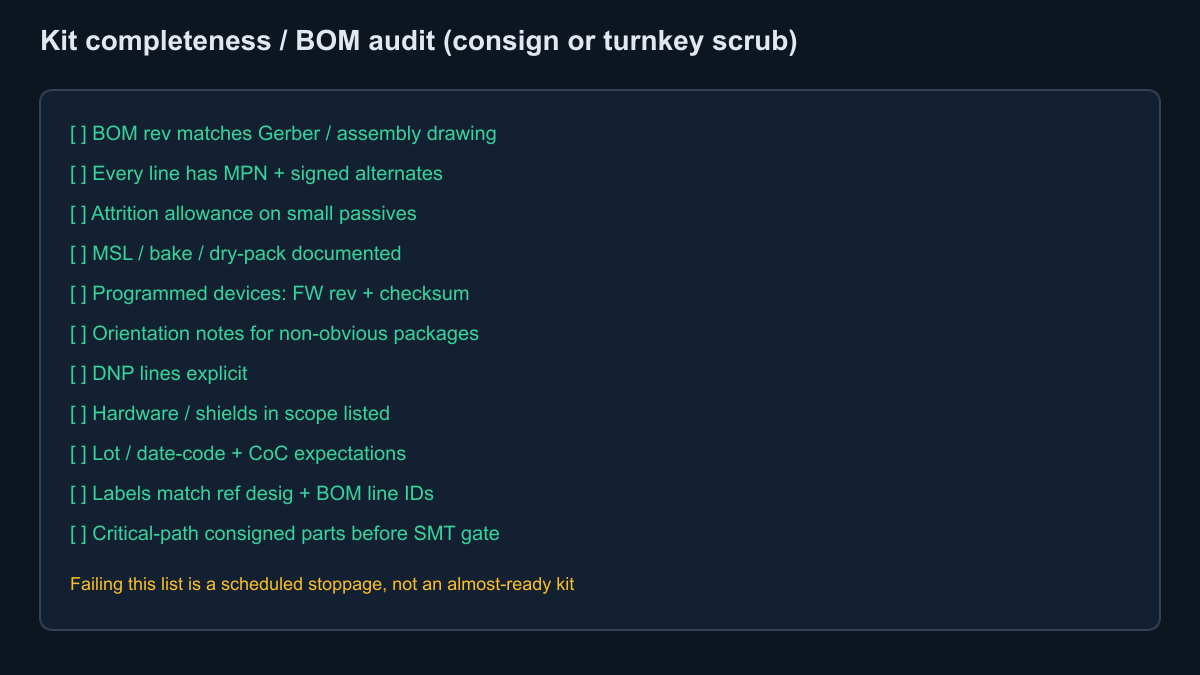
A kit that fails this list is not "almost ready." It is a scheduled stoppage.
Recommended Deep Dives
- How to Choose an SMT PCB Assembly Partner -- Use this when the question shifts from sourcing model to process evidence (IPC class, AOI/X-ray, AVL behavior) behind a China PCBA quote.
- SMT PCB Assembly Process -- Use this to map paste, SPI, place, reflow, and AOI/X-ray stations once the commercial model is chosen and the traveler must prove control.
- How PCBs Are Made -- Use this when bare-board fab flow, DFM, and finish choices still gate assembly yield before any sourcing model can save a bad panel.
- What Is a Quick-Turn PCB? -- Use this when schedule tiers and which process options kill quick-turn feasibility matter as much as turnkey versus consignment math.