
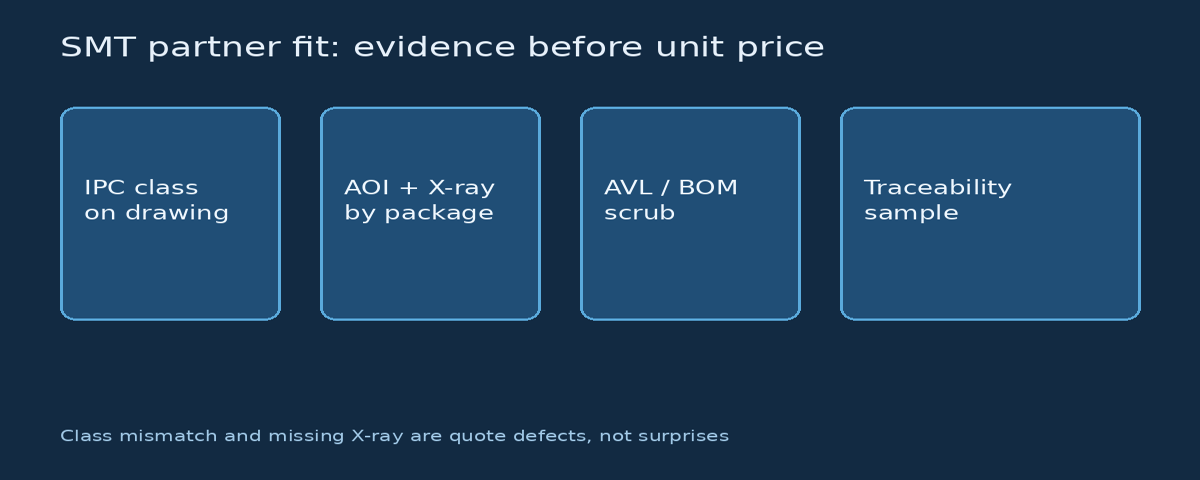
The quote sat fifteen percent under the next bidder. Procurement took it. Six weeks later the lot arrived stamped to IPC-A-610 Class 2 workmanship while the assembly drawing called Class 3 on every sheet. BGAs had AOI notes and no X-ray lot record. Two BOM lines had been swapped to "equivalent" packages without a signed ECO. Unit price was never the real price -- process fit was.
Buyers who compare China PCBA quotes by landed unit cost and only later discover class mismatch, missing X-ray on bottom-terminated packages, or silent BOM substitutions land in the same place. This article is a buyer-side read of how to choose an SMT PCB assembly partner by the evidence behind the number, not by rearranging the usual brochure Q&A order.
Beyond unit price: process evidence that survives the first lot
A low per-board number is easy to defend in a spreadsheet. Process evidence is harder to fake and cheaper to demand before the PO. Ask what IPC-A-610 / J-STD-001 class the quote assumes, in writing, against the class on your drawing. If the drawing is silent, the shop will default -- often Class 2 -- and you will be billed and shipped to that default. Class 3 costs line speed, tighter AOI thresholds, and more rework loops; a shop that claims "we always build Class 3" for commercial work without an upcharge is describing marketing, not a traveler.
Certifications matter as buyer criteria, not as decoration. ISO 9001 is baseline quality-system hygiene for most commercial programs. Sector overlays (ISO 13485, AS9100, IATF 16949) matter when your market requires them -- over-buying paperwork for consumer IoT pays for audits you never use. Ask for certificate scope by site and process family, not a corporate logo PDF. Operator and specialist training against IPC workmanship classes is the shop-floor twin of the wall certificate.
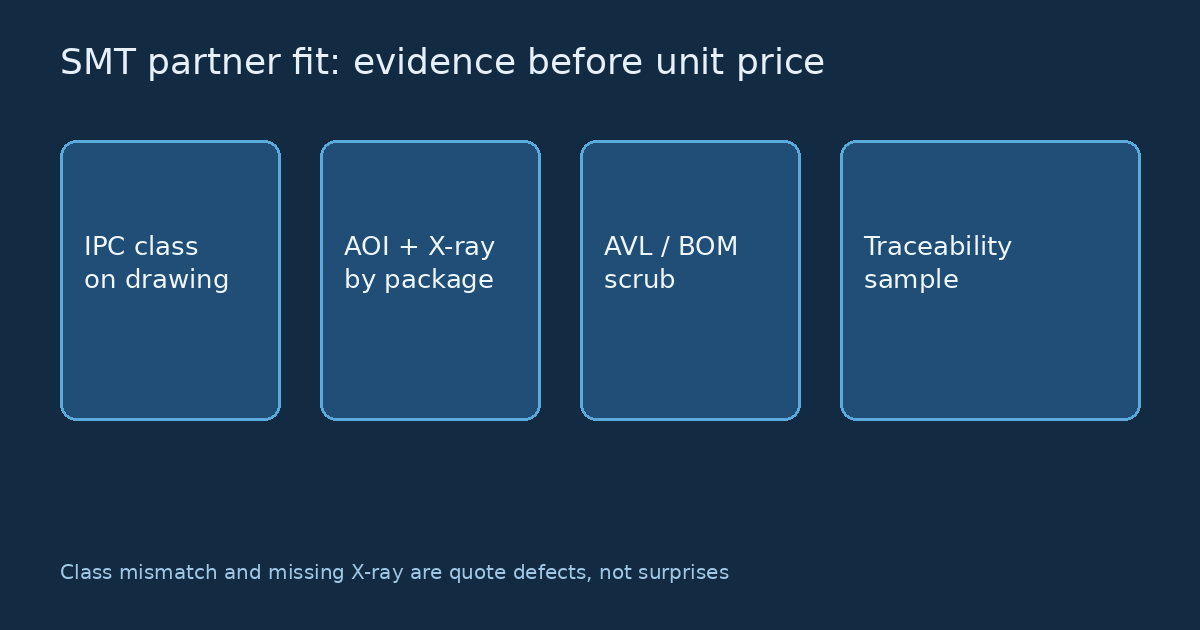
Demand artefacts, not slogans: a sample first-article inspection report, a redacted traceability record (lot codes, paste batch, reflow profile run, AOI pass/fail, machine and operator IDs), and a written test strategy for your package mix. Red flags that reliably kill a quote include no stated IPC class, no in-house AOI, no traceability sample on request, and NRE fees that only appear after the PO. If the RFQ response comes back fast with zero design questions, treat that as a predictor of change orders, not of efficiency.
Test and inspection coverage matched to the package mix
AOI on 100 percent of SMT is table stakes in 2026. Human-only inspection cannot match machine catch rates on fine pitch. SPI (solder paste inspection) before placement catches volume and alignment defects that AOI after reflow can only partially recover. For BGA, QFN, LGA, and other bottom-terminated packages, optical top-side views do not see the joints that fail in the field -- X-ray (AXI) on those packages, in-house or via documented near-term access, is the coverage that matches the package mix. ICT and functional test belong on the quote as scoped line items with fixture NRE called out, not as a vague "testing available" footnote.
Ask how first-pass yield is defined: before rework or after. A high post-rework yield can hide a repair station that touches a fifth of the boards. Defects per million opportunities on a comparable board, plus a sample AXI image set for your BGA pitch, tell you more than a capability brochure photograph of an AOI machine.
BOM, AVL, and shortage behavior under turnkey pressure
Three sourcing models change what the unit price means. Full turnkey: the assembler buys the BOM, applies a component markup, and absorbs procurement labour, incoming inspection, and much of the shortage chase. Consignment: you kit everything and own attrition (small passives routinely lose a few percent in handling). Hybrid: they source commodity lines; you consign allocated MCUs, custom magnetics, or long-lead modules. Comparing a turnkey number to a consignment number without adding your kitting and risk is arithmetic on unlike things.
Who owns BOM scrub -- obsolescence, MOQ, lead time, alternates -- should be explicit. A shop that "just buys what is on the BOM" will discover EOL parts on your critical path. Authorised-distributor-first AVL policy, documented escalation for open-market buys, and alignment to counterfeit-avoidance practice (AS5553 / AS6081 style controls where gray-market buys happen) separate partners who protect the program from partners who protect the schedule with unmarked substitutions. Silent package or MPN swaps without a signed alternate approval are how a cheap lot becomes a field failure with no serial trail.
NCNR (non-cancellable, non-returnable) liability on excess and obsolete material after a revision or cancel belongs in the quote math. "We will figure it out" is a price component you will pay later.
Capacity fit from prototype through volume
Volume envelope mismatch shows up after the pilot. Prototype-oriented lines that cap near tens of boards struggle when you need stable reorder cadence. Mid-tier EMS envelopes that run from tens into tens of thousands with published placements-per-shift numbers are usually a better fit for industrial and commercial programs that must stay visible to engineering. Tier-1 giants optimized for hundreds of thousands of units often park a 5,000-unit program at the back of the ECO queue.
Ask whether NPI and production share the same line, stencil set, and process data. Moving vendors at scale-up re-qualifies fixtures, profiles, and first articles. Published capacity (placements per year per shift), current utilisation, and a named backup line matter more than "we can do millions." MOQ honesty -- both floor and practical ceiling -- beats a broker claim of no limits that silently routes your boards across unrelated factories.
How to read a PCBA quote line by line
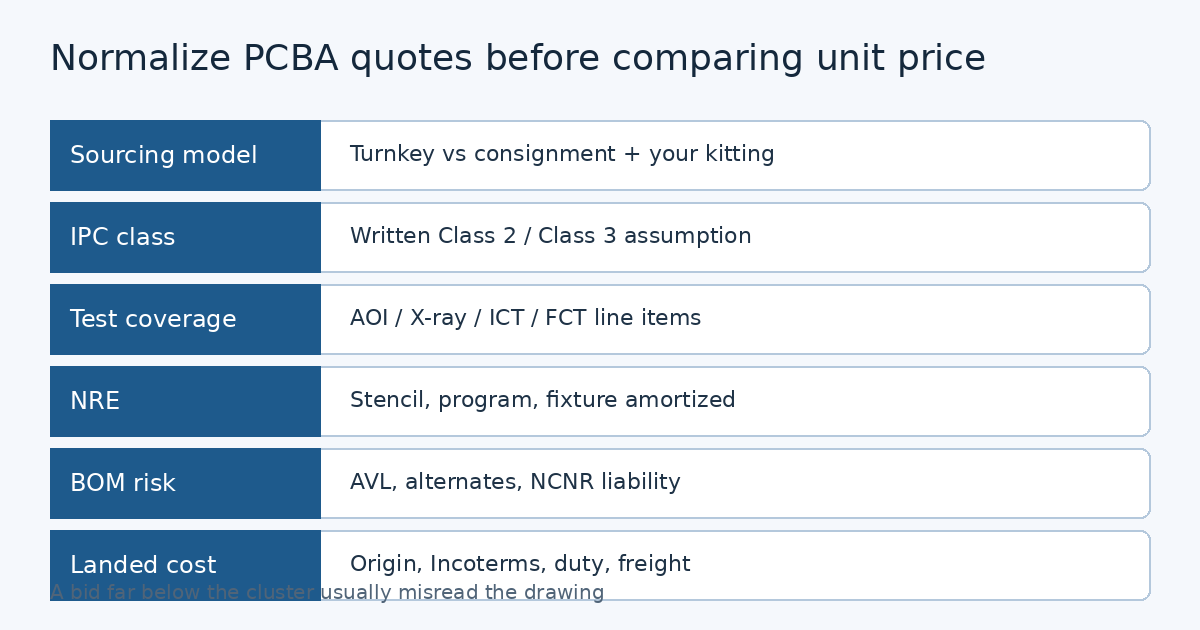
Normalize before you compare. Restate every bid against one sourcing model. Pull NRE out (stencil, programming, ICT fixture) and amortise across realistic year-one volume, not the first 25-piece PO. Confirm IPC class and test coverage assumptions in writing: AOI only versus AOI plus X-ray versus AOI plus X-ray plus ICT or functional test. Confirm country of origin and Incoterms so duty and freight sit in landed cost. Confirm excess/obsolete liability on cancel or revise.
On small and mid-volume builds the BOM often owns half or more of the invoice. Squeezing assembly labour a few percent moves the total far less than fixing alternates, package standardisation, and order timing against distributor breaks. A bid sitting far below the cluster usually misread the drawing -- wrong class, missing X-ray, missing coating -- not a miracle process. Re-confirm the spec before you celebrate the discount.
China turnkey notes for XFPCB readers
China turnkey PCBA compresses fab, sourcing, SMT, and test under one traveler, which cuts handoff lag when the same house owns both bare board and assembly. That advantage only holds when class, inspection, and AVL rules are locked in the RFQ the same way you lock stackup and finish on a bare-board order. Remote buyers should treat time-zone communication, named escalation contacts, and sample traceability output as part of partner fit -- not as after-sales soft skills. Pilot 25 to 100 units with full inspection records before the volume PO; switching later means new stencils, new fixtures, fresh first articles, and a rebuilt documentation pack.
ISO and IPC credentials remain buyer criteria to verify by scope and site. Do not substitute a homepage badge for a process that can show class, AOI/X-ray coverage, and BOM control on your actual package mix. When quotes diverge, re-open the drawing notes before you re-open the price cell.
Choosing an SMT assembly partner is a scoring exercise with evidence attached: process class, inspection matched to packages, sourcing behaviour under shortage, capacity that fits proto-to-volume, and a quote you can read line by line. The partner that engages your files first and your unit price second is the one whose first lot matches the drawing you thought you bought.