
AS9100 is an organization quality-management system (aerospace QMS): traceability, risk, configuration control, and supplier process discipline. It is not a product class, not a microvia reliability stamp, and not a substitute for IPC-6012 Class 3, stackup notes, or material callouts on the fabrication drawing. Buyers who purchase on certificate number alone often receive Class 2 process windows, vague “HDI capable” travelers, and default FR-4 habits — then discover gaps at FAI, microsection, or thermal-cycle life.
This China-fab guide answers first: what AS9100 actually covers versus what drawings must still lock; why aerospace programs like HDI for weight and size (and which fab risks follow); material fields that stay on the drawing; questions beyond the cert PDF; and an RFQ matrix that stops certificate-only buying. Design-rule depth: aerospace PCB design rules. Class language: IPC Class 3 PCB fabrication. Aviation buyer context: commercial aviation PCB requirements. Process capability context: HDI PCB board fabrication capabilities.
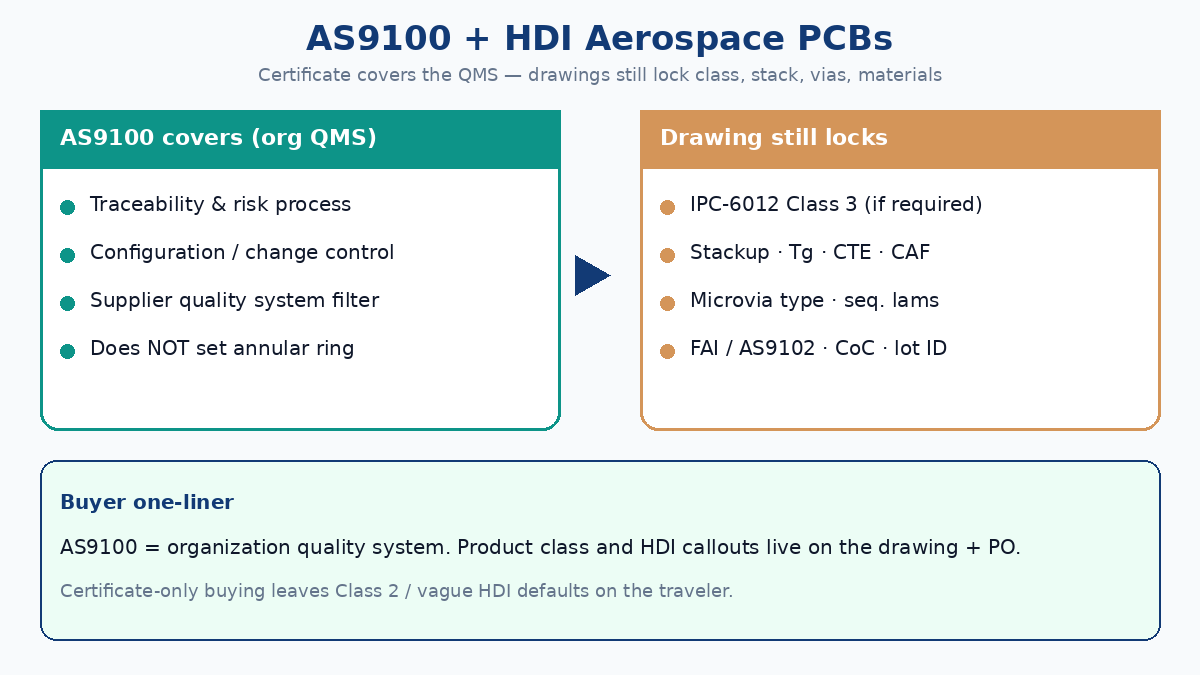
Answer first: AS9100 = QMS filter, not product class
| Phrase you hear | What it actually means | What it does not mean |
|---|---|---|
| “We are AS9100” | The organization runs an aerospace-oriented quality management system | Every board ships IPC Class 3 annular ring / plating without a drawing callout |
| “Aerospace HDI fab” | Marketing for density / process capability | Automatic microvia reliability evidence for your stack |
| “Certified for aviation” | Supplier-system signal (verify scope and current status) | Material, Tg, CTE, CAF, or RF laminate chosen for you |
| “IPC Class 3 + AS9100” | Two different locks: product acceptance + org QMS | Redundant — you often need both, and neither replaces the other |
One-line definition: AS9100 disciplines how the plant manages quality. IPC class, HDI via architecture, and laminate callouts discipline what the lot must be. Certificate-only RFQs leave CAM free to quote the cheapest traveler that still looks “aerospace-ish.”
Program quality and board quality are related but not identical. A strong QMS reduces the chance of uncontrolled changes and lost lot history; it does not enlarge your pads, thicken your barrels, or prove a stacked microvia survives your thermal profile. Write the product requirements as if the supplier were ISO-only — then add AS9100 when the program actually flows it.
💡 Procurement Pro-Tip: Put AS9100 (if the program requires it) on the supplier qualification line, and put IPC-6012 class, stackup, microvia type, and material on the product line. Mixing them into one vague “aerospace quality” sentence is how silent Class 2 defaults survive quote review.
Companion depth on acceptance class versus myths: IPC Class 3 PCB fabrication.
Why aerospace likes HDI — and the fab risks that follow
Weight and volume budgets push interconnect into smaller footprints. HDI (fine lines, microvias, sequential build-up) packs routing under fine-pitch BGAs, shortens critical nets, and can thin the mechanical envelope versus a through-hole-only multilayer with the same I/O count. That is the real aerospace interest — not a brochure word.
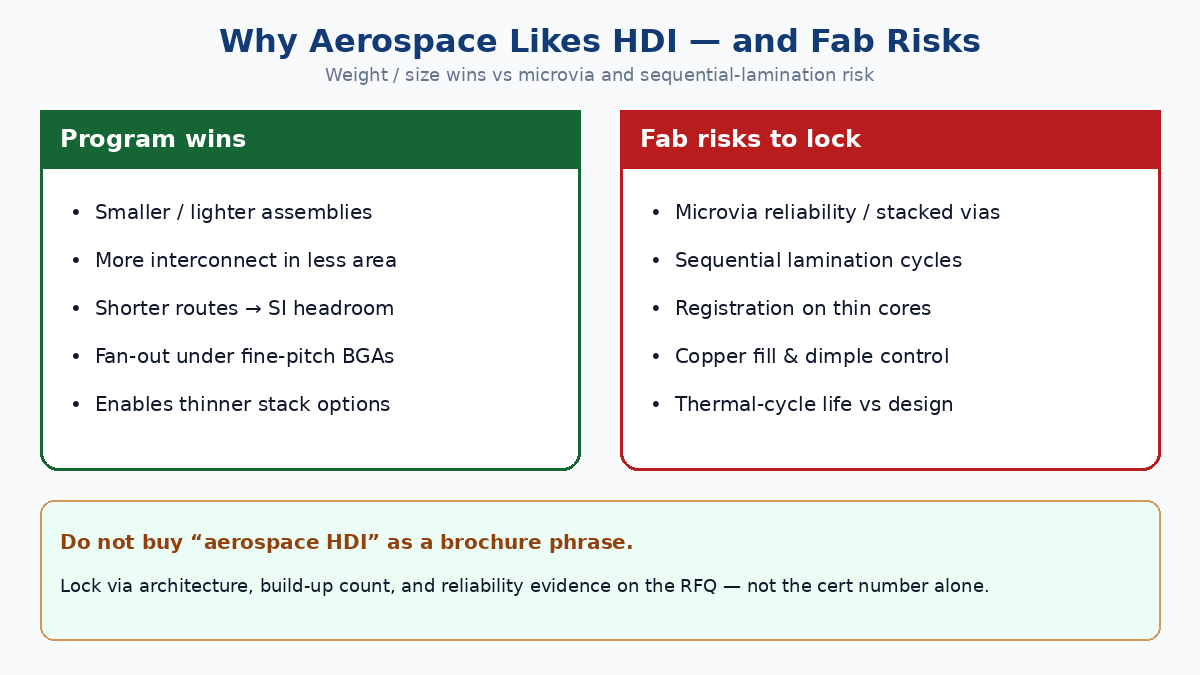
| Program win | What fab must still prove | Fail mode if RFQ is vague |
|---|---|---|
| Smaller / lighter box | Via architecture matches DFM (laser microvia size, capture pads) | Quote assumes staggered; design needs stacked → late EQ |
| Density under BGA | Registration on thin cores across sequential lams | Annular ring / breakout at Class 3 floors |
| Shorter routes / SI headroom | Controlled impedance still cited with coupon yes/no | “HDI” without Z method → electrical disputes |
| Thinner stack options | Copper fill, dimple, and planarization control | Assembly coplanarity / void risk at BGA |
| Weight out of copper/laminate | Thermal-cycle and microvia reliability plan | Field opens after vibration / thermal stress |
Microvia reliability is not free with an AS9100 logo. Stacked microvias, high aspect laser holes, and multiple sequential lamination cycles change scrap economics and life risk. Ask for the build-up count, stacked vs staggered rule, and what evidence (coupon, microsection, thermal cycle sample) applies to this part number — not a plant capability slide.
Practical China-fab note: many plants can laser-drill and plate microvias in volume. Fewer keep stable stacked-microvia yields across multiple sequential presses with Class 3 annular ring floors. Ask which stacks are “standard process” versus “EQ / engineering special,” and price the special path honestly — a cheap HDI quote that later needs a respin is not cheap.
Sequential lamination multiplies registration and material-movement risk. Thin cores stretch and shift; Class 3 annular ring floors punish that drift. Lock scale factors, FA registration checks, and core thickness family when density is aggressive. Layout companion: aerospace PCB design rules. Capability framing (without treating the page as a product cert): HDI PCB board fabrication capabilities.
⚠️ Watch Out for: RFQs that say “AS9100 HDI” with no microvia type, no sequence count, and no Class. You will get three incompatible quotes — all “compliant” to a sentence that never defined the product.
Material selection still belongs on the drawing
AS9100 does not pick laminate. Flight-adjacent and long-life boards still need Tg, CTE, CAF awareness, and — when RF nets exist — Dk/Df families written into the stack table or notes. Leaving “aerospace material” blank usually means FR-4 habit with whatever Tg the buyer’s silence allows.
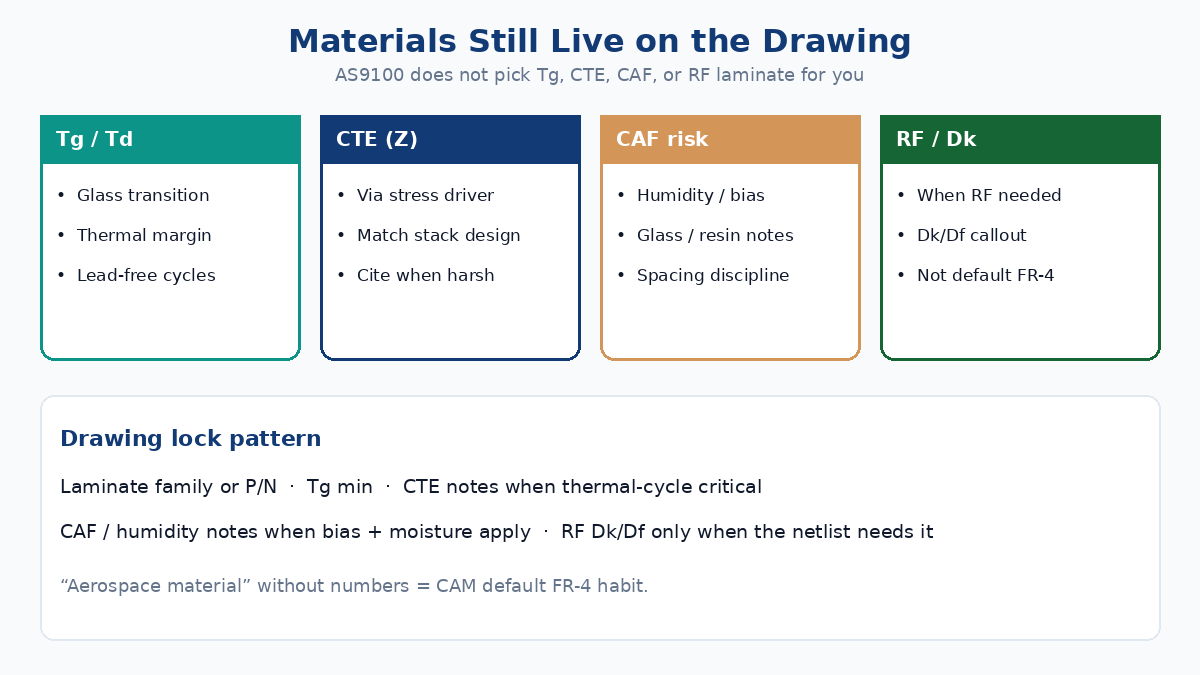
| Drawing field | When to lock it | What silence buys you |
|---|---|---|
| Laminate family / P/N | Always for flight / long-life / RF | CAM default commodity FR-4 |
| Tg (min) | Lead-free assembly cycles; thermal margin | Soft Tg → pad crater / warp risk |
| CTE (Z) notes | Harsh thermal cycle; dense PTH / microvia | Via fatigue blamed on “mystery stack” |
| CAF / humidity | Bias + moisture; fine spacing | CAF shorts after life, not at ICT |
| RF Dk/Df | Controlled RF / microwave nets | Wrong dielectric → retune or scrap |
| Copper foil type | Fine line / impedance / registration | Unexpected etch / scale behavior |
For HDI specifically, thin dielectric layers and multiple laser cycles amplify any mismatch between copper, glass, and resin. That is why CTE and registration notes matter more on a 2+N+2 build than on a loose four-layer through-hole board — even when both quotes wave the same AS9100 PDF.
Rule: Material is a product specification. QMS evidence (AS9100) and material certs (lot CoC) support it — they do not invent it. If the program is commercial aviation with mixed airworthiness expectations, read how drawing language and process expectations interact: commercial aviation PCB requirements.
💡 Procurement Pro-Tip: Require the fab to mirror your stack table on the quote (core/prepreg family, Tg, copper weights). A cert PDF attached to a blank stack is not a material lock.
What buyers should ask beyond the certificate number
A current AS9100 certificate (scope, site, expiry) is a supplier filter. Product risk lives in six follow-ups that belong on every aerospace-adjacent HDI RFQ.
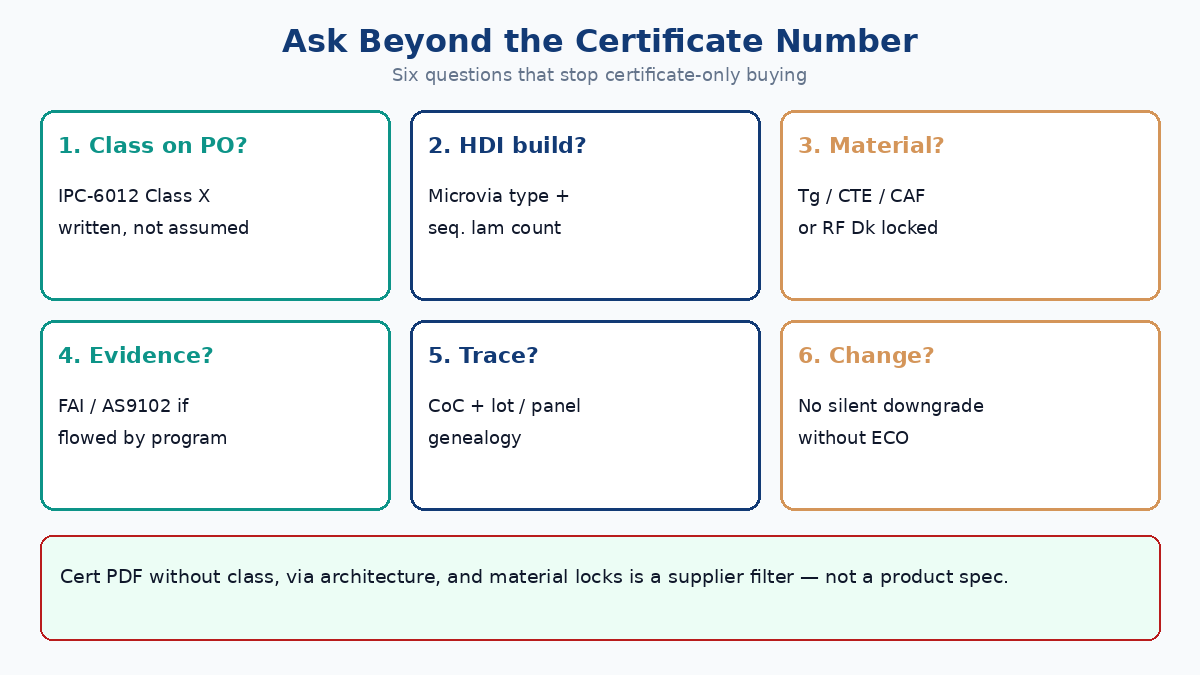
- Is IPC class written on PO line 1? AS9100 ≠ Class 3. Cite IPC-6012 Class (and revision) when reliability demands it; cite IPC-A-610 separately if PCBA is in scope.
- What is the HDI build? Microvia type (laser diameter / capture), stacked vs staggered, sequential lamination count, any buried/blind rules.
- What material is frozen? Laminate family or P/N, Tg, CTE/CAF notes, RF Dk when needed — mirrored on the quote.
- What evidence is flowed? FAI / AS9102 only if the program flows it. Do not invent AS9102 theater; do not skip it when the customer contract requires it.
- What traceability ships? CoC to the stated class and material, lot / panel genealogy, and coupon retention rules.
- What blocks silent downgrade? Written ECO before any class, stack, via, or material reduction — traveler cannot “simplify HDI” after award.
Also verify certificate scope and site: the legal entity and manufacturing address on the cert should match the plant that will run your panels. A group-level cert that does not cover the HDI line you are quoting is a paper shield, not a process shield.
Decision rule: If the reply is only a certificate PDF and a capability brochure, you do not yet have a buildable aerospace HDI package — you have a supplier marketing pack.
China fab RFQ matrix — stop certificate-only buying
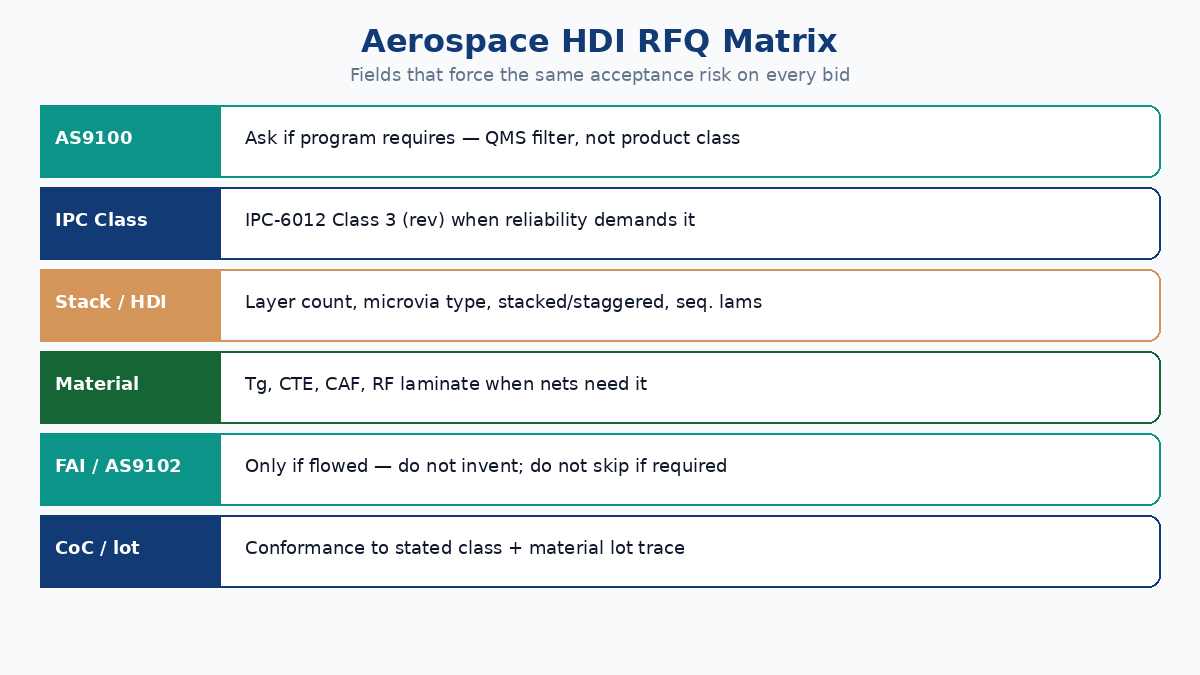
Paste this block so every bidder prices the same acceptance and process risk:
| RFQ / drawing field | What to write | Fail mode if missing |
|---|---|---|
| AS9100 (supplier) | Required / not required by program; site scope if required | Cert shopping without product locks — or unnecessary cost if program does not flow it |
| Bare-board class | IPC-6012 Class 3 (revision) when justified; else explicit Class 2 | Silent Class 2 defaults under “aerospace” title |
| Assembly class (if PCBA) | IPC-A-610 Class X explicit | Hole-fill / solder disputes after award |
| Stackup / HDI | Layer count, microvia type, stacked/staggered, seq. lam count | Incompatible HDI quotes; late DFM failure |
| Material | Family/P/N, Tg, CTE/CAF, RF Dk/Df when needed | Default FR-4; CAF/thermal surprises |
| Impedance (if any) | Z0/Zdiff targets + coupon yes/no | Electrical accept fights |
| FAI / AS9102 | Only if flowed by customer/program | Missing FAI when required — or wasted NRE when not |
| Coupon / microsection | FA plan for PTH and microvia as applicable | “Class 3 / HDI reliable” with no evidence |
| CoC / lot trace | CoC to stated class + material lot / panel ID | Audit gap; no genealogy |
| No silent downgrade | No class / stack / via / material cut without signed ECO | Traveler quietly de-scopes HDI or Class |
Treat the matrix as a bid equalizer. When one supplier prices Class 3 stacked microvia with AS9102 FAI and another prices “HDI capable” Class 2 with visual-only ship, lowest price is not comparable. Force the matrix onto every bid form; reject incomplete replies before negotiation.
Minimum viable aerospace-adjacent HDI RFQ: supplier QMS ask (AS9100 if required) + IPC-6012 class + HDI via/stack definition + material lock + CoC/lot trace + ECO rule. Add AS9102/FAI only when flowed. Add A-610 class when assembly is in scope.
Soft next step for high-reliability / aviation-adjacent HDI
If you are locking a Class 3 or aviation-adjacent HDI build in China, send the stackup, microvia chart, class/coupon block, and whether AS9100 / AS9102 are program-flowed — in the first RFQ. XFPCB supports high-reliability and Class 3 HDI fabrication with drawing-driven documentation and acceptance (class, stack, vias, and material on the traveler). We do not treat an organization certificate as a substitute for your product specification, and we do not claim unrelated OEM customer lists as proof of your lot. Pair this page with aerospace PCB design rules, IPC Class 3 PCB fabrication, commercial aviation PCB requirements, and HDI PCB board fabrication capabilities when you need layout, class, aviation context, and HDI process windows in one package.