
Aerospace PCB design rules are the locked requirement set on the drawing and PO -- not a marketing slogan and not an AS9100 factory badge alone. Buyers and technicians must freeze program type (commercial avionics vs defense vs space), the acceptance stack (IPC-6012 Class 3 / IPC-A-610 Class 3 / J-STD-001 Class 3, plus IPC-6012FS only when flowed down), laminate family and Tg, finish and thickness, thermal-mechanical-EMI reliability margins, and documentation (coupons, CoC, lot traceability, change control). AS9100 is a quality management system for traceability, configuration, and risk -- it is not a PCB acceptance class. This guide expands those rules with factory Information Gain for overseas procurement sourcing China fabs, without overwriting application-focused commercial aviation content.

What aerospace PCB design rules really mean
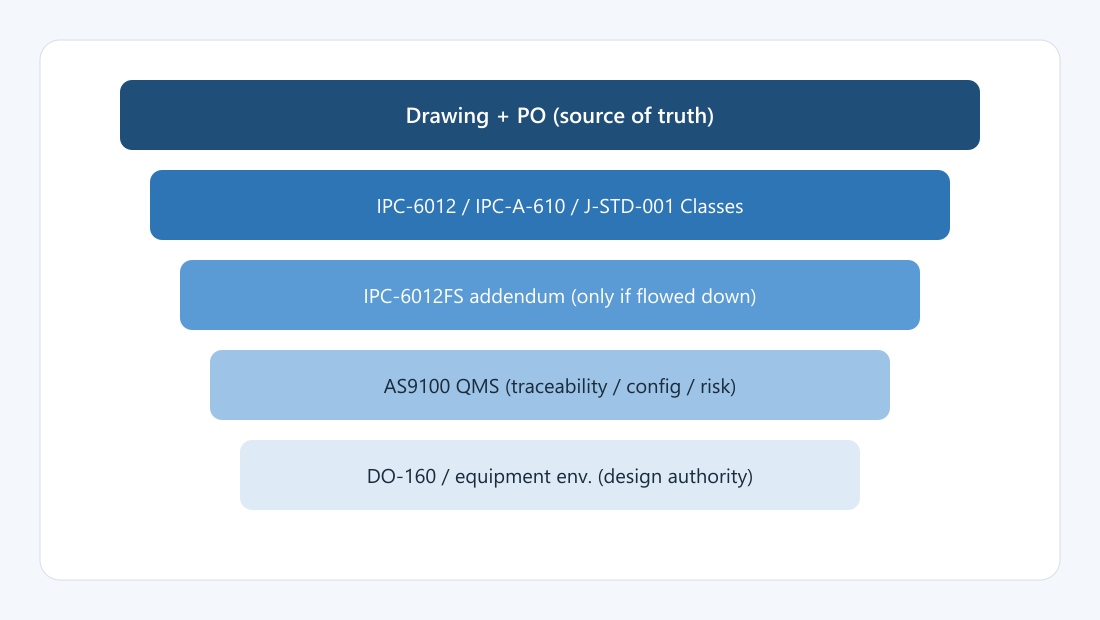
Treat "aerospace PCB" as a family of environments and contracts, not one process recipe. The rules that matter are layered:
| Layer | What it is | What it is not |
|---|---|---|
| Drawing + PO | Source of truth for class, materials, test, docs | Optional brochure text |
| IPC-6012 Class 3 (bare board) | Performance / acceptance for rigid PCB fabrication | Automatic with the word aerospace |
| IPC-A-610 Class 3 / J-STD-001 Class 3 | Assembly workmanship and soldering | A substitute for bare-board class |
| IPC-6012FS | Space / military avionics addendum when the program requires it | Free upgrade because someone said "flight" |
| AS9100 | Supplier QMS (traceability, config control, risk) | Per-panel flight qualification |
| DO-160 / MIL env. categories | Equipment environmental qualification owned by the design authority | A bare-board stamp you can buy off a price list |
Clarify program type early on every RFQ:
- Commercial avionics -- civilian aircraft electronics; requirements still come from the equipment drawing and environment, not from a catalog "aviation FR-4."
- Defense avionics -- often tighter configuration control, finish/plating callouts, and flowed-down military or customer specs.
- Space -- may invoke IPC-6012FS, radiation/outgassing constraints, and deeper lot evidence; do not assume Class 3 alone equals space qualification.
💡 Procurement Pro-Tip: Put the program type and the exact standard revision on the same PO line as the part number. "Aerospace, AS9100, Class 3" without a drawing rev is three marketing words, not a buildable contract.
Rule 1: Lock the requirement set before you RFQ
The first design rule is contractual clarity. Fabricators price and process what is written. Ambiguity becomes silent defaults -- and silent defaults are how high-reliability programs fail in the field years later.
Decision table by program type
| Program type | Typical bare-board language | Assembly language | QMS signal | Add only if flowed down |
|---|---|---|---|---|
| Commercial avionics / aviation-adjacent | IPC-6012 Class 3 (or Class 2 if design authority accepts) | IPC-A-610 + J-STD-001 class as drawn | AS9100 helpful for process discipline | DO-160 categories for the equipment; FS only if specified |
| Defense avionics | IPC-6012 Class 3 + customer SCD / MIL callouts | Class 3 soldering/workmanship common | AS9100 often expected | Any MIL-PRF / customer process specs on the PO |
| Space / launch | IPC-6012 Class 3 and IPC-6012FS when required | Class 3 + customer assembly specs | AS9100 + stronger config control | Outgassing, radiation, special plating, FAI/AS9102 packages |
Myth to kill: an "AS9100 factory" does not ship flight-qualified boards by default. AS9100 audits how the organization manages quality systems. Acceptance of your bare board still comes from the drawing, IPC class, coupons, and inspection depth you paid for.
Myth to kill: IPC Class 3 alone is not full space qualification. Class 3 raises acceptance criteria for fabrication or assembly. Space programs often need the FS addendum, named materials, deeper microsection evidence, and customer qualification plans on top.
⚠️ Watch Out for: Quotes that answer "aerospace?" with "yes, we are AS9100" and never list IPC-6012 class, hole-wall copper minimum, finish thickness, or change-control language. That answer prices a QMS brochure, not your panel.
XFPCB supports high-reliability and aviation-adjacent Class 3 programs when drawings and acceptance criteria are explicit -- following materials, classes, and documentation on the PO without inventing part-level AS9100 or DO-160 stamps the program does not define.
Rule 2: Choose materials for the environment, not for brand slogans
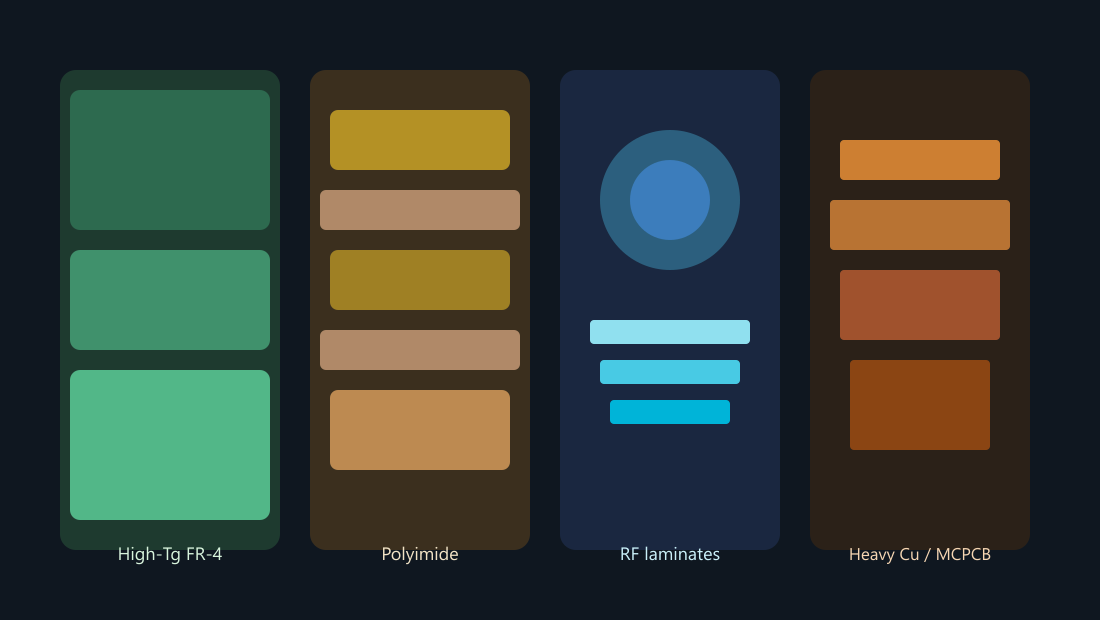
Lock laminate family and properties to thermal cycling, RF loss, power density, and moisture -- not to a competitor's marketing sheet. Prefer generic families on the RFQ so CAM can quote apples-to-apples and so you retain substitute control.
Property-oriented selection (qualitative)
| Family | Typical use case | Tg / thermal posture | Moisture / CTE notes | Electrical notes |
|---|---|---|---|---|
| High-Tg FR-4 (often Tg ~170 °C class) | Many commercial avionics multilayer boards with moderate cycling | Higher Tg helps lead-free reflow and thermal margin vs commodity FR-4 | Still organic; watch CAF risk and bake discipline | Good for digital/mixed; impedance with proper stackup |
| Polyimide / high-temp organics | Wide temperature swing, some flex/rigid-flex, harsh thermal | High Tg and better high-temp stability | Lower moisture uptake vs many FR-4s in many grades -- still verify datasheet | Cost and process window rise; DFM for drill and lamination matters |
| PTFE / ceramic-filled RF laminates | Nav, comm, radar, antenna feeds | Thermal expansion and bonding differ from FR-4 | Often need special bonding films / hybrid stacks | Stable Dk/Df for RF; do not write "FR-4 equivalent" without approval |
| Heavy copper / metal-core | Power conversion, heaters, high-current distribution | Heat spreading and I²R control dominate | Mechanical stiffness and CTE mismatch with ceramics/metals | Creepage/clearance at altitude; connector support |
Numbers above are selection posture, not a substitute for the laminate datasheet on your AVL. Freeze:
- Laminate designation or approved family list
- Minimum Tg (and Td if the design authority cares)
- Copper weight per layer and any heavy-copper zones
- Hybrid stack rules (RF core + FR-4 buildup) with named bonding materials
- "No silent material swap" -- written approval before any substitute
Rogers-branded marketing is not required on most buyer RFQs; call PTFE / ceramic-filled RF laminates (or the exact approved part number on the AVL) unless your drawing already names a brand. Do not paste competitor fabricator names into notes -- they add no process value and confuse AVL control.
💡 Procurement Pro-Tip: Ask for the same Tg and laminate family on the quote, traveler, and CoC. If the quote says "high-Tg FR-4" and the CoC says a different Tg window, stop the lot until engineering signs a deviation -- or reject it.
Rule 3: Design the reliability triad -- thermal, mechanical, electrical
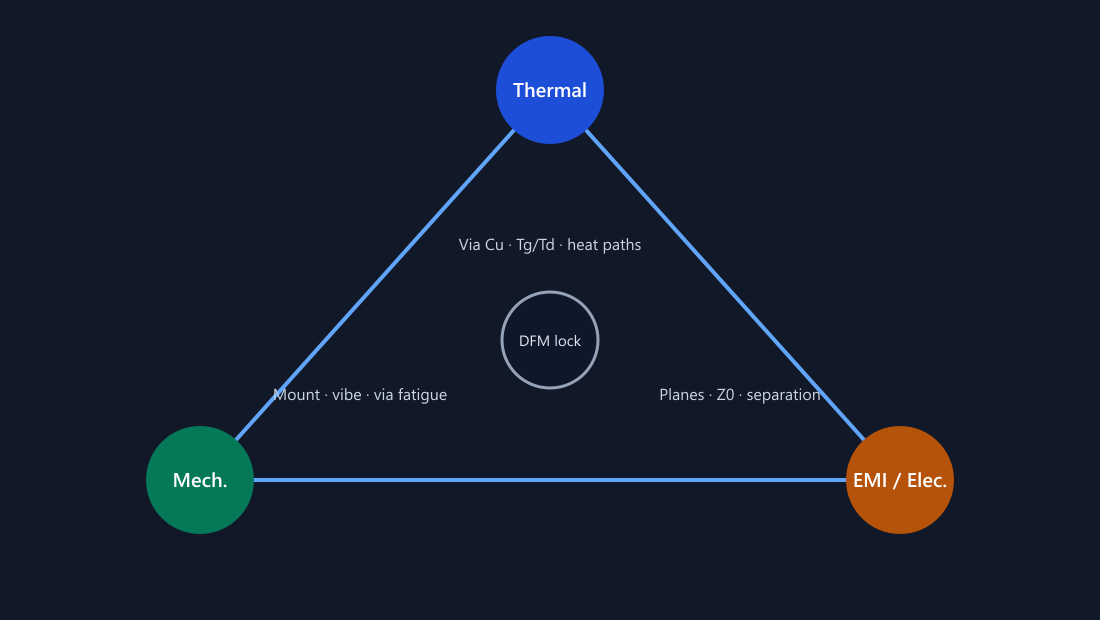
Aerospace-intent boards fail when one triad leg is ignored. Layout and fab DFM notes must address all three.
Thermal
- Size vias and copper for heat and for plating reliability under thermal cycling -- thin hole-wall copper is a latent open waiting for altitude and vibration.
- Match Tg/Td to reflow count and service temperature; lead-free assembly raises the bar versus old SnPb assumptions.
- Provide thermal reliefs that still leave enough copper for reliability; starving pads to "look pretty" in CAD can crack joints under cycling.
- For power boards, budget copper weight and plane continuity early -- field temperature rise is a design number, not a fab surprise.
Mechanical
- Lock mounting hole type (PTH vs NPTH), keep-out, and stiffener strategy before CAM.
- Vibration and shock drive via fatigue: prefer stacked via strategies the fab can actually plate; avoid fragile microvia stacks without process evidence.
- Rigid-flex helps connectors and packaging, but bend radius, coverlay, and transition zones must be drawn -- copying a thick high-rel stack into a tight bend without analysis creates NRE and scrap.
- Edge connectors and gold fingers need wear and plating thickness callouts when the application cycles insertions.
Electrical (planes, impedance, EMI)
- Continuous reference planes and controlled return paths beat random copper fills for EMI.
- Impedance nets need stackup tables, reference layers, and coupon requirements on the fab drawing -- not only a simulation screenshot.
- Separate noisy power switching from sensitive RF/analog; stitch grounds where the design authority requires.
- Altitude and contamination change creepage/clearance needs; do not copy a sea-level consumer spacing table blindly.
⚠️ Watch Out for: Beautiful impedance plots with no coupon callout on the fab drawing. Simulation is design intent; the coupon and ET report are manufacturing evidence.
China fab RFQ matrix for overseas buyers (Information Gain)
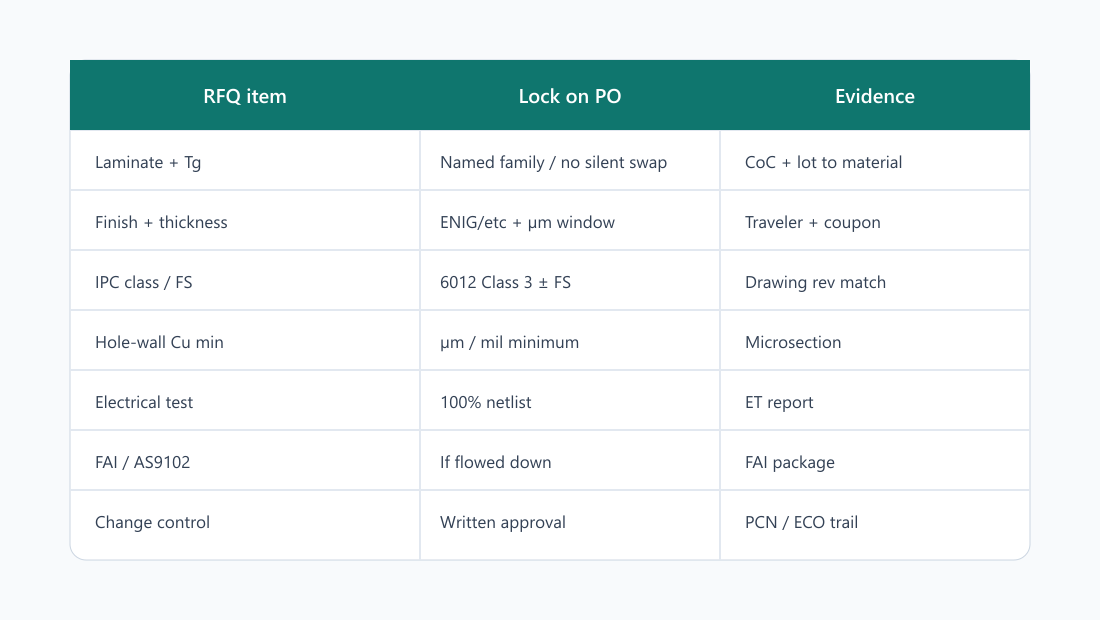
Use this matrix so every China fab quote is comparable. Paste the "Lock on PO" column into your RFQ checklist.
| RFQ item | Lock on PO / drawing | Why it matters | Evidence to request |
|---|---|---|---|
| Laminate lock + Tg | Named family or P/N + min Tg; no silent swap | Prevents "equivalent" FR-4 substitutions that shift CTE/CAF/Dk | CoC tying lot to material; traveler laminate lot |
| Finish + thickness | Finish type + thickness window (e.g. ENIG Au/Ni µm) | Affects solderability, wear, wire-bond or press-fit | Traveler + thickness record / coupon where applicable |
| IPC class + FS addendum | IPC-6012 Class X; IPC-6012FS only if required; assembly classes separate | Class and FS drive inspection cost and process | Drawing rev + acknowledgment on quote |
| Hole-wall Cu minimum | Absolute min plating (µm or mil) | Thermal/vibe via life | Microsection photos/report on FAI or periodic |
| Coupon / microsection | Which coupons, when (FAI, lot, periodic) | Proves plating and dielectric reality | Microsection package with scale |
| Electrical test | 100% netlist ET; flying probe or fixture as agreed | Opens/shorts before assembly | ET pass record linked to panel/lot |
| CoC + lot traceability to material | CoC content list + retention period | AS9100-style discipline without fake part certs | CoC + material certs on file |
| FAI / AS9102 | Required if flowed down -- say so | First-article discipline for defense/space programs | FAI package per customer forms |
| Inspection depth | IPC-A-600 Class 3 (or stated visual/AOI depth) | Bare-board workmanship visibility | Inspection records / AOI sample plan |
| Change control | Written approval before material, stackup, or process change | Stops silent swaps mid-program | PCN / ECO trail |
Also attach: revision-controlled Gerbers or ODB++/IPC-2581, NC drill with PTH vs NPTH, stackup table, fab notes, and (for assembly) BOM, CPL, and netlist. Incomplete zips produce non-comparable prices.
Qualification and documentation that survive audits
High-reliability programs live or die on paperwork that matches the panel.
Coupons and microsections -- Define which coupons ship with the lot or stay at the fab under retention. Microsections should show hole-wall copper, dielectric thickness, and registration against your minima -- not a generic marketing photo.
Certificates and travelers -- CoC should name part number, revision, quantity, laminate lot, finish, date, and applicable IPC class language. Travelers should show process steps and operators/equipment per your retention rule.
FAI / AS9102 -- Only when the customer flows it down. Asking every commercial quote for a full AS9102 package inflates cost; omitting it when the SCD requires it stalls receiving inspection.
Change control -- Ban silent laminate, foil, finish chemistry, or drill-route changes. Require written approval and, when needed, delta FAI. This is where AS9100 QMS value shows up -- as system discipline, not as a sticker on the board.
Honest non-claims -- Do not ask the fab to stamp "DO-160 certified bare PCB" or "AS9100 flight hardware" unless your quality organization has a defined, honest interpretation. Equipment environmental qualification and flight airworthiness sit with the design authority and certification authorities -- not on a bare-panel silkscreen.
Soft next step for high-reliability builds
If you are locking an aviation-adjacent or high-reliability Class 3 construction -- multilayer, HDI, rigid-flex, RF hybrid, or heavy copper -- send XFPCB the drawing package and the RFQ matrix lines above. We manufacture and assemble against written materials, classes, and documentation requirements, and we will flag DFM conflicts before panels run. We will not invent AS9100 part-level or DO-160 bare-board claims your program does not define.
Related XFPCB guides
- Commercial Aviation PCB Requirements -- aircraft applications and aviation-adjacent RFQ language
- PCB Board Design and Layout Considerations -- placement, returns, and pre-order layout checks
- RoHS Compliance in PCB Manufacturing -- finish, alloy, and documentation without brochure badges
- How to Tell If a Printed Circuit Board Is Bad -- field and incoming failure clues
- Multilayer PCB Stackup Fabrication Guide -- stackup tables and reference planes CAM can build