
RoHS for PCBs means restricting ten hazardous substances in each homogeneous material of the bare board and assembled PCBA -- typically 0.1% by weight (1000 ppm) for lead, mercury, hexavalent chromium, PBB, PBDE, and four phthalates, and 0.01% (100 ppm) for cadmium -- unless a valid, time-bound exemption applies. Buyers who only collect a one-line Certificate of Conformity (CoC) still get blindsided by SnPb HASL finishes, SAC reflow on low-Tg laminate, expired exemptions, and missing IPC-1752-style material declarations when CE technical files or customer audits open. This guide is fab and procurement practice: substance limits, homogeneous-material thinking, lead-free process controls, the RFQ document pack, eco programs beyond RoHS, and why halogen-free is a separate claim.
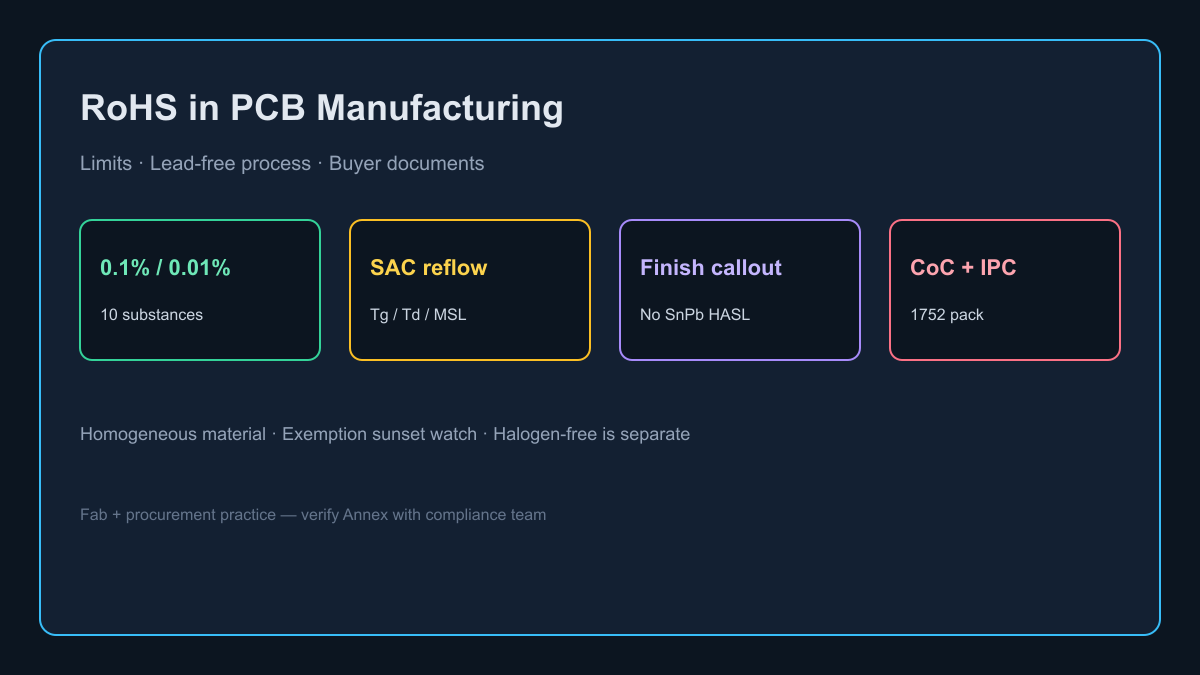
What RoHS requires for PCB and PCBA substance limits
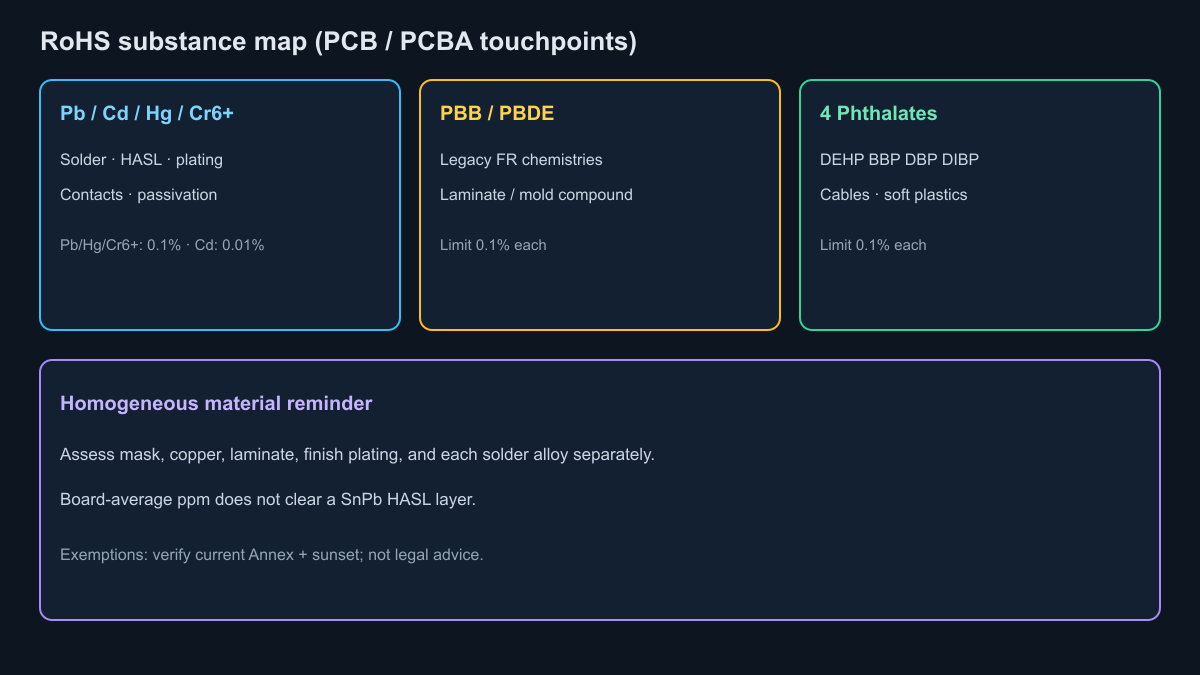
RoHS (EU Restriction of Hazardous Substances, currently the recast Directive 2011/65/EU as amended) caps ten substances in electrical and electronic equipment put on the EU market; for PCB work the practical limits are 0.1% w/w for nine substances and 0.01% for cadmium, applied per homogeneous material, not as a board-average.
| Substance | Typical limit (homogeneous material) | Where it shows up on PCB / PCBA |
|---|---|---|
| Lead (Pb) | 0.1% (1000 ppm) | SnPb solder, SnPb HASL, some alloys, older terminations |
| Mercury (Hg) | 0.1% | Rare on bare PCB; watch specialty sensors / lamps in the BOM |
| Cadmium (Cd) | 0.01% (100 ppm) | Some contacts, pigments, older plating chemistries |
| Hexavalent chromium (Cr6+) | 0.1% | Passivation / conversion coatings if not Cr3+ or Cr-free |
| Polybrominated biphenyls (PBB) | 0.1% | Legacy brominated flame-retardant chemistries |
| Polybrominated diphenyl ethers (PBDE) | 0.1% | Same FR family; confirm laminate / mold-compound declarations |
| DEHP | 0.1% | Soft plastics, some cable / connector materials |
| BBP | 0.1% | Soft plastics, adhesives, cable jackets |
| DBP | 0.1% | Soft plastics, some adhesives |
| DIBP | 0.1% | Soft plastics; often overlooked in harness kits |
These are buyer-facing working limits, not legal advice. Scope, product categories, and exemption Annexes change; your compliance team or counsel must verify the current Annex against the exact EEE category and ship date. High-melting-point solder and certain alloy exemptions have been under review for years, with sunset windows discussed around the mid-to-late 2020s -- treat any "exemption forever" claim as a red flag and re-check before each production release.
Homogeneous material: why a board-average ppm number is wrong
A homogeneous material is a material of uniform composition that cannot be mechanically disjointed into different materials -- for a multilayer PCB that means solder mask, copper foil, laminate resin/glass, surface finish plating, and each solder joint alloy are assessed separately, not averaged across the finished board weight.
Example on a four-layer FR-4:
- Copper foil and plated copper are one class of materials.
- FR-4 resin/glass (CCL) is another.
- LPI solder mask is another.
- ENIG stack (Ni + Au) or immersion silver / OSP film is another.
- Each SAC305 fillet after assembly is another homogeneous material.
A CoC that says "board is RoHS, Pb = 200 ppm average" without naming finishes and solder alloys is not how shop audits read the rule. If the HASL is SnPb, that finish layer alone can blow the lead limit even when the copper and laminate are clean. Ask for declarations that map substances to materials -- IPC-1752 / IPC-1752A class declarations or equivalent material declaration forms -- not a single board-level ppm.
⚠️ Watch Out for: "RoHS CoC" PDFs that never name the surface finish, solder alloy, or laminate grade, and that omit revision and date. Fake or recycled CoCs usually fail the first request for a material declaration tied to the traveler lot.
Where RoHS hits fab and assembly (not just the BOM)
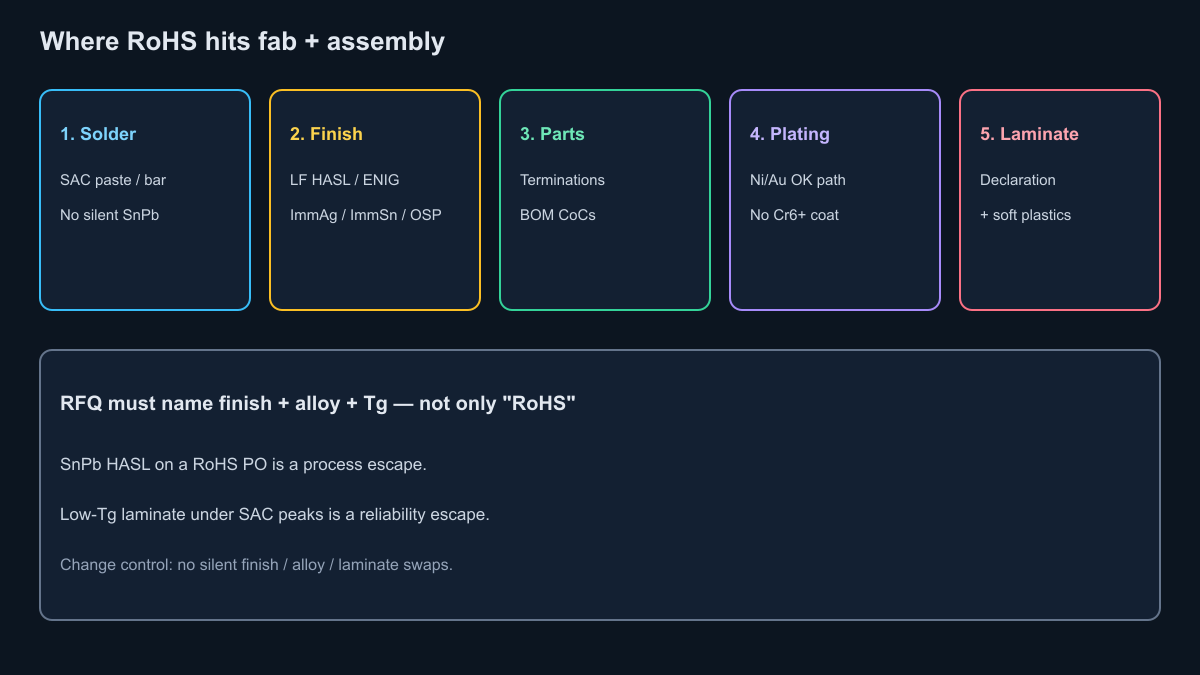
RoHS risk on a China fab + SMT line sits in five places buyers must call out in the RFQ: solder alloy, surface finish, component terminations, plating/passivation chemistries, and laminate / mold-compound declarations -- each is a separate homogeneous material with its own failure mode.
- Solder paste and bar. SAC305 / SAC387 and other lead-free alloys are the default for RoHS builds. SnPb paste on a "RoHS" PO is a process escape, not a paperwork typo.
- Surface finish. Lead-free HASL, ENIG, ImmAg, ImmSn, OSP are common RoHS-capable finishes. SnPb HASL is not. Write the finish name and thickness window on the fab drawing; do not accept "HASL" alone.
- Component terminations and plating. BOM lines can reintroduce Pb or restricted phthalates even when the bare board is clean. Require manufacturer declarations or distributor CoCs for critical ICs, connectors, and cable assemblies.
- Plating and conversion coatings. Edge-connector hard gold with nickel underplate is usually manageable; hex-chrome passivation on hardware is not. Confirm Cr6+ is out of the finish stack.
- Laminate and polymer parts. Standard FR-4 is typically formulated for RoHS assembly, but you still need a declaration. Soft plastics on the PCBA (grommets, wire insulation, some adhesives) drive the phthalate checks.
Lead-free process reality: SAC peaks, Tg/Td, and MSL
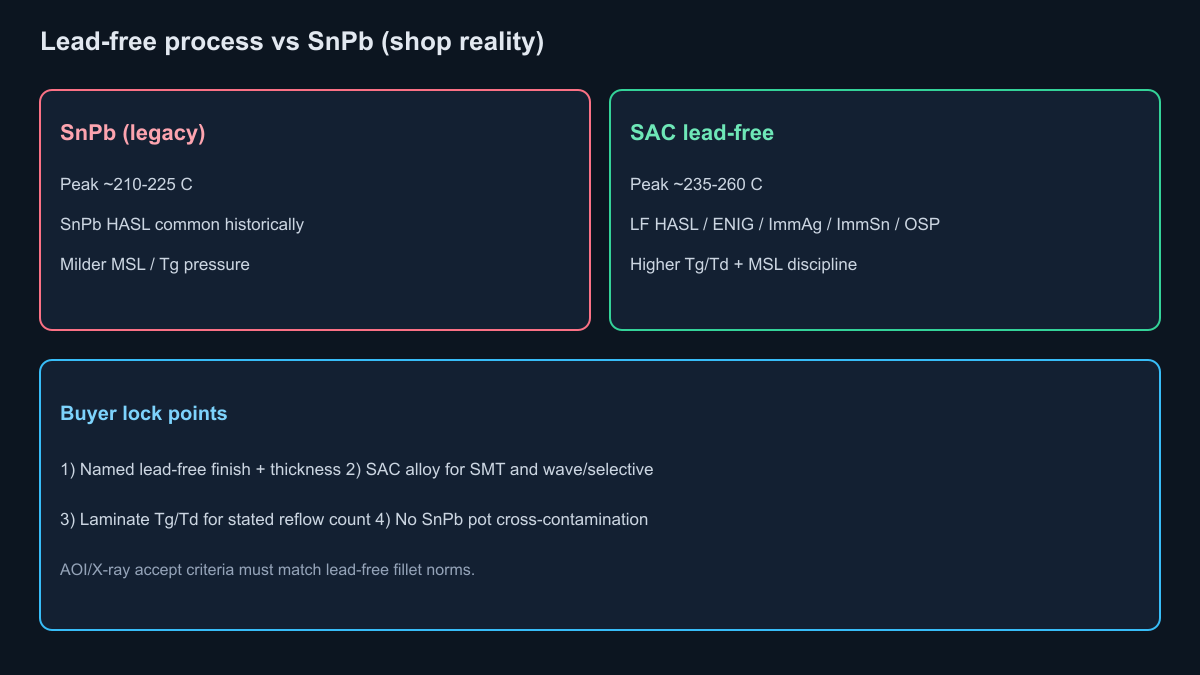
Lead-free reflow peaks higher than SnPb -- typically about 235-260 C peak for SAC305 profiles versus roughly 210-225 C for SnPb -- so laminate Tg/Td, via reliability, and component MSL must be qualified for the hotter profile, not inherited from an old SnPb traveler.
| Process item | SnPb (legacy) | Lead-free SAC (typical) | Buyer / fab action |
|---|---|---|---|
| Reflow peak (approx.) | ~210-225 C | ~235-260 C (paste and oven dependent) | Lock profile coupon and peak window in the traveler |
| Wave / selective | Lower pot temps | Higher pot temps; more dross / copper dissolve risk | Name alloy and pot chemistry; do not mix SnPb and SAC pots |
| Laminate Tg | Many 130-140 C grades survived SnPb | Prefer higher Tg (e.g. 150 C+ class) for multi-reflow / thick boards | Call Tg (and Td when thermal stress is high) on the fab note |
| Td / delam risk | Lower thermal budget | Higher risk of pad cratering, CAF aggravation, delam if under-spec | Ask for material Td and max reflow count on thick / high-layer jobs |
| Finish choice | SnPb HASL common historically | Lead-free HASL, ENIG, ImmAg, ImmSn, OSP | Ban SnPb HASL on RoHS POs; state finish + thickness |
| MSL / baking | Milder moisture sensitivity window | Tighter MSL discipline; bake rules matter more | Require MSL handling notes in the kit and traveler |
| Inspection | Familiar SnPb fillets | Different fillet cosmetics; voids and wetting need clear criteria | Align AOI / X-ray accept criteria to lead-free joint norms |
Finish selection for RoHS builds is a process call, not a sticker:
| Finish | RoHS-capable when specified lead-free | Typical buyer notes |
|---|---|---|
| Lead-free HASL | Yes | Good wetting; watch flatness on fine-pitch / BGA |
| ENIG | Yes | Planar; state Au/Ni thickness; multiple-reflow friendly |
| Immersion silver | Yes | Good for fine pitch; control tarnish / handling window |
| Immersion tin | Yes | Watch whisker and shelf-life controls |
| OSP | Yes | Low cost; limit reflow count; protect against long open time |
| SnPb HASL | No (for RoHS intent) | Reject on RoHS POs unless a documented exemption path exists |
💡 Procurement Pro-Tip: Put three strings on every RoHS PCBA RFQ: (1) finish = named lead-free finish + thickness, (2) solder = SAC alloy grade for SMT and wave/selective, (3) laminate Tg/Td adequate for the stated reflow count. Price without those three is not comparable.
Documentation buyers must request (CoC is not enough)
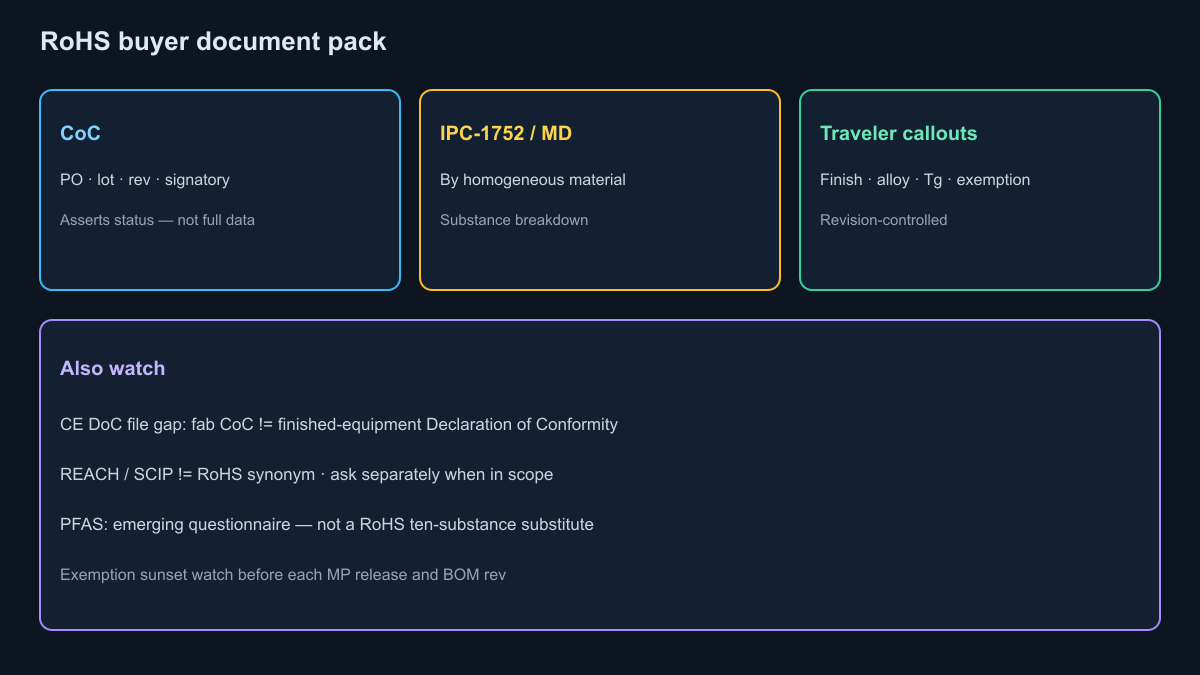
A usable RoHS evidence pack for PCB/PCBA is a revision-controlled set: Certificate of Conformity tied to the PO and lot, plus a material declaration (IPC-1752 / IPC-1752A or equivalent) that names substances by homogeneous material -- plus finish, alloy, and exemption statements that match the traveler.
| Document | What it proves | What it does not prove |
|---|---|---|
| CoC / declaration of RoHS conformity | Supplier asserts the shipped lot meets stated RoHS status | Full substance breakdown; CE DoC for your finished equipment |
| IPC-1752 / material declaration | Substance data by part / material class | Automatic legal clearance for your product category |
| Finish & alloy callout on fab drawing / traveler | Process intent matches RoHS build | Component-level phthalate / Cd status in the BOM |
| Exemption list (if any) with Annex ID + sunset watch | Why a restricted substance is still present | That the exemption still applies on your ship date |
| Test report (XRF / wet chem) on request | Spot-check evidence for high-risk materials | 100% lot guarantee if sampling plan is undefined |
| REACH / SCIP references (when in scope) | Separate chemical / article duties | Substitute for RoHS substance limits |
CE / DoC file gap (buyer reality): Your equipment CE technical file needs manufacturer-controlled evidence. A fab CoC helps the PCB/PCBA slice; it does not replace your Declaration of Conformity for the finished EEE. Keep revision control: Gerber rev, BOM rev, finish note, and CoC date must match the shipped lot.
REACH / SCIP confusion: REACH and SCIP article duties are related chemical-compliance topics, not synonyms for RoHS. Do not accept "REACH OK" as proof of RoHS substance limits, or the reverse. Ask separately when your market and article thresholds require it.
PFAS awareness (no overclaim): Some customers now ask about PFAS in coatings, mask, or process chemistries. Treat this as an emerging questionnaire item: request supplier statements where your customer demands them, without inventing a global PFAS-equals-RoHS rule that does not exist in the RoHS ten-substance list.
RFQ checklist block (paste into the buyer packet)
```
RoHS / lead-free RFQ checklist (PCB + PCBA)
[ ] Product market and EEE category stated (EU / other)
[ ] RoHS status required: compliant / compliant with listed exemptions
[ ] Surface finish named (no bare "HASL"); thickness window if ENIG/etc.
[ ] SnPb HASL explicitly forbidden unless exemption path documented
[ ] Solder alloy for SMT and for wave/selective named (e.g. SAC305)
[ ] Laminate Tg (and Td if multi-reflow / thick) called on fab notes
[ ] Max reflow count and MSL handling notes for moisture-sensitive parts
[ ] CoC required: PO #, lot/date code, board/PCBA rev, signatory
[ ] Material declaration required: IPC-1752 class or equivalent by material
[ ] Exemption IDs listed with internal sunset-review date (verify Annex)
[ ] BOM critical lines: manufacturer CoC / declaration path defined
[ ] Change control: no finish/alloy/laminate swap without written ECR
[ ] Separate REACH/SCIP/PFAS questions only if customer requires them
[ ] Sample XRF or lab test plan defined for first article / high-risk lots
```
Eco beyond RoHS: real fab programs without greenwashing
RoHS is a substance-restriction regime for EEE; it is not an environmental management system, a wastewater permit, or a proof that the factory is "eco-friendly" -- ask separately for ISO 14001 scope, waste/scrap handling, and process-chemistry controls when those matter to your supplier scorecard.
Useful, auditable asks:
- ISO 14001 certificate with scope that covers the manufacturing site you actually use (not a trading-office-only cert).
- Wastewater and etching chemistry controls -- on-site treatment or licensed disposal for copper-bearing and process baths; ask for the control description, not a slogan.
- Scrap copper / panel reclaim with lot traceability so rejected panels do not re-enter unmarked.
- Conflict-mineral / responsible-minerals questionnaires when your customer program requires them -- again, separate from RoHS.
- Process chemistry reductions (for example moving off hex-chrome passivation) documented in the finish specification.
Do not equate a green logo on a quote PDF with RoHS conformity. Do not equate RoHS conformity with halogen-free or with a net-zero claim. Score suppliers on named certificates, named process controls, and named documents tied to the PO.
Halogen-free vs RoHS vs "eco-friendly"
RoHS limits ten named substances; halogen-free is a separate industry claim about bromine/chlorine content in polymers (often tied to IPC/JEDEC-style thresholds around 900 ppm Br or Cl and 1500 ppm total); neither phrase by itself means the product is broadly eco-friendly.
| Claim | What it usually means | What buyers must still verify |
|---|---|---|
| RoHS compliant | Ten substances under limit per homogeneous material (or valid exemption) | Finish, alloy, BOM plastics, exemption sunset, matching CoC + declaration |
| Halogen-free | Br/Cl in relevant polymers below agreed thresholds (supplier definition matters) | Exact test method, which materials are covered, laminate grade on the traveler |
| Lead-free process | SAC (or other Pb-free) solder + compatible finish/laminate | Peak profile, Tg/Td, MSL, no SnPb pot cross-contamination |
| ISO 14001 / eco program | Environmental management system or site controls | Certificate scope, wastewater/scrap practices -- not a substance CoC |
| "Eco-friendly" marketing | Undefined without metrics | Reject as sole evidence; demand numbered specs |
A board can be RoHS and still use brominated flame retardants that are outside the RoHS PBB/PBDE bans. A halogen-free laminate can still fail RoHS if someone plates SnPb HASL or pastes SnPb. Write the claims you need as separate line items on the RFQ.
⚠️ Watch Out for: Quotes that stamp "RoHS / HF / Eco" as one badge. Split the ask: RoHS substance status, halogen-free definition and test method, and any EMS certificate -- three answers, three documents.
💡 Procurement Pro-Tip: Keep an exemption and change-control watch list: Annex ID, substance, where used (solder, finish, part), internal owner, and next verification date before mass production and before each major BOM rev. Sunset dates move; a CoC from last year does not clear this year's shipment.
Related XFPCB guides
- How PCBs Are Made -- fab flow context for laminate, plating, and finish steps that carry RoHS risk
- SMT PCB Assembly Process -- paste print through reflow controls that must match lead-free profiles
- Full Turnkey vs Consignment PCB Assembly -- who owns BOM declarations and shortage substitutions on RoHS builds
- PCB DFM: Design for Manufacturing -- drawing and stackup notes that keep finish and material callouts buildable