
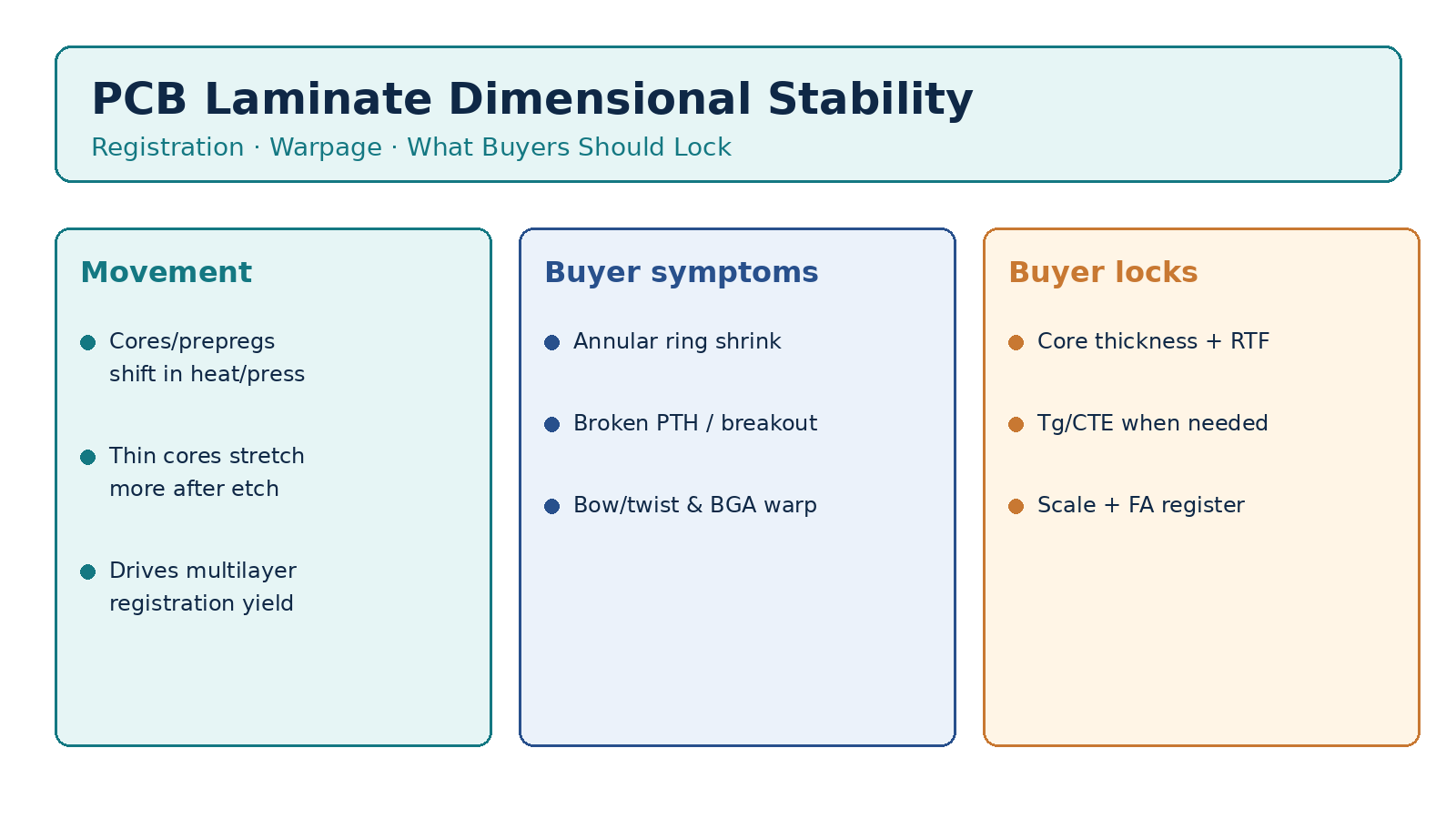
Dimensional stability is how much laminate cores and prepregs move through heat, pressure, and moisture cycles — etch, bake, lamination, and reflow. On multilayer and HDI boards that movement shows up as registration scrap: annular rings that shrink past Class 2/3, broken PTHs after drill misalignment, bow/twist that fails IPC, and BGA pads that warp enough to open solder joints. Buyers who lock copper type, glass/resin windows, Tg/CTE where it matters, and first-article registration checks cut that scrap before it hits NPI.
This China-fab guide answers first: what dimensional stability actually means on the traveler, which buyer symptoms map to thin-core stretch, RTF vs brushed foil in plain fab language, glass style and resin content windows, when high-Tg / low-CTE help, bake myths vs controlled lamination, and the RFQ fields that make quotes comparable.
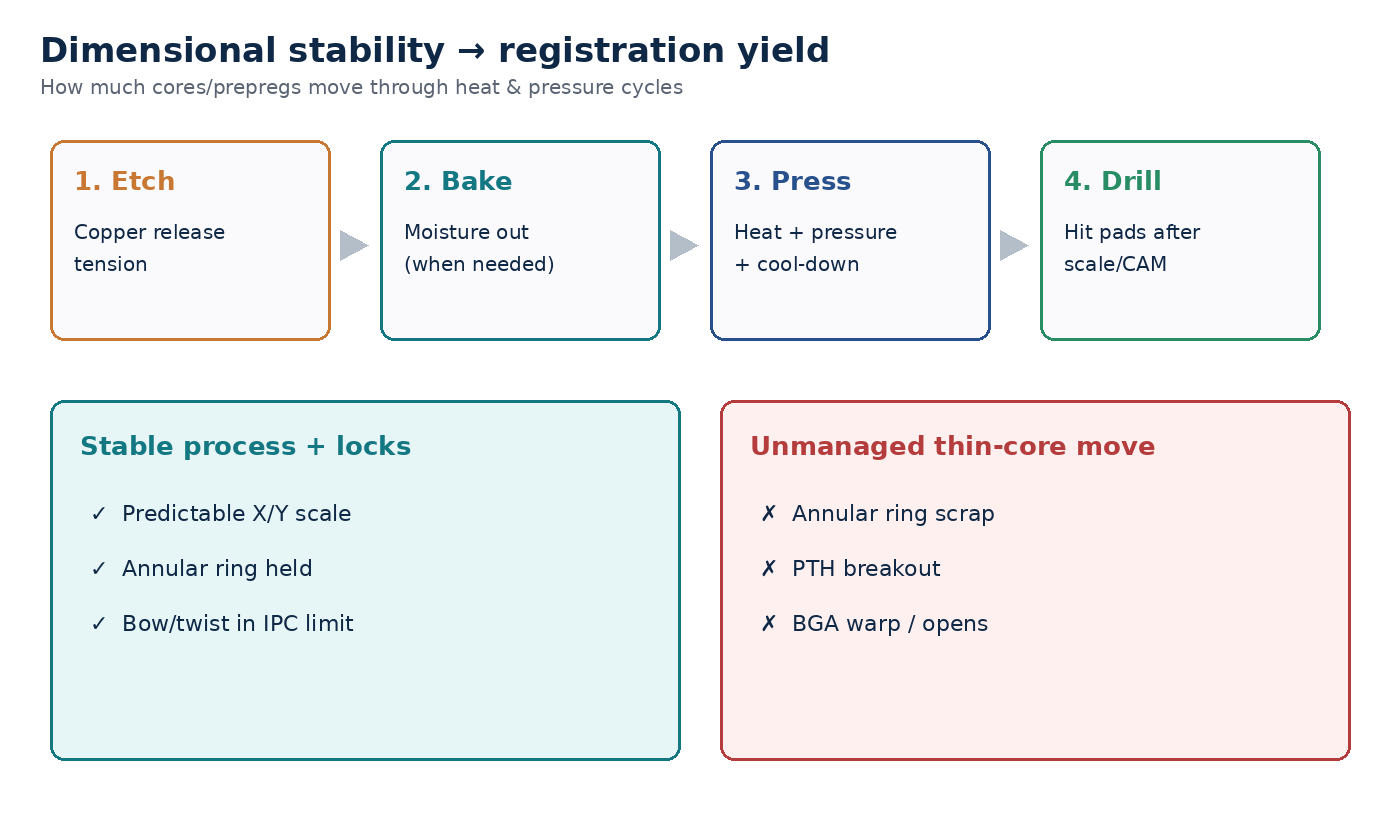
Answer first: dimensional stability = movement through heat/pressure
| Term | Factory meaning | Why buyers care |
|---|---|---|
| Dimensional stability | Predictable X/Y (and Z) movement of cores/prepregs through process heat and pressure | Registration yield on multilayers and HDI |
| Core stretch / shrink | Inner-layer artwork grows or shrinks after etch, bake, and press | Annular ring, pad-to-drill, BGA land alignment |
| Scaling / compensation | CAM X/Y scale applied so finished layers meet artwork intent | Silent fab “magic numbers” vs locked first-article scale |
| Bow / twist | Out-of-plane warp after lamination / reflow | Fixture fit, ICT, BGA coplanarity |
| CTE / Tg | Expansion rate and glass-transition temperature of the resin system | Via reliability and Z-axis stress — not a free X/Y fix |
Thin cores (e.g. 2–4 mil dielectric with thin copper) move more than thick cores under the same press cycle. That is not a quality slogan — it is physics plus foil construction. Etched copper releases tension in the foil; resin softens and flows at press temperature; cool-down freezes residual stress that later shows up as bow. If your stack uses many thin inner layers for HDI or impedance, treat dimensional stability as a process + material lock, not a brochure checkbox. Thick, coarse 7628-style constructions on a simple four-layer rarely need the same RFQ rigor as a 10–14 layer HDI with multiple 3 mil cores.
Related stackup context: multilayer PCB stackup fabrication guide. Material electrical companions: PCB dielectric constant & dissipation factor.
💡 Procurement Pro-Tip: Ask the fab for the scale factors used on first article (X and Y per layer or per panel) and whether they stay locked for the production lot. “We compensate automatically” without a written first-article registration check is how two plants both “meet Gerber” and still ship different annular rings.
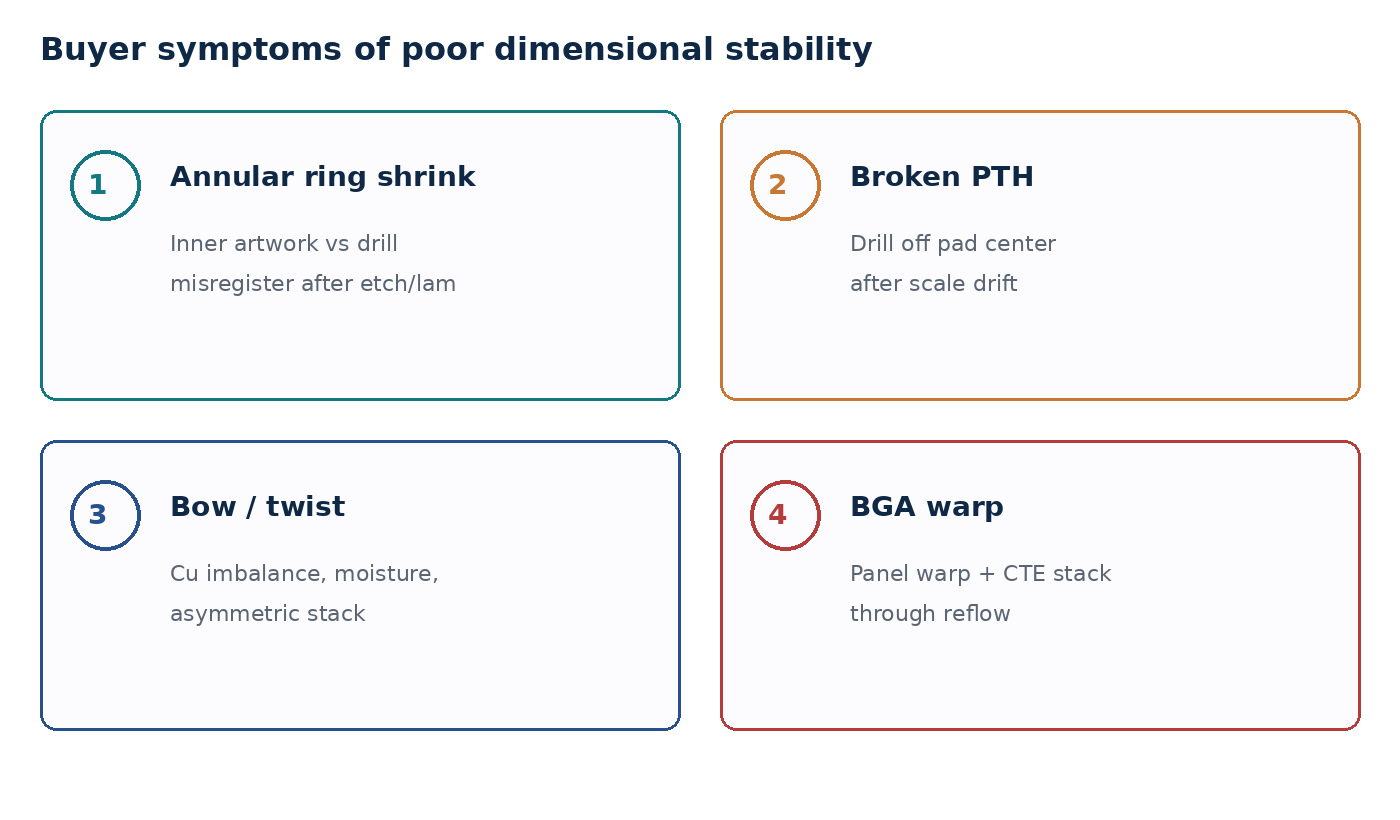
Buyer symptoms: what scrap looks like on the bench
| Symptom | What usually moved | RFQ / drawing fix |
|---|---|---|
| Annular ring shrink / breakout | Inner artwork vs drill misregister after etch/lamination | Min annular ring callout + first-article registration photo/report |
| Broken PTH / barrel crack at drill | Drill hit off pad center after scale drift | Lock compensation; state copper type and core thickness |
| Bow / twist fail | Copper imbalance, asymmetric stack, moisture, press cool-down | IPC bow/twist limit on drawing; balanced Cu % notes |
| BGA warp / open joints | Panel warp + local CTE stack mismatch through reflow | Tg/CTE class when needed; panelization and support notes |
| Layer-to-layer shift on microvia / HDI | Thin-core stretch + sequential lamination | Core thickness + RTF callout; sequential process lock |
Do not diagnose every open BGA as “bad solder paste.” Measure warp and check whether inner registration already ate the pad before assembly started.
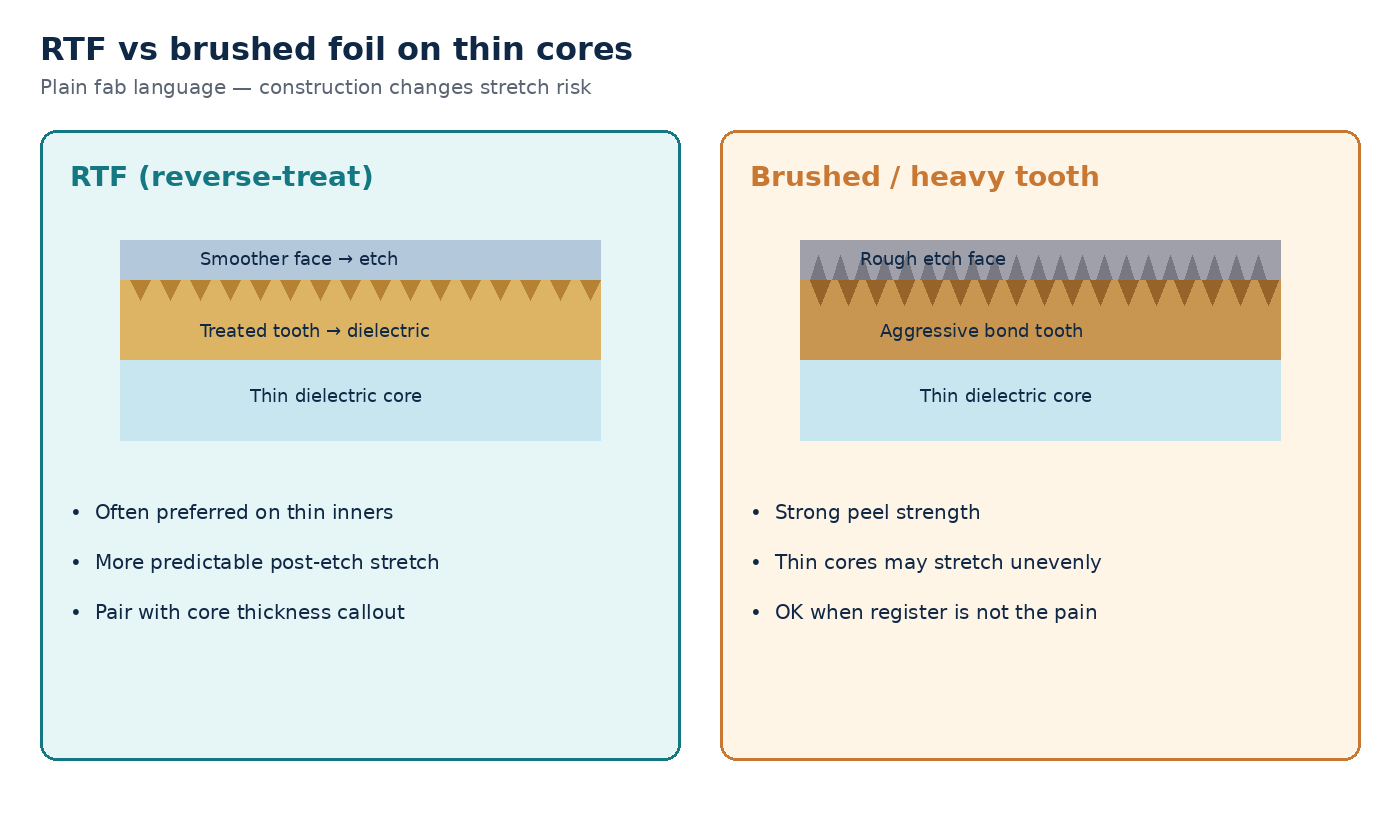
RTF vs brushed foil: thin-core stretch in plain fab language
Copper foil is not just “1 oz copper.” Construction and treatment change how a thin core behaves when it is etched and pressed.
| Foil type (buyer shorthand) | Plain fab meaning | Dimensional-stability angle |
|---|---|---|
| RTF (reverse-treat foil) | Treated side toward dielectric; smoother side toward etch | Often preferred on thin cores — less aggressive tooth can mean more predictable stretch after etch |
| Brushed / HTE-style tooth | Higher roughness / mechanical tooth for peel strength | Strong bond, but thin cores can stretch more unevenly if etch and bake are not controlled |
| VLP / HVLP (low profile) | Low roughness for loss / fine line | Electrical + etch benefit; still need process lock for multilayer register |
For buyers: RTF on thin inner cores is a common China-fab recommendation when registration yield is the pain, not when you only care about peel strength on a thick 1.6 mm four-layer. Pair the foil callout with finished copper weight and core thickness — “RTF” alone is incomplete.
Foil roughness also ties to signal loss and CAF risk discussion elsewhere: copper foil HTE & low-roughness PCB and CAF prevention.
⚠️ Factory callout: If Plant A quotes “standard foil” and Plant B quotes “RTF on all ≤4 mil cores,” they are not bidding the same dimensional risk. Force the copper-type line on the RFQ so unit price reflects the same construction.
Glass style + resin content; when high-Tg / low-CTE actually help
Glass weave style (106, 1080, 2116, 7628, spread-glass variants, etc.) and resin content set how much the dielectric can flow and how anisotropic expansion becomes. High resin content windows can improve fill and sometimes electrical uniformity; they can also increase Z-axis expansion and moisture uptake if process control is weak.
| Lever | When it helps dimensional / registration goals | When it is overkill |
|---|---|---|
| Consistent glass style per core | Repeatable X/Y behavior lot to lot | Mixing random glass “equivalents” mid-build |
| Resin content window | Controlled fill on thin cores / HDI | Specifying exotic RC with no press recipe |
| High-Tg laminate | Lead-free reflow, multiple thermal cycles, via reliability | Expecting high-Tg alone to fix thin-core X/Y register |
| Low-CTE / filled systems | Heavy via density, thick boards, thermal cycling reliability | Paying low-CTE premium solely for a 4-layer consumer board with loose annular ring |
Buyer rule: high-Tg and low-CTE are reliability and Z-axis tools. They help registration only indirectly (more stable process window through reflow). For multilayer registration scrap, lock core thickness, copper type, glass/resin consistency, and scaling first — then escalate Tg/CTE when the stack and thermal profile justify it.
Process: bake myths vs controlled lamination
Moisture bake before press is real when cores or prepregs have absorbed humidity — especially in humid seasons and for thin or high-resin constructions. It is not a magic “bake everything overnight and dimensional problems disappear” ritual.
| Practice | What it actually does | Buyer note |
|---|---|---|
| Moisture bake before press (when needed) | Drives out absorbed water that would create voids / unpredictable flow | Ask when the fab bakes vs when they skip (season, material, thickness) |
| Controlled lamination (heat/pressure/cool profile) | Sets flow, cure, and residual stress that drive bow and scale | Profile lock matters more than tribal “we always bake 4 h” |
| Post-etch bake / stabilize | Stabilizes etched cores before AOI / layup | Useful on thin cores; confirm it is on the traveler |
| “Just bake longer” myth | Extra time does not replace wrong foil, wrong scale, or asymmetric copper | Do not accept bake hours as the only DFM answer |
Demand a lamination process family on critical multilayers: material lot control, bake decision criteria, press profile identity, and cool-down discipline. Scrap that appears only in summer humidity is often moisture + thin-core interaction — not a new Gerber bug.
China fab RFQ: fields that cut multilayer registration scrap
Paste this into the quote package so every bidder prices the same dimensional risk:
| RFQ field | What to specify | Fail mode if missing |
|---|---|---|
| Core thickness per layer | Finished dielectric intent (e.g. 3 mil / 4 mil cores) | Fab substitutes thicker core → Zdiff and register both drift |
| Copper type | RTF / standard / low-profile on which layers | Thin-core stretch differs plant to plant |
| Tg / CTE callouts | When needed: Tg min, CTE-z or material family | “High-Tg FR-4” vague → apples-to-oranges |
| Bow / twist | IPC class limit (e.g. IPC-6012 / IPC-TM-650 method) on drawing | Warp disputed after ship |
| Scaling / compensation | First-article scale lock for production | Lot-to-lot annular ring surprise |
| First-article registration check | Cross-section or X-ray / coupon register report before mass | Scrap discovered at SMT |
| Copper balance | Symmetric Cu % / plane pour notes | Bow blamed on “FR-4” alone |
| Sequential lamination (HDI) | Process steps locked | Extra press cycles without buyer awareness |
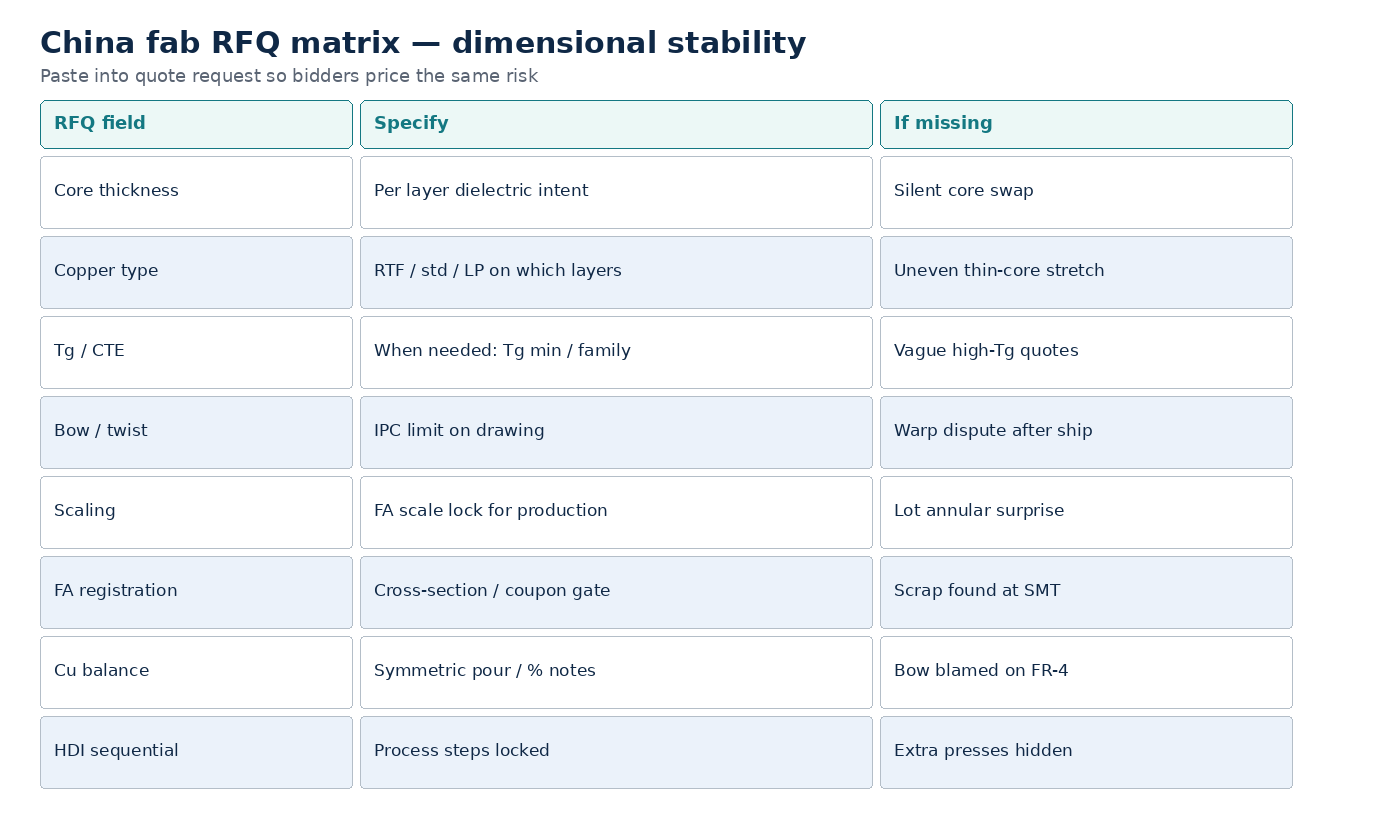
Minimum viable dimensional-stability RFQ: stackup with core thicknesses + copper type (especially RTF on thin inners) + IPC bow/twist limit + first-article registration acceptance. Add Tg/CTE when thermal reliability is in scope; add sequential-lam notes for HDI.
Scaling and first-article: who owns the compensation numbers
CAM scaling is how fabs turn etched, baked, pressed cores back onto the drill/pattern grid. Buyers get burned when:
- Prototype scale ≠ production scale. First article looked fine; mass run used a different panel size, different core lot, or a “improved” scale without written approval.
- Layer-asymmetric scale. One inner layer scaled differently than its mate because etch or foil differed — pad stacks drift even if each layer “looks centered” in CAM.
- No acceptance gate. The PO never required a registration cross-section or coupon measure before releasing the lot.
Practical lock language (adapt to your drawing notes):
| Lock | Example wording | Why |
|---|---|---|
| First-article scale | “Record X/Y scale factors used on FA; production uses same factors unless buyer approves change” | Stops silent CAM drift |
| Registration accept | “FA: min annular ring on designated nets ≥ …; provide photo or microsection” | Makes scrap visible before SMT |
| Material lot | “Same laminate lot family as FA for production, or written equivalent with re-FA” | Glass/resin shift changes stretch |
| Panelization | “Do not change working panel size without DFM notice” | Panel size changes heat/pressure uniformity |
If two China fabs quote the same Gerber set at very different yields historically, compare foil type, bake criteria, and whether scale is locked — not only unit price and lead time.
Soft close for XFPCB buyers
If registration scrap or bow/twist already burned an NPI lot, send the stackup, copper construction intent, and the annular-ring / bow limits with the Gerbers — not only “FR-4 multilayer, best price.” XFPCB can review thin-core and RTF choices, confirm when moisture bake and scale lock belong on the traveler, and put first-article registration checks in writing so production does not reinvent compensation.
Start from the multilayer and foil primers linked above, then attach the RFQ matrix on this page so every China fab answers the same dimensional-stability questions.