
IPC Class 3 is an acceptance and performance class you put on the fabrication drawing and purchase order — not a factory marketing badge, not a substitute for AS9100, and not automatic because a plant builds “aerospace-looking” boards. On bare boards the usual reference is IPC-6012 (qualification and performance); visual accept/reject criteria often track IPC-A-600. On the assembly side, hole fill and solder criteria live under IPC-A-610. Class 1 / 2 / 3 change annular ring, plating, inspection depth, and scrap economics. Buyers who leave class blank get Class 2 defaults in China more often than they expect — then discover Class 3 gaps only after microsection or field life.
This China-fab guide answers first: what Class 3 really is on the traveler, the practical differences versus Class 2 (annular ring, PTH copper, A-610 hole fill, sampling), the AS9100 myth, when Class 2 is enough versus when Class 3 is justified, the cost of over-specifying Class 3 on consumer boards, and an RFQ matrix that blocks silent downgrade. Design-rule depth for flight programs: aerospace PCB design rules. Aviation buyer context: commercial aviation PCB requirements. Process background: how PCBs are made.
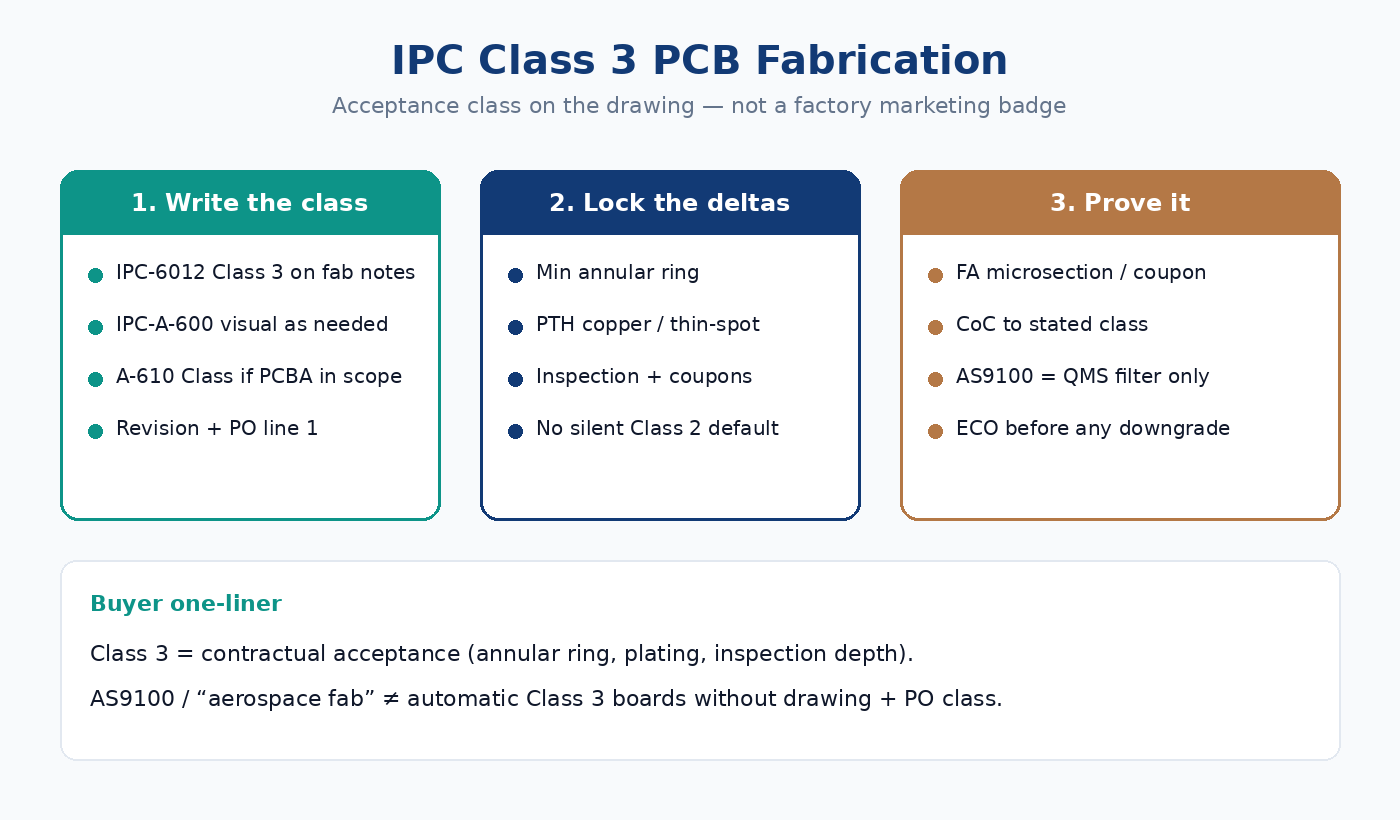
Answer first: Class 3 = drawing class, not a plant badge
| Phrase you hear | What it actually means | What it does not mean |
|---|---|---|
| “IPC Class 3 fab” | Bare-board performance/acceptance to Class 3 under the cited IPC document (typically IPC-6012 + A-600 visual) | The factory is “Class 3 certified” as a marketing logo |
| “We are AS9100” | Quality-management system for aerospace supply chain | Every board ships Class 3 annular ring / plating without a drawing callout |
| “High reliability PCB” | Vague sales language unless tied to class, material, and test | Automatic Class 3 + full microsection + CoC |
| “IPC-A-610 Class 3” | Assembly solder/hole-fill acceptance class | Bare-board fab class (wrong document family) |
One-line definition: Class is a contractual acceptance level written on the drawing and PO. Capability marketing is not acceptance. If class is missing, CAM will usually default to Class 2 process windows and sampling — then argue after you reject on Class 3 microsections.
💡 Procurement Pro-Tip: Put bare-board class (IPC-6012 Class X) and assembly class (IPC-A-610 Class X, if PCBA) on line 1 of the RFQ and the fab note block. “High reliability” without a class number is not enforceable at receiving inspection.
Related DFM discipline that prevents Class 3 scrap before CAM: PCB DFM (design for manufacturing).
Class 1 / 2 / 3 — differences buyers actually feel
IPC classes are not three logos; they change minimums and inspection depth. Exact numeric limits live in the current IPC revision you cite — treat the table below as the buyer-facing map, then lock numbers from the edition on your drawing.
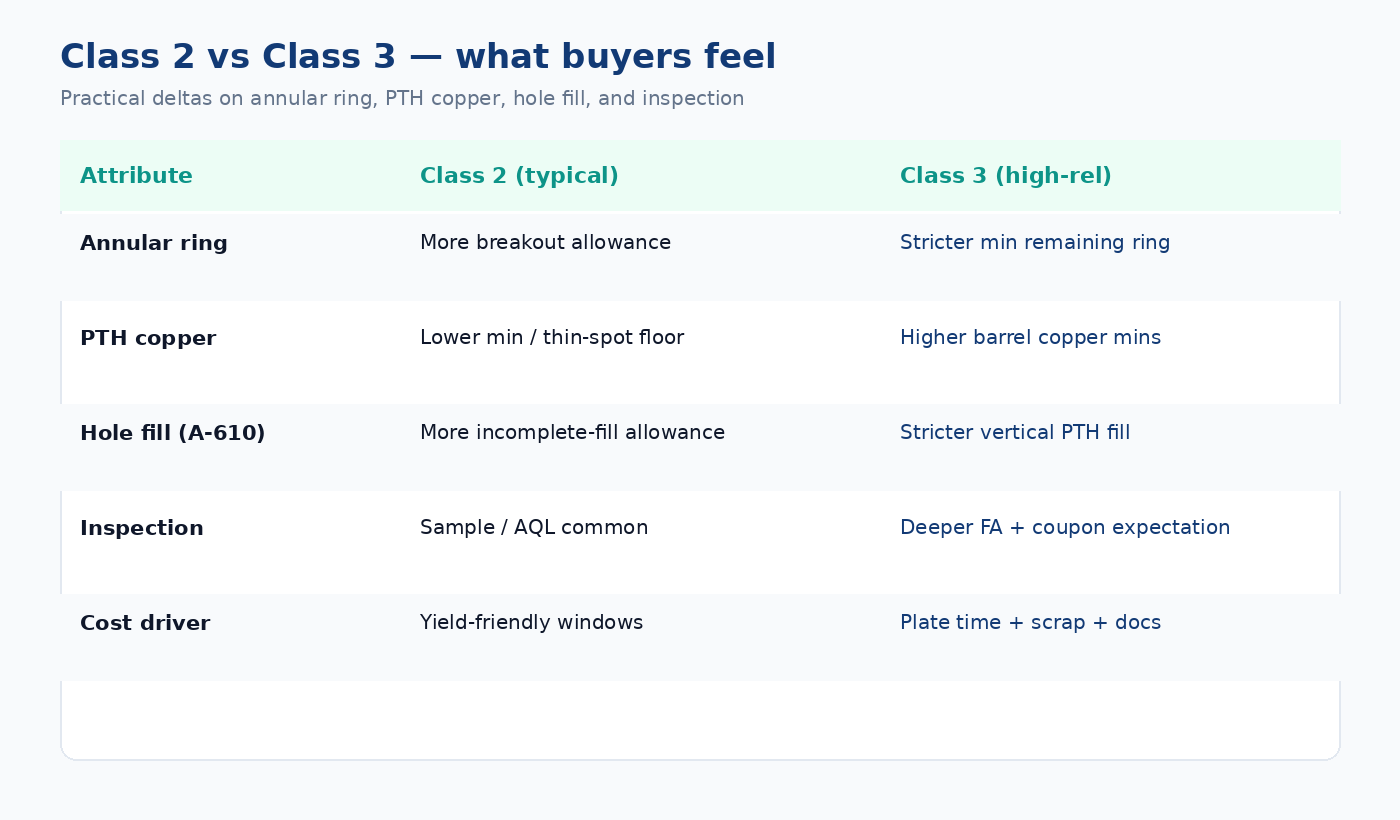
| Attribute buyers feel | Class 2 (typical commercial / industrial) | Class 3 (high reliability / long life / safety-critical) | Why it hits cost |
|---|---|---|---|
| Annular ring | Tighter breakout allowance; more forgiving of drill/register drift | Stricter minimum remaining ring; less tolerance for breakout | Forces larger pads or tighter registration → yield risk |
| PTH copper / plating | Lower minimum average / thin-spot floors (per cited IPC-6012) | Higher minimum copper in barrels; less thin-spot allowance | Longer plate time, coupon discipline, scrap on thin boards |
| Internal shorts / spacing | Commercial spacing windows | Tighter defect criteria and often deeper electrical/visual scrutiny | More CAM holds; more scrap on dense designs |
| Inspection / sampling | Sample-oriented AQL mindset common | Deeper inspection; microsection / coupon expectations rise | NRE for coupons, longer FA, higher unit cost |
| Assembly hole fill (A-610) | More allowance for incomplete vertical fill on some joints | Stricter vertical fill expectations on PTH (Class 3) | Wave/selective process windows; more rework risk |
Annular ring (buyer view): Class 3 assumes the plated hole still has a usable copper ring after worst-case drill wander and etch. If your pad diameter was drawn for Class 2 habit, Class 3 will either fail DFM or force pad growth that eats clearance. Fix on the drawing — do not hope the fab “makes Class 3 somehow.”
PTH copper: Class 3 buyers should require coupon or microsection evidence for average and thin-spot copper — not a verbal “we plate Class 3.” Thin high-aspect-ratio holes are where Class 2 and Class 3 quotes diverge most.
Inspection depth: Class 3 programs commonly expect first-article cross-sections, tighter AOI criteria, and documented CoC language. Class 2 volume often ships on sample visual + electrical continuity. Put the inspection package on the PO or you will get the cheaper traveler.
⚠️ Watch Out for: Mixing documents — quoting “IPC Class 3” with no document number, or citing A-610 Class 3 on a bare-board-only PO. Fab plants work to 6012/A-600; assembly plants work to 610. Split fab vs PCBA class clearly when both are in scope.
Myth: AS9100 ≠ automatic Class 3 boards
AS9100 (and related aerospace QMS stamps) means the supplier runs an aerospace-oriented quality management system. It does not rewrite your Gerber into Class 3 annular ring, does not raise plating minimums by itself, and does not force Class 3 sampling if the PO says Class 2 or is silent.
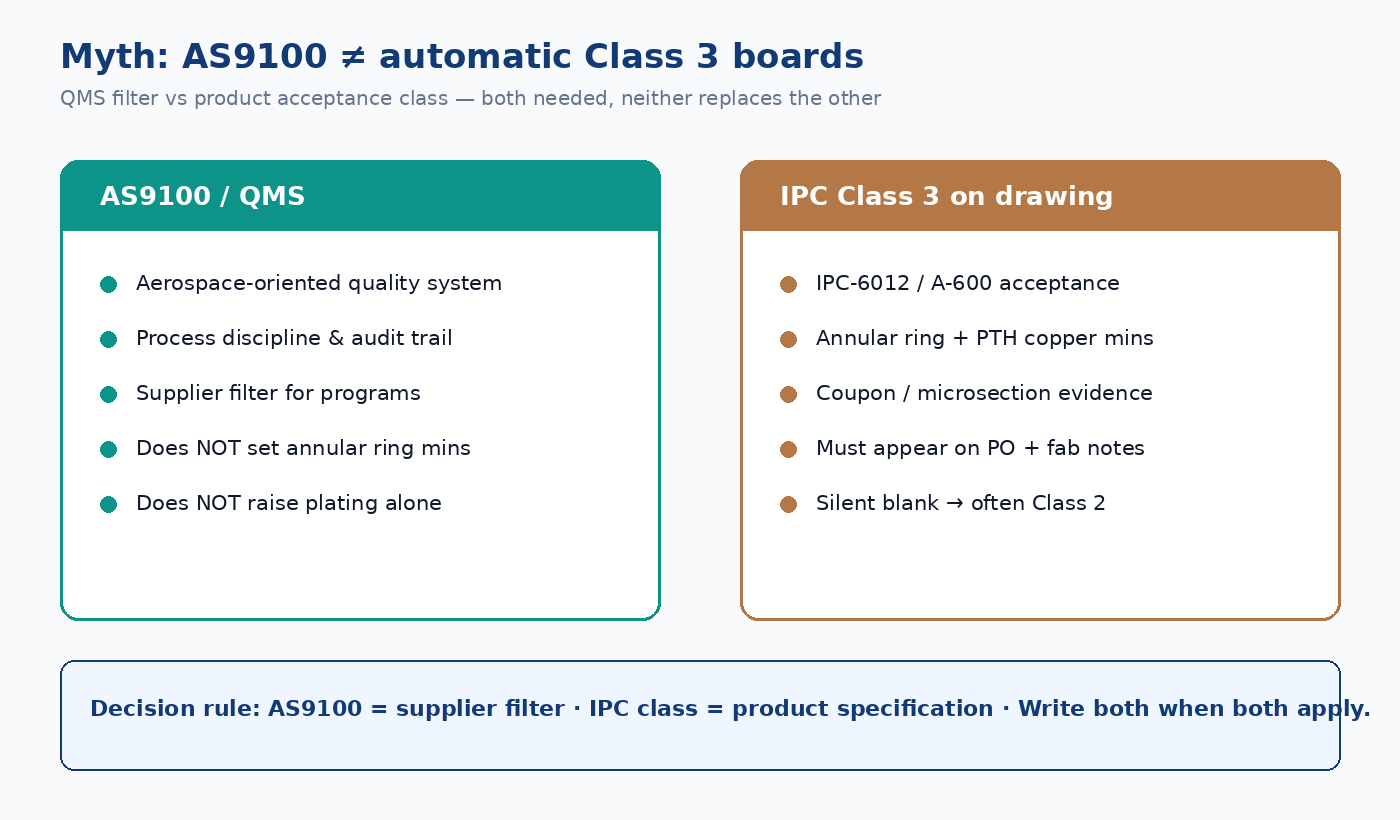
| Claim | Reality | Buyer action |
|---|---|---|
| “AS9100 fab → Class 3 boards” | False. QMS ≠ product acceptance class | Write IPC-6012 Class 3 (and revision) on drawing + PO |
| “We build for aerospace OEMs” | Capability anecdote, not lot acceptance | Ask for coupon/microsection plan for your stack |
| “Military / space experience” | Useful process maturity signal | Still lock class, material, and test matrix |
| “Class 3 process capability” | May mean the line can hit Class 3 when specified | Capability without PO class often ships Class 2 economics |
Decision rule: Treat AS9100 (or ISO 9001) as a supplier filter, and treat IPC class as a product specification. You usually want both for flight / safety-critical hardware — but one without the other is incomplete. Depth for aerospace layout and material locks: aerospace PCB design rules.
When Class 2 is enough vs when Class 3 is justified
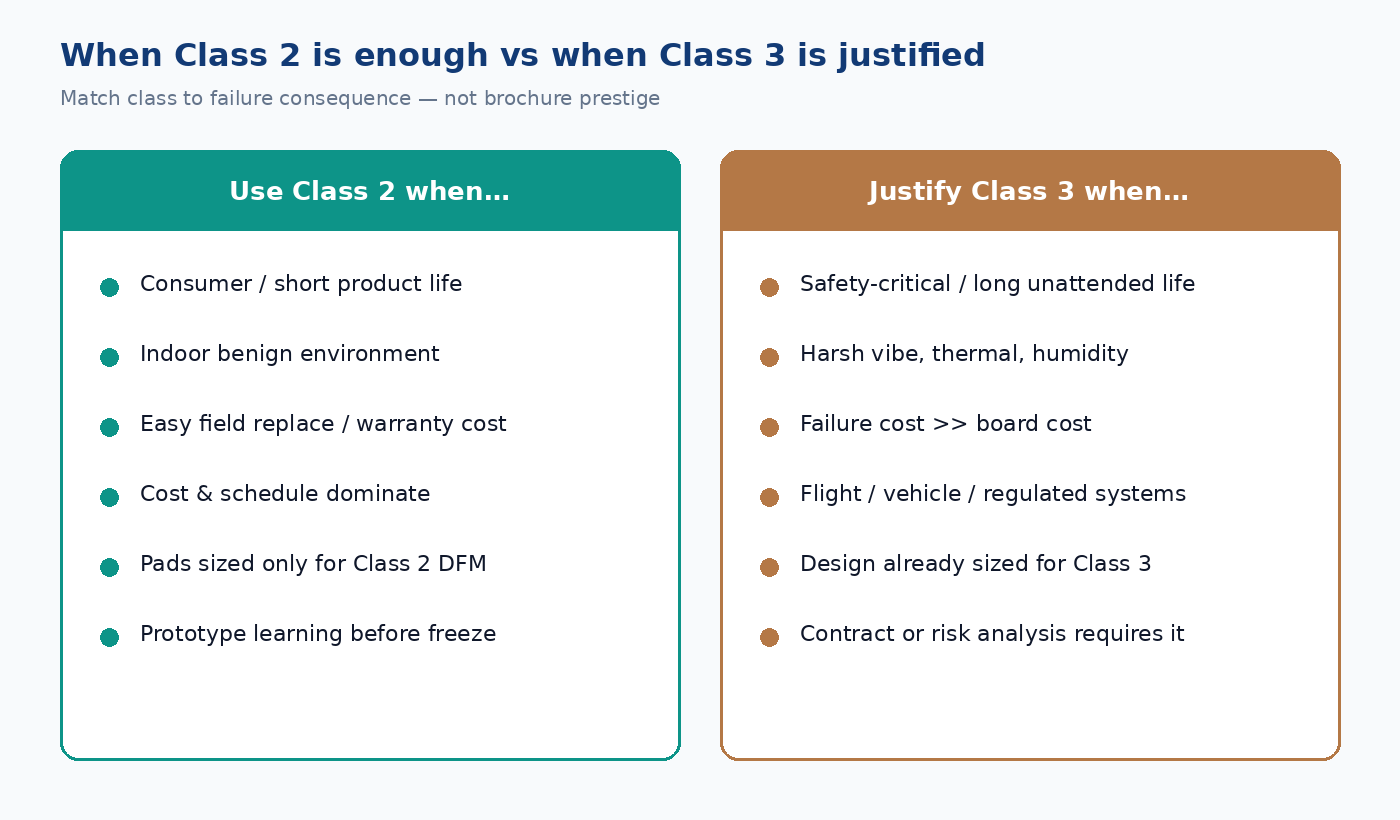
Over-classing burns money; under-classing burns field life. Use function and consequence of failure, not brochure prestige.
| Use Class 2 when… | Justify Class 3 when… |
|---|---|
| Consumer, short life, high volume, easy field replace | Safety-critical control, life support adjacency, flight / vehicle systems |
| Indoor benign environment; failures are warranty cost | Harsh vibration, thermal cycling, humidity, long unattended life |
| Cost and schedule dominate; scrap is recoverable | Failure cost >> board cost (recall, downtime, certification) |
| Prototype learning builds before reliability freeze | Production baseline already proven and reliability is locked |
| Dense consumer HDI where Class 3 pads will not fit DFM | Design already sized for Class 3 annular ring and plating |
Class 3 is justified for long-life industrial controllers in harsh plants, medical-adjacent and transportation electronics where standards or risk analysis demand it, and aerospace / defense programs that already cite Class 3 (or equivalent contractual performance). Class 2 is enough for most phones, toys, short-life gadgets, and many commercial IT boards — provided your thermal and mechanical environment is mild and replaceability is real.
Commercial aviation programs often mix airworthiness process expectations with IPC class language — do not assume “aviation” automatically means Class 3 on every coupon; read the drawing. Companion: commercial aviation PCB requirements.
💡 Procurement Pro-Tip: If marketing wants “Class 3” for a consumer SKU to sound premium, ask engineering for the failure-mode that Class 2 cannot accept. If the answer is empty, you are buying plating time and scrap, not reliability.
Cost and time of over-specifying Class 3 on consumer boards
Class 3 is not free. China fabs price the yield risk and inspection package, not the three characters on a PowerPoint.
| Cost driver | What changes vs Class 2 | Typical buyer impact |
|---|---|---|
| Pad / clearance redesign | Larger pads or tighter CAM holds | Respin risk; lost density |
| Plating / aspect ratio | Longer plate, tighter thin-spot control | Higher unit price on thick / small-hole boards |
| Coupons & microsection | FA coupons, lab time, possible lot holds | Days added to FA; NRE line items |
| Sampling / AOI rigor | Deeper inspection, more rejects | Lower apparent yield → price up |
| Documentation | CoC, material certs, traveler locks | Admin lead time; change-control friction |
Rule of thumb for buyers: On a loose four-layer consumer board with generous pads, Class 3 may add a modest premium. On HDI, fine annular ring, or high aspect-ratio PTHs designed for Class 2, Class 3 can mean DFM failure or a painful respin — far more expensive than the plating delta. Do not “upgrade class” in an ECO without a DFM pass.
Silent downgrade is the opposite failure mode: PO says Class 3, traveler runs Class 2 sampling, and nobody notices until a field failure or customer audit. Block that with coupons and CoC language (next section).
China fab RFQ matrix — language that sticks
Paste this into the quote package so every bidder prices the same acceptance risk:
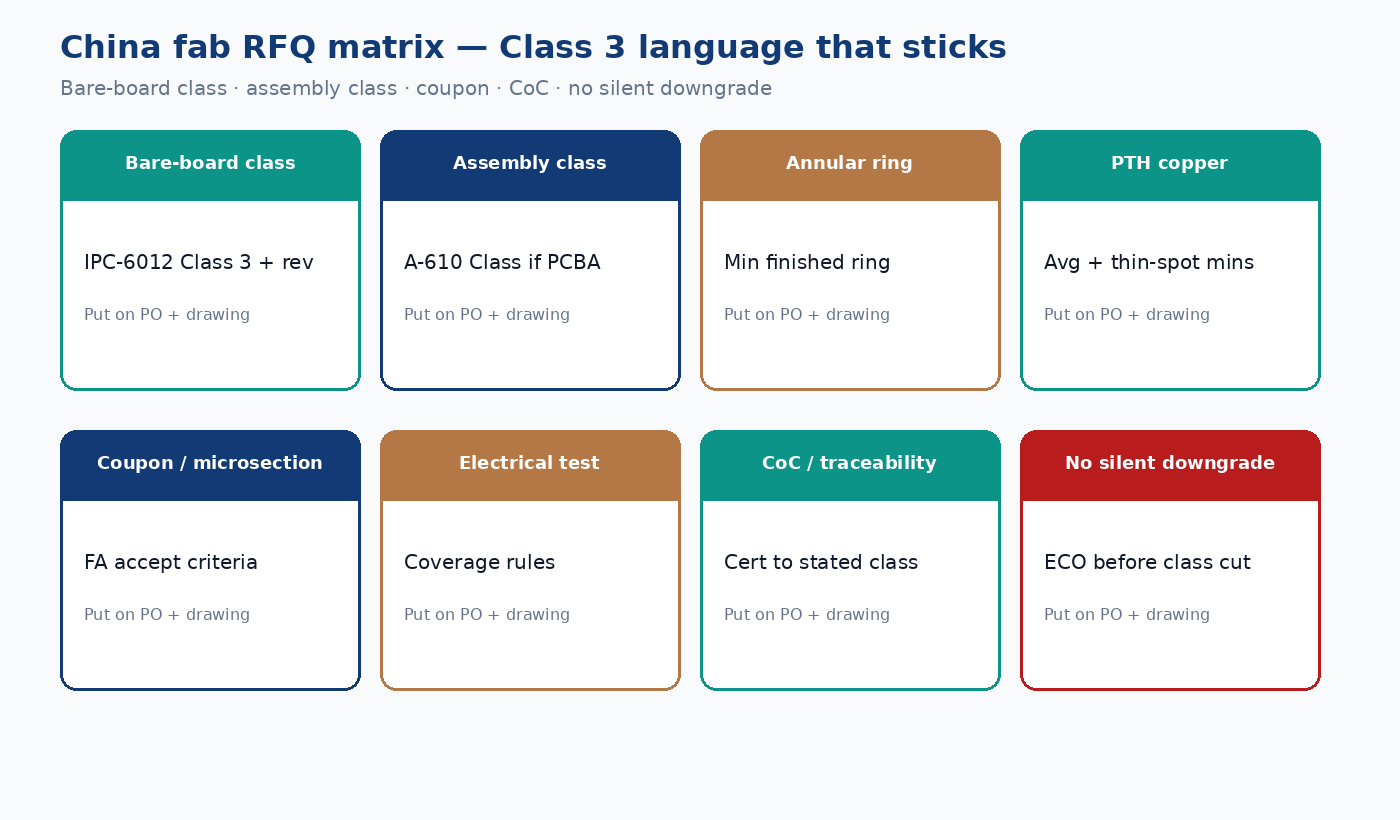
| RFQ / drawing field | What to write | Fail mode if missing |
|---|---|---|
| Bare-board class | IPC-6012 Class 3 (cite revision) + IPC-A-600 visual as applicable | Defaults to Class 2 process window |
| Assembly class (if PCBA) | IPC-A-610 Class 3 (or Class 2) explicit | Hole-fill disputes after wave/selective |
| Annular ring | Min finished annular ring + breakout rules per class | Pad size fights CAM; silent Class 2 habit |
| PTH copper | Min average / thin-spot copper per class + hole size / aspect notes | Thin barrels pass electrical, fail life |
| Coupon / microsection | FA coupon plan; which layers/holes; accept criteria | “Class 3” claim with no evidence |
| Electrical test | Continuity/isolation coverage; flying probe vs fixture | Visual-only ship on dense nets |
| CoC / traceability | Certificate of conformance to stated class + material lot | Audit fails; no lot genealogy |
| No silent downgrade | Written: no class reduction without signed ECO | Traveler quietly reverts to Class 2 sampling |
| Material / Tg if needed | Laminate family, Tg, CAF notes when reliability demands | Class 3 plating on weak material stack |
Minimum viable Class 3 RFQ: IPC-6012 Class 3 (revision) + min annular ring + PTH copper callouts + FA microsection/coupon + CoC + “no class change without ECO.” Add A-610 Class 3 when assembly is in scope. Add AS9100 only as a supplier requirement, never as a replacement for the class line.
Soft next step for high-reliability programs
If you are locking a Class 3 or long-life build in China, send the stackup, hole chart, and the class/coupon block above in the first RFQ. XFPCB supports high-reliability and Class 3 fabrication programs with drawing-driven acceptance — class and coupons on the traveler, not fake “Class 3 certified” badges. Pair this page with aerospace PCB design rules and how PCBs are made when you need layout and process context in one package.