
Someone gets a dead board working on the bench. A wire bridges a burned trace, a capacitor is replaced, a pad is rebuilt with foil. The board powers up. The email to the factory then says "build it like the repaired one," with a photo and no file change. That is how a one-off fix becomes a lot that does not match any drawing, and that nobody can test the same way twice.
A walk-in repair bench and a production fab are different vendors. The bench's job is to put one board back in service. The fab's job is to build the files you send. A photo of a clever fix is not those files.
Three names for what just happened
IPC-7711/7721 uses two words the bench usually collapses into "repair."
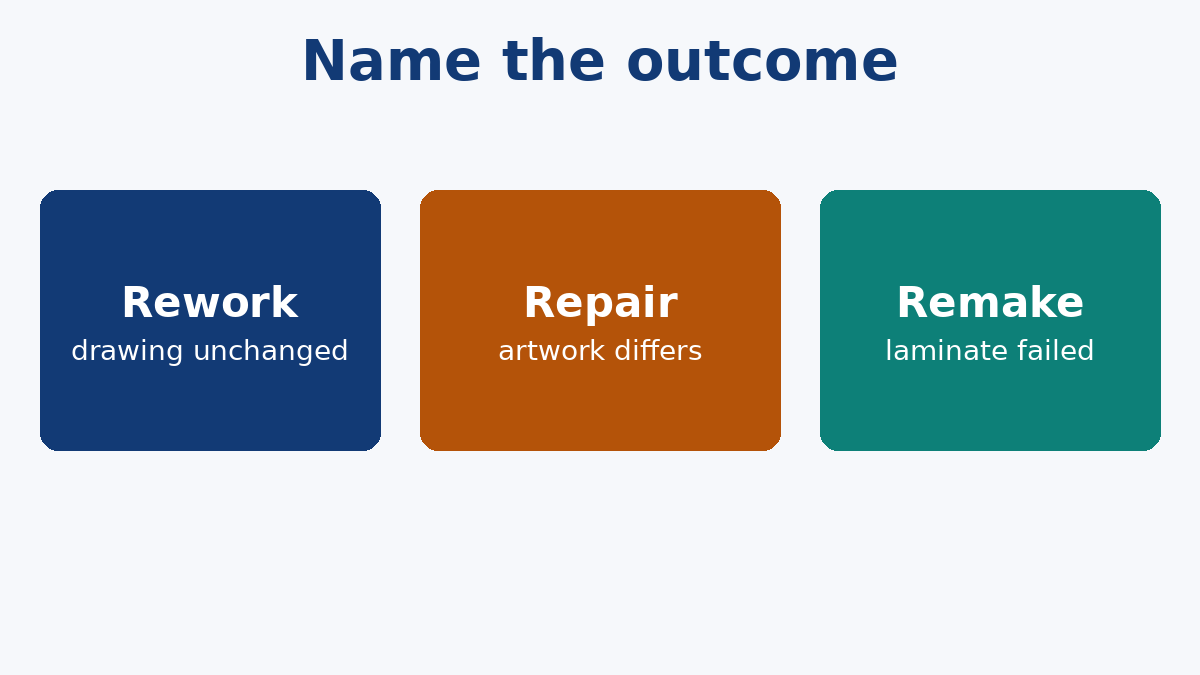
Rework puts the board back to the original. The part was the right part, the pad is still the pad, and you removed a bad joint or a bad component and restored what the drawing already said. Polarity, value and footprint match the BOM. The next lot does not change. If you want the factory to do that same rework on returns, say so as a rework instruction against the existing revision. Do not send it as a new design.
Repair, in that standard's sense, restores function with something the original artwork did not have. A jumper that skips a burned trace, a foil land stuck down where the pad lifted, a cut that isolates a short. The board may work. It is no longer the board in the Gerber. Production must not "add the same wire" because a technician remembers it. Either the change is written into the next revision, or it stays a documented repair of that serial number and dies with that serial number.
Remake is the third outcome, and it is the one when the laminate, a plated hole or an inner layer is what failed. No jumper on the outer layer fixes a barrel that is open inside the board. More heat on a board that has already been reworked several times is how pads come off. If that is the situation, the next conversation is a new build of a known revision, plus what you learned, not another hour with the iron.
What the factory can build from
For a rework to original, the useful note is short: reference designator, the manufacturer part number you actually fitted if it was not the BOM part, polarity, and that the artwork is unchanged. If the fitted part differs, it is not rework anymore. It is a BOM change, and the assembly drawing has to say so before a lot is kitted.
For a repair that changes copper, the factory needs the change, not the heroics:
- Which net, from which point to which point. A photo helps only if the points are identifiable.
- Whether the jumper is the permanent route or a temporary patch on units already built.
- If it is permanent, the updated Gerber or a redline that CAM can apply, plus the assembly note if the jumper is a wire or a zero-ohm rather than etched copper.
- What to do with boards already in the field. The lot being quoted does not include them unless you say it does.
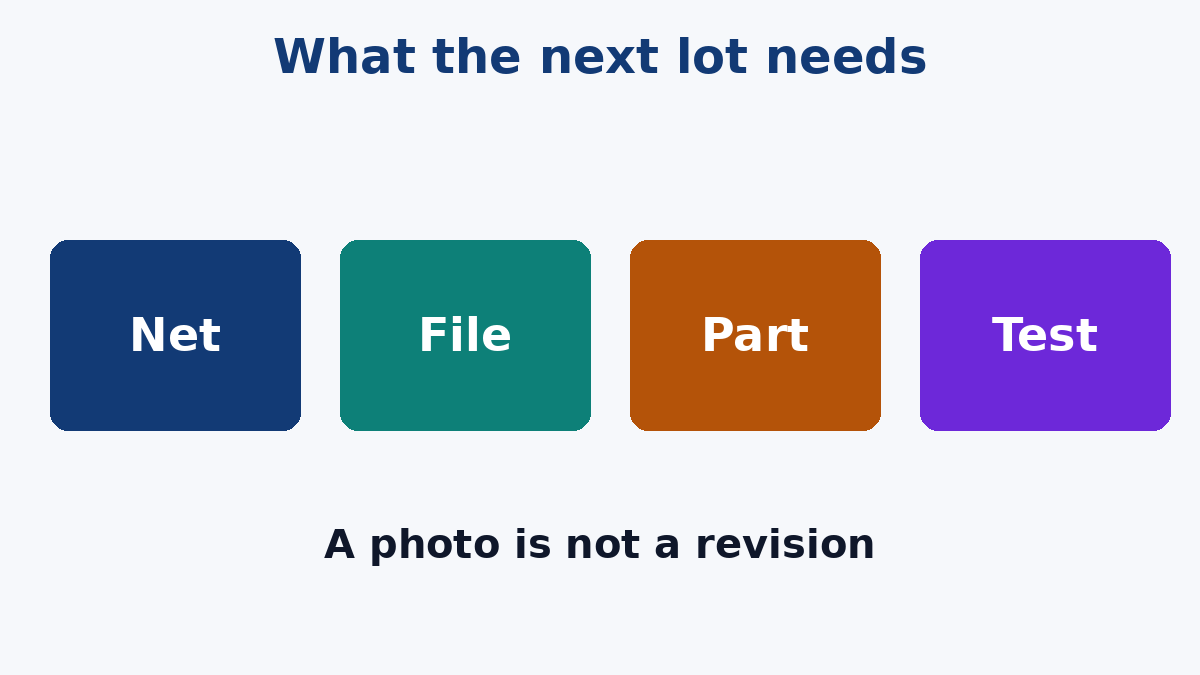
Our Manufacturing Files page is the set a quote is actually built from: Gerbers, drill, stackup, BOM, pick-and-place and the assembly notes. A repaired sample can sit next to that set as evidence of the problem. It cannot replace the set. If the files and the sample disagree, the files win, and you should expect an engineering question rather than a silent copy of the wire.
For a remake, send the revision you want built and what failed, in enough detail that the new lot does not repeat a pad stack or a via you already know is open. "Same as last time but better" is not a stackup.
What a powered-up board has not proved
A board that runs on the bench after a jumper has shown that this net, on this unit, can be made continuous. It has not shown that the joint will survive vibration, that the jumper is clear of the lid, or that a hidden pad under a BGA is attached. Pressing on a package until the picture comes back is a symptom, not a repair.
Hidden joints need a look, not another power cycle. Our X-Ray Inspection page is that check for joints you cannot see, including BGAs. Our Testing & Inspection page is the wider set: visual, AOI, electrical test, flying probe and X-ray when the build asks for them. Decide which of those the repaired unit must pass before it is called good, and use the same list on the next lot. A repair that only "turns on" will be argued about the next time a unit fails the real test.
What not to ask the fab to copy
- A wire glued across the board with no net name and no revision.
- A component "the same or better" with no part number. Better is not a voltage rating or a footprint.
- A BGA that was swapped with a heat gun and not inspected. The next lot should be built, not re-enacted.
- A stack of field failures with no pattern. Ten photos of ten different nets are ten repairs. They are not a design change until someone says which net is systematic.
- A request to match a local shop's turnaround. The fab is building a revision, or performing a defined rework. It is not a walk-in bench, and it should not be priced or scheduled as one.
If the only record of the fix is in one person's memory, write it down before that person is on another job. The lot cannot be built from a conversation that already happened.
A note that closes the repair
- Original artwork restored, or artwork changed, or board scrapped.
- If changed: the net, the from-to, and the file that now contains it.
- The part numbers that differ from the last BOM.
- The test the repaired unit passed, and the test the next lot must pass.
- Serial numbers that carry a wire the new revision will not.
The bench saved a unit. The factory can only save the next ones if the fix has become a revision, a rework instruction, or a decision to remake.