
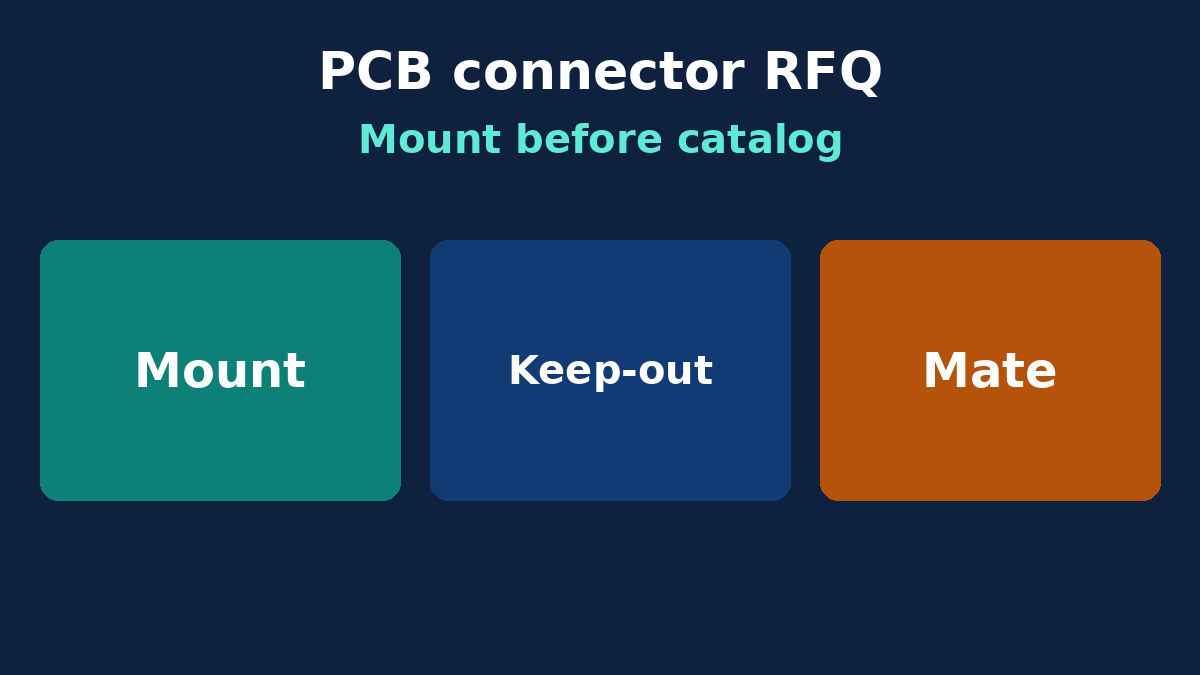
Connector catalogs sort the world into board-to-board, wire-to-board and I/O. Useful language—until the RFQ still forgets how the part is fastened to this board, where the housing is allowed to sit, and which face actually mates. That is when a China line builds a perfect solder joint into a product that will not close, or golds an edge that was never called out as a contact.
This post is the factory callout set for overseas buyers and engineers. It keeps the useful industry split (BTB / WTB / I/O, edge vs header) and drops brand menus. Flex ZIF/FFC tails are a sibling topic; do not treat this as that guide.
Name the job before the family
Say what the connector must do on the traveler:
- Board-to-board (stacking, right-angle, coplanar).
- Wire-to-board (header + housing, terminal block).
- I/O to the outside world (USB, RJ45, circular, coax—named by MPN, not by vibe).
- Edge / gold finger where the PCB edge is the male contact.
Family names without mount style are not enough.
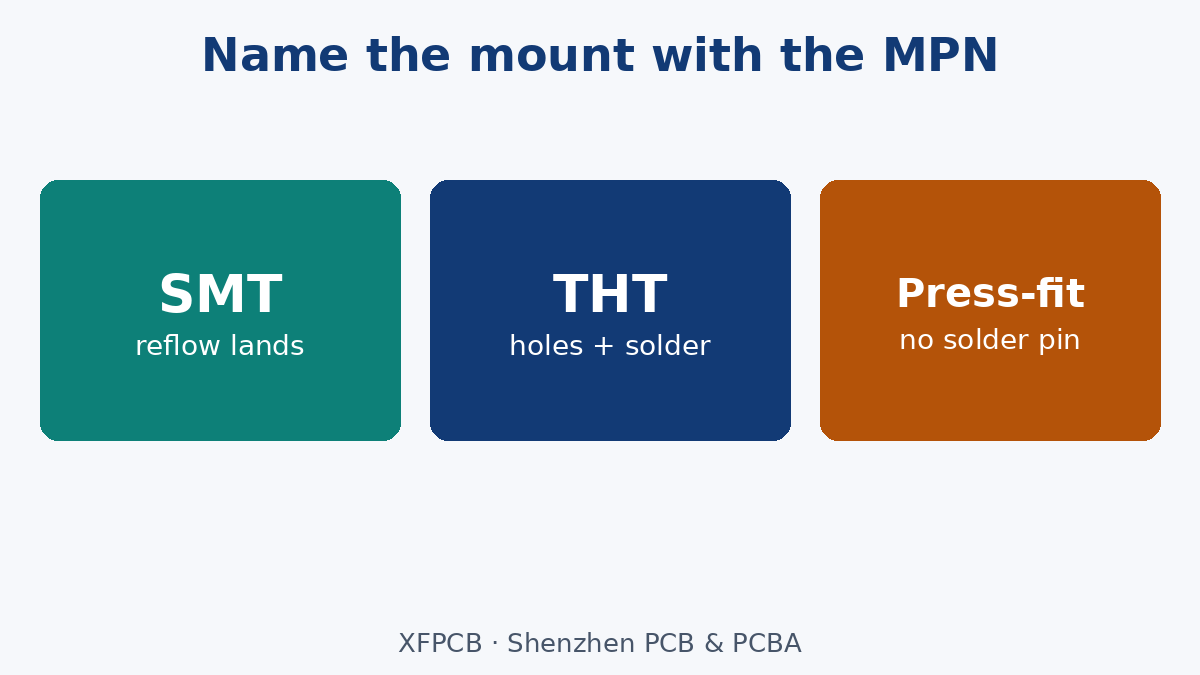
Mount style is a process choice
SMT wants a flat land pattern, paste volume the datasheet allows, and often pegs or mechanical anchors on larger shells. Reflow first; mating force later.
Through-hole wants hole size and annular ring the pin needs, and wave, selective or hand solder named. It buys mechanical strength for mating abuse.
Press-fit wants a compliant pin and a finished hole the vendor specifies—no solder on that interface. Backplane press-fit is a different traveler from SMT USB.
Do not leave “connector” as a BOM description. Our Through-Hole Assembly and SMT PCB Assembly pages are different seats; the connector picks one (or both, for hybrid shells).
Keep-outs the housing will punish
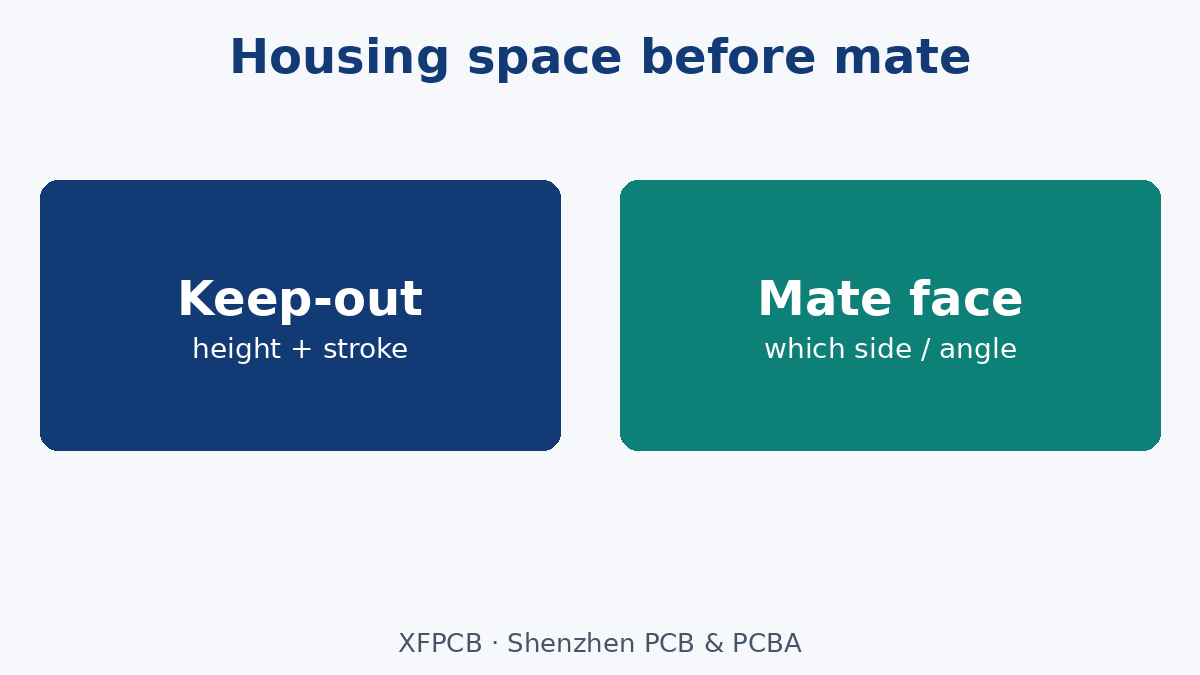
Connectors fight height, keep-out and mating stroke:
- Component keep-out around the shell so the mate can enter.
- Board-edge clearance for right-angle I/O and for card-edge insertion.
- Height under a stacking BTB so the second board does not hit tall parts.
- Polarization and keying drawn so reverse mate is visible in silk or plastic.
If conformal coat or potting is in scope, connectors are classic keep-outs. Say so on the assembly drawing.
Edge connectors are a fab finish, not a catalog plug
A gold-finger edge is plated and beveled as a fabrication feature. Call out which fingers are contacts, finish family, and whether bevel is required. Treating “edge connector” as only an assembly line item misses the fab note. Mating slot geometry lives with the backplane or receptacle vendor—not as a hope on the daughtercard alone.
Mating face and cycles without invented ratings
Write which side contacts (top/bottom for FFC-style parts), orientation (vertical vs right-angle), and whether the product is few-cycle service or many-cycle user I/O. Plating and contact design follow that ask. Do not invent amp-per-pin or IP numbers on the blog; take them from the datasheet and put them on the BOM line.
Selection order that survives a quote
- Electrical: voltage, current, signal class (power, low-speed, controlled impedance).
- Mechanical: mount style, orientation, lock, polarization, mate cycles.
- Environment: temperature, sealing if any—as a product requirement, not a logo.
- Then pick the MPN family.
Pitch and stack height are layout constraints after that order is fixed. Fine pitch without a placement and inspection plan is a yield bet.
Hybrid shells and first-article mate
Some USB and RJ45 shells mix SMT hold-downs with THT shield tabs. Quote both processes. First article should include a mechanical mate into the intended receptacle or cable—electrical continuity on pins does not prove the shell clears the enclosure or that the latch still clicks after reflow heat.
What we are not claiming
No connector brand ranking, no universal pitch table, no rewrite of flex ZIF tail DFM, and no invented IP or amp ratings. Lock mount style, keep-outs and mating face on the RFQ. Then the catalog name is a part number, not a guess.