
The short answer is easy: FR-4 is a flame-retardant laminate made of woven glass cloth and epoxy resin, and it is the base material of most rigid circuit boards. "FR" stands for flame retardant, and the name comes from the NEMA grade system for industrial laminates.
The longer answer is more useful. FR-4 is not one material but a family of materials that share a basic recipe and differ in the details, and those details explain why two boards both described as "FR-4" can behave very differently in reflow, in drilling, at high frequency or after years in a humid environment. This article opens the recipe up: what goes into an FR-4 laminate, what each ingredient does, how the laminate is made, and how to read the numbers on an FR-4 datasheet without being misled by them.
For the separate question of when to use FR-4 and when to move to something else, see our other materials articles; here the focus is on what FR-4 actually is.
The ingredients
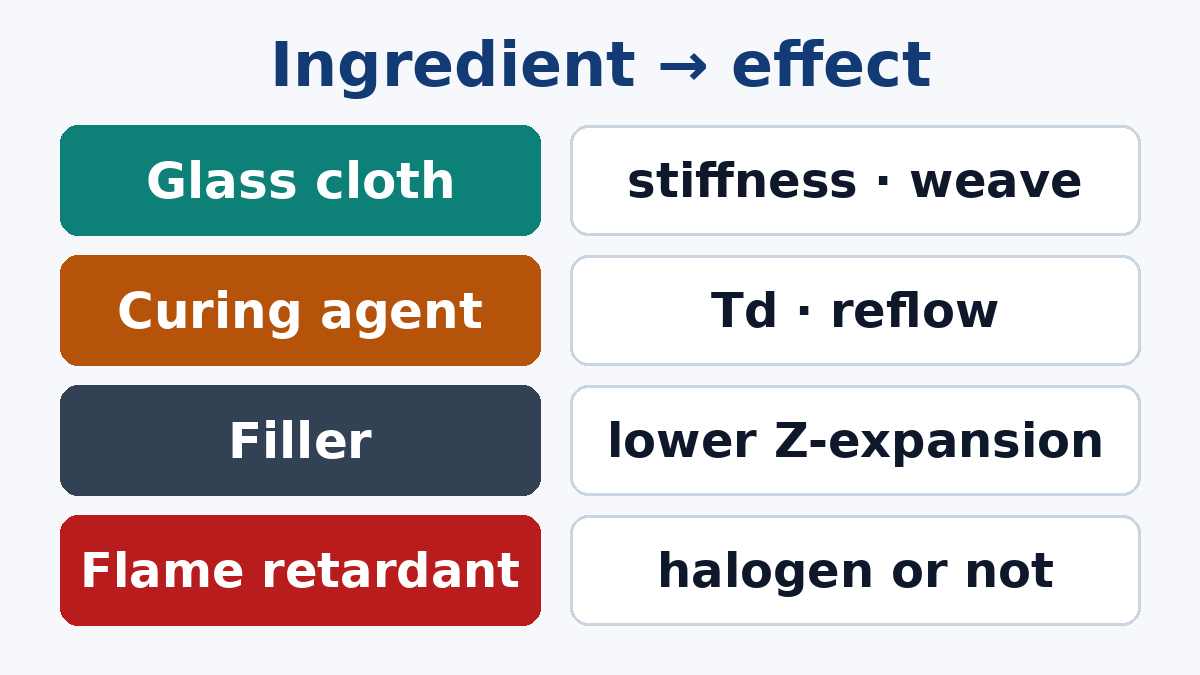
Woven glass cloth. Fine filaments of electrical-grade glass (E-glass) are spun into yarns and woven into cloth. Different weaves, called glass styles, range from very thin, fine cloths to thick, coarse ones. The glass gives FR-4 its stiffness, strength and dimensional stability, and it keeps in-plane expansion low. The weave pattern also matters electrically, because glass and resin have different dielectric constants.
Epoxy resin. The resin binds the glass, insulates, and bonds to the copper foil. Standard FR-4 resin is based on bisphenol-A epoxy, often with multifunctional epoxies added to raise the glass transition temperature.
Curing agent. The epoxy needs a hardener to cure. Traditional FR-4 used dicyandiamide ("dicy"). Many materials developed for lead-free soldering use phenolic curing agents instead, which raise the decomposition temperature and improve resistance to repeated high-temperature exposure. This is one of the less visible differences between FR-4 grades and one of the most important for reflow robustness.
Flame retardant. Conventional FR-4 achieves its flame resistance with a brominated compound built into the resin. Halogen-free FR-4 replaces it with phosphorus-based compounds and inorganic fillers. Halogen-free materials meet the same flammability requirements by a different route, and they behave somewhat differently in processing and in properties.
Fillers. Many modern FR-4 grades contain inorganic fillers. Fillers reduce expansion through the thickness of the board, which helps plated holes survive thermal cycling, and can improve thermal stability. They also make the material harder on drill bits, which the fab has to account for.
Copper foil. Strictly part of the copper-clad laminate rather than FR-4 itself, but the foil type and surface treatment affect adhesion and high-frequency loss.
How FR-4 laminate is made
- Glass cloth runs through a bath of resin mixture in a machine called a treater, then through ovens that drive off solvent and partly cure the resin. The result is prepreg, glass cloth carrying resin in a partly cured state (called B-stage).
- For copper-clad laminate, sheets of prepreg are stacked to the required thickness with copper foil on one or both sides, and pressed under heat and pressure until the resin is fully cured (C-stage).
- The laminate is cut into panels and supplied to PCB factories, together with matching prepreg for multilayer lamination.
So the cores in a multilayer board and the prepreg between them come from the same material system. When a drawing specifies an FR-4 grade, that applies to both.
How IPC classifies FR-4 grades
IPC-4101 is the specification for base materials for rigid and multilayer boards. It divides glass-epoxy materials into specification sheets, the "slash sheets", based on resin system, flame retardant, filler content and minimum values for properties such as Tg, Td and thermal endurance. Calling out a slash sheet on a drawing tells the fab what kind of FR-4 you need far more precisely than the word "FR-4" alone, while still allowing any brand that meets it.
Reading an FR-4 datasheet
Datasheets list a dozen or more values. A few matter most for most boards, and each comes with a test method that affects how to read it. The test methods are defined in IPC-TM-650.
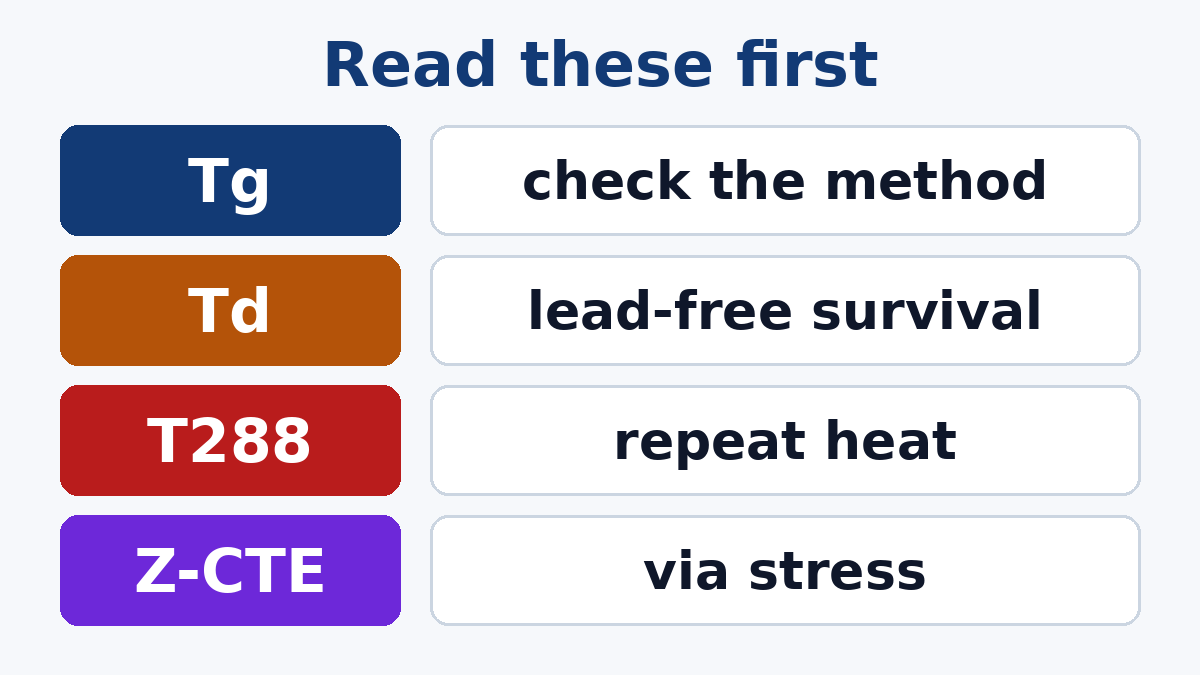
Tg, glass transition temperature. The temperature range where the resin changes from a hard, glassy state to a softer, rubbery one. Above Tg, expansion through the board thickness increases sharply. Tg can be measured by DSC (differential scanning calorimetry), TMA (thermomechanical analysis) or DMA (dynamic mechanical analysis), and the methods give different numbers for the same material, with DMA typically reading highest. When comparing two datasheets, check that the Tg values were measured the same way.
Td, decomposition temperature. Measured by thermogravimetric analysis, usually as the temperature at which the resin has lost 5% of its weight. Td says more about lead-free reflow survival than Tg does. A material can have a high Tg and a modest Td, or the reverse.
T260 and T288, time to delamination. The time the material survives at 260 °C or 288 °C before it delaminates, measured by TMA. These values indicate how much repeated high-temperature exposure the material can take: multiple reflows, rework, thick boards.
Z-axis CTE. Expansion through the thickness, usually given below Tg and above Tg, and sometimes as a total percentage expansion from room temperature to 260 °C. This is what stresses plated through-holes during soldering and thermal cycling. Lower is better, and fillers help.
Dk and Df. Dielectric constant and dissipation factor, which govern impedance and signal loss. Both depend on frequency and resin content. A single value "at 1 MHz" tells you little about behaviour at gigahertz frequencies; for impedance work, use the supplier's data at relevant frequencies, per glass style and resin content.
CTI. The comparative tracking index, relevant for boards with high voltages where surface tracking matters.
What this means in practice
A higher Tg is not automatically a better board. For lead-free assembly, Td, T288 and z-axis expansion often matter as much as Tg. A High Tg PCB material chosen for its thermal performance should be judged on all of those values, not on Tg alone.
"FR-4" on a drawing is under-specified. It allows any glass-epoxy laminate that meets the flammability rating. If your board needs lead-free robustness, halogen-free composition, high CTI or specific Dk values, say so, ideally with an IPC-4101 slash sheet or a list of required properties and an allowance for equivalents.
Compare like with like. When evaluating two materials, compare values measured by the same test method at the same conditions.
The ingredients show up in manufacturing. Filled materials wear drills faster; phenolic-cured materials can behave differently in drilling and desmear; halogen-free materials have their own processing windows. A factory that knows the exact material can set up its process accordingly, which is another reason to state the grade rather than leave it open.
Our PCB Materials page lists the material families we commonly build with. If you are unsure which FR-4 grade suits your board, send us the layer count, thickness, assembly process and any special requirements, and our engineers will suggest a grade and the callout to put on your drawing.