

Market reports on flexible circuits have been predicting double-digit growth for as long as most buyers can remember. Some of those forecasts have since expired, and the newer ones disagree with each other by wide margins depending on how they define "flex" and which segments they count. We are not going to add another number to the pile.
For someone placing a flex or rigid-flex order, the headline market size is not the useful part anyway. What matters is where the demand is coming from, because each source of demand pulls on specific materials, specific equipment and specific engineering attention inside the factories that build flex. When a large program in one segment ramps, it is those shared resources that get tight, and a smaller buyer feels it as a longer material lead time or a quote that comes back with an alternative laminate.
This article looks at the demand drivers we actually see at a Shenzhen PCB and PCBA factory, and then at what they mean for how you write a flex RFQ, choose materials and plan lead time.
Where flex demand is coming from
Phones, wearables and hearables. This is still the segment that shaped the flex industry: thin, fine-line, high-volume circuits for displays, cameras, batteries and antennas. Much of the highest-volume work runs on dedicated capacity at very large suppliers. Its indirect effect on everyone else is on materials: thin adhesiveless polyimide laminates, thin coverlay and fine-grain copper foils are produced in large quantities for this segment, which makes them easier to buy, while unusual constructions are not.
Vehicles, especially battery packs. Electric vehicle battery modules increasingly use flexible circuits instead of discrete wire harnesses for cell voltage and temperature sensing. These circuits are physically long, often carry nickel tabs or connect to busbars, and come with automotive documentation expectations. Camera modules, displays and lighting add more flex to a vehicle. For a factory, long circuits change panel planning: a circuit that does not fit the standard working panel needs a different process route or a supplier with longer panel or roll capability.
Medical and health devices. Wearable patches, hearing devices, catheter and probe circuits and compact diagnostic equipment use flex for its thinness and its ability to fold into small housings. Volumes are usually modest, but documentation, cleanliness and material traceability requirements are high.
Industrial equipment and robotics. Printheads, moving sensor heads, robot joints and scanners use flex in continuous motion. This is where dynamic bend life matters most, and where rolled-annealed copper and carefully balanced stackups earn their cost.
Data and communications hardware. Optical modules, compact high-speed interconnects and dense computing hardware use rigid-flex to remove connectors and cables from tight spaces. Some of these designs also call for low-loss flexible dielectrics such as liquid crystal polymer or modified polyimide.
Drones, cameras and compact consumer hardware. Many smaller products move from rigid boards plus a cable to a single rigid-flex assembly once the enclosure gets tight enough. This is the segment most of our overseas customers sit in.
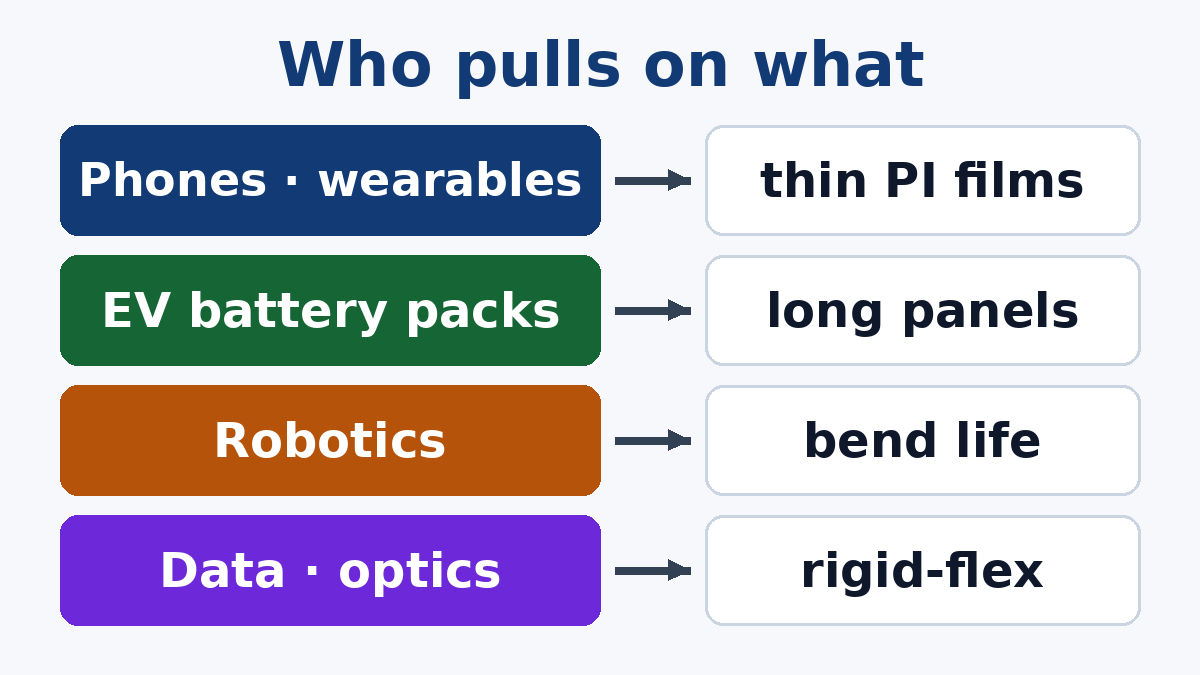
What these drivers change inside the factory
From a production point of view, flex demand is not one queue. Each segment pulls on a different bottleneck.
Materials. Standard thicknesses of adhesiveless polyimide copper-clad laminate, standard coverlays and common stiffener materials are generally available. The constructions that take longer to source are the uncommon ones: thick polyimide, unusual copper weights on flex, specific low-loss flexible dielectrics, a named brand of pressure-sensitive adhesive, or a particular EMI shielding film. When a large program consumes one of those, smaller orders that specify the same item wait.
Panel size and handling. Long battery circuits, long display tails and very large flex outlines compete for the panel formats that can hold them. If your outline is long, ask early which panel the fab will use; it affects both price and which factories can build it.
Tooling. High-volume flex is often cut with hard tooling, while prototypes and small lots are laser cut or cut with simple tooling. The changeover between the two is a planning event, not a detail: the die has to be made and approved, and the outline tolerance and edge quality can differ.
Rigid-flex lamination capacity. Rigid-flex involves more lamination cycles, no-flow or low-flow prepregs, and more careful registration than a rigid board or a pure flex circuit. It is the part of the process that gets congested first when several rigid-flex programs ramp at once.
Assembly. Flex assemblies need carriers or fixtures for printing and placement, stiffeners in the right places and careful baking because polyimide absorbs moisture. Each new flex assembly brings fixture work that has to be scheduled.
What it means for your flex RFQ
None of this needs a buyer to follow the market closely. It does mean a few habits in the RFQ make a noticeable difference.
Say where the program is going. "Five prototypes now, a pilot lot after validation, production volume next year" lets the fab quote the prototype on materials and tooling that will still make sense in production, instead of the cheapest route for five pieces that then has to be redone.
Specify materials by property, then name what is mandatory. For flexible materials, the relevant IPC specifications are IPC-4202 (flexible base dielectrics), IPC-4203 (cover and bonding materials) and IPC-4204 (flexible metal-clad dielectrics). Calling out the property, such as adhesiveless construction, polyimide thickness and RA or ED copper, rather than a single trade name, gives the fab room to offer an equivalent that is in stock. If a specific material is genuinely required by qualification, say so clearly; that tells the fab to check its availability before quoting a lead time.
Separate the circuit from the accessories. Stiffeners, adhesives, EMI films and connectors are often the long-lead items on a flex job, not the laminate. List them with their own material callouts and drawings so they are sourced in parallel.
State the bend use. Static install-and-forget flex and dynamic flex have different material and stackup needs. The Flexible PCB build that works for a folded display tail is not automatically the right one for a hinge that cycles all day.
Give the outline early. Panel fit, tooling and which factory route is used all depend on the outline. A dimensioned outline with tolerances, sent with the first RFQ, avoids surprises at the quote stage.
Lead-time planning that survives a busy market
Lead time on flex is less predictable than on standard rigid boards, mostly because of materials and tooling, so planning matters more than negotiating.
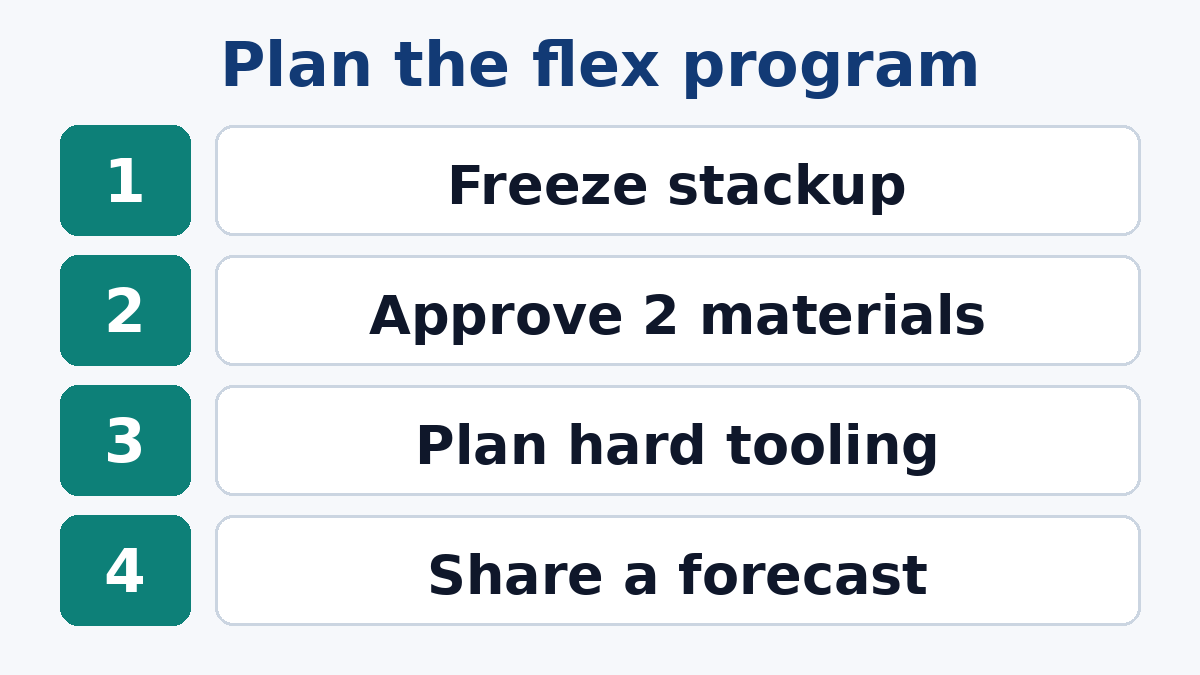
- Freeze the stackup before the second build. Every stackup change at prototype stage can mean a different material order. Settling it early lets the fab buy production materials ahead of the order.
- Approve equivalents in advance. If your engineering team has evaluated two laminate or coverlay options, put both on the drawing. Dual approval is the single most effective protection against a material shortage.
- Plan the tooling transition. Decide at which build hard tooling will be made, and include a sample approval step. Do not combine the first hard-tooled lot with a deadline-critical shipment.
- Share a rolling forecast. Even an approximate forecast lets the factory reserve material and lamination slots. A forecast that is updated monthly is more useful than an accurate one sent once.
- Order rigid-flex earlier than you think. Because of the extra lamination and registration steps, rigid-flex should be scheduled with more margin than an equivalent rigid board. Check the realistic window against your build plan with the fab, and compare it with the Rigid-Flex Capability the factory actually publishes rather than a generic expectation.
- Keep the assembly side in the loop. If the same supplier assembles the flex, fixture and stencil preparation can start while the circuits are in fabrication.
When the market does matter
There are moments when general market conditions do reach a smaller buyer directly: when copper or polyimide prices move sharply, when a large consumer launch absorbs a specific thin material, or when automotive programs ramp. The response is the same in every case: material flexibility on the drawing, early forecasts and an RFQ that tells the factory what is essential and what is negotiable.
If you are planning a flex or rigid-flex program, send us the outline, stackup idea, bend requirements and expected volumes. Our engineers will tell you which materials and tooling routes we would plan for each stage, and where your design depends on items that are worth ordering early.