
Most prototype orders we receive either say nothing about IPC at all, or say "IPC Class 2" and stop there. Both usually work out, because a competent factory builds to its normal workmanship standard anyway. But a prototype is supposed to tell you something about the product, and if the standards behind it are unstated, the prototype may be telling you less than you think.
IPC does not publish a single "prototype standard". What it publishes is a set of documents covering design, materials, fabrication, acceptance and assembly, and a prototype touches all of them. This article maps those documents onto a prototype build, shows how to call them out on a drawing in a line or two, and explains when a prototype should be built to the same requirements as production and when it is reasonable to relax them.
The documents behind a board
You do not need to own every standard to reference it correctly, but it helps to know which document governs which part of the job.
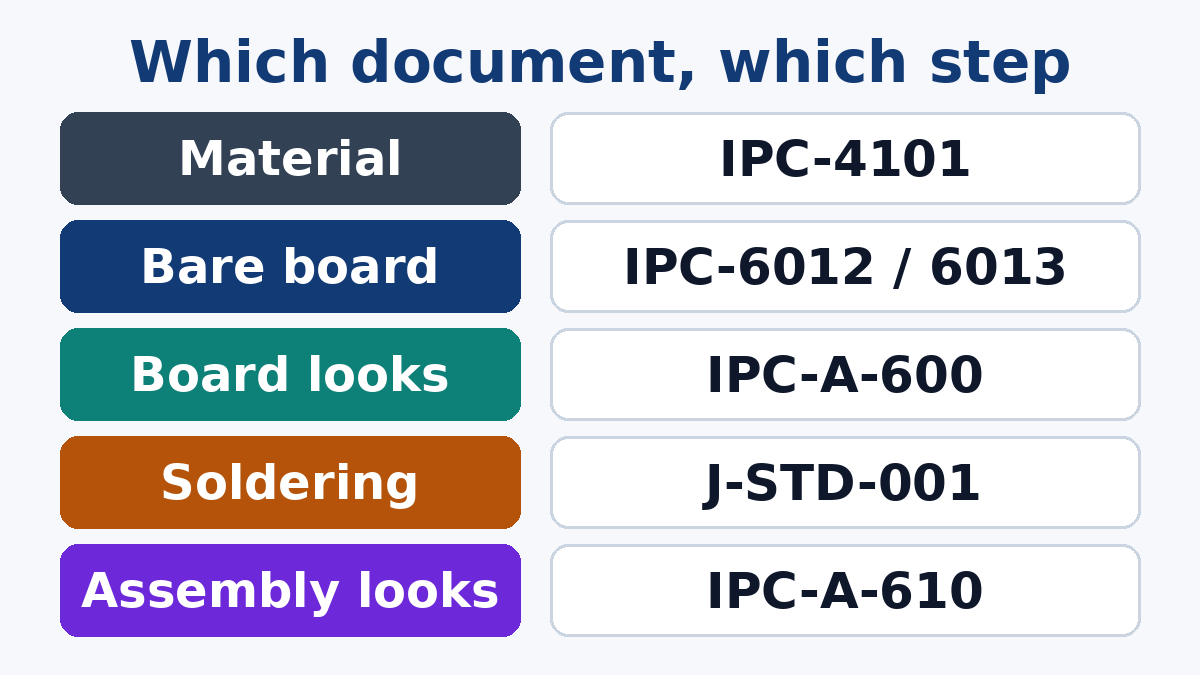
Design. IPC-2221 is the generic design standard for printed boards, with IPC-2222 adding rules for rigid organic boards. IPC-7351 covers surface-mount land patterns. These guide the designer; a factory does not inspect against them directly, but its process limits assume designs in that range.
Base materials. IPC-4101 specifies laminate and prepreg for rigid and multilayer boards, organised in specification sheets ("slash sheets") that define resin system and properties. Calling out a slash sheet is a precise way to say "FR-4 with these properties" without naming a single brand.
Surface finishes. Several finishes have their own IPC specifications, for example IPC-4552 for ENIG and IPC-4556 for ENEPIG.
Fabrication performance. IPC-6012 is the qualification and performance specification for rigid printed boards. IPC-6013 covers flexible and rigid-flex boards, and IPC-6018 covers high-frequency boards. These define the requirements a finished board must meet, by class: plating thickness, annular ring, hole quality, dielectric spacing, and the tests and coupons that demonstrate them.
Visual acceptability. IPC-A-600 illustrates what acceptable and nonconforming conditions look like on a bare board, by class. It is the picture book that goes with the performance specification.
Assembly. J-STD-001 sets the requirements for soldered assemblies: materials, processes and solder joint requirements. IPC-A-610 is the acceptability standard for electronic assemblies, the illustrated criteria an inspector uses to judge joints and component placement.
Supporting documents. J-STD-003 covers solderability testing of printed boards. IPC-1601 gives guidance on handling, packing and storing boards. For moisture-sensitive components, J-STD-020 and J-STD-033 are the references.
What "Class 2" actually means on a drawing
The product classes, Class 1 for general electronics, Class 2 for dedicated service electronics and Class 3 for high-performance or harsh-environment electronics, are defined consistently across these documents. Writing "Class 2" without naming a document leaves the factory to assume which documents you mean. In practice they will assume IPC-6012 and IPC-A-600 for a rigid board and IPC-A-610 for an assembly, which is usually what was intended. But it is better to say so, particularly when the board is flexible, high-frequency or built for a customer whose quality team will read the drawing later.
The difference between classes, and when Class 3 is worth the cost, is covered in our separate articles on Class 3 fabrication. Here the question is narrower: how to write the requirement for a prototype.
A prototype callout in two lines
For most rigid prototype boards, two lines on the fabrication drawing are enough:
- Fabricate and test per IPC-6012, Class 2. Acceptability per IPC-A-600, Class 2.
- Base material per IPC-4101 /[slash sheet number], or approved equivalent.
For the assembly:
- Assemble per J-STD-001, Class 2. Acceptability per IPC-A-610, Class 2.
Add the revision of each document if your quality system requires it; otherwise state that the current revision applies. If anything on the board must be treated differently, such as a tighter impedance tolerance, a specific plating thickness, a cosmetic exception or a test requirement, write it as a specific note. A specific note on the drawing takes precedence over the general standard, so you do not need to choose a higher class just to tighten one requirement.
When the prototype should match production
A prototype is often treated as a lower-stakes build, and in many cases that is correct. But some prototypes are used to make decisions that production will inherit, and those should be built to production requirements:
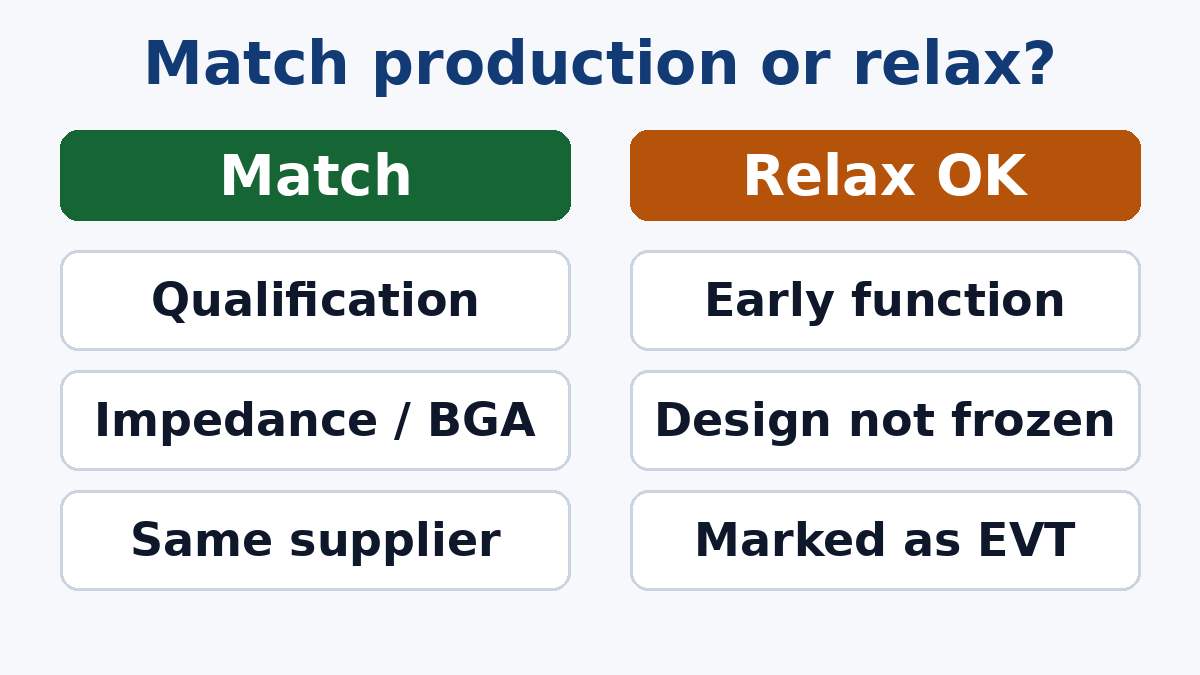
- Design verification and qualification builds. If prototypes are used for environmental testing, reliability testing or certification, they should be built to the class, material and finish of the production board. A Class 3 production design tested on Class 2 prototypes has not been tested.
- Boards with features that are sensitive to process. Controlled impedance, fine-pitch BGA, heavy copper and high-frequency material behave differently if built to looser rules or on a substitute material.
- First-article builds for a production supplier. If the prototype factory will also be the production factory, the prototype is the first look at its process for your design. Build it the way production will be built.
When relaxing is reasonable
Early engineering boards, used to check that a circuit works, do not need full production requirements. Reasonable relaxations include:
- Class 2 instead of Class 3, when the early build is for functional checks only and the design is not yet frozen
- Standard material instead of a specific qualified laminate, if the circuit is not sensitive to the difference
- Electrical test and visual inspection only, without coupon microsections
Say so explicitly ("Engineering build, not for qualification") so nobody later mistakes the results for evidence about the production design.
What a prototype cannot prove, even to IPC requirements
Building a handful of boards to IPC-6012 Class 2 shows that this lot met the requirements. It does not show process stability across lots, how the board behaves on another factory's materials, or long-term reliability. Some performance requirements are verified on test coupons from the production panel; for a small prototype lot, ask whether coupon testing and a microsection report are included or available, and decide whether you need them.
The same applies to assembly. A prototype assembled to IPC-A-610 Class 2 with joints that meet the criteria tells you the build was acceptable. It does not tell you the solder joints will survive your product's thermal cycling; that needs testing.
Practical habits for prototype orders
- Name the documents and class on the drawing, not just "IPC standard".
- Use the IPC-4101 slash sheet, or a list of required properties, for the material.
- State the purpose of the build: engineering, design verification or pre-production.
- Put specific requirements as notes rather than raising the class for the whole board.
- Ask for a certificate of conformance stating the documents and class the boards were built to, and keep it with the test results.
If a prototype drawing does not state the documents or class, our engineers will raise it as a question at the quote stage rather than assume. If you are planning a qualification build and want to check that the prototype drawing matches what production will need, send us the drawing and our PCB Prototype team will review the callouts with you before the order.