

Most advice on choosing a PCB manufacturer is a list of attributes: capabilities, quality systems, certifications, lead time, support. The list is right. The trouble is that every manufacturer's website claims all of them, and a buyer comparing five suppliers ends up comparing five near-identical claims.
What separates suppliers is not what they say about themselves but how they behave on your work. The good news is that you can observe that behavior cheaply, long before you commit a production program: in how they respond to your RFQ, in the engineering questions they send, and in what arrives with your first order. This article is about reading those signals, written from the other side of the process. As a Shenzhen PCB and PCBA factory, we answer RFQs every day, and we know which responses buyers should trust and which ones should worry them, including our own.
Start with your requirements, not their brochure
Before you evaluate anyone, write down what your boards actually need. Layer count and construction, the tightest trace and space, hole sizes and aspect ratio, materials and any controlled impedance, surface finish, IPC class, volumes from prototype to production, test requirements, and any industry certification your customers require of your suppliers.
This sounds obvious, but many supplier comparisons fail because the buyer never separated "must have" from "nice to have." A supplier with deep high-layer-count capability is not better for a 4-layer consumer board; they may simply be more expensive and slower for it. The right manufacturer is the one whose normal, everyday process matches your normal requirements, with margin for your hardest feature.
Read capability claims with two columns in mind
Capability tables usually show the limit of what a factory can do. That number matters less than what the factory does routinely. A shop that has built a very fine line width once for a special project may list it next to values it runs every day.
When you ask about capability, ask for two answers: what is standard production, and what is possible with engineering review, extra cost or lower yield. A factory that answers the second question honestly, and tells you when your design sits in that zone, is giving you something more valuable than a big number. For reference, you can compare that conversation with the published envelope on a supplier's capability page; our own is on the PCB Capabilities page, and we would rather tell you a feature is at the edge than find out together after lamination.
Send a real RFQ and watch the response
The quotation stage is a free trial of how a supplier works. Send the same complete package to each candidate: fabrication data, drill files, a fabrication drawing with material, stackup, finish, class and tolerances, quantities, and required delivery.
Then look beyond the price.
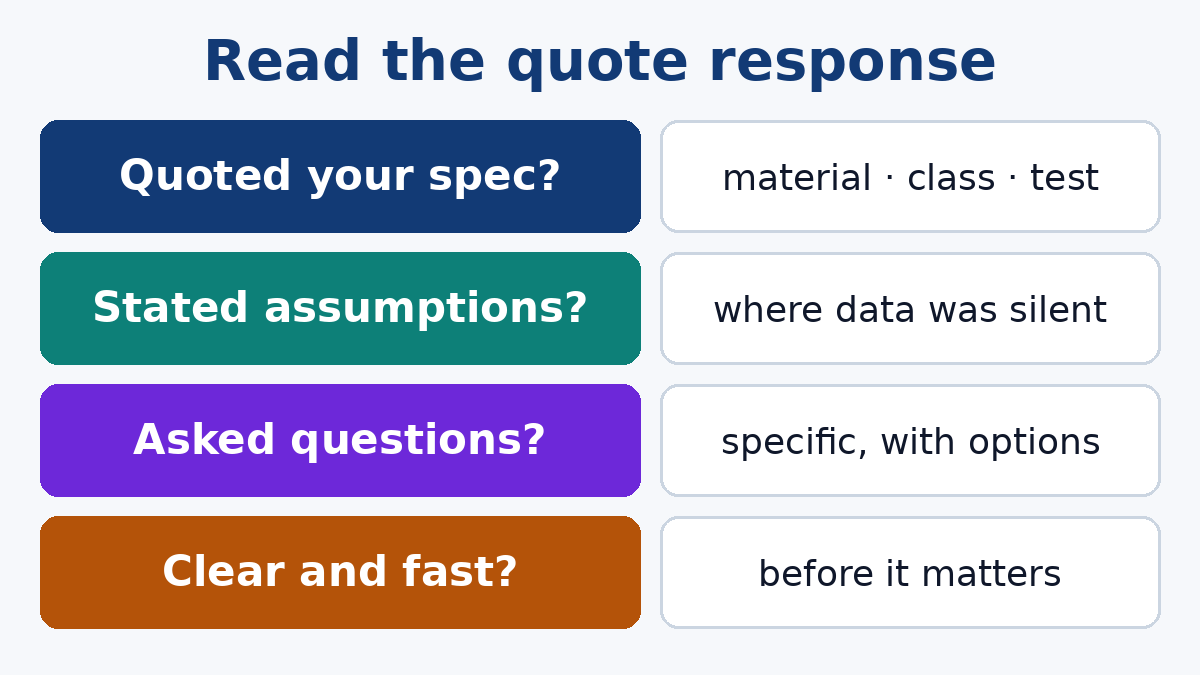
Did they quote what you asked for? Check that the quote lists your material, thickness, copper weights, finish, class and testing. A quote that simply says "FR-4, 1.6 mm, HASL" when you specified something else either did not read your drawing or is quietly substituting.
Did they state assumptions? Good quotes say what they assumed where your data was silent or ambiguous. Silence on assumptions means you discover them later.
Did they ask questions? Almost every real design has something worth confirming. A supplier that asks sensible questions about an impedance note, an unclear hole tolerance or a missing panel requirement is showing you its engineering front end. A supplier that asks nothing on a complex board is either very lucky or not looking.
How fast and how clear were they? Speed matters less than clarity, but both tell you what the relationship will feel like when a real problem appears.
Judge the engineering questions, not just their existence
Engineering queries, often called EQs, are one of the best windows into a factory. Look at their quality:
- Specific and referenced. A good EQ points to a location, a layer and a value: "Annular ring on these vias is below our minimum for your class; propose increasing pad size or accepting tangency." A vague "please check your design" is not useful.
- Offers options. It proposes a solution and explains the trade-off, rather than just stating a problem.
- Respects your authority. It asks before changing anything that affects form, fit or function, and records your answer. A factory that changes things without asking is the one to avoid, however convenient it seems at the time.
If you want to see the quality of a supplier's engineering review, send a design that you know has one or two borderline features and see whether they catch them.
Ask how quality is proven, not whether it exists
Every supplier will say quality is important. Ask what evidence comes with the boards:
- Certificate of conformance tied to your part number and revision.
- Electrical test confirmation, and what method was used.
- Impedance test report on coupons, if you specified controlled impedance.
- Cross-section or microsection report, if your class or contract requires it.
- Solderability or other lab tests where specified.
- For assembly: first-article report, inspection coverage and test results.
Then ask what happens when something goes wrong. How is a complaint handled? Will they provide a structured root-cause and corrective action report? Can they show an anonymized example? The answer tells you more about their quality system than any certificate, although you should still check the certificates your industry needs, including scope and site.
Look at how they handle schedule honestly
Lead time is where many relationships go sour, usually not because the factory is slow but because it promised something it could not do. Ask:
- What is the normal lead time for this construction, and what drives it?
- Is the material in stock, or does it need to be ordered?
- Does an expedited option change anything in inspection or testing?
- How will you be told if a date is at risk, and how early?
A supplier that tells you on the first day that your specialty laminate needs to be ordered is more reliable than one that accepts an impossible date and apologizes later. If speed genuinely matters for prototypes, a Quick Turn PCB service is designed for it; what you are checking is whether the factory is honest about which of your boards can realistically go through it.
Treat the first order as a structured trial
The first order is where claims become evidence. Make it count:
- Pick a representative board. Not your simplest design, and not the one with the most risk. Something typical of what you would place long-term.
- Ask for the full documentation set you would expect in production, even if it is a small quantity.
- Inspect on arrival. Check dimensions, finish, mask registration, marking, packaging and the documents against your drawing.
- Record what happened. Was the promised date met? How many EQs were there, and how quickly were they resolved? Were there surprises?
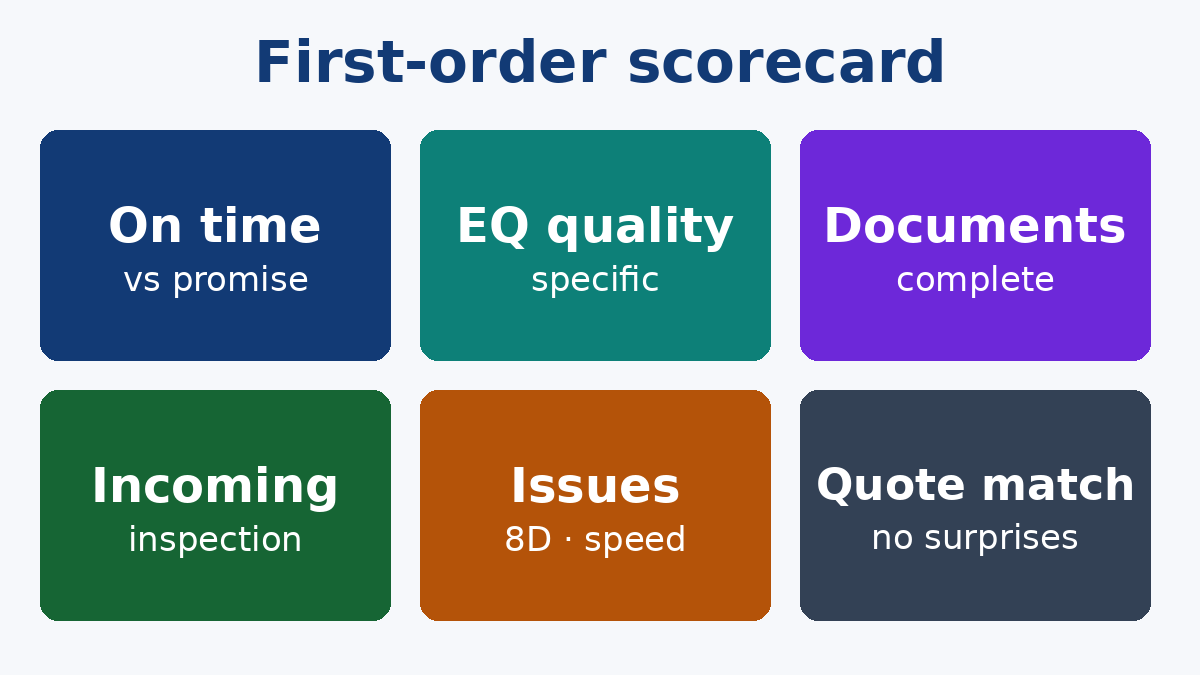
A simple scorecard across the first few orders, covering delivery against promise, EQ quality, documentation completeness, incoming inspection results and response to issues, turns a subjective impression into something you can compare across suppliers.
Price last, but compare it properly
Price matters, but it should be compared on equal scope. Two quotes are only comparable when they include the same material, class, finish, testing, documentation, packaging and shipping terms. A low price that excludes impedance testing or specifies a different laminate is not cheaper; it is a different product.
Also consider what the price includes in engineering time. A supplier that reviews your design properly and catches a problem before fabrication has saved you a full respin, which is worth far more than a small unit-price difference.
What a good fit feels like after a few orders
After three or four orders with a suitable manufacturer, a few things become routine. Quotes match your drawings without correction. Engineering questions are few, specific and resolved quickly. Documentation arrives without being chased. When there is a problem, you hear about it from them first, with a proposed fix. And your own team spends less time managing the supplier and more time on the product.
That is the practical answer to "what should I look for in a PCB manufacturer": not the longest capability list, but the supplier whose behavior on your own work you can predict. If you would like to put us through that process, send a representative board using the steps on our How to Place an Order page and judge our quote, our questions and our first delivery on the same terms as everyone else's.