

We host buyer visits at our Shenzhen factory regularly, and the visits that help both sides most have something in common: the visitor arrived with a plan. They knew what they wanted to see, what documents they wanted to look at, and which of their own boards they wanted to talk through. The visits that help least are the polite tours: a walk past clean machines, a presentation, lunch, and a flight home with a good feeling and very little evidence.
This checklist is written from the host side of the table. It is meant to help you get real information out of a day at any PCB or PCBA factory, ours included. It assumes you are evaluating a supplier for a real product, not sightseeing, and that you have limited time on site.
Decide what the visit is for
A visit can do several jobs, and it helps to pick one or two:
- Qualification before a first order. You want to confirm the factory is what it claims to be and that its processes can build your class of board.
- Pre-production review for a specific product. You already chose the supplier and want to walk your own board through the line and align on inspection, packaging and documentation before volume.
- Problem resolution. Something went wrong and you want to see the corrective action in place.
- Relationship and capacity planning. You are placing more work and want to understand where your orders sit in the plant's loading.
Each of these calls for a different agenda. A qualification visit spends most of its time on the floor and in records. A pre-production review spends it with engineering and at the specific stations your board will pass through.
Before you book the flight
Much of what a visit can tell you can be checked from your desk first, and doing so frees your time on site for the things only a visit can show.
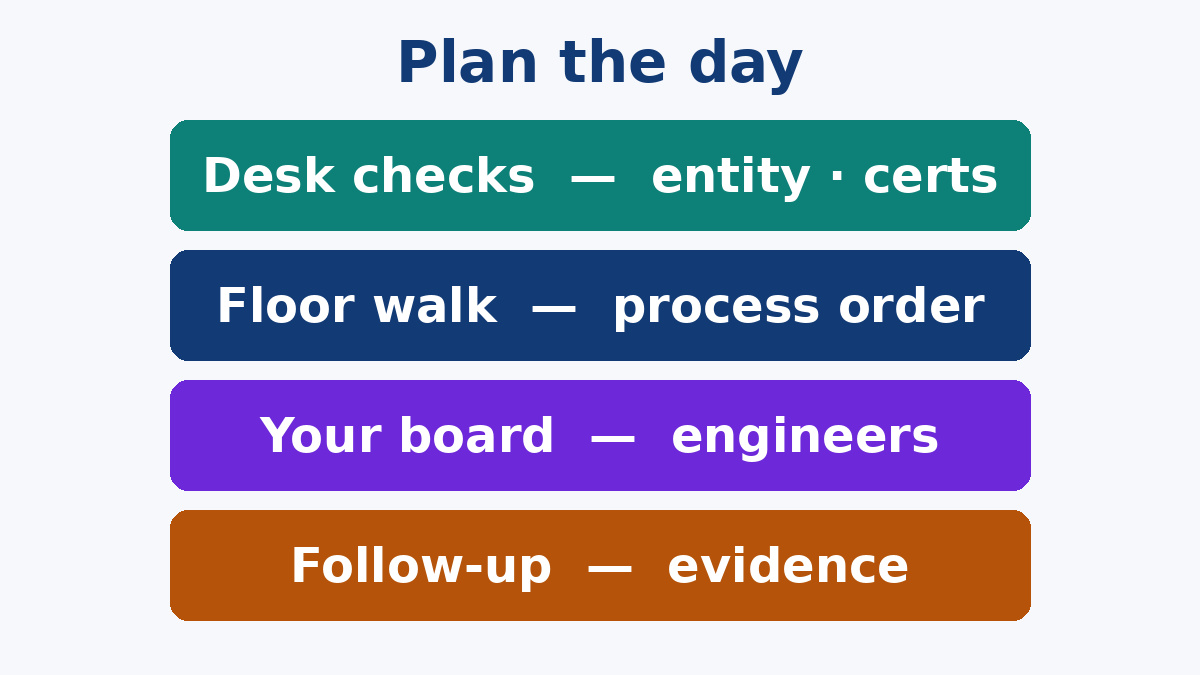
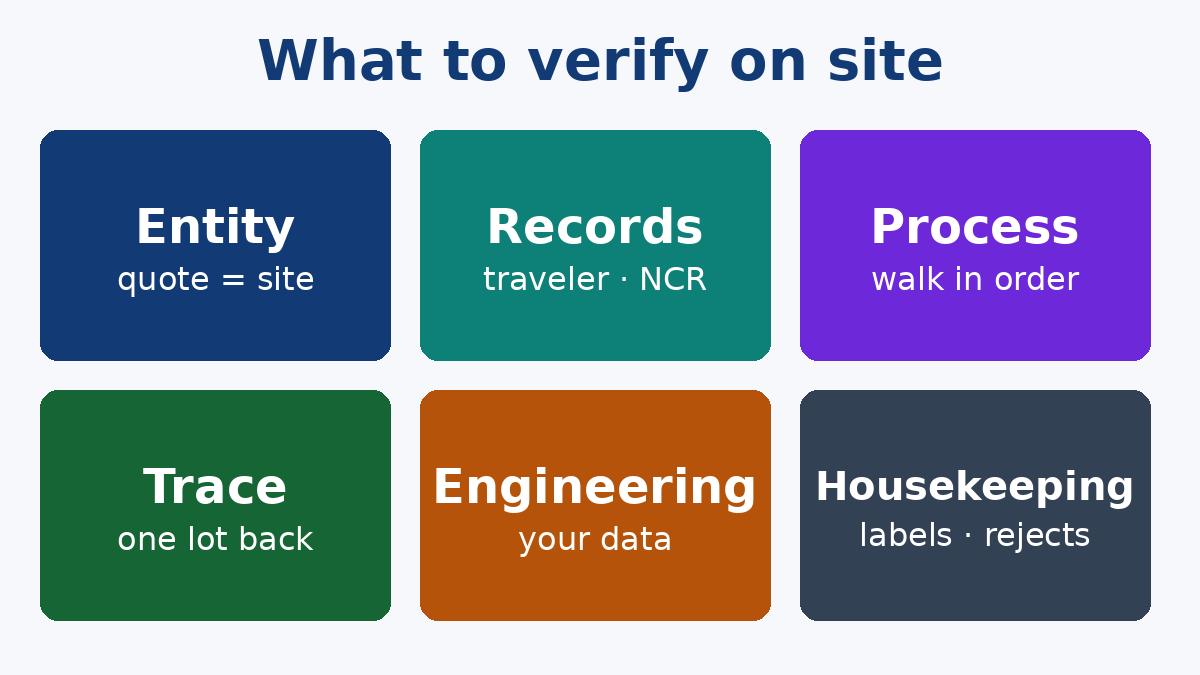
Confirm the entity and the site. Check that the company on the quotation, the certificate holder and the factory address are the same, or that any difference is explained. Some companies quote from a trading office and build at a partner's plant; that is not automatically bad, but you should know which site you are auditing and whether any steps are subcontracted, such as certain surface finishes, via filling or assembly.
Check certificates properly. Look at the scope, the site covered and the expiry date, and verify with the issuing body where possible. A certificate tells you a management system exists; the visit tells you whether it is being run.
Send an agenda in advance. A good factory will welcome it. Include the areas you want to see, the records you would like available (see below), the people you want to meet, and the time you want with engineering. Ask for an NDA to be in place if you will discuss your designs.
Bring your own board. Pick a representative current or upcoming design and send the data ahead under NDA, so their engineers can prepare a review. Watching how a factory handles your real data is worth more than any capability slide.
Plan the practicalities. Check current entry requirements for your nationality and whether you need an invitation letter from the factory; most factories can provide one on request. Ask about photography rules in advance so no one is surprised at the door.
Records to ask for on the day
Ask for these to be ready. You will not read them all in detail, but how quickly and confidently they are produced says a lot.
- A current job traveler for a board similar to yours, showing process steps, sign-offs and inspection results.
- Recent nonconformance and corrective action records, including customer complaints and how they were closed.
- Calibration records for measuring equipment, such as impedance testers, X-ray, thickness gauges and SPI.
- Chemical analysis logs from the plating line and records of the laboratory tests they run (cross-sections, solderability, peel strength, as applicable).
- Incoming inspection records for laminate and, for PCBA, components.
- For assembly: reflow profile records, MSD handling logs and ESD audit records.
If the answer to most requests is "we will send it later," note that.
On the floor: follow the board, not the tour
The best way to walk a factory is in process order, following the path your board would take. Ask your host to walk the PCB fabrication process in sequence rather than showcasing the newest machines first. At each area, look for a few specific things.
Front-end engineering and CAM. How are incoming files checked? Who raises engineering questions, and how are they tracked until closed? Can they show you a recent engineering query log? This is where many problems are prevented, and it is often skipped on tours because there is nothing dramatic to look at.
Inner layer imaging and AOI. Is the imaging area clean and controlled? Are inner layers inspected before lamination, and what happens to a panel with a defect?
Lamination. How are materials stored and identified? Are press programs controlled per material? Ask how they handle a material that is not in their standard stock.
Drilling and plating. Are drill bits tracked for hit count? How often is the plating bath analyzed, and who acts on the results? Ask to see a cross-section from a recent lot and how they measure copper thickness in the hole.
Solder mask, finish and legend. Look at registration on fine-pitch areas of work in progress. Ask whether any finish is subcontracted.
Electrical test and final inspection. Is every board electrically tested? How are failures repaired or scrapped, and are repaired boards identified? What do final inspectors use as a reference?
For PCBA lines: check moisture-sensitive device storage and floor-life tracking, stencil storage and identification, how feeder loading is verified against the BOM, whether SPI data is used to correct the printer, how AOI calls are reviewed at the verification station, and what the rework bench looks like. Watch how operators handle boards: ESD protection, gloves where needed, boards stacked or racked.
Throughout, notice what is not in the brochure: housekeeping, whether work in progress is labeled, whether rejected material is segregated and tagged, and whether operators can explain what they are checking. Unlabeled boards on a bench and a rework area with no records are more telling than any machine list.
Trace one lot backwards
One exercise reveals more than a full tour. Pick a finished lot, ideally one shipping that day, and ask the factory to trace it backward: the traveler, the inspection records, the laminate lot and its incoming inspection, the plating records for that date, and for PCBA, the component lots, reflow profile and AOI results. A factory with working traceability can do this in minutes. One that runs traceability only on paper will struggle, and that tells you how a field-failure investigation would go.
The engineering session on your board
Reserve at least an hour with the engineers who would actually handle your work. Go through the data you sent in advance:
- What engineering questions would they raise, and how would they send them?
- What would they propose for stackup and impedance, and how would they verify it?
- Which features push their process, and what is the plan for those?
- For assembly: what inspection and test coverage would they propose, and why?
Listen for specifics. "No problem" is less reassuring than "this BGA pitch with that via-in-pad requirement needs filled and capped vias, which we do in-house, and we would want to confirm your pad finish." Compare what you hear with what the factory's published capabilities say, such as its PCB Capabilities page. The discussion should be consistent with the page, and where your design pushes the limits, the engineers should say so.
Signs that deserve a follow-up question
Not every one of these is disqualifying, but each deserves a direct question:
- Areas you are not allowed to see without a clear reason (other customers' confidential work is a good reason; the plating line "being cleaned" all day is not).
- Equipment that is clearly idle or covered while the quote assumed in-house processing.
- Records that are too perfect: no nonconformances at all usually means they are not recorded.
- Different answers from sales and from engineering on the same question.
- No one on the floor can explain what happens to a rejected board.
- Willingness to show you another customer's design. If they will show you theirs, they will show others yours.
After the visit
Write your findings within a day or two, while details are fresh, and separate what you saw from what you were told. Send the factory a list of follow-up items: records they promised, questions they could not answer on the day, and any improvements you would require before an order. How they respond is part of the evaluation.
If the visit was positive, the natural next step is a first order sized as a pilot, with a first-article report and the inspection records you asked about during the visit. That turns the impression from the day into evidence on your own product.
If you cannot travel
A live video walkthrough is a reasonable substitute for an initial screening. Ask for it to be continuous, starting at the factory entrance and following the process in order, with the camera pointed at what you ask to see: a live traveler, an SPI screen, a cross-section under the microscope, a rework log. Pair it with a document review. It will not replace an on-site audit for high-reliability work, but it is far better than a slide deck.
If you are planning a visit to Shenzhen and XFPCB is on your list, send us your agenda and a board you would like to review. We would rather host a demanding visit than a polite one.