
PET (polyethylene terephthalate, the polyester used in drinks bottles and packaging film) makes a capable flexible circuit substrate. It is inexpensive, available in clear grades, has good moisture resistance and is easy to handle in large formats. It shows up in membrane switches, keypads, LED strips and decorative lighting, RFID antennas, disposable sensors and simple interconnects.
Most comparisons of PET and polyimide stop at a property table: PET is cheaper and clearer, polyimide survives higher temperatures and more bending. That is true, but it does not tell you how to decide. In our experience, the decision that settles almost everything else on a PET circuit is how parts and connections will be attached to it. PET cannot go through a normal lead-free reflow profile. Once you know your attachment method, the material choice, the construction and even the type of supplier follow from it.
The thermal fact that drives everything
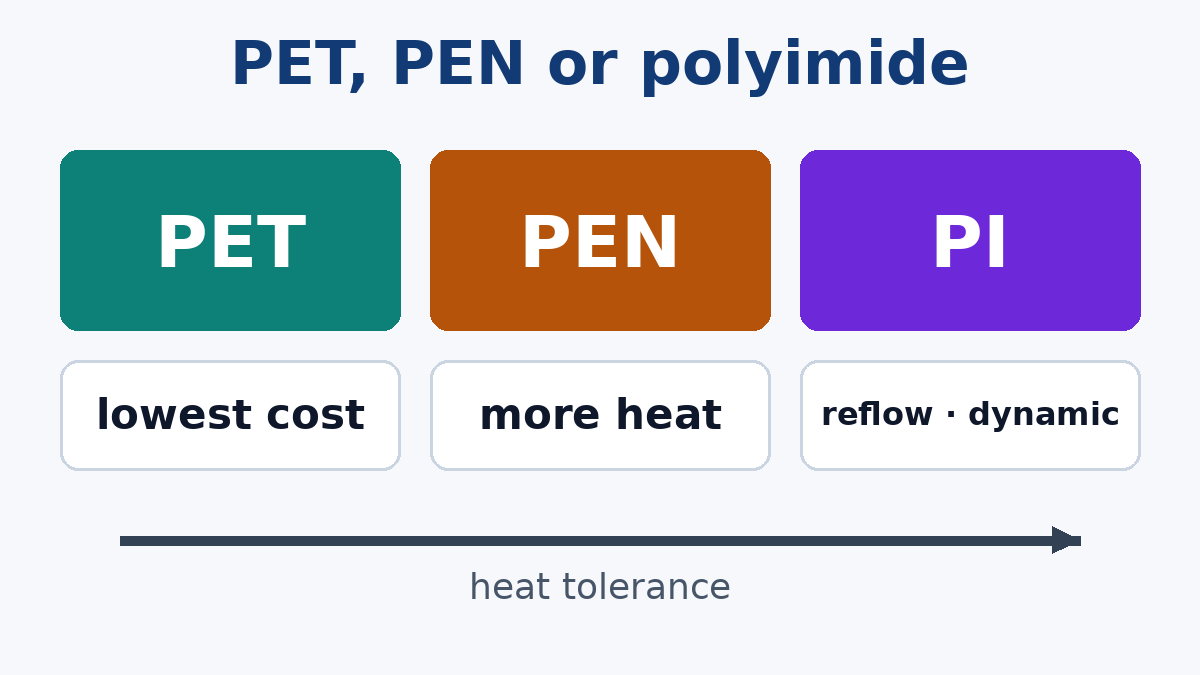
Polyimide film has no practical melting point in the soldering range and keeps its shape through repeated reflow. PET is a thermoplastic: it softens well below soldering temperatures and melts in the range where standard lead-free reflow peaks. Even before it melts, heat makes unstabilised PET film shrink and distort. Heat-stabilised grades reduce shrinkage, but they do not turn PET into a reflow material.
That is why PET circuits are either assembled at low temperature, assembled without solder, or have no components at all. Which of those applies to your product is the first question.
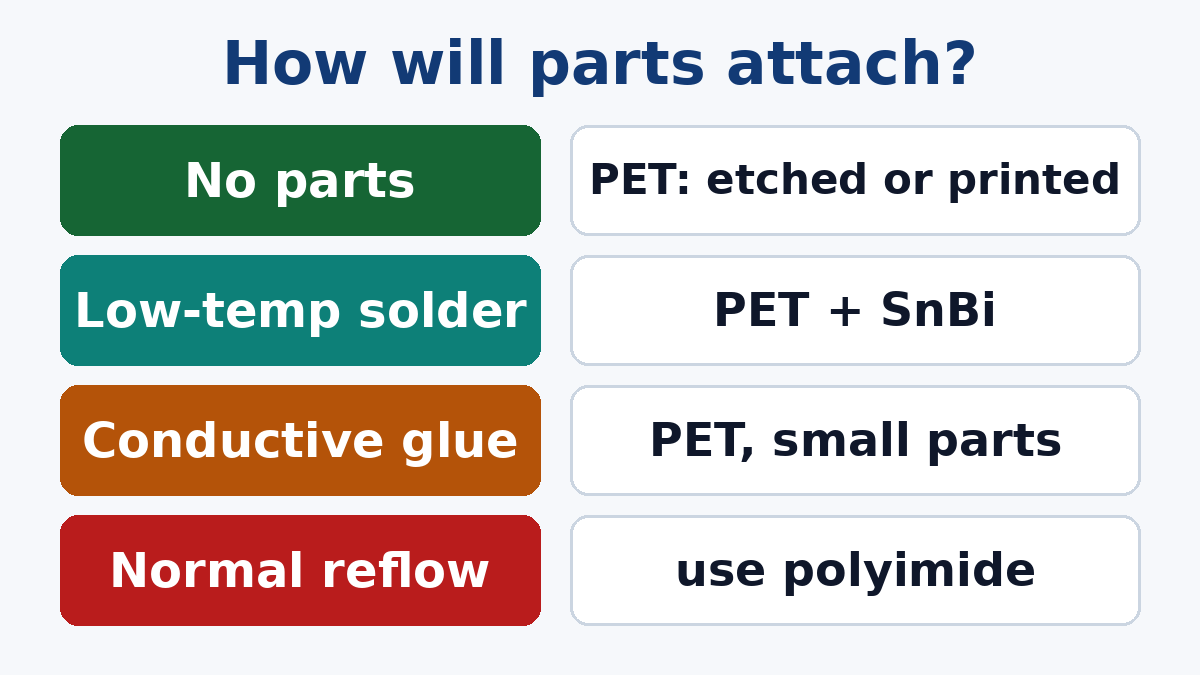
Option 1: No components on the flex
Many PET circuits carry no parts. A membrane switch, a heater pattern, a sensor electrode or a simple jumper between two boards may only need conductors and a termination.
For these, PET is often the right answer, and the remaining decisions are about the conductor and the termination:
- Etched copper on PET gives low resistance, fine features and good current capacity. It is the construction a flex circuit factory builds.
- Printed silver or carbon on PET is the membrane switch and printed electronics route. It is cheaper for simple patterns and large areas, but has much higher resistance and coarser features. It is usually made by printing specialists rather than flex circuit factories.
- Etched aluminium on PET is common for RFID antennas made in very high volume.
Terminations are typically ZIF/FFC connector tails with a stiffener, crimped contacts, or a heat-seal or anisotropic conductive film bond to another board or display.
Option 2: Low-temperature solder
When parts must be soldered to the PET circuit, low-melting-point alloys such as tin-bismuth based pastes allow reflow at much lower temperatures than standard lead-free solder. This is the most common way to put LEDs, resistors and small ICs onto PET.
Points to settle before committing:
- Confirm the PET grade's temperature limit with the material data and the fabricator, and leave margin for the oven's temperature spread across the panel.
- Check every component. All parts must tolerate the low-temperature profile, which is easy, but they must also be compatible with the alloy and the pad finish.
- Consider joint properties. Bismuth-containing joints behave differently from standard lead-free joints, particularly under mechanical shock and in thermal cycling. For a product that is dropped or flexed near the joints, test this.
- Plan support. Thin PET needs a carrier or fixture to stay flat through printing, placement and reflow.
- Avoid hand rework with a normal iron temperature. Rework must also stay within PET's limits.
Option 3: Conductive adhesive
Isotropic conductive adhesives can attach components with a cure temperature far below soldering temperatures. They suit printed silver circuits especially, since printed silver does not take solder well. Adhesive joints are generally weaker mechanically and have higher resistance than solder joints, so they suit small, light parts and low-current circuits. Anisotropic conductive film is the standard way to bond fine-pitch PET tails to displays and glass.
Option 4: Use polyimide where the parts are
If a product needs standard reflow, many components, fine-pitch ICs or rework, the answer is often to keep components off the PET entirely. A small rigid board or a polyimide flex carries the components, and the PET circuit connects to it through a connector or a bonded tail. The PET part stays cheap and the soldered part uses materials made for soldering.
If the whole circuit needs reflow, use polyimide flex. That is the default construction for a Flexible PCB that carries components.
The middle option: PEN
Polyethylene naphthalate (PEN) is another polyester film with higher temperature resistance and better dimensional stability than PET, at a cost between PET and polyimide. It is used for some flexible circuits and printed electronics where PET is borderline. It still does not tolerate standard lead-free reflow the way polyimide does, so treat it as an improvement for low-temperature processes rather than a polyimide substitute.
Other properties worth checking
Bending. PET handles static bends and installation folds well. For repeated dynamic bending, polyimide with rolled-annealed copper is the more reliable combination.
Transparency. Clear PET is a real advantage for transparent lighting and visible circuits, but the finished appearance depends on the adhesive, coverlay and copper density, not only on the base film. If appearance matters, ask for a sample of the complete construction.
Dimensional stability. PET can shrink when heated in processing, which affects registration between layers and between the circuit and its coverlay or stiffener. Heat-stabilised film and process control help; very fine features on large PET circuits need care.
Environment. PET has good moisture resistance, but its temperature ceiling in service is lower than polyimide's. Check the product's maximum operating temperature, including heat from LEDs or nearby electronics.
Choosing the right supplier type
Because of these differences, PET circuits are made by several kinds of factory. Polyimide flex circuit factories etch copper and handle fine features, multilayer constructions and standard SMT. Membrane switch and printed electronics specialists print silver and carbon on PET, and are often the economical route for simple printed patterns. Some flex factories also build copper-on-PET circuits; ask specifically, rather than assuming that a flex shop runs PET.
What to put in a PET flex RFQ
- Base film: PET (or PEN), thickness, clear or not, heat-stabilised if required
- Conductor: etched copper (weight) or printed silver/carbon
- Coverlay or insulating print, and its transparency
- Attachment method: none, low-temperature solder (alloy), conductive adhesive, connector or bonded tail
- Maximum process temperature you expect the circuit to see
- Bending: static install or repeated, with radius
- Stiffeners and connector tail dimensions
- Appearance requirements, if the circuit is visible
If you are deciding between PET and polyimide for a new flexible circuit, send us the outline, the parts that need to go on it and how it will be used. Our engineers will suggest the construction and assembly method, and tell you honestly when a printed-circuit specialist would be a better fit than a flex factory.