
When a customer asks us how to speed up their PCB assembly, they usually expect an answer about the factory: more shifts, faster placement machines, a quicker reflow profile. Those things exist, but on most orders they are not where the time goes. A typical board spends far longer waiting than it does on the line. It waits for an answer to an engineering question, for the last component on the BOM, for a decision about an alternate part, for a first-article approval, or for a test fixture that nobody ordered.
The useful consequence is that a large share of the cycle time is under the buyer's control. This article goes through the order from the factory's side, shows where the waiting usually happens, and lists the levers you can pull before and during the order. It assumes you already send a complete data package; that subject has its own article, so here the focus is on decisions and timing rather than file formats.
Where the days actually go
If you followed a typical turnkey order through our factory, the hands-on work would look something like this: CAM and DFM review, bare board fabrication, component purchasing, kitting, stencil, SMT, any through-hole or secondary operations, inspection, test and packing. Several of those run in parallel. The board fabrication and the component purchasing, for example, normally happen at the same time.
The delays sit between the steps:
- Engineering questions. A footprint does not match the part, a polarity mark is ambiguous, the BOM and placement file disagree. Work on that item stops until someone answers.
- Component availability. One part on a long BOM is out of stock or has a long factory lead time, and the whole build waits for it.
- Alternate approval. The purchasing team finds a substitute, but the customer needs to approve it, and the approval takes days.
- Consigned material. Parts supplied by the customer arrive late, short, or in packaging that cannot go on a feeder.
- First-article hold. The first boards are built, then the line waits for the customer to approve them before continuing.
- Test. A functional test fixture or test program is needed, but its design starts only when the boards are already built.
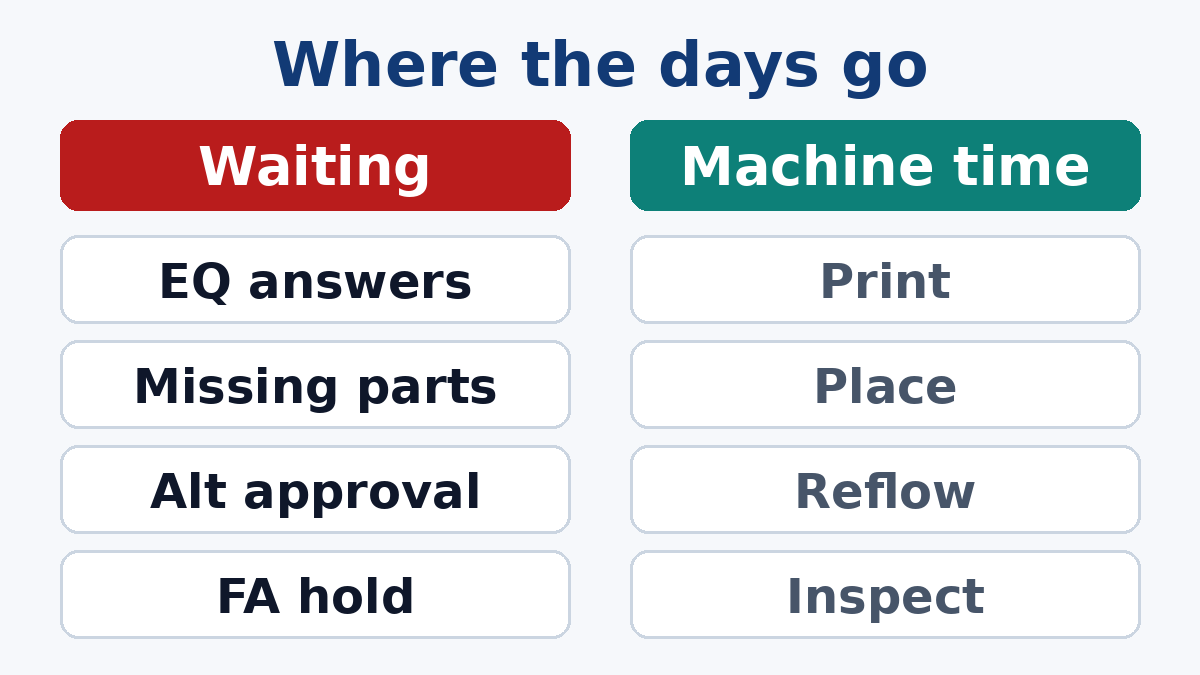
None of these is a machine problem, and none of them is solved by asking the factory to "expedite". They are solved by decisions made earlier.
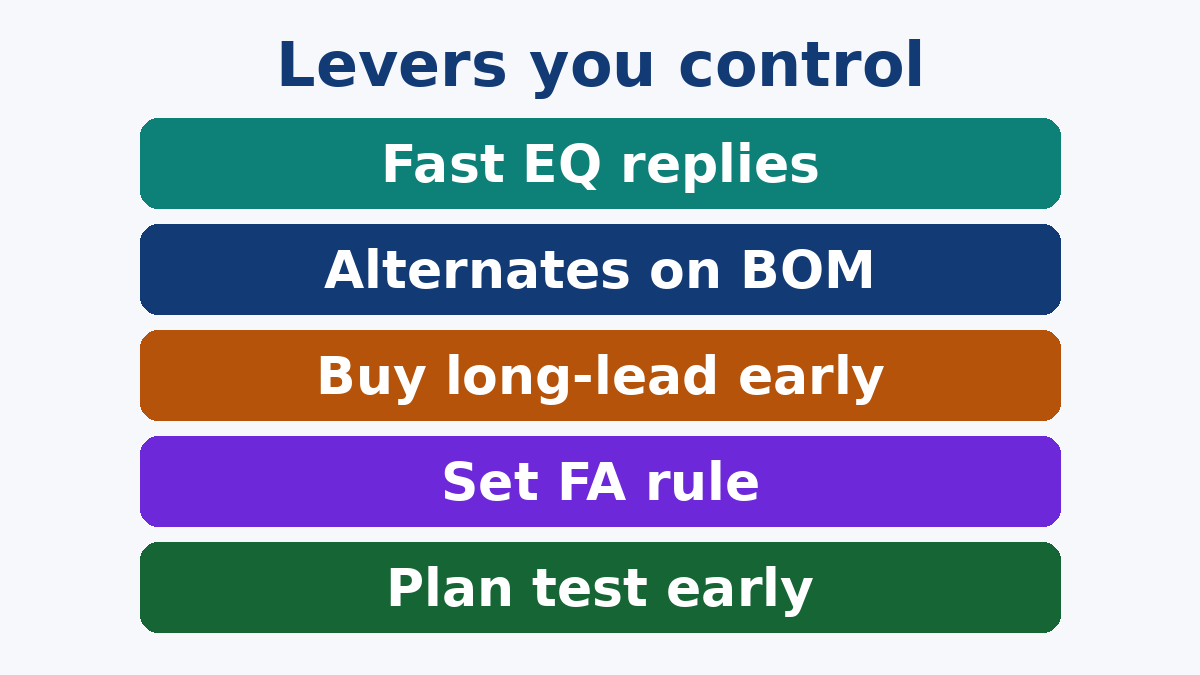
Lever 1: Answer engineering questions in hours, not days
Every order with a non-trivial board will produce some engineering questions. The number matters less than how quickly they are closed. Practical habits that help:
- Name one technical contact who can answer for both the board and the BOM, and a backup for holidays and travel.
- Allow for the time difference. A question sent at the end of our day that is answered at the start of yours costs nothing if the answer comes back before our next morning.
- Answer all open questions in one reply, and say explicitly when a decision is "use your judgment".
- For repeat orders, keep a record of previous answers so the same questions are not asked twice.
Lever 2: Put approved alternates on the BOM before the order
The largest single source of waiting on turnkey orders is part availability. A BOM that names only one manufacturer part number for a common resistor or capacitor turns a routine substitution into an approval loop.
Mark which lines may be substituted with an equivalent part (same value, package, tolerance, voltage and temperature rating, and dielectric for capacitors), and list approved alternates for the lines that matter: regulators, crystals, connectors, anything with a footprint or performance dependency. Lines that genuinely must not be substituted should say so. Our Component Sourcing team can then buy the whole BOM in one pass instead of stopping at the first shortage.
Lever 3: Release long-lead parts before the design is final
Some components have factory lead times far longer than the rest of the build: certain processors, FPGAs, power modules, custom magnetics, specialised connectors. If the design is close enough to final that those parts will not change, buy them, or authorise the factory to buy them, before the rest of the order is released. The board layout can still be refined; the long-lead part is already on its way.
The same applies to production: for parts that are hard to buy, a buffer of stock held against a forecast does more for delivery reliability than any expedite request.
Lever 4: Let fabrication and purchasing run in parallel
With turnkey PCB assembly, board fabrication and component purchasing start at the same time, and kitting is finished when the boards arrive. When boards and parts come from different sources, the build can only start when the slowest of them arrives, and someone has to coordinate. If you consign some material, send it early, labelled, counted, and in packaging that suits automatic placement: reels, cut tape with leaders, or trays, rather than loose parts in bags.
Lever 5: Decide the first-article rule up front
For a new design, a first-article check makes sense: build a few boards, inspect them, confirm polarity and placement, then continue. What costs time is an undefined approval step. Before the order, decide:
- Whether the factory may continue after its own first-article inspection, or must wait for your approval.
- What you need to see to approve: photos, an inspection report, X-ray images of specific parts, or physical boards.
- Who approves, and how quickly they can respond.
For repeat orders of a stable design, a customer first-article hold is often unnecessary; the factory's own first-article inspection covers it.
Lever 6: Plan test with the design, not after it
If the product needs functional testing, the fixture and test software can take longer than the assembly. Agree test points and the test method during layout, send the test specification with the order, and supply the firmware and any test equipment early. If a functional test is not ready, decide whether boards should ship after electrical and visual inspection only, with functional testing done at your end, rather than letting finished boards wait.
Lever 7: Simplify the build where it does not cost the product anything
Some design choices add process steps that each take time:
- Components on both sides mean two reflow passes; placing everything on one side, where the layout allows, removes one.
- Each through-hole part adds an insertion and soldering step after SMT.
- Unusual parts that cannot go on standard feeders need manual handling or special nozzles.
- Conformal coating, potting, press-fit connectors and box build each add a separate operation.
These are all legitimate when the product needs them. When it does not, removing them shortens every future order.
Lever 8: Have the shipping details ready
A finished order can still sit waiting for shipping instructions, a commercial invoice description, an import classification or a courier account. Settle these when you place the order, especially for the first shipment to a new destination.
What not to do
A few common attempts to speed up assembly tend to have the opposite effect:
- Skipping the DFM review to save a day usually costs more when a problem appears on the line.
- Changing the design during the build. Even a small change resets purchasing, stencil and programming for the affected parts.
- Splitting an order across suppliers at the last minute to chase a faster date often introduces coordination delays and revision mismatches.
- Paying for an expedited board when the critical path is a component. Check what is actually holding the order first.
A short checklist before you release an order
- One technical contact named, with a backup
- BOM marked with substitution rules and approved alternates
- Long-lead parts identified and, where possible, already ordered
- Consigned parts scheduled, counted and in placement-ready packaging
- First-article rule and approver agreed
- Test method and fixture plan settled
- Shipping and import information ready
If you send us an upcoming order, our engineers and purchasing team will tell you which items are on the critical path and which of these levers would shorten it the most.