
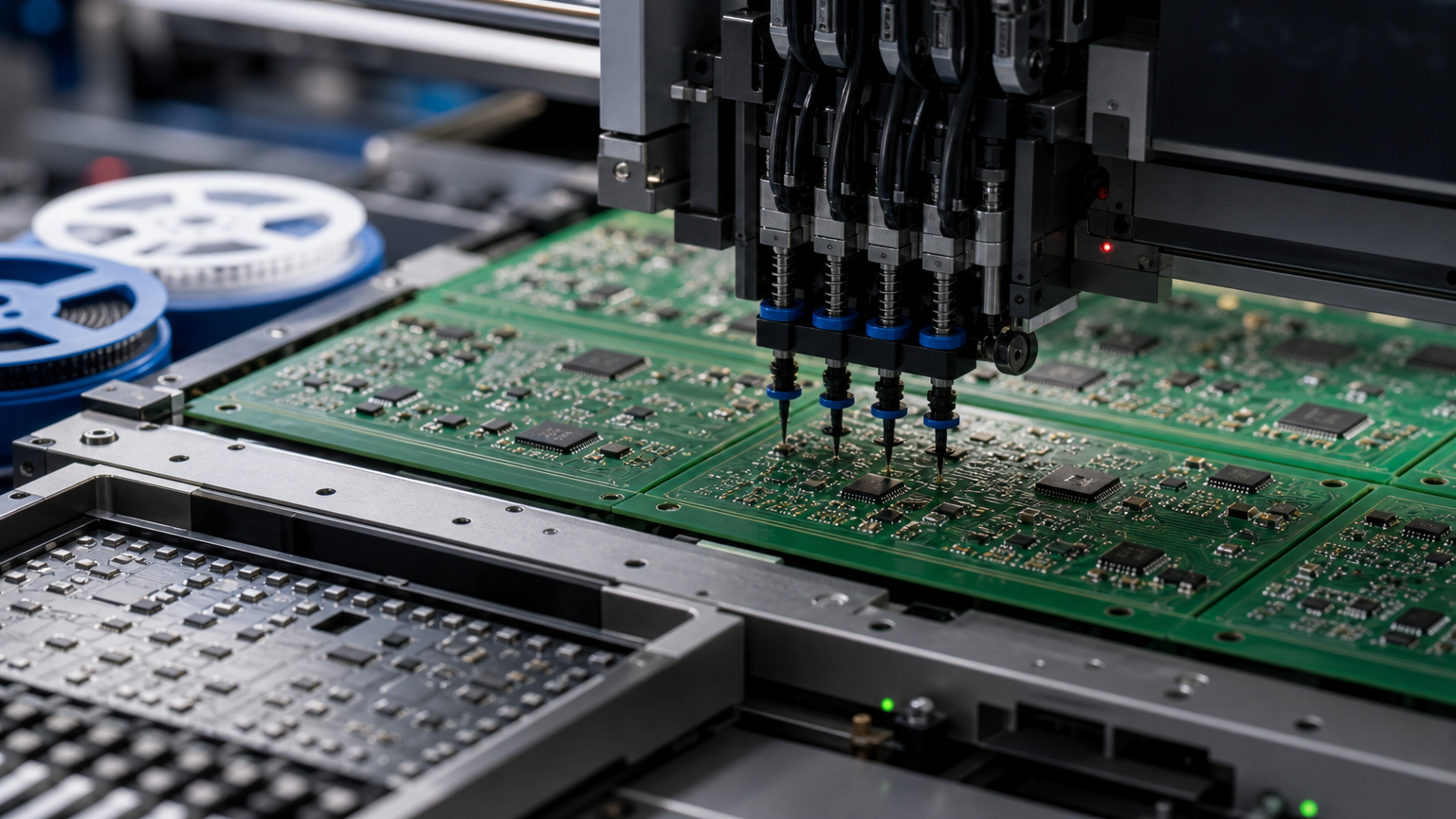
BOM reviews that list only "10 uH inductor" without Isat, DCR, package height, and shielded vs open construction are asking the assembler to guess. SMD inductors (surface-mount inductors) provide inductance for filtering, energy storage, choking, decoupling, and tuning while soldering to pads on SMT lines.
They replaced many through-hole chokes because pick-and-place throughput and low profiles win on modern PCBA. Miniaturization is harder than for chip resistors: inductance needs magnetic path volume, so physics pushes back when height shrinks.
Functions you are actually buying
Choking high-frequency noise on power rails, LC filtering with capacitors, decoupling isolation between domains, resonant tuning in RF blocks, and occasional delay or compensation networks. The same henry value can fail if SRF sits in the wrong place or saturation collapses inductance under load.
Families you will see on reels
Wirewound SMT inductors wind copper on ceramic or ferrite cores and generally deliver higher Q and higher inductance for a given size, with more leakage unless shielded. Multilayer chip inductors sinter spiral paste inside ferrite for compact, lower-leakage parts with typically lower Q. Film or specialty constructions appear in niche RF values.
Drum, molded, and shielded power inductors serve DC-DC stages where Isat and thermal rise dominate selection.
Datasheet fields that prevent field failures
L at stated frequency and bias, tolerance, DCR, Irms, Isat, SRF, Q where relevant, and recommended land pattern. Temperature rise curves matter for enclosed products. Automotive grades need explicit callouts. Very small values (sub-nH RF parts) make PCB parasitics part of the inductor - layout length can dwarf the component.
Testing on the bench
A normal multimeter checks continuity-ish behavior: opens look infinite; many power inductors look nearly short on resistance mode. That does not measure henries. Use an LCR meter or impedance analyzer for L, Q, and SRF. Incoming inspection should compare against a golden sample when counterfeit risk exists.
SMT notes for yield
Follow land patterns to limit tombstoning. Mind polarity marks only when the body is polarized (most two-terminal inductors are not). Keep magnetically sensitive traces and overlapping inductors in mind for unshielded parts. Reflow profiles must respect moisture sensitivity if the datasheet rates it.
For multilayer-focused selection see multilayer chip inductor guide. Put full inductor MPNs and alternates in the package when you place an order.