
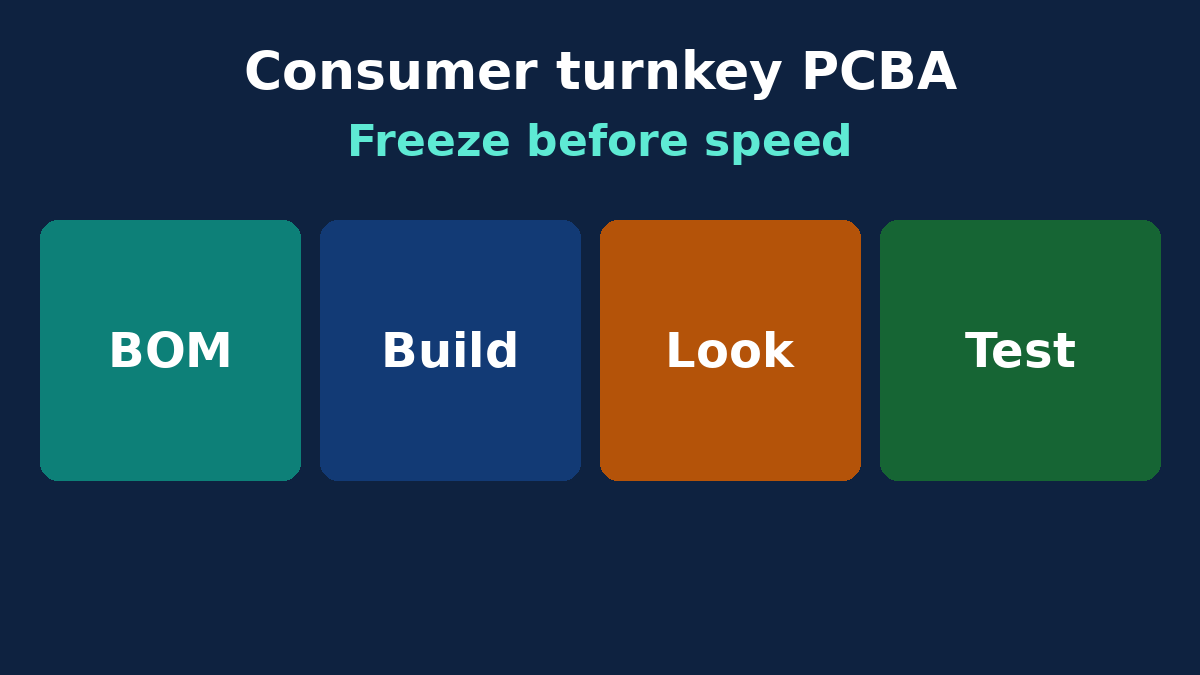
“Who is the quickest turnkey PCB manufacturer for consumer electronics?” is the wrong first question. A turnkey PCBA schedule is only as real as the inputs that are frozen. For a consumer product—short life, frequent ECOs, cosmetic class that buyers notice, and a volume ramp that is still a wish—those inputs are not a slogan. They are four written gates. Until they exist, every calendar promise is a guess about work that has not been defined.
This is a factory view for overseas buyers and engineers who already expect fab, parts and assembly under one traveler. It is not a ranking of factories, not a lead-time table, and not a redesign offer dressed up as manufacturing.
What “turnkey” means here
On a China line, turnkey usually means the factory buys the AVL parts (or agreed alternates), builds the bare board, assembles, and runs the tests you named. It does not mean free layout redesign, enclosure tooling, app firmware, or a marketing sample program. Those are separate scopes. If the RFQ asks for “full design-to-delivery” without saying which of those scopes are in, the quote and the calendar will diverge as soon as the first EQ lands.
Our Turnkey PCB Assembly page is the service boundary for that model. The rest of this post is what has to be locked before that boundary can carry a consumer schedule.
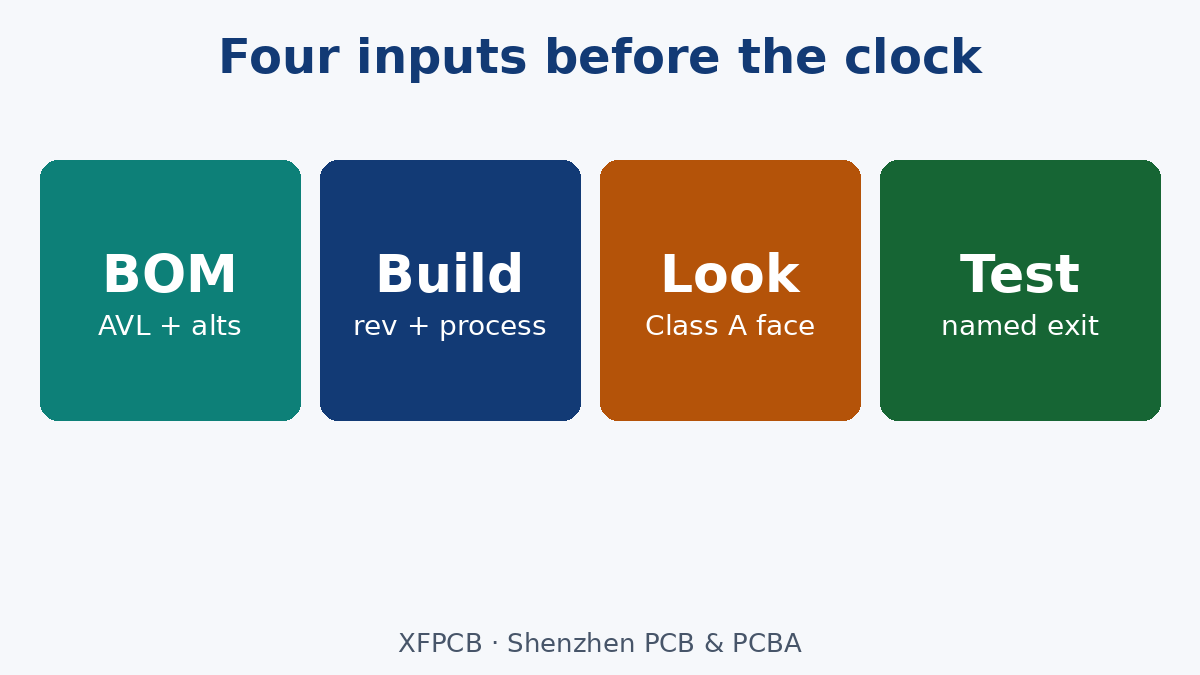
Gate 1: BOM risk, not only MPN rows
Consumer BOMs age in months, not years. A part that is “active” on a distributor page can still be allocation-only, last-time-buy, or about to change package. Turnkey speed dies when the factory discovers that on day three of purchasing.
Freeze, in writing:
- The AVL: manufacturer and MPN, not a vague description.
- Allowed alternates, with the same form factor and the same electrical envelope the design actually needs.
- Which lines are do-not-substitute (crystal, RF front-end, safety-rated parts, regulated radio modules).
- Who owns the buy when a line is NCNR or allocated: you consign those, or the factory waits for your written release.
Our Component Sourcing page is the purchasing side of that gate. A turnkey clock that starts before alternates are named is a purchasing clock, not an assembly clock.
Gate 2: Build level on the traveler
Consumer programs jump from a bench board to a “pilot” without saying which stack, which finish, which stencil, and which assembly revision the factory is allowed to copy. EVT, DVT and a production intent build are different travelers even when the schematic looks the same.
Write the build level on the PO and the assembly drawing: revision of Gerbers and BOM, surface finish, solder process (lead-free or not), single-sided or double-sided reflow, and whether selective or wave THT is in scope. If this spin is only allowed to prove fit or one net, say that. Do not ask the line to treat a soft prototype package as if it were the mass-production panel.
Gate 3: Cosmetics the buyer will reject
Consumer housings show the board edge, the silkscreen, and the connectors. A Class 2 electrical pass still fails a brand audit if flux haze, scratch, or uneven legend is visible through a window. Cosmetics are not “be careful.” They are acceptance criteria: which surfaces are Class A (visible), which are hidden, and whether a photo standard or a limit sample exists.
If you do not define that, the factory will ship to IPC workmanship for the class on the drawing, and your marketing sample team will still reject the lot. That rejection is schedule, not quality theatre.
Gate 4: Outgoing test named, not implied
“Tested” without a list is not a gate. For consumer turnkey, name what leaving the factory means: bare-board electrical test already done, ICT or flying probe on which nets, firmware load or not, functional fixture yes/no, and what happens to a fail (rework allowed, or quarantine). Hidden BGA joints need a stated X-ray or sample plan if you care about them; continuity alone will not see them.
A schedule that assumes “we will figure out test on the line” is a schedule that stops when the first fail has no disposition.
What consumer products add on top of generic turnkey
Consumer Electronics boards often combine dense SMT, a few connectors that take abuse, and a cost target that fights every extra process. That combination does not make a factory “faster.” It makes incomplete freezes more expensive:
- Volume intent without a panel and tooling plan is not a volume quote.
- A last-minute enclosure change that moves connectors is an ECO, not a small tweak.
- A retail date that was never mapped to fab + buy + assemble + ship calendar is a press release, not a manufacturing plan.
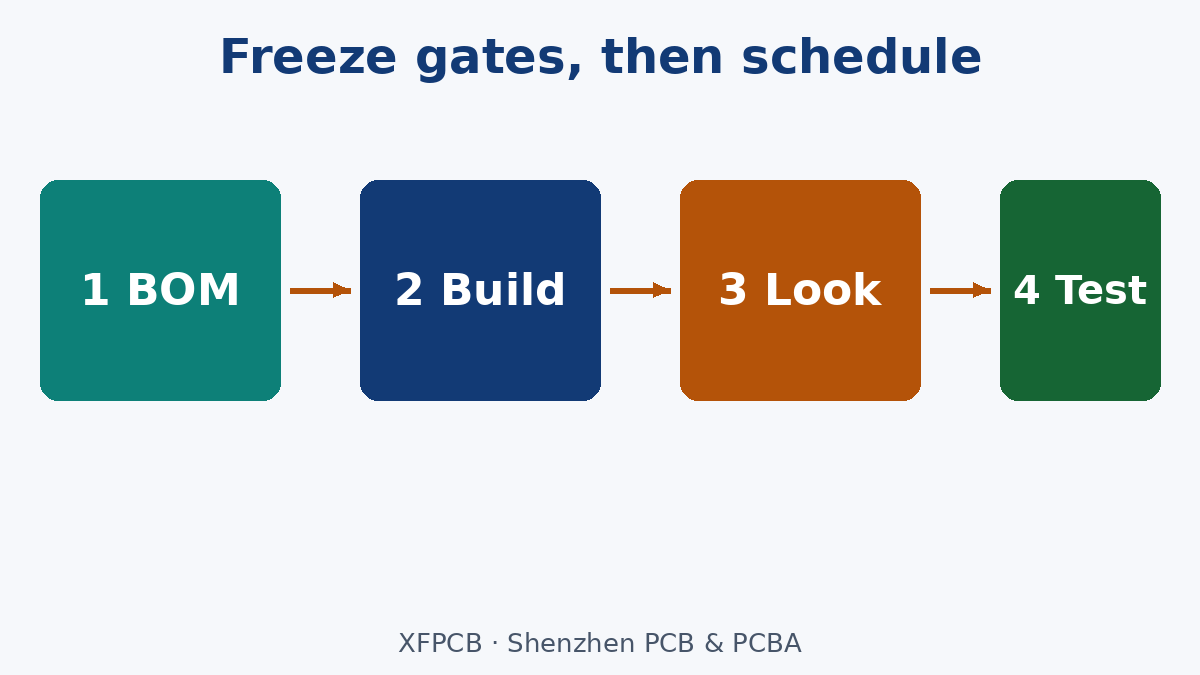
None of those are solved by asking who is quickest. They are solved by freezing the four gates above, then asking for a schedule against that package.
What this post is not claiming
No factory lead times, no “fastest” ranking, no invented cost deltas, and no claim that one certificate makes a consumer line immune to BOM risk. Certifications and in-house equipment matter; they do not replace a frozen AVL or a written test list. Design-house services, if you need them, are a separate SOW—do not bury them inside a turnkey PCBA RFQ and expect the calendar to absorb the ambiguity.
When the four inputs are written, the remaining levers are ordinary: EQ response time, long-lead buys started early, fab and kitting in parallel, and a clear approval owner. Those levers only move a defined job. For consumer electronics turnkey PCBA, definition is the first schedule decision.