
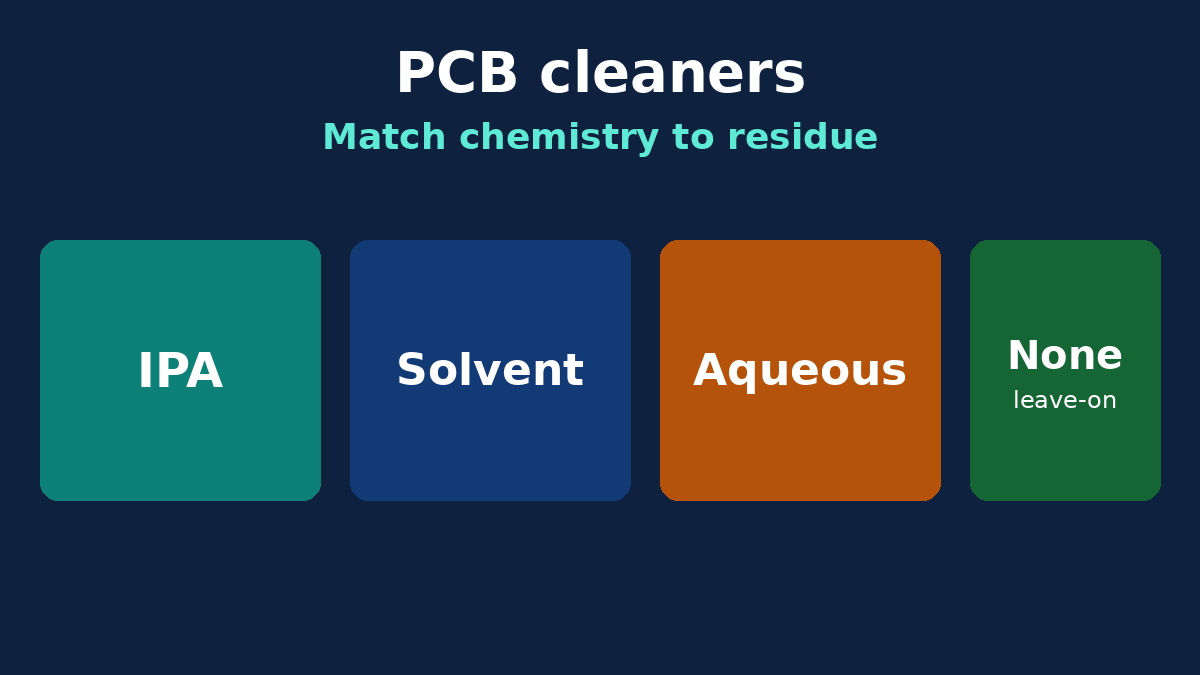
“What is the best PCB cleaner?” is a bench question. On a production traveler the useful question is different: what residue is allowed to remain, what chemistry removes what you will not allow, and what drying must prove before bias is applied.
This post is that chemistry match for overseas buyers and engineers. It keeps the useful facts from cleaner handbooks—IPA grade, purpose-made flux removers, aqueous saponifiers, contact cleaners—and drops DIY myths, invented cleanliness numbers, and brand pitches. Ionic contamination limits and wash-process evidence belong in a sibling post; here the decision is which cleaner family belongs on the note.
Start from the flux and the reliability ask
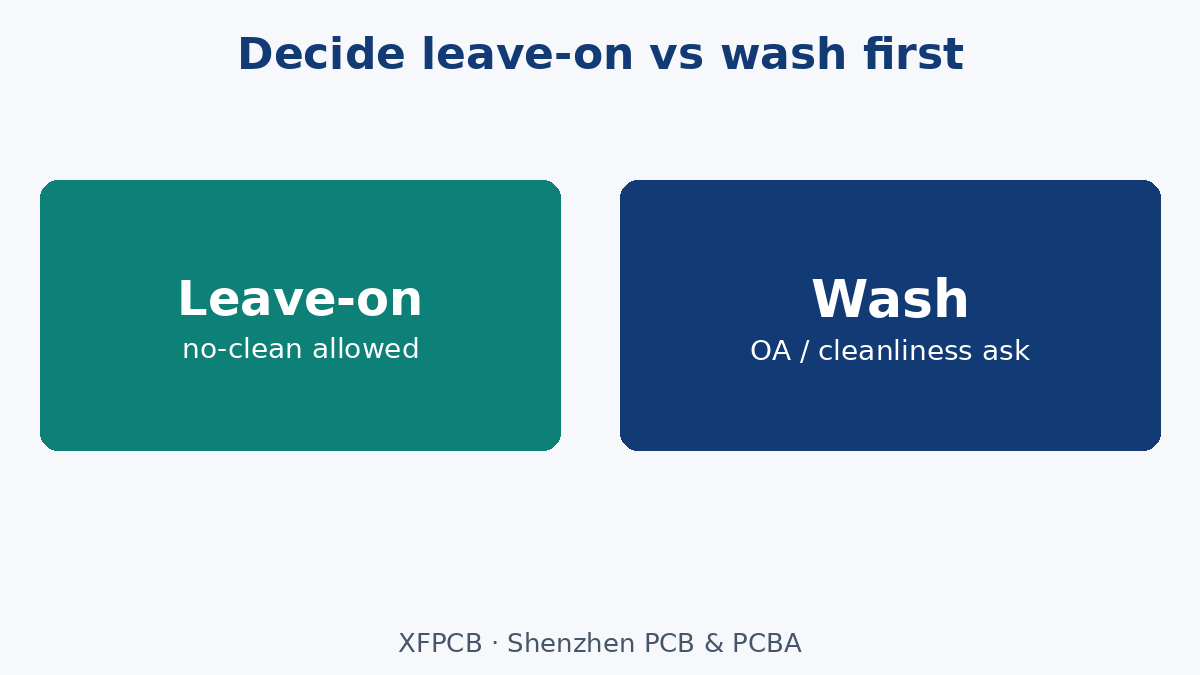
No-clean flux is formulated so a controlled residue can stay on a board that will see its intended environment. Water-soluble (OA) flux is formulated to be washed. Rosin systems may need solvent or saponifier depending on the grade and the residue class you accept.
If the assembly drawing says no-clean and Class 2 consumer indoor, aggressive washing is often the wrong “improvement.” If the product sees high humidity, fine pitch underfill keep-outs, or a cleanliness requirement tied to coating adhesion, leave-on residue may be the wrong choice even when the paste was labeled no-clean. Write the requirement. Then pick chemistry.
Our Lead-Free Assembly page is the solder-process family; cleaning is a line after that process, not a substitute for naming the flux.
IPA: grade is about water and dry-down, not magic
Isopropyl alcohol is the common rework and spot cleaner. Concentration changes water content and dry time:
- Higher purity IPA (often specified around 99%) flashes off faster and leaves less water behind—useful for precision rework when the soil is flux and oil that alcohol will dissolve.
- Mid grades (often ~91%) still work for many flux soils and dry a little slower.
- ~70% IPA carries more water. It can help some polar soils and is a poor default under BGAs and connectors where trapped moisture is the risk.
IPA is not a universal defluxer for every modern no-clean or for heavy white residue after lead-free. If alcohol alone leaves a film, the chemistry is wrong—not the brush technique.
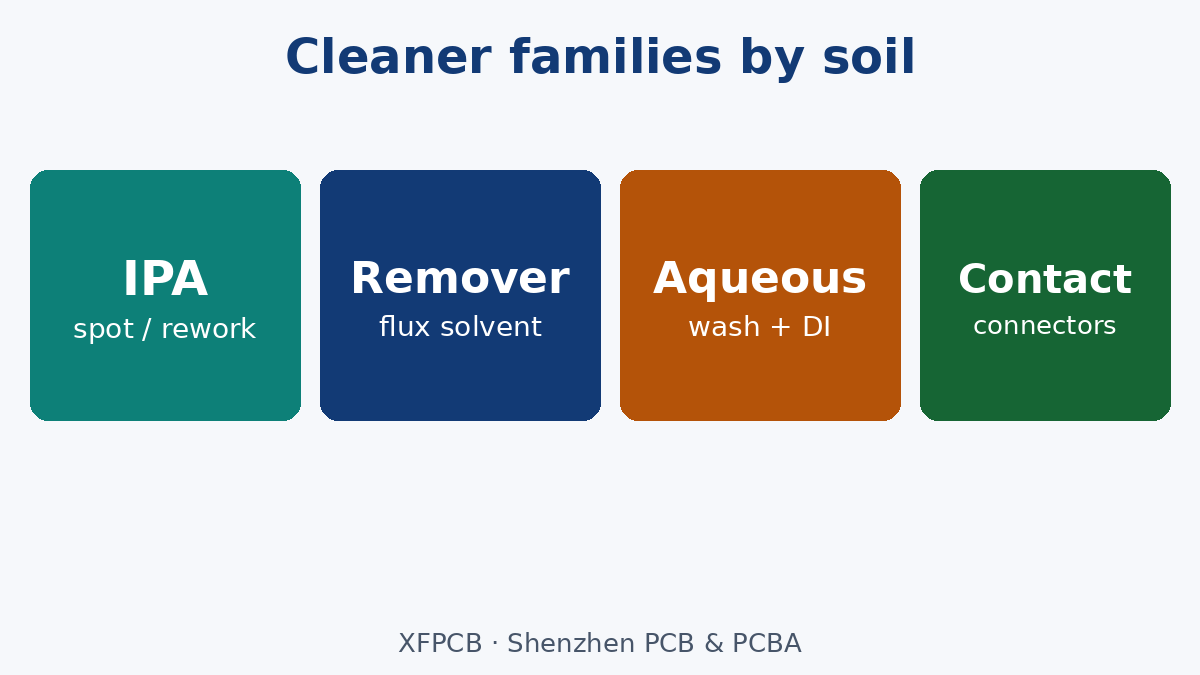
Flux removers and engineered solvents
Purpose-made flux removers and electronic solvent sprays are built for rosin and many synthetic residues. They belong on rework benches and, in some lines, in controlled solvent wash. Use them when IPA fails and when the component set and plastics are compatible with the solvent family on the SDS. Spray so dissolved soil runs off while wet; letting dirty solvent dry in place re-deposits residue.
Aqueous saponifier and deionized rinse
Water-based cleaners with saponifiers suit water-soluble flux and many high-volume wash lines. They need deionized rinse and a drying process that reaches under low-standoff parts. Flammability is lower than many solvents; trapped water is the failure mode. Bare boards before assembly are a different traveler from assembled wash—do not assume the same recipe.
Ultrasonic energy can drive fluid under parts and can also damage some components. Treat ultrasonics as a process qualification, not a default tip from a handbook.
Contact cleaners are not board wash
Contact cleaners target switches, connectors and oxidation on mating surfaces. They are not the wash recipe for a fully populated SMT board. Keep them off plastics and coatings the SDS does not allow.
Choose by soil, then by process seat
| Soil / situation | Chemistry family | Process seat |
|---|---|---|
| Light flux after hand solder | High-purity IPA or flux remover | Bench rework |
| Heavy flux / white residue | Engineered flux remover or qualified wash | Rework or wash line |
| Water-soluble flux process | Aqueous saponifier + DI rinse + dry | In-line or batch wash |
| Dust / fingerprints | Air + IPA wipe | Handling |
| Connector oxidation | Contact cleaner | Connector only |
| No-clean, residue allowed | None (or spot only) | Leave-on |
Our SMT PCB Assembly traveler should state whether the job is leave-on no-clean or washed. Silence becomes tribal knowledge on the line.
Drying and power-up without folklore
Whatever chemistry you use, boards need to be dry where moisture can hide before electrical bias. That is a process time and method (air knife, oven profile, bake when the product requires it)—not a fixed “24 hours” borrowed from a blog. ESD-safe brushes and grounded operators matter on populated boards; a metal jaw or ungrounded iron is a different hazard.
What we are not claiming
No “best cleaner” ranking, no invented ionic limits, no claim that 99% IPA replaces a wash line, and no claim that XFPCB’s wash capability is universal for every flux. Match chemistry to residue and to the reliability ask on the drawing. Put that match on the traveler so rework and production are not two different chemistries by accident.