
On a multilayer stack drawing, a dielectric gap is a height you want after press—not a shopping list of glass styles. The fab meets that height with core dielectric, prepreg plies, or both. For prepreg fill, the practical fork is one sheet versus several sheets of a given style (and resin content). Same target mils can be built more than one way; cost, thickness tolerance and impedance all move.
This post is that fork for overseas buyers and engineers. Resin-fill and pressed-thickness callouts in general are covered in the prepreg selection post. Laminate Dk/Df method comparison and low-Dk material gates are separate. Here: when one ply is enough, when multi-ply is forced, and what to write so CAM does not invent a construction.
Pressed thickness is the number that matters
Prepreg charts list pressed thickness after flow and cure, not the fluffy as-received sheet. Supplier tables differ. Always confirm the construction with the fab that will press your panel. Glass style (for example 1080 / 2116 / 7628 families—named only as illustrations of “style,” not as a stock promise) plus resin content plus sheet count set the height.
Impedance-controlled gaps care about that finished height and about Dk of the resin/glass mix at the frequency you stated. Changing sheet count without updating the impedance note is how coupons fail.
Single-sheet gaps
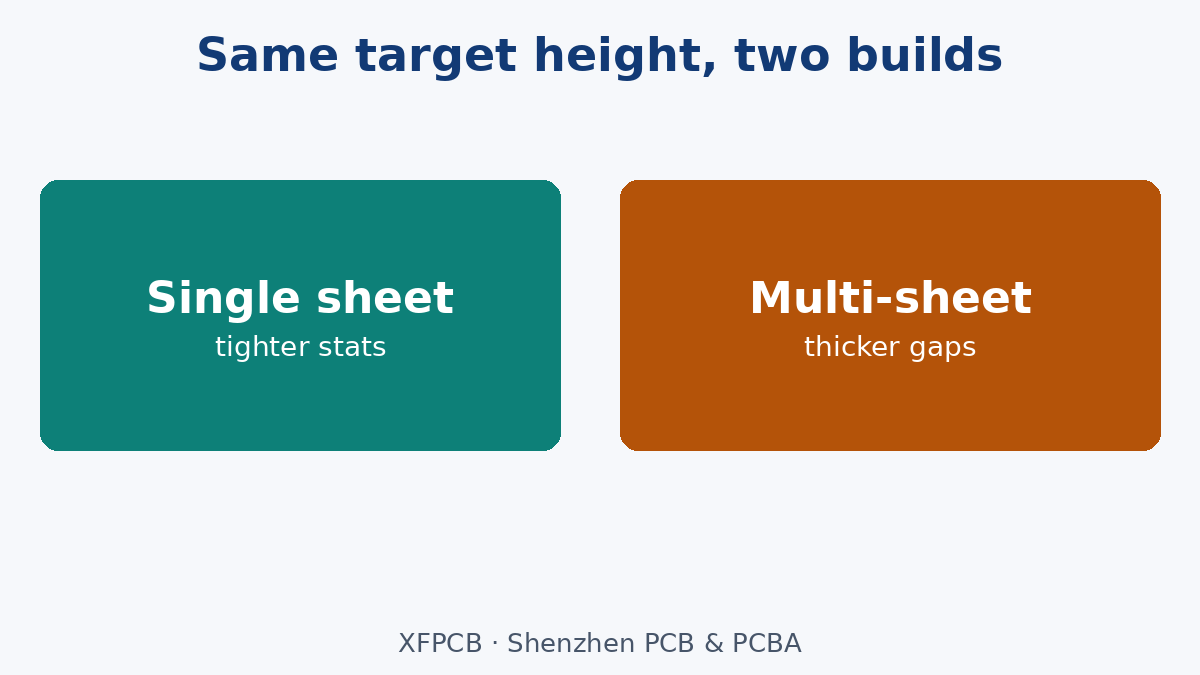
A single prepreg ply is often preferred when it can hit the target: fewer variables, typically tighter thickness statistics, and usually lower material cost for that gap. Very thin targets may force a single ultra-thin style because two plies would overshoot. Those thin styles need tighter process control and are not the default commodity fill.
Multi-sheet gaps
Thicker dielectric targets usually need more than one ply—one sheet cannot reach the height. Multi-ply stacks add tolerance (each sheet contributes variation) and cost. They also give the fab levers: mix styles or counts to land near the drawing while keeping resin fill into copper patterns.
Engineers sometimes multiply “pressed thickness × N.” That is a starting estimate only. Flow into copper, glass weave, and press cycle move the result. The fab’s qualified construction for your copper weight is the authority.
What the stack note must say
- Target dielectric between which copper layers (or core designation).
- Allowed constructions: single-ply style X, or multi-ply list, or “fab equivalent meeting H and Dk.”
- Impedance nets that depend on that gap.
- Whether hybrid resin systems are allowed.
Our Multilayer PCB Guide is the construction family. Our Impedance Control PCB page is the measurement seat when the gap is an impedance dielectric.
Cost without slogans
Single-ply is often cheaper for that gap when it qualifies. Multi-ply is not a defect—it is physics for thicker insulation. Do not force single-ply into a height it cannot make, and do not multi-ply a thin gap “for quality” without an electrical reason.
What we are not claiming
No universal inch/mm thickness bands as XFPCB defaults, no glass-style stock list, no invented tolerance ppm, and no rewrite of the prepreg resin-fill post. Name the gap, allow single or multi-sheet constructions that meet pressed height, and confirm with the pressing fab.