

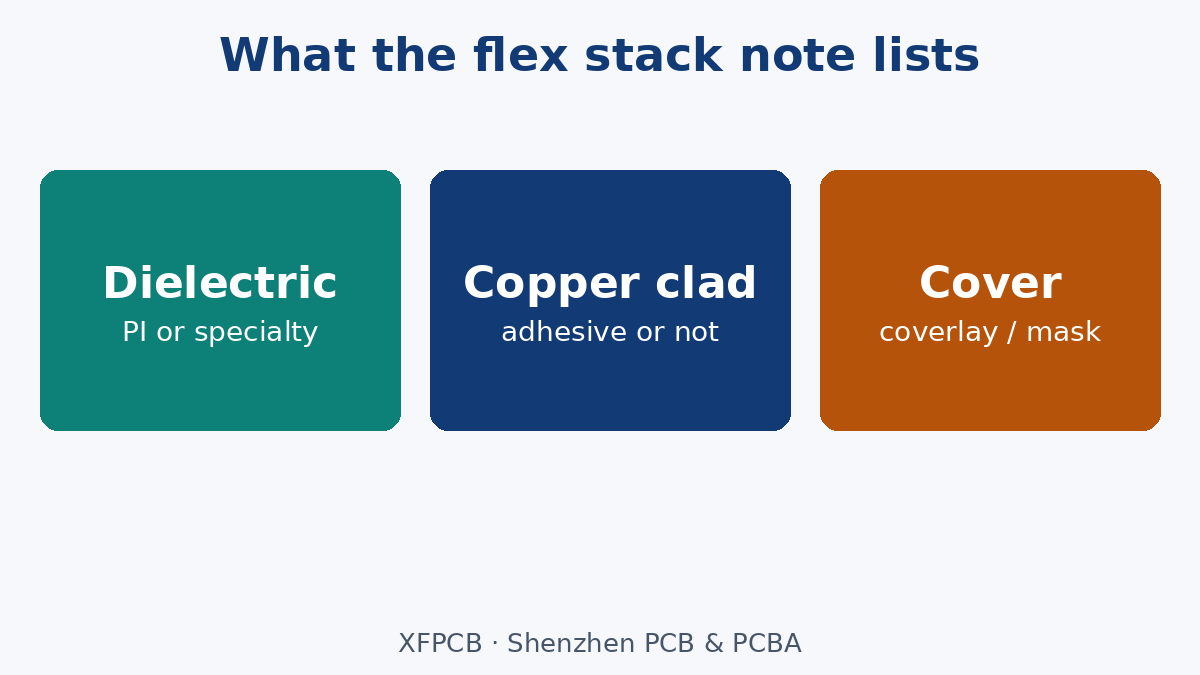
High-speed flexible circuits fail RFQs the same way rigid boards do: the loss and impedance conversation starts before the stack note names the dielectric, the copper construction and the cover. Flex adds bend and moisture to that list. The competitor pitch that jumps straight to a miracle film, or to 3D printing, skips what a China fab actually builds from.
This post is the materials callout for overseas buyers and engineers who need a flex (or rigid-flex) stack that can carry a controlled high-speed path. It keeps useful industry facts—polyimide versus lower-loss films, adhesiveless clads, coverlay versus flexible mask, copper type—and drops invented Dk tables and brand rankings.
What “high-speed flex” asks of the stack
A flex circuit that only has to fold once at install is not the same job as a dynamic flex, and neither is automatically a microwave laminate problem. High-speed here means the nets care about impedance continuity, loss and skew across the flex region—USB, SerDes, RF jumpers, camera and display links—not that every flex must leave polyimide.
Write the electrical ask on the drawing: which nets, target impedance family (single-ended or differential), and whether the flex zone is static bend or dynamic. Then the materials note can answer it. Our Flexible PCB page is the construction family; this post is what to name inside that family when speed is part of the ask.
Dielectric film: PI first, specialty films when justified
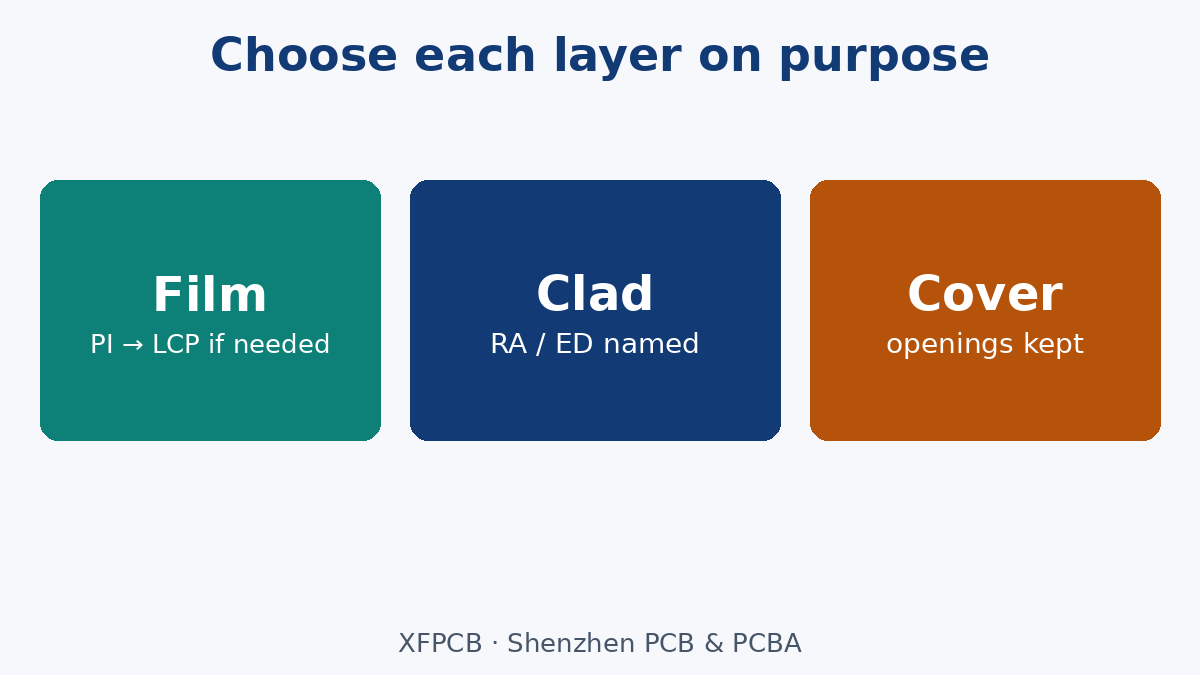
Polyimide (PI) film is still the default flex dielectric for most industrial and consumer builds: temperature range, availability, and a known fab traveler. Moisture absorption and dissipation factor are why PI can be the wrong film when the loss budget is tight and the path is long on flex. Liquid crystal polymer (LCP) and other low-loss flex films exist as a different materials family—lower moisture uptake and often lower loss tangent in the bands datasheets publish—but they are a process and supply change, not a drop-in rename of “PI.”
Do not put a single Dk or Df number in the RFQ without the frequency and the test method. Datasheet rows are not interchangeable across methods; that discipline belongs with laminate comparison practice, not a flex slogan.
If the high-speed path only lives on a short flex tail into a rigid section, a hybrid rigid-flex stack with the critical nets on the rigid laminate may be cheaper and more controllable than forcing the entire flex film to be exotic. Our Rigid-Flex PCB page is that construction split.
Copper clad: adhesiveless versus adhesive, and copper type
Many flex clads put a thin adhesive between copper and PI. That adhesive is part of the dielectric thickness and part of the loss. Adhesiveless (cast or sputtered then plated) constructions remove that layer and are often preferred when impedance and loss are tight, at the cost of a different materials callout and availability check.
Copper type matters on flex for both bend life and high-frequency loss. Rolled-annealed (RA) copper is the usual dynamic-flex choice for fatigue. Electrodeposited (ED) copper is common on static flex. Foil roughness affects skin-effect loss at GHz; if the loss budget is tight, the stack note should name the copper type and any roughness grade the laminate supplier publishes—not a vague “low loss copper.” Dynamic bend material selection is a sibling topic; do not copy a dynamic RA rule onto a static high-speed jumper without checking bend cycles.
Coverlay, flexible mask and bondply
Coverlay (PI film + adhesive, laser or drilled openings) is the usual solder-mask substitute on flex. Flexible liquid photoimageable mask exists for finer features in some travelers. Bondply joins flex layers or flex to rigid. Each adds thickness and adhesive that move impedance.
Design mistakes the fab sees repeatedly: coverlay openings that leave solder too close to a dynamic bend, stacked traces that stiffen the bend, and plating or etch steps that assume a rigid-mask process after the coverlay is already on. Opening accuracy is its own process limit—name which cover and which opening method you need.
For controlled impedance on the flex region, treat coverlay thickness and adhesive as stack inputs the same way prepreg height is on rigid. Our Impedance Control PCB page is the measurement and callout discipline; the flex stack must still list the dielectric and cover thicknesses the calculator assumed.
CTE, moisture and conductivity—without myth
Flex dielectrics and adhesives expand with heat and take up moisture. That moves dimensions and can move impedance after reflow and after humidity exposure. It does not mean flex is “unprotected” compared with multilayer rigid in every product—coverlay and stiffeners are the protection you specify. Thermal conductivity of the film is rarely the first lever for a signal flex; copper geometry and the heat path off the board still dominate for hot parts. Do not buy an exotic film to fix a missing copper pour.
What the factory needs on the note
- Dielectric film family and thickness (PI, LCP, or other—by supplier callout or equivalent rule).
- Adhesiveless or adhesive clad; copper type (RA/ED) and weight.
- Coverlay or flexible mask; bondply if multilayer flex.
- Which layers carry the controlled high-speed nets; bend keep-outs for those nets.
- Impedance targets and coupon expectation, if any.
What we are not claiming
No Dk/Df bake-off table, no claim that LCP is always best, no 3D-printed flex as a production substitute for a qualified clad and coverlay process, and no invented loss percentages. High-speed flex materials are a stack note. Name dielectric, copper and cover before the schedule or the loss budget can be honest.