
Industrial control boards fail in plants for reasons that never show up on a consumer Gerber checklist: continuous heat next to a VFD, vibration from a motor frame, conductive dust on uncoated traces, and EMI that resets an MCU that looked fine on the bench. Brochure “industrial PCB” pages often list standards, process steps, and a supplier pitch — then leave export buyers without a traveler that maps environment → material / stackup → IPC class → coating / copper / plating → China fab RFQ locks. This factory buyer guide owns that map. Soft CTA only. Sibling XFPCB lanes already own industrial MCU board PCBA RFQ depth and large-scale / volume manufacturing cadence — name those lanes in prose; do not clone them. Class 2 vs Class 3 and certified-supplier / AS9100 verify angles stay on their own pages as prose pointers. No competitor brands. No invented XFPCB certificates, turnaround days, dollar menus, or capability dashboards.
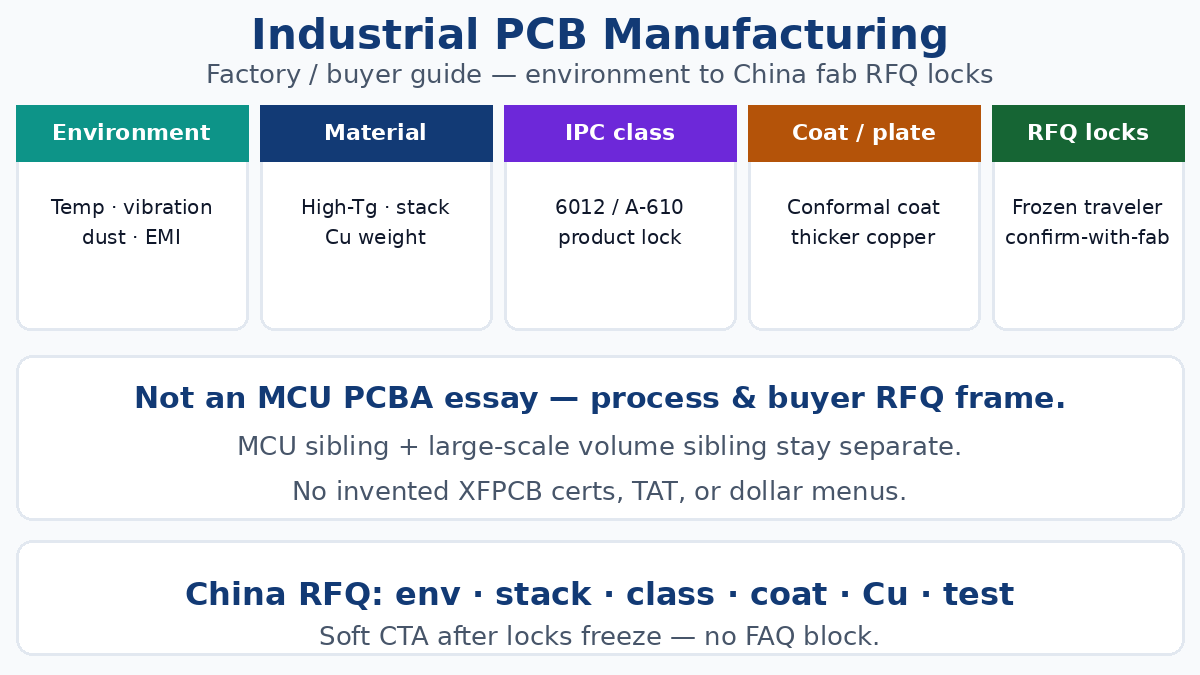
What “industrial” means on a fab traveler
“Industrial” is not a logo color. In CAM and procurement speech it means the board must keep working in a plant cabinet or machine enclosure under stress that consumer layouts never see. Typical environment drivers:
- Temperature — elevated ambient near drives and power stages; cold starts in outdoor cabinets; thermal cycling as equipment powers on and off for years.
- Vibration and shock — motors, conveyors, mobile equipment, and panel doors that slam. Solder joints, connectors, and tall components feel that first.
- Dust, moisture, and contamination — conductive dust, oil mist, condensation. Creepage shrinks when surfaces get dirty; conformal coat and spacing notes stop being optional cosmetics.
- EMI / electrical noise — VFDs, relays, welders, and long cable runs. Return paths, filtering, and sometimes isolation matter more than silkscreen polish.
- Duty cycle — often 24/7. A field fail is downtime and a truck roll, not a warranty SKU swap.
Consumer boards optimize cost and compactness. Industrial boards optimize durability, traceability, and a traveler that still matches the drawing after coating and soak. If your RFQ only says “industrial grade” with no environment fields, CAM will price a quiet commercial Class 2 habit — then argue when receiving expects something else.
This page is the bare-board manufacturing and buyer RFQ frame. The live industrial microcontroller board sibling owns MCU package ladders, 24 V entry, isolation, and FCT/program language for control-board PCBA. Keep those angles separate: process and materials here; MCU traveler there.
Environment → design locks (write these before CAM)
Do not start with a laminate brochure. Start with four environment lines on the RFQ, then let materials and class follow:
- Ambient and hotspot intent — max cabinet ambient, whether the board sits next to a power stage, and whether outdoor cold soak applies. That drives Tg, copper weight, and thermal vias — not a vague “high temp OK.”
- Mechanical — fixed panel vs moving equipment; expected vibration class if the OEM claims one. Tall electrolytics, connectors, and heavy magnetics need staking, underfill, or mechanical support notes on the assembly side; fab still needs copper and via strength that survive the same world.
- Contamination and coat — coated vs uncoated; wash vs no-clean before coat; connector and testpoint keep-outs. Dusty or humid plants without coat lean on creepage and mask quality harder.
- EMI neighbors — VFD / motor / relay adjacency. Impedance and stack notes matter when industrial Ethernet or other controlled nets ride the same board; filtering and return strategy matter even when SI is not the headline.
Buyer check: if those four are blank, “industrial PCB manufacturing” quotes are commercial travelers with thicker marketing adjectives. Fill environment first; then pick FR-4 Tg, copper, finish, class, and coat.
Materials and stackup choices that survive plants
High-Tg FR-4 is the default workhorse for many industrial controls: glass-transition ratings in the higher commercial band (often discussed around 170 °C-class laminates in buyer speech) resist delamination and warpage better under heat than low-Tg consumer cores. Extreme temperature or long thermal cycling may push polyimide or other specialty families — those are confirm-with-fab and confirm-with-OEM material calls, not invent-a-datasheet moments. Do not paste a plant-specific Tg table here; freeze the laminate family and Tg intent on the stackup note and let bidders confirm stock and process windows.
Copper weight follows current and heat. Signal-heavy logic can stay on 1 oz where DFM allows; power conversion, motor drives, and high-current distribution often need Heavy Copper PCB construction (2 oz and up, sometimes much thicker on power planes). Thicker copper changes etch compensation, minimum L/S, and drill/plate windows — name finished copper weights outer and inner separately. Thermal vias under hot pads help only when the stack and via fill policy are written; “add vias” without size and fill is folklore.
Layer count and reference planes matter for EMI and impedance. A Multilayer PCB Guide stack with solid returns often beats a two-layer power-and-signal mash when industrial Ethernet, USB, or other controlled pairs share the board with switching stages. Pair critical nets with an impedance-control process note and coupon expectation when the drawing cares — density and SI without stack reference is how fab quotes and lab measurements diverge. High-Tg notes belong on the stack when temperature margins are real; treat High Tg as a material intent field, not a marketing badge.
Surface finish follows shelf life, fine-pitch needs, and assembly cycles. ENIG is common when oxidation resistance and flat pads matter; HASL / lead-free HASL still appears on thicker copper or cost-driven builds. Match finish to package pitch and any press-fit — confirm with fab; do not invent thickness menus as XFPCB claims.
IPC class expectations (product lock, not plant badge)
IPC class is an acceptance level on the fab drawing, assembly drawing, and PO — not a certificate hanging in the lobby. Many China fab travelers default toward Class 2 process windows when the field is silent. Class 3 tightens workmanship and inspection depth when downtime or safety risk justifies it.
For bare board, cite IPC-6012 (and IPC-A-600 visual as needed) with an explicit class. For PCBA, cite IPC-A-610 separately. Mixing document families — writing “IPC Class 3” with no document number, or putting A-610 language on a fab-only PO — is how receiving fights start. Prefer Class 2 when failure is warranty cost and replaceability is real. Justify Class 3 when the plant cannot tolerate downtime, vibration and thermal life are harsh, or failure cost dwarfs board cost. Over-classing a mild HMI board buys scrap and calendar without buying the EMI or surge survival that actually mattered.
QMS stamps (ISO 9001, AS9100 where a program flows it) filter suppliers; they do not enlarge annular rings or invent Class 3 plating. Certified-supplier and AS9100 verify angles live on their own XFPCB buyer pages — prose pointers only. Here the rule is simple: put class on the product line; put certificates on the supplier line when the program requires them. This guide does not invent XFPCB AS9100, ITAR, or Class 3 plant certificates.
Conformal coating, thicker copper, and plating notes
Conformal coating is an industrial reliability tool, not a silkscreen color. Acrylic, urethane, silicone, and parylene-class options differ in rework, chemical resistance, and application method. Write coat type, keep-outs (connectors, testpoints, RF antennas, heatsink interfaces), and sequence versus programming or FCT when PCBA is in scope. Coat over dirty flux creates leakage and adhesion fails; wash / cleanliness intent belongs on the traveler when class and environment demand it. Uncoated boards in dusty cabinets need honest creepage and mask quality instead of hoping silkscreen “industrial” text helps.
Thicker copper and plating. Power paths need named finished copper; vias that carry current or see mechanical fatigue need plating thickness floors that match the class and drawing — confirm-with-fab numbers, not invented µm trophies. Filled and capped vias under heavy components or high-current pads are process lines, not CAM folklore. Outer plating and finish chemistry interact with coat adhesion and solderability after storage; state shelf-life and assembly window expectations when the OEM cares.
Mask and creepage. Industrial high-voltage or contaminated environments need spacing that survives dirt and humidity. Mask formulation and dam design matter next to fine pitch and coat edges. Put creepage / clearance intent on the drawing when safety standards apply; do not assume the fab “knows industrial.”
Manufacturing process — same steps, tighter gates
Industrial PCB Manufacturing follows the familiar path — DFM, inner layers, lamination, drill/plate, outer etch, mask/finish, electrical test, FQC — but gates tighten where environment and class demand it.
- DFM before CAM freeze. Clearances, copper balance, drill aspect, impedance coupons, and heavy-copper etch compensation get reviewed before panels are committed. Open EQs on an “industrial” lot are NPI work wearing a production badge.
- Lamination and registration. Multilayer balance and registration protect annular ring when thermal cycling and vibration will stress plated holes for years.
- Drill and plate. Aspect ratio and plating windows must match copper weight and via duty. Silent “standard plate” under a Class 3 or high-current callout is a scope gap.
- Electrical test and inspection. Continuity / isolation at the method you bought (flying probe or fixture); AOI where offered; microsections / coupons when class and impedance require them. Volume programs may sample after prove-out — write the sample plan; do not let gates vanish quietly. Large-scale cadence and FA→ramp discipline belong on the live large-scale manufacturing sibling; this page only insists industrial lots keep the gates the drawing named.
Assembly-side AOI, X-ray, ICT, and FCT matter for industrial MCU and power boards — own those on PCBA RFQs and the MCU sibling. Fab-only POs still need bare-board electrical and class language.
DFM and China fab RFQ locks for industrial jobs
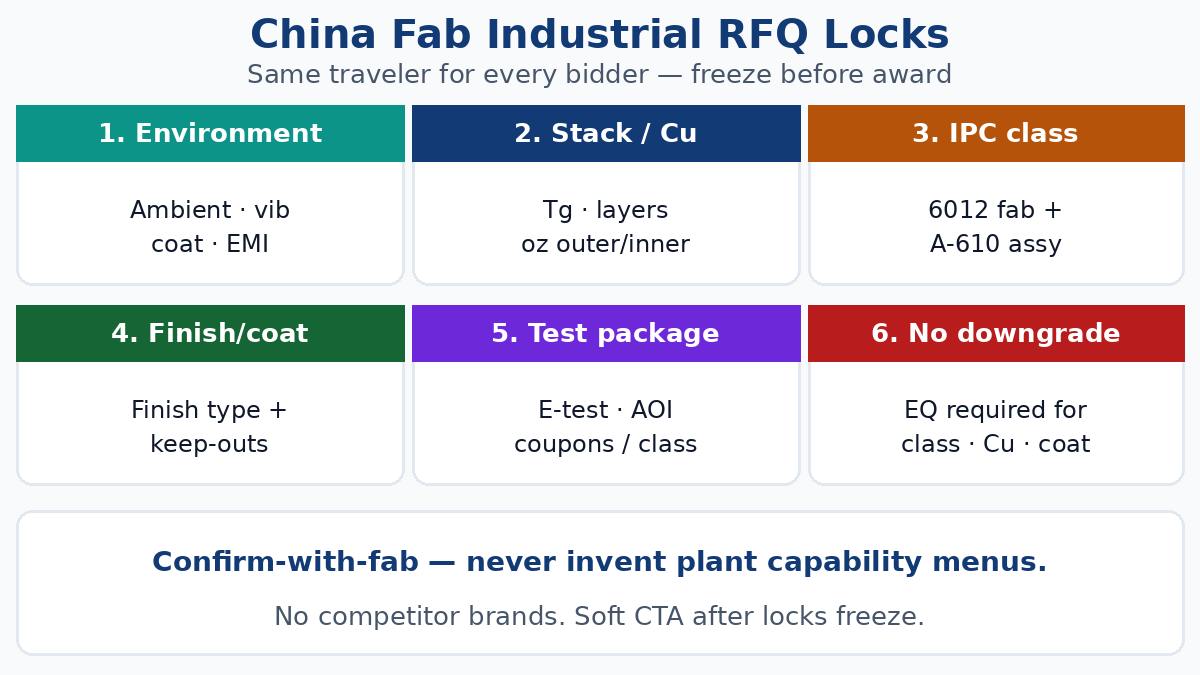
Export quotes diverge when industrial language stays soft (“harsh environment OK,” “thick copper capable,” “Class 3 preferred”). Paste comparable locks so every bidder prices the same traveler. Attach stackup, Gerbers, and fab notes with Manufacturing Files before soft adjectives are scored as comparable.
RFQ lock list (buyer packing list):
- Environment block — ambient / hotspot, vibration intent, coated vs uncoated, EMI neighbors.
- Material / stack — laminate family and Tg intent, layer count, copper weights outer/inner, impedance nets and coupon yes/no.
- IPC document + class — IPC-6012 Class X for fab; IPC-A-610 Class X when assembling — revisions preferred.
- Finish and coat — finish type; coat type / keep-outs / sequence if coated.
- Copper and via policy — heavy-copper regions, via fill/cap where required, plating intent tied to class (confirm-with-fab).
- Test / inspection package — electrical method, AOI / microsection / coupon expectations; no silent downgrade without EQ.
- Traceability — lot / date code / CoC fields if the OEM needs field returns.
- No invented plant menus — µm, oz, and day claims come from bidder confirmation against your frozen notes — not from this article inventing XFPCB capability tables.
Quick-turn spins are fine for layout prove-out; do not confuse a proto calendar with a frozen industrial production traveler. When files and locks are ready, route commercial award through normal channels via How to Place an Order — after environment, class, and coat fields are written, not before.
Soft next step
If your industrial control or power board still ships with “industrial grade” and a silent class field, rewrite the RFQ around environment → stack/material → IPC class → finish/coat/copper → named test gates. XFPCB fabricates and assembles to the traveler you freeze within stated capability — we do not invent certificates, turnaround trophies, or dollar menus in this guide. Compare dock dates and quality gates on the same lock list, then unit price. Soft CTA only: send the frozen package when the four environment lines and class/coat fields are no longer brochure adjectives.