
Overseas buyers searching “large-scale PCB manufacturers in the USA” often land on directory-style posts: a short definition of “large scale,” a technology checklist, then a branded top-five list of domestic plants. That format helps sales SEO. It does not help a program manager decide whether US large-scale capacity is required, when a China high-volume fab or PCBA path is the rational RFQ, or how to score capability without collecting logos. Sibling XFPCB lanes already own choosing USA-based criteria and large-scale process / volume manufacturing practice — name those lanes in prose; do not clone them. This page owns one job: what “large-scale PCB manufacturer in the USA” means for overseas buyers comparing US domestic versus China volume fab / PCBA — volume thresholds, ITAR and defense gates, dual-source and hybrid models, when US large-scale is mandatory versus when China mass / high-volume is the RFQ path, and how to score plants on capability without a brand list. Soft CTA only. XFPCB is a Shenzhen China fab — we do not claim a USA plant, ITAR registration, or AS9100 for ourselves in this guide. No competitor brand names.
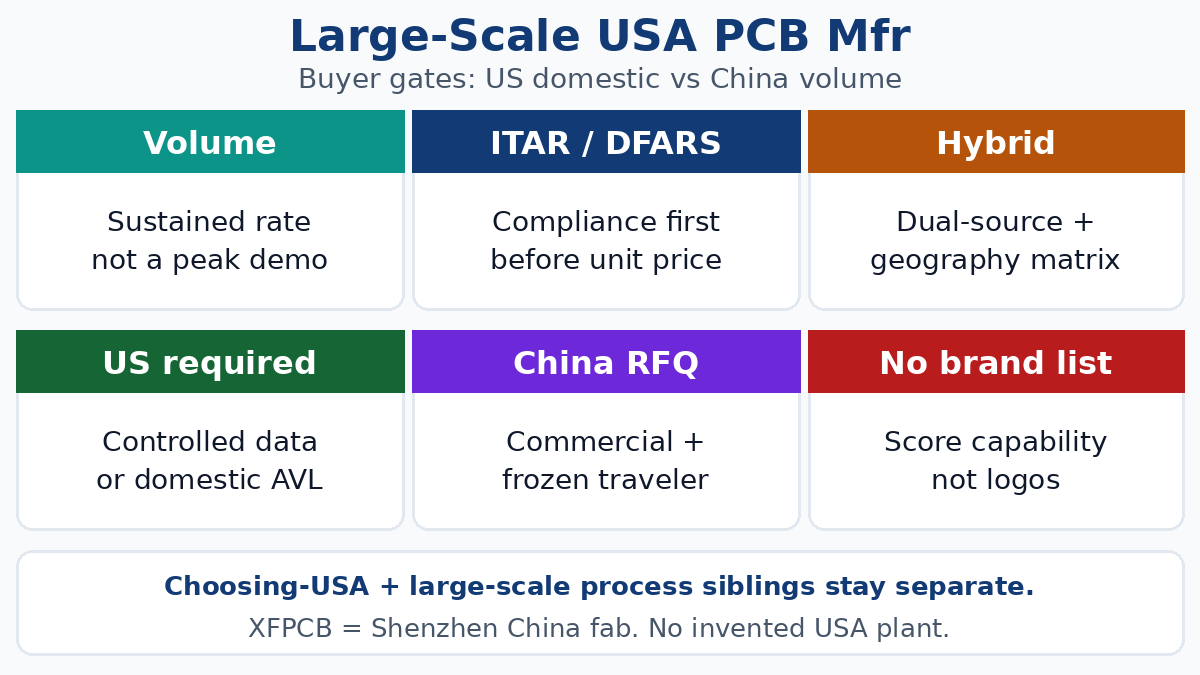
What “large-scale” actually means on a buyer scorecard
Marketing pages often collapse “large scale” into one number — for example six-figure monthly units — plus SMT, AOI, X-ray, and “global sourcing.” Those themes are real filters. They are incomplete. For awards that survive first article and ramp, score large-scale on five axes that travel with the traveler, not the brochure:
- Sustained rate, not a peak demo. Can the plant hold a stated weekly or monthly output for your panel size and layer class for the life of the call-off — not only a one-week surge for a photo?
- Revision lock and ECO discipline. Volume without a frozen Gerber / ODB++ revision, stack, finish, and class / test notes is just a larger NPI fire.
- Panelization and utilization honesty. Boards per panel, breakaway method, and scrap assumptions must be written before unit price means anything.
- Inspection / test depth that survives quantity. Which AOI, electrical, X-ray, and functional gates stay at 100% versus sample — and what yield trigger returns them to 100%?
- Compliance geography. Domestic-only, ITAR, DFARS, or customer AVL clauses can make “large scale” irrelevant if the plant cannot legally touch the data or ship the lot.
Industry practice (not XFPCB plant trophies): many USA shops advertise same-day or multi-day quick-turn and mid-volume capacity; many China fabs advertise panelized mass lots and sustained SMT rates. Neither geography automatically owns “large scale.” A 50k commercial IoT lot with a freezeable traveler is a volume problem. A 5k defense lot with controlled technical data is a compliance problem first. Do not award on the marketing adjective alone.
Depth on how China volume fabs qualify panel lock, FA→ramp, and sampling belongs on the live large-scale manufacturing lane. Depth on when a USA fab fits for communication, IP hygiene, and landed-cost structure belongs on the choosing USA-based lane. Here the only job is geography × scale × compliance for the overseas buyer who is comparing US large-scale options to a China RFQ path.
Volume thresholds buyers can use without fake plant menus
There is no universal ISO number that says “above N units = large-scale USA manufacturer.” Use program bands as decision heuristics, then freeze your own quantity and call-off on the RFQ:
| Buyer band (heuristic) | Typical program shape | Geography first question |
|---|---|---|
| Proto / engineering spins | Tens to low hundreds; revision still moving | Lead time and EQ churn — often Quick Turn PCB or domestic NPI — not “large-scale” yet |
| Pilot / soft launch | Hundreds to low thousands; revision nearly frozen | Can you dual-path NPI domestic and volume offshore? |
| Sustained commercial volume | Thousands to tens of thousands per call-off; frozen traveler | China PCB Mass Production and High Volume PCB Assembly are often the RFQ path unless compliance blocks them |
| Defense / controlled / domestic-only | Quantity may be low or high | US (or approved domestic) large-scale / qualified plant first — China is not a substitute |
Treat “100,000 units” brochure claims as a capability conversation starter, not an award criterion. Ask: over what calendar, at what panel size, with what shared-cell risk, after what FA sign-off? A plant that can surge 100k of a simple 2-layer board may still be the wrong “large-scale” partner for your 12-layer impedance-controlled stack at 8k per month. Write your monthly rate, panel intent, and layer class on the RFQ so bidders cannot hide behind a trophy number.
When US large-scale is required (gates, not slogans)
Route to a USA (or explicitly approved domestic) large-scale / qualified manufacturer when any of these gates fire — before you compare unit price:
- ITAR / export-controlled technical data. If drawings, Gerbers, or software are controlled, follow counsel and program rules. Do not “test” an overseas RFQ with redacted files and hope. XFPCB does not claim ITAR registration in this guide.
- DFARS / domestic preference / customer AVL. If the contract or prime AVL names domestic fabrication or assembly, geography is a hard filter.
- Government or defense end-use with plant list constraints. Large-scale capacity only matters after the plant clears the list.
- Mandatory on-site witness or domestic audit cadence that your schedule cannot replace with remote FA reviews.
- Customer policy that forbids offshore PCBA even when bare boards could theoretically travel — treat assembly and fab geography as separate lines on the award sheet.
When those gates fire, shortlist US large-scale capable plants on capability and compliance evidence, not on a public brand ranking. Score AS9100 / ISO claims, ITAR registration where required, layer / via / material menus, and documented volume travelers against your frozen package. Sibling posts on certified suppliers and AS9100 versus ISO own certification nuance in prose — do not merge those deep-dives here. XFPCB does not invent AS9100 or ITAR badges for a Shenzhen commercial fab.
When China high-volume is the rational RFQ path
A China volume RFQ is rational when all of the following hold:
- The program is commercial (or otherwise cleared for offshore fab / PCBA under your export and customer rules).
- The revision can freeze — stack, finish, via plan, class / test, and panel notes written once for every bidder.
- Quantity and call-off fit sustained panelized fab and / or SMT rates, not only a one-lot prototype.
- You can accept ocean / air / customs calendars as logistics, with buffers written beside dock dates — supply-chain disruption language belongs on the live supply-chain issues lane; here, only require buffers on the traveler.
- Capability fits a published China menu on PCB Manufacturing and Technical Capabilities — do not award on hope for HDI, heavy copper, or exotic materials the bidder never priced.
In that lane, “large-scale USA manufacturer” is often the wrong search intent. You are not choosing among five US logos; you are qualifying a China mass / high-volume partner on the same traveler discipline US volume shops claim: locked revision, panel utilization, FA→ramp, inspection depth, and capacity honesty. Soft CTA: XFPCB fabricates and assembles commercial volume inside stated Shenzhen capability — we will not claim a US plant to win the keyword.
Dual-source and hybrid models (without pretending one plant is two)
Overseas buyers often need both geographies without violating compliance:
- Hybrid by product line. Defense / controlled SKUs stay on US large-scale / qualified plants; commercial SKUs RFQ China volume.
- Hybrid by lifecycle. Domestic or quick-turn NPI until revision lock; China mass / high-volume for frozen production — never the reverse on controlled data.
- Dual-source commercial. Two China fabs, or one US mid-volume plus one China volume, on the same frozen package — with incoming correlation until both travelers prove out.
- Assembly split. Bare boards offshore, Turnkey PCB Assembly or domestic assembly only where AVL requires it — write fab and assembly geography as separate award lines.
Dual-source fails when the second plant receives a different revision, when Component Sourcing AVL rules differ silently, or when controlled work is “temporarily” routed overseas to chase unit price. Landscape and certified-supplier prose lanes own market structure and certificate reading; here the rule is simple: hybrid is a written geography matrix, not a slogan.
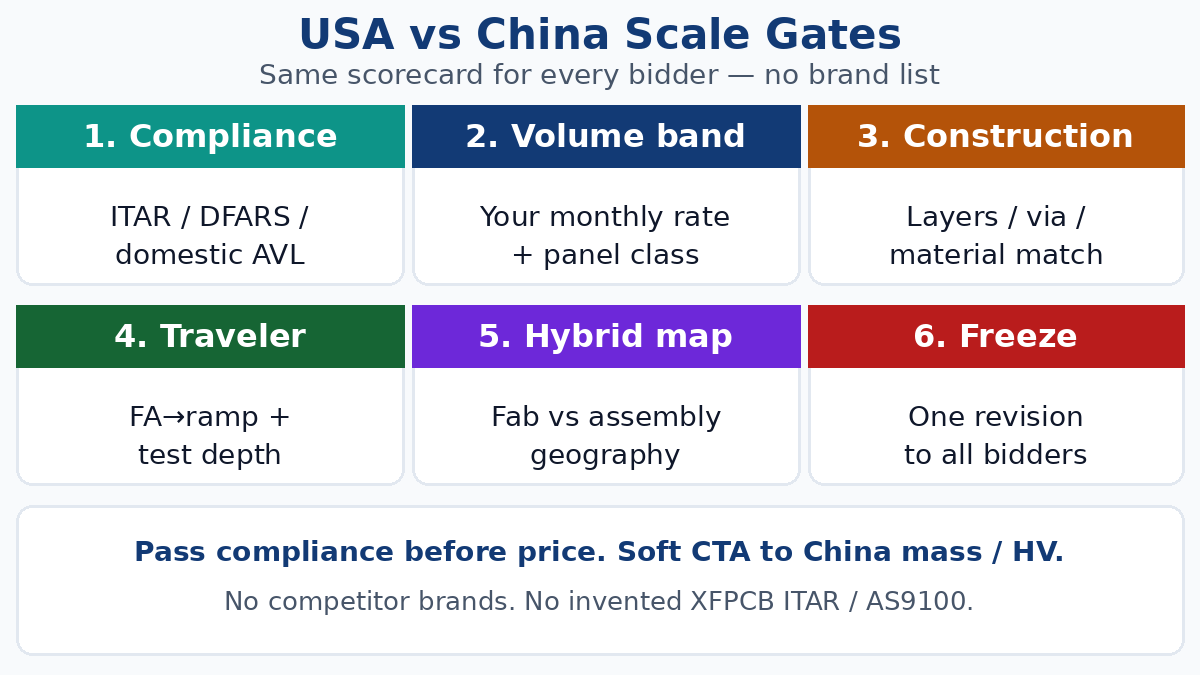
How to score capability without a brand list
Refuse the top-five directory as your shortlist method. Use a blank scorecard every bidder fills against the same frozen package:
- Compliance fit — ITAR / DFARS / domestic-only / AVL: pass / fail before price.
- Construction fit — layers, via types, materials, finish, impedance, flex / HDI class: menu match or written exception.
- Volume fit — stated monthly / weekly rate for your panel; shared-cell risk; overtime / expedite rules.
- Quality traveler — FA coupons, AOI / electrical / X-ray / FCT depth, sample triggers, Class 2 vs 3 if applicable.
- Sourcing and turnkey scope — consigned vs turnkey, AVL, counterfeit controls, lead-time clock start after CAM freeze.
- Change control — ECO path, who can release a new revision into the volume cell.
- Logistics honesty — production-complete vs dock date, Incoterms, buffer days — not “global partners” adjectives.
Rank quotes only after every bidder answers the same table. Still-divergent prices usually mean mismatched assumptions (panel, test depth, geography constraints), not a morality story about countries. Do not paste competitor names into the award sheet; paste evidence.
Common award mistakes on this SERP intent
- Awarding a USA brand list because the SERP title said “USA.” If the lot is commercial and freezeable, you may be overpaying for geography you do not need — or under-checking compliance if the lot is controlled.
- Sending a China RFQ with controlled data “just for price.” Compliance is not a quotation exercise.
- Calling a proto shop “large-scale” because it offers 24-hour turns. Quick turn is a calendar product; large-scale is sustained rate after lock.
- Ignoring assembly geography. A US large-scale fab with offshore PCBA (or the reverse) can still fail AVL.
- Dual-sourcing without a freeze. Two plants on two revisions is two NPIs, not resilience.
- Inventing badges. Do not assume every “large-scale USA” page implies ITAR or AS9100 — ask for the certificate scope that matches your product. Do not assume XFPCB holds those badges either.
Soft next step
Build the geography × scale matrix before you collect logos. If ITAR, DFARS, domestic-only, or prime AVL gates apply, shortlist US large-scale / qualified plants and stop forcing an overseas comparison that cannot clear compliance. If the program is commercial, the revision can freeze, and capability fits a Shenzhen menu, route the RFQ to China mass production and high-volume assembly — compare dock dates, inspection depth, and panel assumptions, then unit price.
For XFPCB, use How to Place an Order when a China volume path fits: one revision-locked package, quantity / call-off, panel intent, class / test depth, FA→ramp language, and honest geography notes (fab and assembly). We will price inside stated China capability — not invent a USA large-scale plant, not invent ITAR or AS9100 claims, and not publish a competitor brand list to rank against.